An invisible or hidden cut is placed where the audience cannot see it, in a moment when the frame is dark, blurred or close to the lens, usually to make several takes look like one. The founding example is Hitchcock's Rope (1948), which Roger Ebert says was shot "without any visible cuts, so that it would look like one continuous shot."
Invisible cut
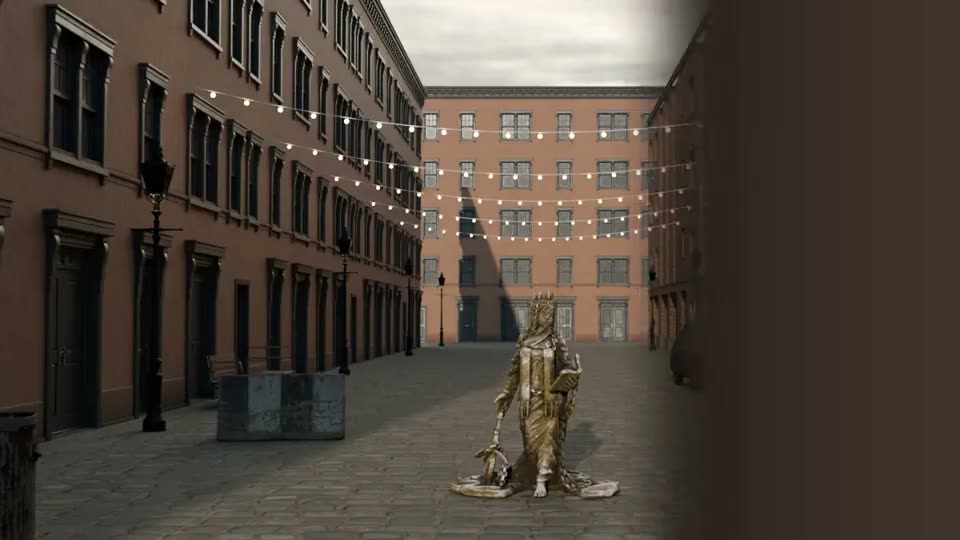
Our illustration: the camera trucks right along an empty street while a dark foreground pillar sweeps across the lens. For a few frames the pillar fills the screen, and the cut hides there: when it clears, we are in a different shot, much closer to the gilded statue.Our illustration, made in Vinc's virtual camera lab (CC0 assets).Read the full lesson: Types of Transitions in Film Editing, Named and Explained →
 Invisible cut