Whether an AI-generated track can go in your film depends on the plan you made it on, whether the terms exclude film and TV, and whether anyone can own it at all. This guide compares the published terms of Suno, Udio, ElevenLabs Music, Stable Audio and AIVA, sets out the label lawsuits as reported, and explains what US copyright law and North American PRO rules mean for your cue sheet.
Method. Pricing pages, terms of service, the US Copyright Office's January 2025 copyrightability report, PRO announcements and cue-sheet pages were checked on 18 November 2026; litigation facts come from label releases and dated trade press. Vinc makes an AI film studio and has no commercial relationship with any company named.
The short answer
Whether you can put an AI track in a film depends on the plan you made it on, what the terms say about film and TV, and whether anyone can own the result. Pricing pages and terms as read on 18 November 2026:
Tool
Published price
Who owns the output, per the terms
Film or TV use
Suno
Free; Pro $10/mo, Premier $30/mo, Platinum $120/mo (annual billing: $8, $24, $100 a month, i.e. $96, $288, $1,200 a year)
Paid plans: Suno assigns its rights to you. Free: personal, non-commercial use only
Commercial use allowed for songs downloaded on a paid plan; film isn't singled out
Udio
Free; Standard $10/mo ($8/mo billed $96 a year); Pro $30/mo ($24/mo billed $288 a year)
Udio and its licensors own all output
No. Downloads and commercial use are prohibited
ElevenLabs Music
Free; Starter $6/mo; Creator $22/mo; Pro $99/mo; Scale $299/mo; Business $990/mo
You keep your rights in input and output
Excluded on every plan except "Enterprise Music"
Stable Audio
Free; Solo $12/mo; Session $30/mo; Producer $90/mo; Studio $199/mo
You own outputs, per Stability's licence FAQ
Every plan lists a "Commercial license"; film isn't mentioned
Free; Standard €11/mo; Pro €33/mo (both billed annually, excl. VAT)
Free and Standard: AIVA. Pro: "Copyright owned by YOU"
Not stated
Only Udio and ElevenLabs say anything direct about film. The rest rely on general commercial-use wording, so read the full terms before you lock picture.
Entry-level paid plan, monthly price (USD)
ElevenLabs Starter$6
Suno Pro$8
Udio Standard$8
Stable Audio Solo$12
Prices from each provider's pricing page, checked 19 November 2026. Suno and Udio figures are the per-month rate when billed annually; Udio's monthly-billed Standard plan is $10. AIVA (€11/mo) is left out because it is priced in euros.
Entry prices sit within a few dollars of each other. For a film, the rights each plan carries matter more.
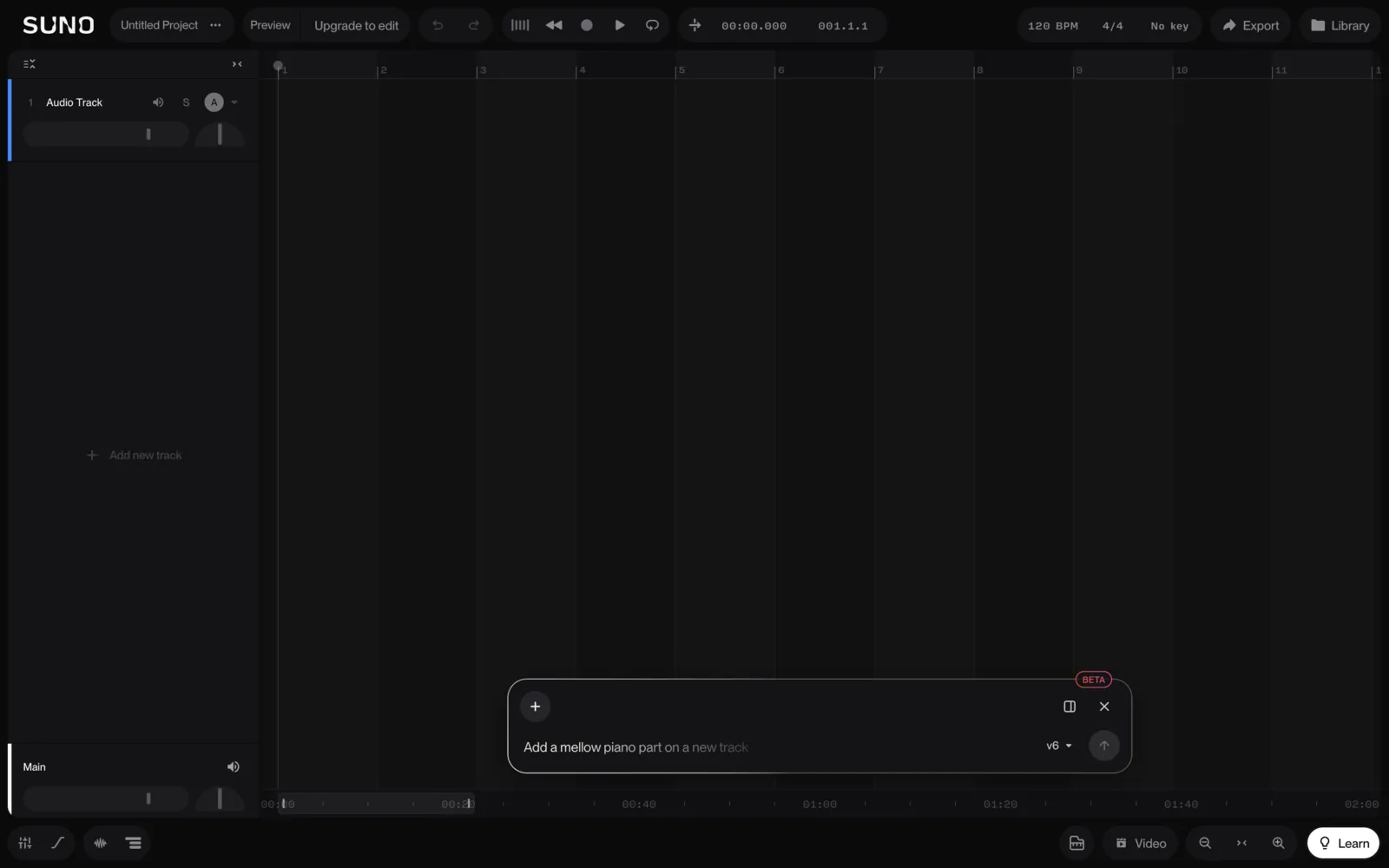
Suno Studio
ElevenLabs Music
Stable Audio
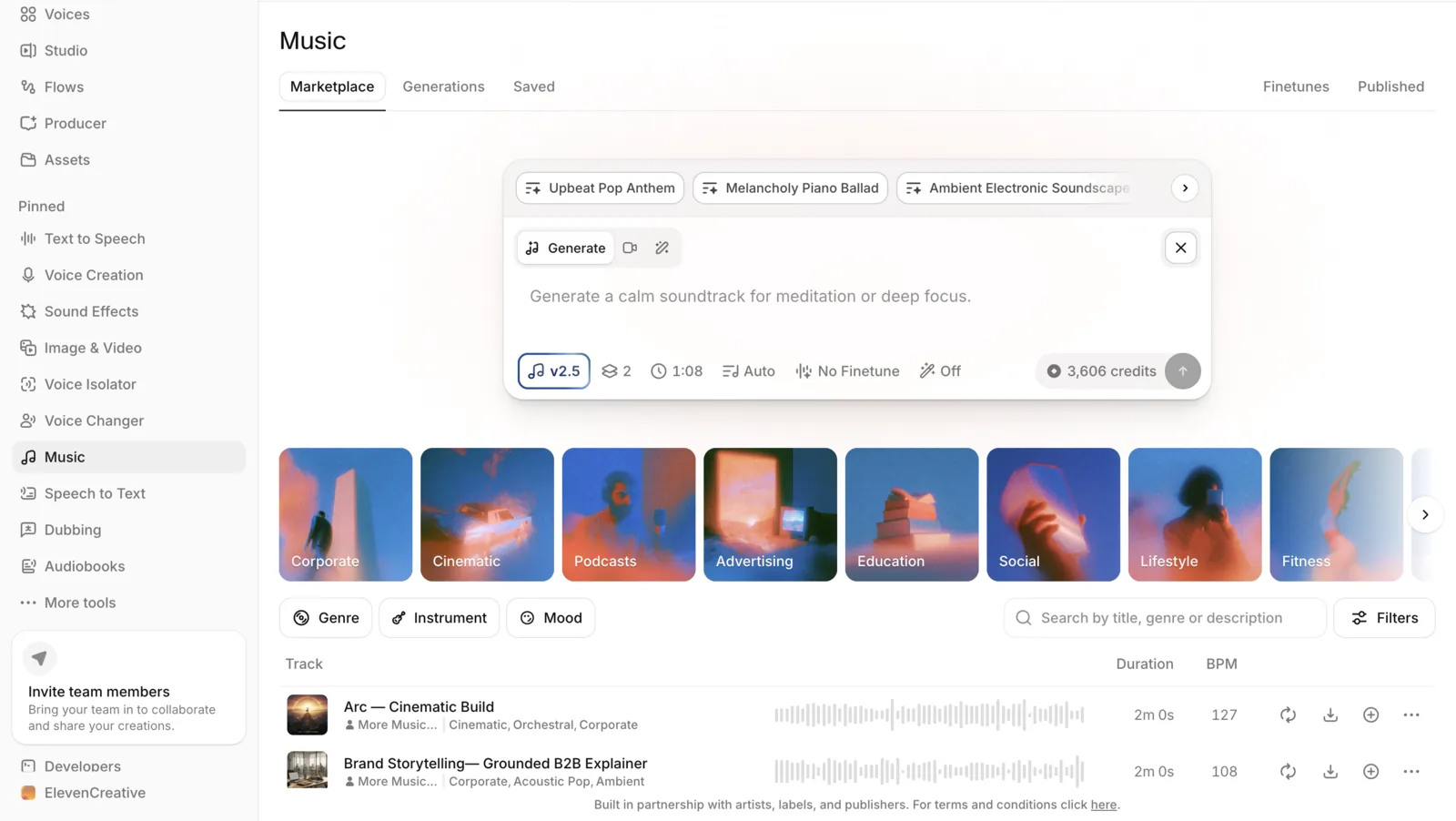
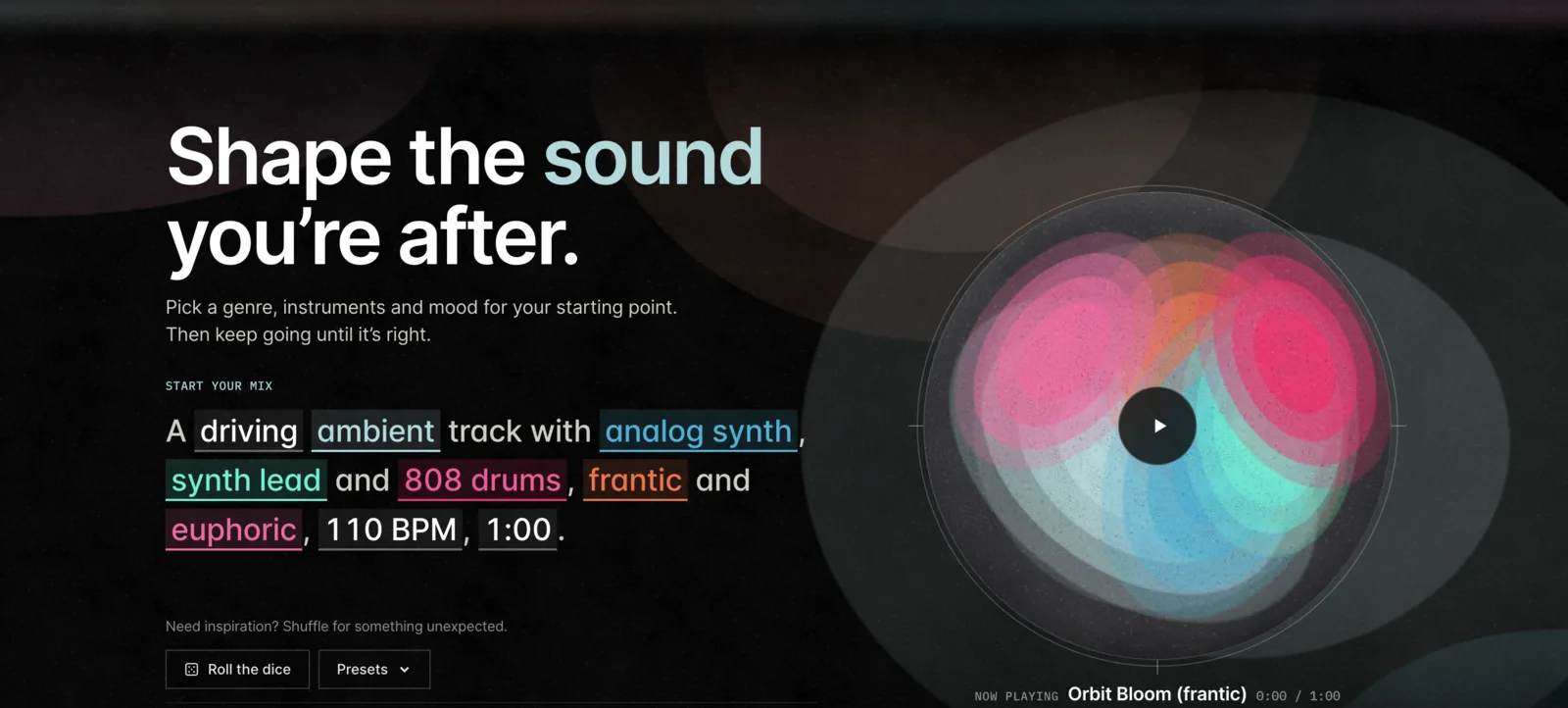
A new, empty Suno Studio project; ElevenLabs Music's generator above its licensed marketplace; and the mix builder on Stable Audio's homepage. Udio's and AIVA's public pages show no generator screen, and we had no signed-in session for either, so they aren't shown.Screenshots by Vinc of Suno and ElevenLabs; screenshot of Stable Audio's product page. All 18 Nov 2026.
Suno: commercial rights, but only on downloads you've paid for
Suno's terms (revised 10 August 2026, effective 3 September) say, for Pro and Premier subscribers, "Suno hereby assigns to you all of its right, title and interest in and to any Output owned by Suno." Free users may use output only "for your lawful, personal and non-commercial purposes."
Commercial rights come with the download. Suno's FAQ: "For any song that you download from the platform as a paying subscriber, you have the commercial rights to the music and can use it for commercial or personal use." Recording or stream-ripping is prohibited.
Downloads are rationed. Since 3 September 2026, Suno's own update says, Pro gets 20 downloads a month, Premier 60, and the free tier up to 7 lifetime trial downloads, which are for personal use only. Commercial rights attach only to songs downloaded on a paid plan.
There's no promise of copyright. "Suno makes no representation or warranty to you that any copyright will vest in any Output."
Download every cue you use while subscribed, and keep the receipts. (On 9 September 2026 Suno replaced its earlier models with a v6 family, The Decoder reported.)
Udio: a closed system for now
Udio's terms (revised 12 November 2025) are the reverse of Suno's. The company "and/or its licensors own all right, title and interest in and to the Services and the Output", you "may not download copies of any Output", and exploiting output "for any commercial purpose" is prohibited.
This follows Udio's settlement with Universal Music Group, which kept the product "with creations controlled within a walled garden" until the launch of a licensed service, which UMG said would come in 2026. Nothing made there can go into a distributed film.
The lawsuits, as reported
Date
Event
Source
24 Jun 2024
Sony Music, UMG and Warner Records sue Suno and Udio, seeking up to $150,000 per work
Reuters
29 Oct 2025
UMG and Udio settle and sign licences for a platform due in 2026
UMG press release
Nov 2025
Warner Music Group and Udio settle
WMG press release
Late Nov 2025
Warner settles with Suno; downloads will require a paid account
BBC; Music Business Worldwide
2 Jul 2026
Judge Alvin K. Hellerstein refuses to let Sony add about 30,000 works to its Udio suit
Digital Music News
18 Sep 2026
UMG and Sony file a second suit against Suno, alleging 60,202 infringed recordings and arguing that v6 is "the fruit of the same poisoned tree"
Digital Music News
The labels argue training on their recordings isn't fair use; no court had ruled on that in the reports we read. For a filmmaker it's a risk question: insurers and distributors will want to know which tool made each cue, and when. See film rights and chain of title for the wider rights file.
The other generators
ElevenLabs Music
ElevenLabs Music is ElevenLabs' music generator, governed by a separate Music Terms document (updated 9 October 2026). Commercial use is allowed on every plan, but the Media Rights row reads "except film, TV, radio, and Studio Games" for every tier up to Enterprise Music Lite, and those rights include "the right to synchronize Output in timed relation to audiovisual content". Only Enterprise Music carries no exclusion.
You "retain any and all rights in and to your Input and Output", so the barrier is licence scope: a Creator-plan short can use the music on YouTube, but not in a film release.
Stable Audio
Stable Audio is Stability AI's music generator, sold in five plans from Free to Studio at $199 a month, each marked "Commercial license". Stable Audio 3.0 sits under Stability's Community License, free for organisations with under $1M in annual revenue, and its FAQ says "you own outputs generated from the Core Models." The pages we read don't mention film, broadcast or festival use.
AIVA
AIVA is an AI composition tool that ties copyright to plan. Free and Standard (€11 a month billed annually) leave copyright with AIVA, and Standard limits monetisation to YouTube, Twitch, TikTok and Instagram. Pro (€33 a month) says "Copyright owned by YOU" with monetisation "without restrictions"; film isn't mentioned.
Can anyone own AI music?
Terms can assign whatever rights the provider has, but can't create a copyright the law doesn't recognise. The US Copyright Office's Copyright and Artificial Intelligence, Part 2: Copyrightability (29 January 2025) concludes:
"Copyright does not extend to purely AI-generated material, or material where there is insufficient human control over the expressive elements."
"Based on the functioning of current generally available technology, prompts do not alone provide sufficient control."
"Human authors are entitled to copyright in their works of authorship that are perceptible in AI-generated outputs, as well as the creative selection, coordination, or arrangement of material in the outputs, or creative modifications of the outputs."
So a cue you prompted and downloaded unchanged probably has no US copyright owner: you may not be able to stop reuse, and it may not earn royalties. A cue a composer arranged or substantially edited is protected only in its human contribution.
Cue sheets and performance royalties
A cue sheet is the document that gets composers paid when a film is performed. ASCAP describes it as "a schedule of the music contained in a film or television program," listing each cue's title, use, duration, and composers and publishers with their shares.
On 28 October 2025, ASCAP, BMI and SOCAN said they would accept "partially AI-generated" works, but "Musical compositions that are entirely created using AI tools are not eligible for registration with any of the individual societies." For a production:
List every cue anyway, fully AI ones included, with the source noted.
Expect no performance royalties on fully AI cues. Tell any composer whose fee assumes backend income.
Document human authorship on hybrid cues. Keep session files and a note of who did what.
Library music: the familiar alternative
Production-music libraries price by use, and film and festival rights usually sit in the top tiers. (Prices are localised, so we haven't compared them.)
Library
What the published tiers cover
Film / festival coverage as listed
Musicbed
Individual and Business tiers cover web, podcast and social
"Broadcast", "Cinema / Film Festival" and "VOD / OTT / CTV" appear only under Enterprise ("Request Quote")
Epidemic Sound
Creator covers social, podcasts and websites; Pro adds digital ads and client work; Pro Plus adds "OTT media"
No festival or cinema line on the plan cards; the pricing page links a separate film page
Marmoset
Custom licensing and a self-serve platform with an "Independent Film" category
Licences "for every use and medium imaginable — whether it's a podcast, a feature film, or even public performances"
A library's catalogue is human-composed and its licence names the media you're cleared for. Against that, festival and theatrical use often sits in a quote-only tier, and you pick existing tracks rather than scoring to picture.
A clearance checklist for AI music in a film
These follow from the terms above. They aren't legal advice.
The six clearance steps below, in the order you'd do them, from choosing the plan before you generate to telling the insurer before you deliver.
Check the plan, not just the tool. Suno's rights need a paid download; AIVA's ownership changes at Pro.
Look for a film or sync exclusion. ElevenLabs excludes film below Enterprise Music; Udio bars commercial use.
Download officially while subscribed. Keep the file, date, plan and account.
Log the prompt and the human work.
Fill the cue sheet honestly. Register only what qualifies as partially human-authored.
Tell your insurer and distributor which tool made which cue; litigation was still active in November 2026.
How we compiled this
Pricing pages, terms, the Copyright Office report and PRO announcements were opened on 18 November 2026; litigation facts come from label releases and the press dated in the table. We didn't check Google's Lyria, smaller generators, or rules outside the US and Canada. Vinc makes an AI film studio and has no commercial relationship with any company named here.
AI Storyboard Generator From Script: The Workflow, the Tools and Their Prices, and the Pitfalls
How an AI storyboard generator turns a script into boards: what a panel needs, a script-to-shot-list workflow, Boords and LTX Studio prices, and the pitfalls.