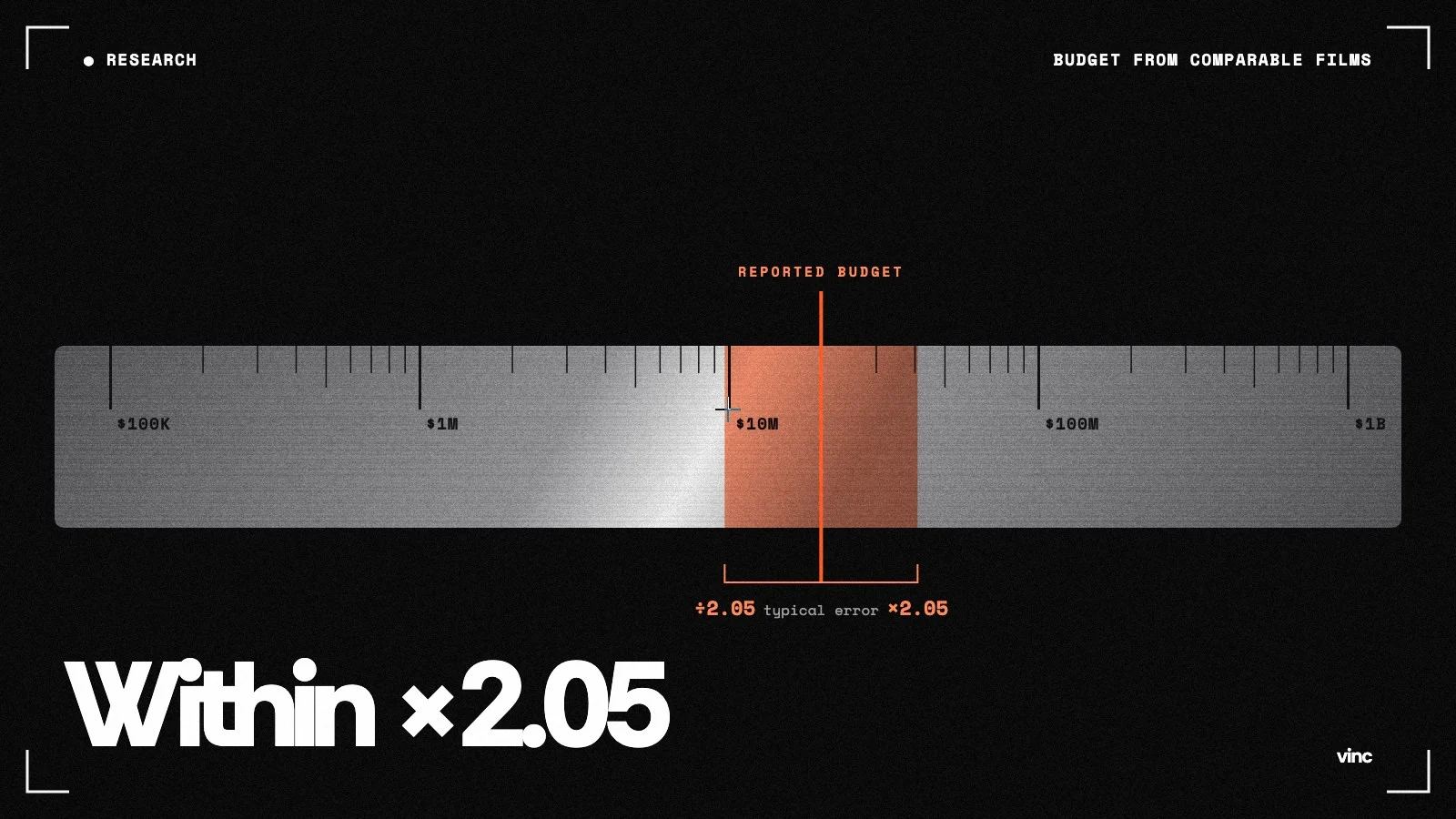
Vinc's comparable-film budget range was typically within ×2.05 of the reported budget on 79 unseen 2026 films, beat our previous model and an industry-median guess, and its 80% range held for 76% of films, 87% on mid-budget titles.
Method. Our own test: a pre-registered check run once on 10 November 2026 (79 unseen 2026 films; 46-film tax-credit floor check). Vinc makes an AI film studio, and these are our own tests of our own pipeline.
What this means for you
The fastest honest way to size a budget before anyone prices a line is to read a range off comparable films. We tested Vinc's budget range against the reported budgets of 79 films released in 2026: it was typically within a factor of about two, beat our previous model and an industry-median guess, and its 80% range held for 76% of films.
- Plan against a range, not a single number. Only 14% of the model's single best guesses landed within ±25% of the reported budget, while its 80% range held for 76% of films.
- Size your budget from five or so comparable films, and favour recent ones. Refitting on recent films produced most of the improvement in our test, and every method we tested guessed low on 2026 films, by about a quarter on average. If your comps are older, lean toward the high end.
- Trust the bracket most for mid-budget films. There the range held 87% of the time. If your film could cost over $50M, treat the range as a starting bracket and widen it.
- Use tax-credit filings as a floor. A state film credit reports a production's qualified spend, and the real budget can't be lower than that. It's a quick way to sanity-check a comp's reported figure.
- Turn the range into a priced budget with a line producer, using a script breakdown of departments and shooting days.
How the test was set up
We fixed the models, metrics and test population in advance, plus eight amendments, each checked by a separate AI reviewer, and hashed every document so it couldn't be quietly edited. The confirmation run was executed once, at 12:03 UTC on 10 November 2026.
| Setting | Value |
|---|---|
| Test films | 79 films released in 2026 that the model had never seen: 77 US releases with a public budget on English Wikipedia, plus 2 Hindi films |
| Training data | 6,721 earlier films with reported budgets (in-sample results reported separately and never pooled with the test) |
| Main metric | Typical error as a multiplier: ×2.0 means the estimate is typically within a factor of two of the reported budget, high or low |
| Range metric | How often the model's 80% range contained the reported budget. A well-calibrated 80% range should hold about 80% of the time |