Video model guides lean on film vocabulary, but the same words can mean different things across docs, and a focal length means little without a sensor size. This article gives textbook definitions of shot sizes and camera moves, computes field of view for common lenses on full frame and Super 35, and maps each term to the model docs that list it.
Method. Film definitions from two open textbooks and American Cinematographer; vendor docs read November 18, 2026; field-of-view figures are our arithmetic from the standard formula. Vinc makes an AI film studio.
Looking for full definitions of shot sizes and framing? See [Film Terms: Framing and Shot Types](/blog/film-terms-framing-and-shots).
Why the exact camera word matters
Every major video-model guide borrows film-crew vocabulary. Google's Veo guide has sections for angles, movements and lens effects, Runway publishes a camera-terms library, and MiniMax accepts a fixed set of bracketed camera commands. Knowing what each word means on a real set tells you what you're actually asking for.
Below: textbook definitions, field of view for common focal lengths, and which model docs list each term. For the vendors' wider prompting rules, see How to Prompt AI Video Models.
Shot sizes: the standard scale
Shot size describes how much of the subject fills the frame. These definitions come from the open textbook Video Production Handbook (LibreTexts, section 8.1), using a standing person as reference.
Abbreviation
Name
Framing on a person
EWS / ELS
Extreme wide (extreme long) shot
Full person plus "a lot of the surrounding area". Often the establishing shot, and may contain no person at all
From the bottom of the sternum to the top of the head
CU
Close-up
From the tops of the shoulders to the top of the head
ECU / XCU
Extreme close-up
One detail only, such as the eyes or mouth
The scale in the table, drawn on one figure from extreme close-up to extreme wide. Sources split and name the wide end differently, as the next paragraph shows.
CU
MCU
MS
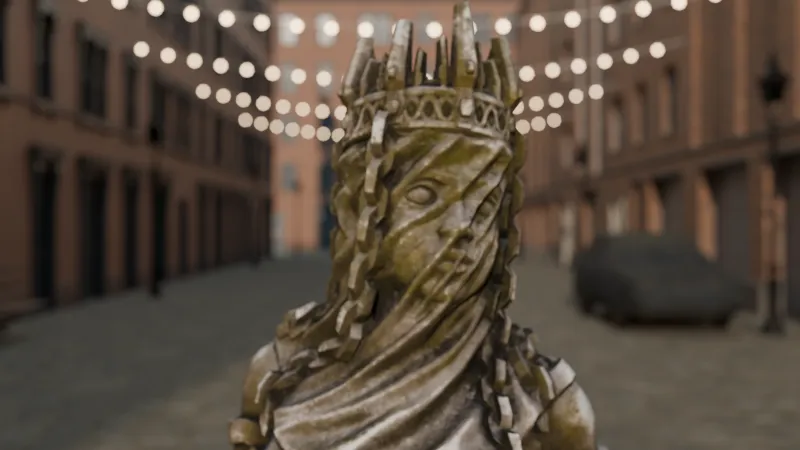
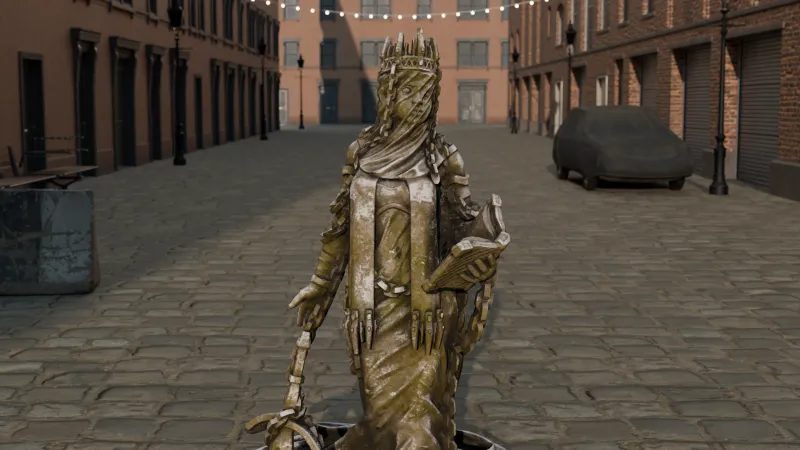
The scale on one subject, a 1.74 m statue, from close-up to medium shot. All three are 50 mm on full frame. The camera moves closer for each size: the frame is 0.42 m tall at the statue for the CU, 0.70 m for the MCU and 1.05 m for the MS. Rendered in Vinc's virtual camera lab.Scene: CC0 Poly Haven assets (Gothic Statue by Benny Weimer; facades by James Ray Cock; Evening Road 01 sky by Jarod Guest and Sergej Majboroda).
MLS / MWS
FS / WS
WS (wider)
EWS
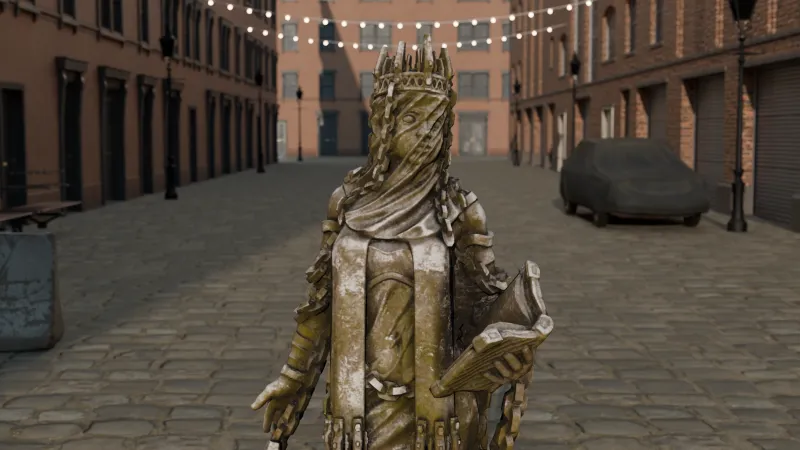
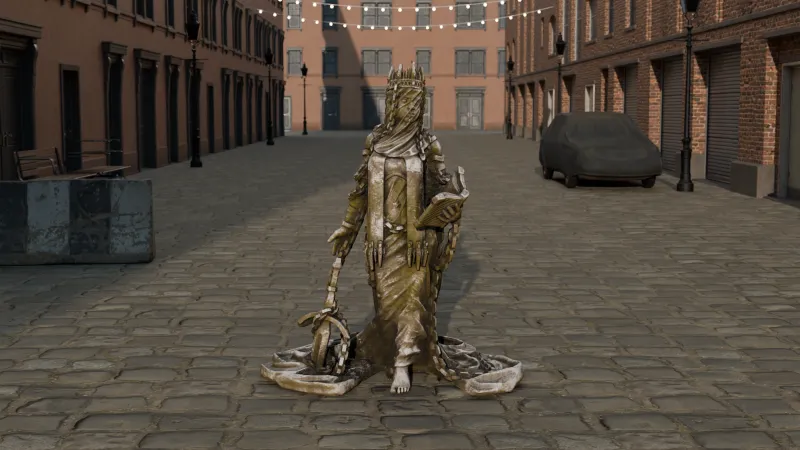
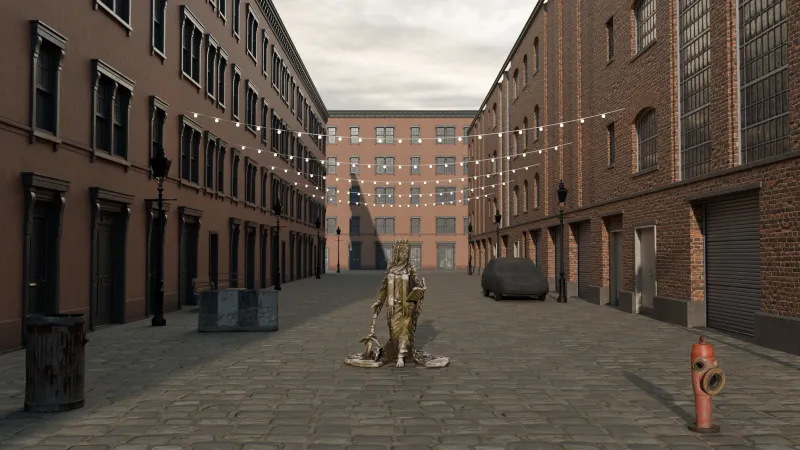
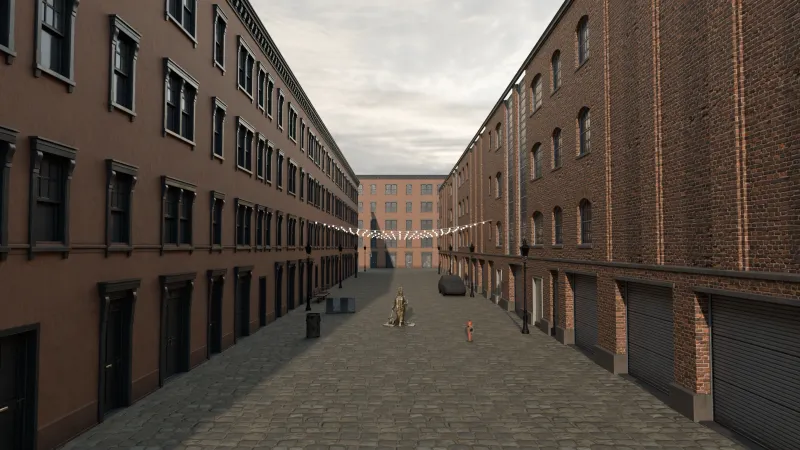
The wide end. MLS (1.45 m of frame) and full shot (2.3 m) are on 50 mm. The wider shot is on 35 mm, with 6 m of frame at the statue. The EWS is on 24 mm from 3.5 m up, with 20 m of frame, so the statue is a small figure in the street. As the next paragraph says, sources name these steps differently. Rendered in Vinc's virtual camera lab.Scene: CC0 Poly Haven assets (Gothic Statue by Benny Weimer; facades by James Ray Cock; Evening Road 01 sky by Jarod Guest and Sergej Majboroda).
Sources disagree at the wide end. The handbook treats wide, long and full as one size. Runway's camera terms page splits them: "Full" shows "the entire subject from head to toe", while "Wide" shows "the subject and their surroundings". Google's prompt guide pairs "full shot / long shot" as one entry and "wide shot / establishing shot" as another. Treat "wide" as the least precise word on this list.
Shot size is not camera distance
The LMU open textbook No-Nonsense Filmmaking (Livingstone and Livingstone, 2025) makes two points that matter for prompting. First, "there is no standard shot size. It is always relative to the subject matter": a wide shot of two dinosaurs on a mountaintop looks nothing like one of two cockroaches on a leaf.
Second, shot sizes "are not a gauge of the proximity of the camera to the subject": a close-up works "with a wide-angle lens as with a telephoto lens". A shot-size word fixes the framing, not the lens, so name the lens separately if it matters.
When distance words aren't precise enough, the book suggests framing against the body ("head and shoulders", "waist", "cowboy", "two shot"), which is less ambiguous than "wide". Luma's camera angle list includes both "Cowboy Shot" and "Two-Shot".
Camera moves: rotate, travel, or zoom
Sort moves by what physically happens: the camera rotates on a fixed point, travels through space, or stays put while the lens changes.
Move
What physically happens
Definition source
Pan
Camera rotates left or right on a fixed axis
LMU: "movement from a fixed axis point". "You cannot pan up or down"
Tilt
Camera rotates up or down on a fixed axis
LMU: "up and down movement from a fixed axis point"
Dolly
Camera travels toward or away from the subject
LMU: "in-and-out movement". Google: "physically moves closer to the subject or further away"
Truck / track
Camera travels sideways
LMU: "rightward or leftward movement". Google: "often parallel to the subject"
Pedestal
The whole camera rises or lowers without tilting
LMU: in a ped, "that axis point itself moves up and down"
Crane / jib
Camera on an arm, rising, falling or sweeping in an arc
American Cinematographer: a long shaft "with a fulcrum" lets the camera move in an arc. Cranes of about 6–12 feet "are often called jibs"
Arc / orbit
Camera travels around the subject
Google: "a circular or semi-circular path around the subject"
Zoom
Camera doesn't move. The lens changes focal length
Google: "the camera's lens changes its focal length to magnify or de-magnify the subject"
Handheld, Steadicam, gimbal
Support methods, not directions
American Cinematographer: handheld "can convey immediacy and energy". A stabilizer vest carries the weight on the operator's hips and shoulders. A gimbal is a "counterbalanced multi-axis head"
LMU definitions are from its Movement chapter. The American Cinematographer quotes are from Jay Holben's "Shot Craft: Tools for Camera Movement" (April 2024), which also calls a slow dolly creep-in "especially effective" in moments of crisis or realisation.
The moves in the table: pan and tilt rotate the camera, dolly, truck, pedestal, crane and arc move it through space, and a zoom changes only the lens.
Focal length and field of view, with the formula
How much of the scene a focal length shows depends on the width of the sensor or film frame. For a rectilinear lens focused at infinity, the angle of view is (Wikipedia: Angle of view)):
angle of view = 2 × arctan( d / (2 × f) )
d = sensor width in mm (for horizontal field of view), f = focal length in mm
We used d = 36 mm for full frame and 24.89 mm for Super 35, the width of the 4-perf film exposure area (24.89 × 18.66 mm, per Wikipedia: Super 35). Digital "Super 35" sensors vary slightly, so rerun the formula with your camera's width for precision. The table is our arithmetic, rounded to 0.1°; the full-frame figures match the published table for 24, 35, 50 and 85 mm.
Focal length
Horizontal field of view, full frame (36 mm)
Horizontal field of view, Super 35 (24.89 mm)
Full-frame focal length with the same view as this lens on Super 35
18 mm
90.0°
69.3°
26.0 mm
24 mm
73.7°
54.8°
34.7 mm
28 mm
65.5°
47.9°
40.5 mm
35 mm
54.4°
39.1°
50.6 mm
50 mm
39.6°
28.0°
72.3 mm
85 mm
23.9°
16.7°
122.9 mm
135 mm
15.2°
10.5°
195.3 mm
Horizontal field of view on full frame (36 mm wide), degrees
18 mm90.0
24 mm73.7
28 mm65.5
35 mm54.4
50 mm39.6
85 mm23.9
135 mm15.2
Computed with 2·arctan(36 / 2f). Our arithmetic; matches the published values for 24, 35, 50 and 85 mm.
The same focal length means different shots on different formats. The width ratio is 36 / 24.89 ≈ 1.45. A 35 mm lens on Super 35 sees 39.1°, almost the same as a 50 mm lens on full frame (39.6°). So "35 mm lens" alone could mean 54° or 39° of horizontal view.
At least one vendor writes focal lengths as full-frame equivalents. Kling's 4.0 user manual has example prompts that pair focal lengths with angles: "24mm, 74° horizontal FOV", "18mm, 90° FOV", "28mm, 65° FOV" and a "50mm equivalent lens with a 40° horizontal field of view". The Kling 4.0 prompt guide uses "35mm equivalent, 54° horizontal FOV". Every pair matches the full-frame column to the nearest degree, so adding the angle removes the ambiguity. OpenAI's archived Sora 2 guide used "35 mm virtual lens" and "40 mm spherical" without naming a format.
Which model docs list which term
"Yes" means the term, or a close variant, appears in that vendor's official docs as we read them on 18 November 2026. A dash means we didn't find it, not that the model ignores the word. Sora 2 is for reference only: OpenAI shut down its API on 24 September 2026.
Term
Google (Veo, Omni)
Runway Gen-4.5
Kling
Luma
LTX-2.5
MiniMax Hailuo
Sora 2 (archived)
Extreme close-up
Yes
Yes
Yes
Yes
—
—
—
Close-up
Yes
Yes
Yes
Yes
Yes
—
—
Medium close-up
—
—
Yes
Yes
Yes
—
Yes
Medium shot
Yes
Yes
Yes
Yes
—
—
—
Full shot
Yes
Yes
Yes ("full body shot")
Yes
—
—
—
Wide / long shot
Yes
Yes
Yes
Yes
Yes
—
Yes
Extreme wide shot
—
Yes
Yes ("extreme long shot")
Yes
—
—
—
Pan
Yes
Yes
Yes
—
Yes
Yes
—
Tilt
Yes
Yes
Yes
—
Yes
Yes
Yes
Dolly
Yes
Yes
Yes
Yes
Yes (API)
—
Yes
Push in / pull out
—
Yes
Yes
—
Yes
Yes
Yes
Truck
Yes
Yes
"lateral camera movement"
—
API: dolly_left/right
Yes
—
Pedestal
Yes
Yes
—
—
—
Yes
—
Crane / jib
Yes
Yes
—
Yes
API: jib_up/down
—
—
Arc / orbit
Yes
Yes
Yes
Yes
"circles around"
—
Yes ("arc")
Tracking
—
Yes
Yes
Yes
Yes
Yes
—
Zoom
Yes
Yes
—
—
—
Yes
—
Handheld
Yes
Yes
Yes
Yes
Yes
"Shake"
Yes
Static / locked-off
Yes
Yes
—
Yes
Yes
Yes
—
Rack focus
Yes
Yes
—
—
API: focus_shift
—
—
Focal length in mm
—
—
Yes, with field of view
—
—
—
Yes
Luma's API also returns a list of supported camera-motion strings (docs); we didn't call it.
Where vendor wording departs from film usage
LTX's API calls a sideways move a dolly. Its camera_motion values include dolly_left and dolly_right. In the LMU textbook, "You can only dolly in or out". Use LTX's names in its API, but don't carry them to other models.
Runway separates truck from tracking. Runway's truck moves "left or right, parallel to the subject"; tracking follows "alongside a moving subject". LMU treats "Track/Truck" as one move, so for Runway, say whether the camera is following someone.
Zoom and dolly blur in one vendor example. Google and Runway both define zoom as a change in focal length, yet Runway's own "Zoom" example says "The camera performs a smooth pull back", which is a dolly in film terms. MiniMax keeps [Push in] and [Zoom in] as separate commands.
How we compiled this
Film definitions come from two open textbooks, No-Nonsense Filmmaking (Livingstone and Livingstone, LMU, 2025, CC BY-NC-SA 4.0) and Video Production Handbook (Clemens et al., ASCCC OERI, LibreTexts, page updated April 2026), plus Jay Holben's April 2024 American Cinematographer article. We read all vendor docs on 18 November 2026. Field-of-view figures are our arithmetic; Vinc makes an AI film studio.
How these images were made. The shot-size renders come from Vinc's virtual camera lab. They are path-traced in Blender Cycles in a street built from CC0 Poly Haven assets, with a physical camera set to the focal lengths and distances in the captions. They are simulations, not stills from a film or an AI model.
AI Music for Film: Suno, Udio and Other Generators on Licences, Ownership, Lawsuits and Cue Sheets
Whether an AI-generated track can go in your film depends on the plan you made it on, whether the terms exclude film and TV, and whether anyone can own it at all. This guide compares the published terms of Suno, Udio, ElevenLabs Music, Stable Audio and AIVA, sets out the label lawsuits as reported, and explains what US copyright law and North American PRO rules mean for your cue sheet.