We relit two Gaussian splat scenes in Chrome using normals estimated from each splat's shape. It took 23 to 65 ms per light and looked like a colour grade rather than a moved light. Then we checked the licences of the open relighting methods: most of those that work on ordinary footage are research-only or GPL, which leaves relighting rendered frames as the commercially licensed route.
Method. Relight runs made 18 November 2026 in our own splat tests (one run per scene, Apple M5 MacBook, headless Chrome 157, three.js r185, Spark 2.1.0), judged by eye from saved frames. Licences checked via GitHub and licence files the same day; none of the surveyed methods were run. Vinc makes an AI film studio and uses Spark in its product.
What this means for you
Choose the world's lighting when you generate it. If the shot needs low sun from the left, ask for that in the world prompt. In our test, changing it afterwards from the splats alone gave a mood grade, not a believable new light.
Use cheap grades for mood. A shape-based shade or a colour volume will darken, cool or warm a scene convincingly enough for a mood pass.
Put movable lights on meshes. Characters and props you build as meshes in the same scene can be lit properly.
For a real relight, work on rendered frames. Running rendered plates through a model such as NVIDIA's DiffusionRenderer is the commercially licensed route we found, at the cost of a cloud GPU with 16 GB or more.
Check the licence before using an open splat relighter on paid work. Four of the nine methods we surveyed are research-only and two are copyleft (GPL-3.0).
Splats bake their lighting in
Each splat in a Gaussian splat scene stores the colour it should show, and sometimes how that colour shifts with viewing angle, but not why it is that colour. Light, shadow, surface colour and shininess are fused into one value. If a world was generated with afternoon sun from the left, the sun is painted into every splat, and moving the key light means undoing that painting.
This article has two parts: one small experiment of our own on how far a cheap browser approximation gets, and a survey of open relighting methods and their licences.
Relighting needs a surface direction, or normal, at every point. Splats have none, but splats sitting on a surface tend to be flattened against it, so each splat's shortest axis (rotated by its own rotation) gives a cheap normal estimate with no training and no GPU job. We pointed normals away from the object's centre for a single object, or toward the camera's start position for a world viewed from inside.
On 18 November 2026 we re-shaded each splat with simple diffuse (Lambert) lighting, leaving view-dependent colour untouched:
new colour = colour × 1.35 × (0.3 + 0.7 × max(0, normal · light direction))
The 0.3 is an ambient floor so nothing goes fully black, and 1.35 keeps overall brightness close to the original. We rendered four light directions (key left, key right, top and back) plus a normals view on two Spark example scenes: the butterfly (177,132 splats, a single object) and the valley (500,000 splats, a stylised generated landscape).
The machine was an Apple MacBook with an M5 chip and 16 GB of memory, running headless Chrome 157 with three.js r185 and Spark 2.1.0 at 1920 × 1080. Each scene was run once, and plausibility was judged by eye from the saved frames, because there is no ground-truth relit image to measure against.
Results
Scene
Splats
Normal estimation
Time per relight (all splats)
Our judgement
Butterfly
177,132
20.9 ms
22.8–39.9 ms
Low plausibility
Valley
500,000
41.5 ms
59.5–65.1 ms
Low to medium plausibility
Time to relight every splat for one light direction (CPU, in the browser)
Butterfly, key left28.0 ms
Butterfly, key right39.9 ms
Butterfly, top26.6 ms
Butterfly, back22.8 ms
Valley, key left62.7 ms
Valley, key right64.2 ms
Valley, top59.5 ms
Valley, back65.1 ms
Our test, 18 Nov 2026. Apple M5 MacBook, Chrome 157, Spark 2.1.0. One run per scene.
Speed is not the problem. About 60 to 65 ms per light for all 500,000 valley splats is slow for a live slider but fine for a button. Spark's programmable splat shaders could likely run it every frame on the GPU; we have not built or timed that version.
The butterfly: the light barely reads. Its thin, flat wings make every splat on a wing report almost the same normal, so whole wings brighten or dim together, with no modelling, falloff or sense of a light source. We judged it low plausibility.
The valley: a grade, not a light. Key left looks like the same landscape at a moodier time of day, which is usable as a mood change. As relighting it fails three ways, and we judged it low to medium plausibility:
The normals are noisy. Neighbouring splats on the same rock face point in quite different directions.
The sky gets shaded like a surface, because sky splats have shapes too.
Baked highlights stay, because the method multiplies the existing colour without removing the old light.
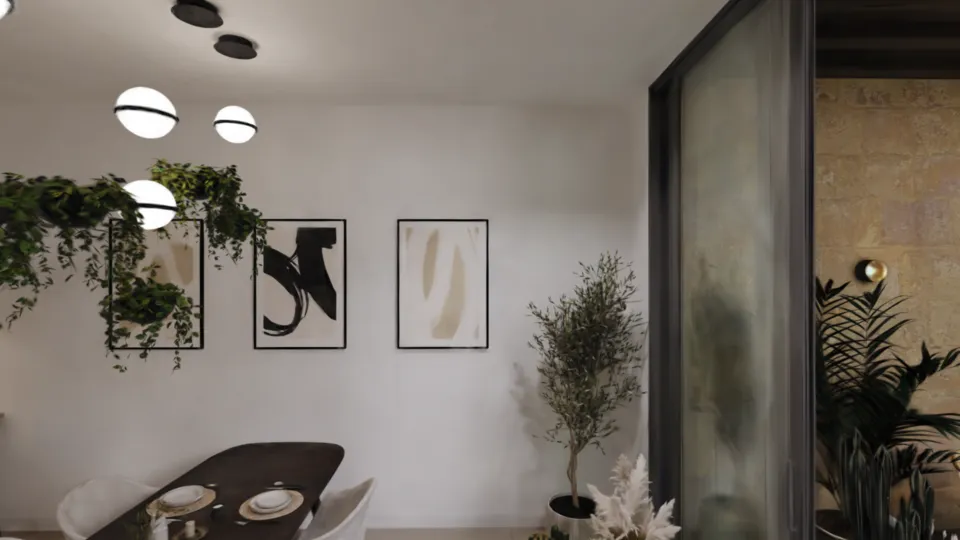
The butterfly and valley files carry no stated licence, so we re-ran the identical relight the same day on a furnished apartment interior published under CC BY 4.0 (661,466 splats, normals pointed toward the middle of the room). Estimating normals took 60.9 ms and each light took 81.4 to 91.7 ms. It failed the same way as the valley.
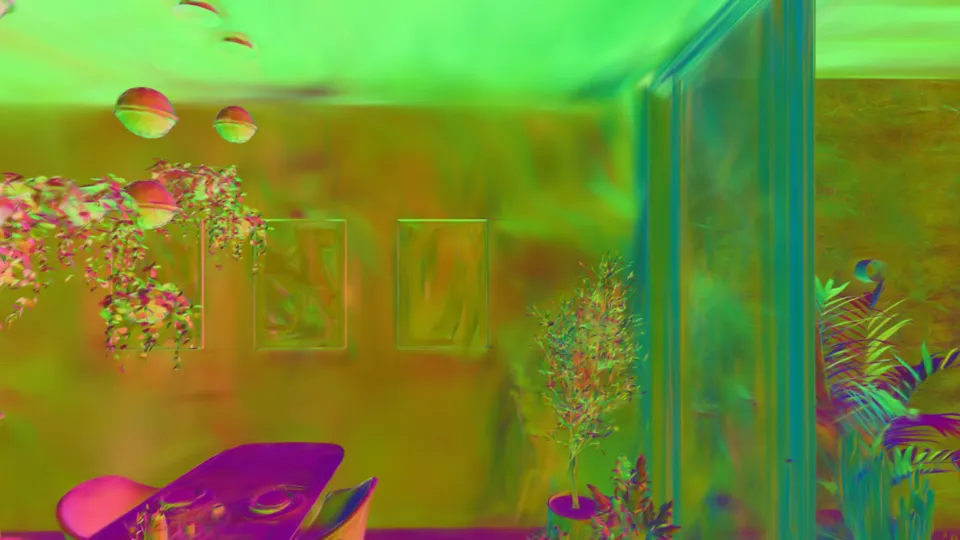
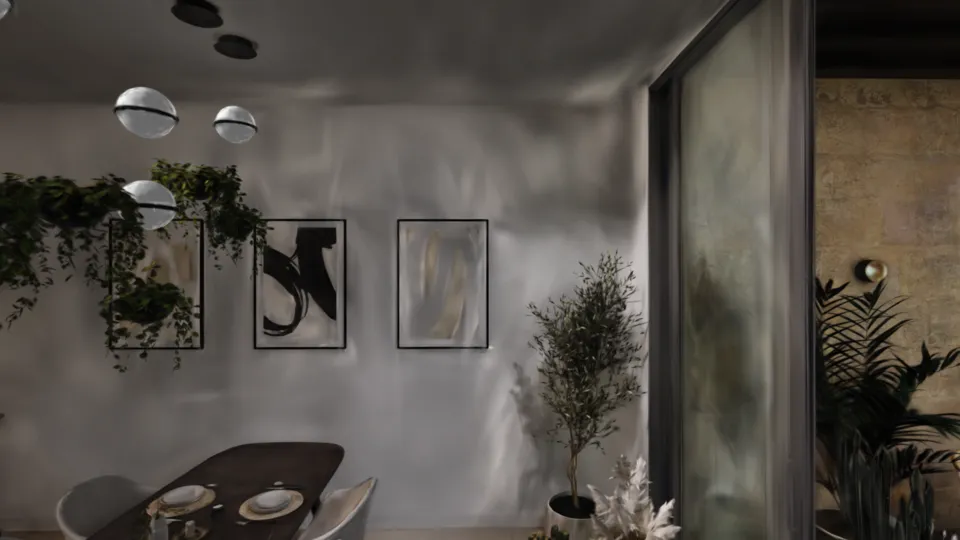
Original
Estimated normals
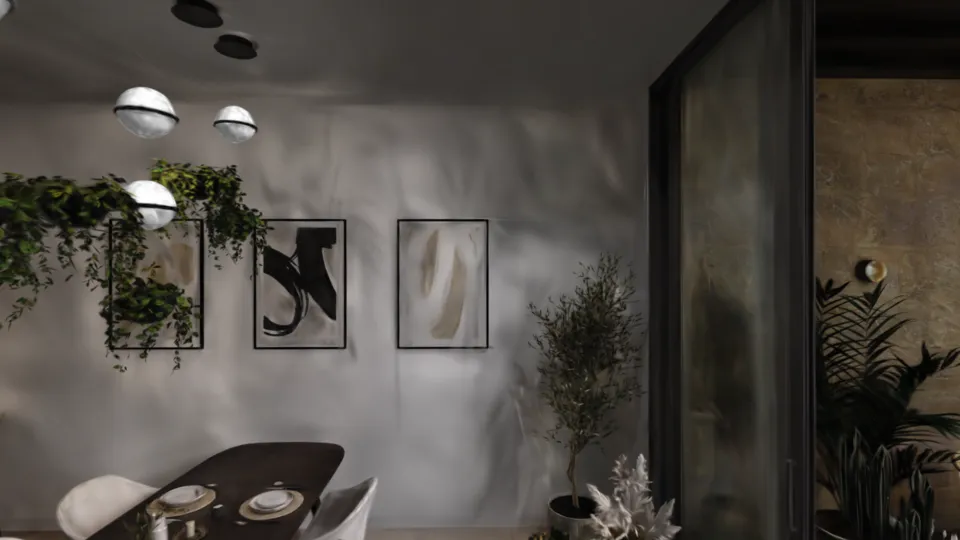
Key from the left
Key from the right
Notice that the white wall goes grey and blotchy under both lights, the glowing pendant lamps get shaded as if they were matte surfaces, and key left and key right are hard to tell apart. A grade, not a relight. Relighting all 661,466 splats took 87 to 92 ms per light on the CPU.Scene: “SA3D_R&D_XP47” by Stéphane Agullo (sa3d.fr), CC BY 4.0, via PlayCanvas; relit by us. Our test, 18 November 2026.
Verdict: shading from shape is fast and useful as a cheap time-of-day or mood grade, but not for moving a key light in previs. It starts from colour with the old lighting still in it; a proper relight first has to separate lighting from surface colour, which is what the research methods below attempt.
The open research, and its licences
We surveyed open relighting methods for Gaussian splats on 18 November 2026. We have not run any of them.
Method
What it does
Licence
Commercial use
Relightable 3D Gaussians (R3DG)
Per-splat normals, material properties and ray-traced visibility, so scenes can be relit and composited
Inria/MPII Gaussian-Splatting licence
No, research only
GaussianShader
Shading for reflective surfaces on splats
Inria/MPII Gaussian-Splatting licence
No, research only
IRGS
Inter-reflective splats with ray tracing for inverse rendering
Inria/MPII Gaussian-Splatting licence
No, research only
2D Gaussian Splatting
Flat "surfel" splats with well-defined normals, useful for shading
Inria/MPII Gaussian-Splatting licence
No, research only
GS-IR
Inverse rendering of splats into normals, albedo, roughness, metalness and occlusion
MIT at the top level
Check what rasteriser it bundles
GS³ (triple splatting)
Relighting from one-light-at-a-time captures
GPL-3.0
Copyleft: distributing software built on it brings source-release obligations
SSD-GS
Scattering and shadow decomposition for relightable splats
GPL-3.0
Copyleft
BiGS
Bidirectional Gaussian primitives trained on one-light-at-a-time data
BSD-3-Clause
Yes, but needs light-stage-style capture
3DGS-DR
Deferred reflection for shiny surfaces
No licence file
All rights reserved by default
Four of these carry the original 3D Gaussian Splatting licence from Inria and the Max Planck Institute for Informatics, which grants rights "to use the Software for research purposes" and says the user "cannot use, exploit or distribute the software for commercial purposes" without consent. Two points follow:
No permissive, physically based splat relighter works on ordinary captures. GS-IR is MIT at the top level but its bundled rasteriser needs checking, and the one BSD method, BiGS, needs a controlled one-light-at-a-time lighting rig.
All of them require per-scene training on an NVIDIA GPU. None runs on a Mac or in a browser.
Relight the frames, not the splat
The other route leaves the splat alone and relights the rendered images. NVIDIA's Cosmos DiffusionRenderer estimates per-pixel surface maps (albedo, normals, depth, roughness and metalness) from video frames, then re-renders them under any HDR environment map you provide. For previs, you would render a camera move through a splat world and get relit plates back.
Its licensing is the most usable we found. The code is Apache 2.0 and the models are under the NVIDIA Open Model License, which states "Models are commercially usable," with conditions: pass on the licence and a notice when you distribute the model, show "Built on NVIDIA Cosmos" for Cosmos models, and your rights end automatically if you bypass the model's guardrails without an equivalent.
The hardware is heavy: an NVIDIA GPU with at least 16 GB (48 GB or more recommended), at least 70 GB of disk, about 56 GB of model weights, and a reported peak of about 27 GB GPU memory for one example step. We have prepared a test, not yet run, that relights one splat-world clip under three HDR environment maps (HDRIs), for about 1.2 hours on a 48 GB A40, or about $0.70 at the $0.59 an hour RunPod charged us in November 2026; both figures are our estimates.
Spark itself also supports colour volumes and custom splat shaders for light pools and local darkening, which World Labs' Spark 2.0 announcement calls "real-time editing and relighting". It is a grading tool, not physical light.
What we did not test
Any learned relighting method, including every method in the survey table and DiffusionRenderer.
A GPU shader version of our approximation inside Spark.
Removing baked lighting before re-shading.
Captured real scenes. The butterfly and valley were synthetic or generated, and we don't know how the apartment scene was made.
A numerical measure of quality. Our judgements are visual, from one person looking at the saved frames.
More than one run, other machines or other browsers.
How we compiled this
All times and visual judgements come from run files and frames saved by a script driving headless Chrome on 18 November 2026; licences were checked through the GitHub API or the licence file, and DiffusionRenderer's details from its README and the NVIDIA Open Model License page, the same day. Spark's butterfly and valley samples carry no stated licence, so we describe their frames rather than publish them; the frames shown are from the CC BY 4.0 apartment scene by Stéphane Agullo (sa3d.fr). Vinc makes an AI film studio and uses Spark in its product; we have no relationship with NVIDIA, Inria or the method authors.
What an AI Shot Really Costs, and Why Credits Are the Wrong Unit
Price AI film work by the cost of a shot the client accepts, not by the credits it takes to render one. This article puts three public figures from November 2026 side by side and shows that each one points the same way: generation is a small, visible line item, and judgement, revision and review are where the money goes.