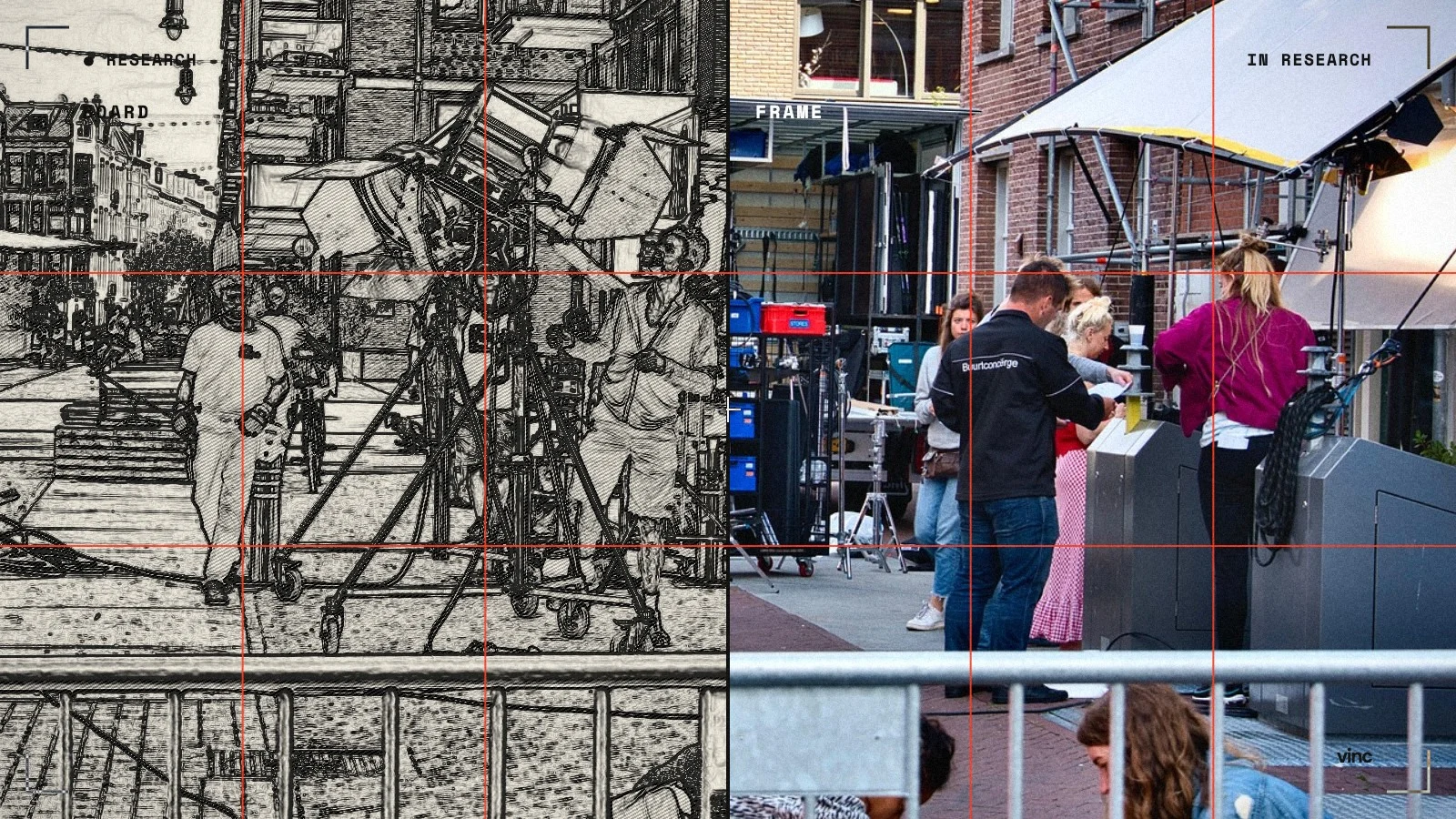
Frames written from a storyboard's read scored 33.0 out of 50 for staging, against 22.5 for frames written from the shot plan, but the gain wasn't uniform: the close-up was a clear win and the two-shot got worse. This article sets out the test, the rubric and the rules we took from it, and does not claim the result holds beyond three beats.
Method. Our own tests, run 3 August 2026: a one-board comparison (one render per version) and a scored test of 3 beats × 2 versions graded out of 50 by a separate AI image-reading model; nothing was re-run for this article. Vinc makes an AI film studio, and these are our own tests of our own pipeline.
What this means for you
- Don't feed a sketch to an image model as the reference image if you want a photographic frame. In our test the model copied the sketch style and gave back more drawings.
- Describe the board in words, then edit the description like a prompt. One short phrase per idea, explicit position words (frame-left, right two-thirds, dead centre), and don't say the same thing three ways.
- Place at least two things relative to each other. "She stands frame-left; the door fills the right two-thirds" is a staging. "She stands frame-left" is not.
- Lead with the shot size, and be careful with height fractions on two-shots. Our two-shot got worse when each character was given a height fraction.
- Score staging separately from beauty, with a short checklist: position, shot size, angle, key elements, empty space. If you automate the description step, make a failed description visible, or every frame quietly falls back to the plain text.
A storyboard panel says where things sit in the frame; an image model working from a text prompt doesn't have to keep any of it. In August 2026 we tested how much of a board's staging survives inside Vinc's shot-generation tool, and what the words need to make it survive. Frames written from the board averaged 33.0 out of 50 for staging fidelity against 22.5 from the shot plan, across three beats, but one of the three got worse; treat these as lessons from a small test, not laws.
Why a drawing can't go in as a picture
On 31 July 2026 we handed the image model a graphite panel as a reference image, and got back more graphite or comic panels. The model copies the medium, not the layout; we call this medium bleed.
So the bridge is words: a vision model describes the panel's composition (the board's read), and that goes into the image prompt. Our setup on 3 August:
| Step | What it did |
|---|---|
| Draw | One storyboard sheet per scene, graphite style |
| Crop and read | One vision call found the panel's bounding box and also returned five fields: framing, subjects, eyeline, depth, space |
| Medium scrub | Clauses naming pencil, graphite, sketch, hatching or greyscale dropped, to avoid medium bleed again |