A fuller 3D blocking won the two shots that depended on space (a rooftop leap and a walk to a cryo-pod), a rough blocking with plain stand-ins won the two framing-led shots, and generating straight from a keyframe never won but never failed and was cheapest per second. Picture quality was about equal throughout; what the 3D guide changed was the camera, and the video model copied the guide's mistakes too. It was one take per method per genre, judged by us, so treat it as a strong hint rather than proof.
Method. Our own test, 18 November 2026: four one-shot scenes (action, horror, romance, sci-fi), each rendered three ways in Higgsfield Cinema Studio 4.0 from identical scripts, characters and sets, with costs and timings from the render logs. Vinc makes an AI film studio, and this was a test of our own pipeline.
What this means for you
If the shot depends on geography, block it in 3D and build the set pieces that matter. A leap between two roofs, or a walk up to a particular object, only worked when the 3D guide had the gap or the object in it.
If the shot is mostly about framing, a rough guide is enough. A slow push-in on one room, or a static two-shot, came out best from a quick blocking with plain coloured stand-ins.
If the exact camera doesn't matter, generate directly. Going straight from a single generated frame never won a genre, but it never produced a bad take, and it was the cheapest per second.
3D blocking didn't improve the picture. Faces, wardrobe, light and texture looked about the same in all twelve takes. What the blocking changed was the camera.
The video model copies the guide, mistakes included. In seven of the eight takes that had a 3D guide, the final followed the guide's framing and motion closely, flaws and all.
These results come from one take per method per genre, judged by us: a strong hint, not proof. Every take is shown below.
What we did
We made four one-shot scenes three ways each. Only the planning before the render changed.
Maya sprints across a rooftop and leaps a two-metre gap to the next roof; Viktor reaches the edge and stops
A jump between two spaces, tracking camera
Horror
8 s
Clara opens a cellar door; a grey hand grips the door from inside; she stumbles back and drops a candlestick
A slow push-in on one closed room
Romance
6 s
Lena reads a letter on a rainy platform; Arjun holds an umbrella over her and takes her hand
A static medium two-shot at eye level
Sci-fi
8 s
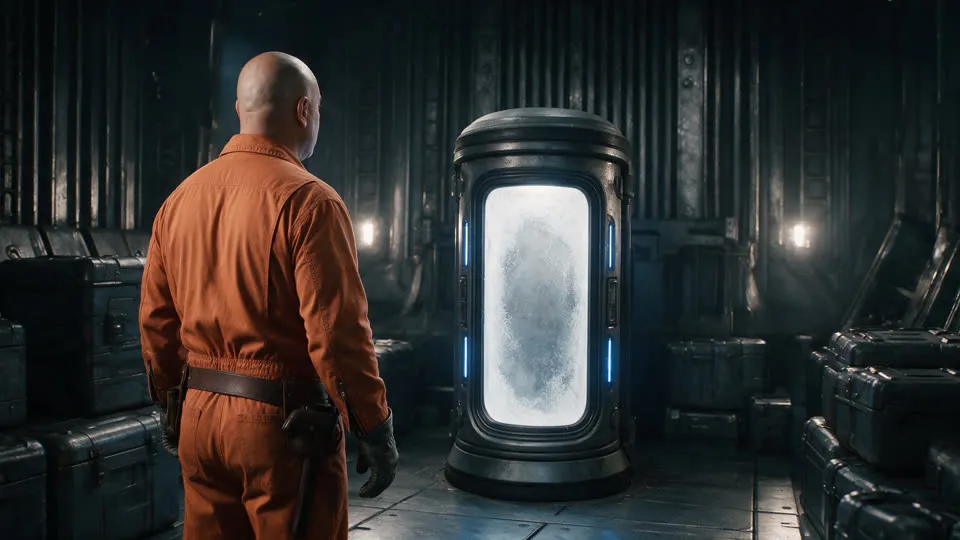
An engineer walks up to a frosted cryo-pod, wipes the glass, a woman's eyes open, the lights turn red
Following someone toward an object, then a reveal
A, direct. An image model (Seedream) made one keyframe from the shot description and the character and location sheets. The video model animated it with a simple camera preset (truck right, dolly in, or static) and chose everything else.
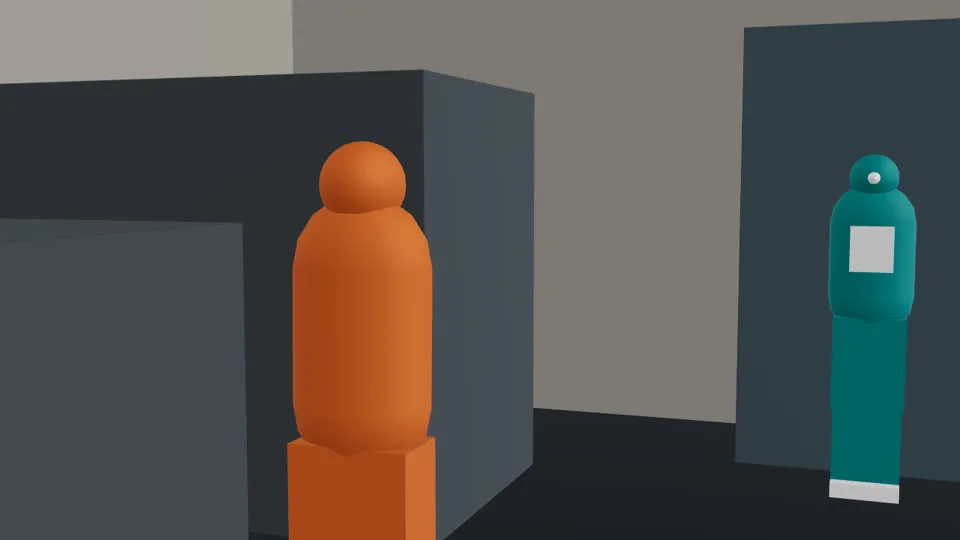
B, rough 3D guide. An AI planner placed one armless coloured figure per character plus a few boxes and walls, then code placed the camera. This took 25 to 70 seconds.
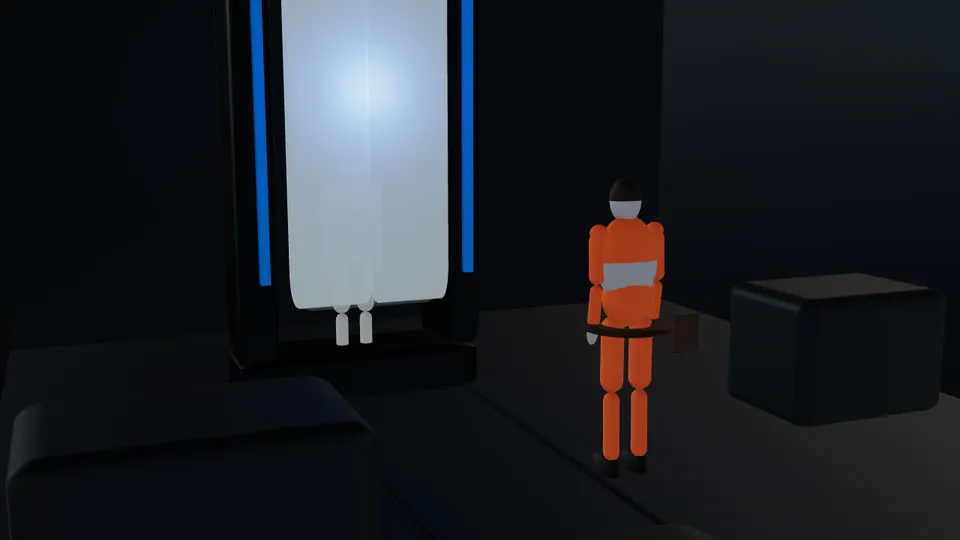
C, fuller 3D scene. An AI builder assembled the set from a library of 3D props, placed posed mannequins and lights, and checked its own renders. This took about 1.5 to 3.5 minutes.
For B and C, the 3D scene was rendered as a guide video the full length of the shot and sent to the video model as a reference, with an opening frame and the same sheets A used.
A: generated keyframe
B: rough guide, first frame
C: fuller scene, first frame
The three starting points for the sci-fi shot. A starts from a photoreal still. B's stand-ins mark who stands where but leave out the pod. C has the pod, its blue light strips and a mannequin in an orange suit.Our test, 18 November 2026.
All twelve finals were rendered by Higgsfield's Cinema Studio 4.0 at 720p and 16:9, with the same camera settings within each genre. We switched off our pipeline's fallback to a different video model (Seedance) and re-shot three takes that had already fallen back.
What we can't claim:
One take per method per genre. Video models vary every time, so one take can't separate the method from the luck of the roll, and two genres came down to a single visible moment.
We judged it ourselves. Verdicts come from frame-by-frame viewing by the person who ran the test, not a blind panel.
One video model, single shots only. Other models may follow a reference video more loosely or more strictly, and we didn't test continuity across several shots.
Small differences in the requests. The 3D methods asked for audio and the direct method didn't; every clip here is muted. The romance B and C guides reused earlier builds, so their preparation costs are estimates.
Action: the leap across the gap
C won. It's the only take that tells the story as written.
A: direct
B: rough guide
C: fuller scene
A opens under a pink dusk sky with a clean leap from the parapet, then the view jumps to a new angle beside a chimney and the gap is never clearly shown. B tracks both runners closely, then switches to the same kind of chimney view. C tracks past the parapet and holds on Viktor gripping the edge while Maya lands crouched on the lower roof across a visible gap.Our test, 18 November 2026. All three rendered by Cinema Studio 4.0 from the same script and sheets.
The guides explain the difference.
B guide
B final
B's guide is a static, side-on wide shot of two coloured stand-ins sliding along a long block. There is no gap and no second roof. With no geography to follow, the video model made up its own camera. This was the one 3D take that didn't track its guide.Our test, 18 November 2026.
C guide
C final
C's guide has the air-conditioning units, the parapet and a lower roof beyond it. Two running mannequins head for the edge while the camera tracks right and ends on one figure at the parapet. The final follows that path and ends on the same composition.Our test, 18 November 2026.
Why it matters: a jump only reads if the audience can see both sides of it. The prompt said "two-metre gap", but the model only kept the gap when the guide had one.
Horror: the cellar door
B won, with A a close second. C produced the clearest case of a guide's mistake being copied into the final.
A: direct
B: rough guide
C: fuller scene
A: a large grey hand bursts from the open cellar door as Clara pulls back, and the candlestick ends up on the floor. B: a slow push-in on the room, a long-fingered hand grips the door edge, and Clara turns away with the candlestick dropped. C: the door opens on darkness with a flat, hand-shaped print floating in it.Our test, 18 November 2026. All three rendered by Cinema Studio 4.0 from the same script and sheets.
B guide
B final
B's guide is plain: the room, the door, a table, a box and two coloured stand-ins. It fixes the layout and the slow push. The scare itself came from the written prompt.Our test, 18 November 2026.
C guide
C final
C's guide models the hand as a flat three-finger shape floating in the black doorway. The final shows the same flat shape where a hand gripping the door should be.Our test, 18 November 2026.
Why it matters: a crude stand-in for an important detail (a hand, a creature, a face) can end up in the final as that crude stand-in. Leave such details out of the guide and describe them in words, or tell the model the guide's shapes are placeholders (we haven't tested that yet).
Romance: the umbrella two-shot
B won. The script asked for a static medium two-shot at eye level, and B delivered it.
A: direct
B: rough guide
C: fuller scene
A plays every beat (letter, umbrella, look-up, hand) but frames it wider and bluer than asked, with the platform and tracks running away behind them. B is a medium two-shot: Arjun steps in with the umbrella, Lena looks up and he takes her hand. C centres both of them under the umbrella with the platform edge in the foreground, but the hand-hold only starts in the last moments.Our test, 18 November 2026. All three rendered by Cinema Studio 4.0 from the same script and sheets.
B guide
B final
B's guide is two coloured stand-ins that end side by side. The final ends with the two characters in the same positions.Our test, 18 November 2026.
C guide
C final
C's guide is side-on, with flat figures, a bench, an umbrella and a yellow platform line. The final keeps that centred composition under the umbrella.Our test, 18 November 2026.
Why it matters: in a short fixed-frame shot, the guide only has to lock the framing and end positions. Plain stand-ins do that; the fuller scene left the key beat late.
Sci-fi: the cryo-pod
C won. It followed the script, and its own guide, almost frame for frame.
A: direct
B: rough guide
C: fuller scene
A gets the wipe, the face and the red light, but the last frames crop Reyes awkwardly at the edge. B pushes into a large close-up where Reyes' head fills much of the frame before ending on a wider, red-lit frame. C opens wide behind Reyes, follows him to the pod, and he wipes the frost to reveal the woman before the pod turns red.Our test, 18 November 2026. All three rendered by Cinema Studio 4.0 from the same script and sheets.
B guide
B final
B's guide is a tight view of two stand-ins between grey walls, with no pod at all. The final copies the cramped framing, so there's nothing for the reveal to frame.Our test, 18 November 2026.
C guide
C final
C's guide has the lit pod with blue strips, a mannequin inside and a red tint at the end. All three carry into the final.Our test, 18 November 2026.
Why it matters: when the camera has to arrive somewhere specific, that place has to exist in the guide. The B guide left the pod out, and the final had no pod to frame.
Which method for which shot
The 3D guide decides where the camera goes and where people end up. Faces, wardrobe and light come from your reference images and the video model.
Shot type
What to do
Why, from this test
Jumps, gaps, chases, anything crossing between two places in one shot
Block it in 3D, and build the set pieces the action depends on at roughly the right size
Only the guide with a visible gap produced a readable leap
Following someone toward a specific object (a pod, a car, a door)
Block it in 3D with that object in the scene
With the pod in the guide, the reveal was framed as scripted. Without it, the camera crowded the actor
A contained two-shot with a fixed frame
A rough guide with plain stand-ins, or a clear framing note in the prompt
The rough guide gave the exact medium two-shot. Direct generation framed it wider
A slow push-in on one room
A rough guide, or direct generation with a dolly-in preset
The rough guide won and direct came a close second
Mood, atmosphere, establishing shots
Generate directly from a strong keyframe
Never broken, cheapest per second
A key moment that is a small physical detail (a hand, a creature, a face)
Keep that detail out of the 3D guide and describe it in words
A crude hand in the guide came out as a crude hand in the final
Stand-ins carry position, not action: in the rough guides, leaps and stumbles came only from the prompt. And check the guide before you render, because whatever it gets wrong, the final will too.
How to do it yourself
You need a rough video of the camera move at the length of your shot, and a video tool that accepts a reference video.
Make the guide. In Blender (free), block the set with boxes and simple figures and animate a camera at your lens's focal length. Or film toys on a tabletop with your phone for the full shot length; if the story needs a gap, leave one.
Feed it in as a reference.
- Kling 4.0 (Omni Reference): a feature_video input can "extract the camera path and pacing from a reference video". Limits are up to 5 videos, 3 to 30 seconds each, 30 seconds in total. - Seedance 2.5: ByteDance's launch post (31 July 2026) says it takes up to 10 video clips as references, with a camera-only example: "Adjust only the camera movement." - Higgsfield Cinema Studio 4.0, the model we used, accepts uploaded videos up to 30 seconds. Its help page doesn't say a video reference transfers camera motion; in our test it clearly did. - Luma Modify Video works the other way round: film a rough blocking and it restyles the footage "without losing the integrity of the performance, motion, camera or character".
Send your character and location images with it, so the look comes from those, not the guide.
Write the action into the prompt. The guide fixes where things are; the words supply what they do.
In Vinc (our product, and the pipeline this test ran on), you place the crew, camera and lens in the 3D Studio, and the rendered guide goes to the video model with your locked sheets.
What it cost and how long it took
Dollar figures are what the video and image providers billed us for each step on 18 November 2026. What you pay depends on your tool and plan.
A: direct
B: rough guide
C: fuller scene
Preparation per shot (AI cost)
$0.14 (keyframe)
$0.02–$0.06
$0.63–$1.47
Preparation time per shot
about 1.2–1.7 min
25–70 s, plus 1–2 min to render the guide
1.5–3.5 min, plus 1–2 min to render the guide
Video render rate
about $0.46 per second
about $0.55 per second
about $0.55 per second
Total per second, all four films
$0.48
$0.56
$0.69
A 10-second shot (the action scene)
$4.76
$5.61
$6.18
Wall-clock time per shot, end to end
about 7–15 min
about 7–12 min
about 9–15 min
Cost per second of finished video, all four films
A: direct$0.48
B: rough guide$0.56
C: fuller scene$0.69
Our test, 18 November 2026: preparation plus Cinema Studio 4.0 render, divided by 32 seconds of video per method.
A guide video raises the render rate, and the fuller build costs more to prepare. Render times were mostly set by queue load: two direct takes took 12 to 15 minutes because all four were submitted at once on shared accounts.
Try it
How we compiled this
We ran this test of our own pipeline on 18 November 2026: twelve Cinema Studio 4.0 takes from shared scripts, sheets and shot plans, with per-take cost and timing from the render logs, judged frame by frame by the engineer who ran it. Cost per second is total preparation plus render cost divided by 32 seconds of video per method; the 10-second figures use the action shot's own costs and leave out one lost and rebuilt 3D build. Tool capabilities were checked against each vendor's documentation in November 2026.
What an AI Shot Really Costs, and Why Credits Are the Wrong Unit
Price AI film work by the cost of a shot the client accepts, not by the credits it takes to render one. This article puts three public figures from November 2026 side by side and shows that each one points the same way: generation is a small, visible line item, and judgement, revision and review are where the money goes.