We timed four Gaussian splat scenes, from a 177,000-splat object to a million-splat captured set, against a 200-object three.js mesh scene in Chrome on an M5 MacBook. Three of the four held 60 fps, and the results suggest that how much of the screen the splats cover drives cost more than how many splats there are.
Method. Measured 18 November 2026 in our own splat tests: one run of 236 frames per scene at 1920×1080, headless Chrome 157, three.js r185 and Spark 2.1.0 on an Apple M5 MacBook with 16 GB. Format and product facts checked against project pages the same day. Vinc makes an AI film studio and uses Spark in its product.
What this means for you
A generated splat world is a workable previs set on an ordinary laptop. On a 16 GB MacBook, a 500,000-splat world drew in about 5 ms a frame, close to a 200-object mesh scene with shadows at about 3 ms, and both held 60 fps.
Test your tightest camera position, not the splat count. A 301,000-splat scene with the camera close inside large, soft splats cost 1.6 times as much per frame as the 500,000-splat wide valley. The expensive shot is the close-up.
Keep the camera inside the area a captured scene was shot from. Our one-million-splat captured scene dropped to about 30 fps near large floaters (blurry stray splats), and a camera placed outside the captured area showed almost nothing but floaters.
Use compressed SPZ files when you can. Our SPZ files used 14 to 23 bytes per splat; the older .splat file used 32. That is the difference between a quick load and a slow one on a weak connection.
Use the splat world as the set and meshes for what has to move. Splat lighting is baked in and splats are hard to edit by object, while mesh props, characters and lights can be relit and rearranged freely.
Gaussian splats (millions of small coloured, semi-transparent ellipsoids) can look finished from the moment they load, and World Labs' Marble exports its worlds as splats. Vinc already uses Spark, a three.js splat renderer, to show Marble worlds in its browser studio, so we measured what a splat scene costs to draw against a mesh previs scene. It is a small test, run once per configuration on one machine.
The machine and the method
Everything ran on 18 November 2026 on one Apple MacBook with an M5 chip and 16 GB of unified memory, in headless Chrome 157 (WebGL through ANGLE on Metal), at 1920 × 1080 and a device pixel ratio of 1. We used three.js r185 and Spark (@sparkjsdev/spark) 2.1.0, the version in Vinc's studio; Spark's latest release, 2.4.0, is not benchmarked.
Each run moved the camera along a fixed path for 240 frames after 60 warm-up frames, with four set aside for screenshots, so every figure is based on 236 measured frames. We ran each configuration once (the licensed apartment scene below, twice): no repeat runs, no error bars and no second machine.
Render time is three.js's renderer.render() plus a one-pixel readPixels call that forces the GPU to finish. Spark's depth sort runs in a background worker and is
Render-bound fps is 1,000 divided by mean render time: GPU headroom, not what a viewer sees. Delivered fps is the browser's requestAnimationFrame rate, capped near 60, so it only shows whether 60 fps was held.
Load time runs from creating a SplatMesh to Spark reporting it initialised, from local disk. It measures decoding, not download.
Peak memory sums every Chrome process, including a browser baseline of roughly 0.6 to 0.7 GB, so compare runs with each other.
The five scenes
Butterfly (butterfly.spz, 177,132 splats, 4.0 MB): a single object from Spark's examples, and the only file with third-order spherical harmonics (view-dependent colour). Camera orbit radius 1.6 units.
Valley (valley.spz, 500,000 splats, 6.8 MB): a stylised generated world from Spark's examples, of the kind Marble produces. The camera panned 30° either side from the origin.
Fireplace (fireplace.spz, 301,000 splats, 4.4 MB): another Spark example world, same panning camera.
Train (train.splat, 1,026,508 splats, 32.8 MB): a captured real scene from the Tanks and Temples dataset, distributed as demo data for antimatter15's WebGL splat viewer. Orbit radius 5 units.
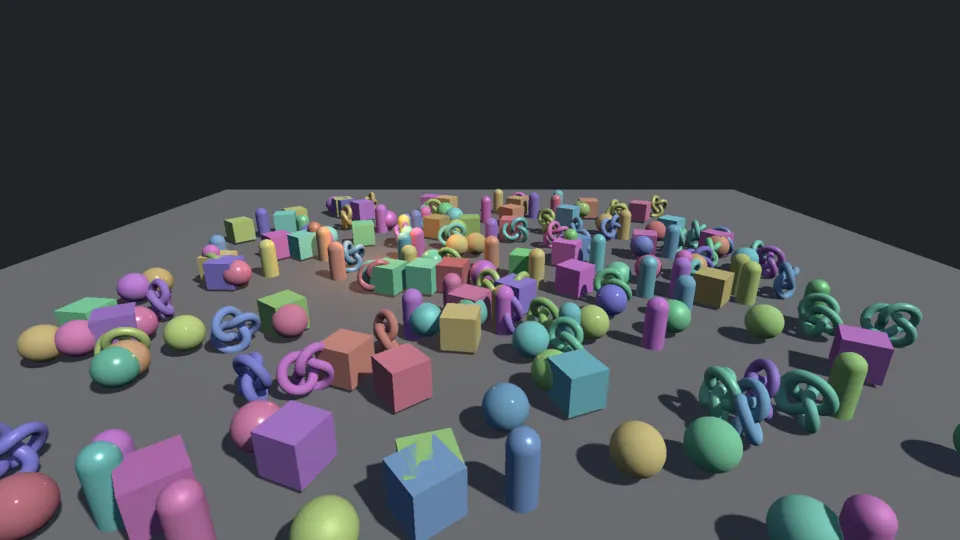
Mesh baseline:200 primitive objects with physically based materials, 670,202 triangles, three lights and a 2048 × 2048 shadow map. With the shadow pass, three.js reported 1,336,574 triangles and 396 draw calls per frame. Orbit radius 18 units.
Results
Scene
Splats
File
Load
Render mean
Render, slowest 5% of frames
Render-bound fps
Delivered fps
Peak Chrome memory
Butterfly (object)
177,132
4.0 MB
440 ms
3.89 ms
5.1 ms
257
60.7
759 MB
Valley (generated world)
500,000
6.8 MB
146 ms
4.91 ms
7.3 ms
204
61.4
783 MB
Fireplace (generated world)
301,000
4.4 MB
176 ms
7.89 ms
10.7 ms
127
60.8
801 MB
Train (captured scene)
1,026,508
32.8 MB
224 ms
13.76 ms
32.4 ms
73
54.4
835 MB
Mesh baseline (200 objects, shadows)
670,202 triangles
–
–
3.09 ms
6.4 ms
323
60.8
713 MB
Mean render time per frame at 1920×1080, lower is better
Mesh baseline (670k tris)3.09 ms
Butterfly (177k splats)3.89 ms
Valley (500k splats)4.91 ms
Fireplace (301k splats)7.89 ms
Train (1.03M splats)13.76 ms
Our test, 18 Nov 2026. Apple M5 MacBook, headless Chrome 157, three.js r185, Spark 2.1.0. 236 frames per run, one run each.
Render time of the slowest 5% of frames (95th percentile), lower is better
Butterfly5.1 ms
Mesh baseline6.4 ms
Valley7.3 ms
Fireplace10.7 ms
Train32.4 ms
Same runs: our test, 18 Nov 2026. A 60 fps display allows about 16.7 ms per frame.
Three of the four splat scenes held 60 fps for the whole path, as did the mesh scene, with their slowest 5% of frames well under the 16.7 ms a 60 Hz display allows.
The train scene did not. Its median was 16.9 ms, its 95th percentile 32.4 ms and its worst frame 37 ms, and delivered frame rate fell to 54.4 fps with a 95th-percentile frame gap of 33.1 ms. On parts of the orbit the browser showed about 30 frames a second, at views close to large floaters.
What the frames looked like
The four benchmarked files carry no stated asset licence, so we describe their frames instead of publishing them. To show a splat set next to the mesh baseline, we ran the same benchmark that day on a furnished apartment interior by Stéphane Agullo, licensed CC BY 4.0 (661,466 splats, 8.4 MB in PlayCanvas's SOG format), panning 30° either side from the middle of the room.
Splat interior, 661,466 splats
Mesh baseline, 200 objects with shadows
Notice that the splat set already looks like a finished room, while the mesh scene is grey-box previs. The look costs frame time when the camera is inside the set: the interior averaged 15.7 to 18.2 ms a frame over two runs, with its slowest 5% of frames at about 63 ms and 42 to 47 fps delivered, against 3.09 ms for the mesh baseline.Splat scene: “SA3D_R&D_XP47” by Stéphane Agullo (sa3d.fr), CC BY 4.0, via PlayCanvas; rendered by us. Mesh scene: ours. Our test, 18 November 2026.
That fits the overdraw pattern: fewer splats than the train, but walls, plants and frosted glass close to the camera on every side. The machine was short of free memory during the second run, so treat the two runs as a range.
Valley: a stylised alpine valley with a river, wooden houses and a snow-capped peak. From the authored viewpoint it reads like finished concept art, which is the strongest argument for splats in previs.
Fireplace: from the origin, the frame is a warm, out-of-focus wash of orange and yellow, unreadable as a set without a different camera position.
Train: a weathered "Western Pacific" locomotive is sharp near the middle while the edges and sky smear into floaters. In an earlier framing run with the camera outside the captured area, the frames showed almost nothing but floaters.
Splat worlds are hard to relight or edit by object; we cover both in editing splats with code and relighting splats. We have not measured splats and meshes drawn together, and depth sorting between them is a known area to check.
Splat count is not what you pay for
The fireplace has 301,000 splats and cost 7.89 ms a frame. The valley has two-thirds more, 500,000, and cost 4.91 ms: the fireplace was 1.6 times more expensive with fewer splats.
The difference is where the camera sat. The valley camera looks across a wide landscape where most splats cover a few pixels; the fireplace camera sits inside a close-up of the fire, where large, soft splats fill the screen and overlap. Every overlapping layer has to be blended, so cost tracks screen coverage and overlap (overdraw), not splat count.
The train points the same way: about twice the valley's splats but 2.8 times the average cost, with its worst frames near big floaters. Treat this as a strong hint rather than a law, since it rests on one comparison between two scenes with different content and we did not measure overdraw directly. Our next test re-renders the valley at 1280 × 720 and 3840 × 2160 with nothing else changed.
Memory and file size
Peak Chrome memory ranged from 759 MB (butterfly) to 835 MB (train), against 713 MB for the mesh baseline. With the browser baseline included, a splat scene added on the order of tens to a couple of hundred megabytes; we did not isolate the baseline, so we can't give a precise per-scene number.
SPZ, the compressed format Niantic publishes under the MIT licence and describes as about ten times smaller than PLY, stored the valley in 6.8 MB, about 14 bytes per splat. The fireplace came in at about 15 and the butterfly, with its spherical harmonics, about 23. The train, in the older uncompressed .splat format, used 32 bytes per splat: 32.8 MB for just over a million splats.
Bytes per splat by file
Valley (SPZ)14 B
Fireplace (SPZ)15 B
Butterfly (SPZ, view-dependent colour)23 B
Train (.splat)32 B
Our test, 18 Nov 2026: file size divided by splat count, from the four files tested. SPZ files are compressed; .splat is not.
Load time and the first frame
The three world and capture files decoded in 146 to 224 ms from local disk. The butterfly took 440 ms in the benchmark but 110 to 161 ms in later runs on the same file, so a single load figure is noisy, and we did not measure network download.
The very first run of the session (a framing check, not a measured run) took 928 ms to draw its first frame; every later run took 22 to 41 ms. That is shader compilation, cached by Chrome after the first run, so expect a new user to wait around a second before a splat scene appears.
What we did not test
Other hardware or browsers. One M5 MacBook and headless Chrome only: no Windows, discrete GPUs, phones, Safari, Firefox or visible window.
Resolution scaling. Every run was 1920 × 1080 at a pixel ratio of 1; Retina displays would draw more pixels.
Repeat runs, Spark's sort cost, or the cost of view-dependent colour (only the butterfly had it).
Spark's level of detail. Spark 2.0 added a system that streams large worlds, but we ran 2.1.0 without it. World Labs says most consumer devices can only render 1 to 5 million splats at interactive frame rates, so this is next for larger worlds.
WebGPU, and look quality beyond our own visual judgement.
How we compiled this
We ran this test ourselves on 18 November 2026 with a small three.js r185 and Spark 2.1.0 test page, driven by a script that runs one configuration at a time in an isolated headless Chrome and saves results, screenshots and peak memory. All figures come from those saved results, and we looked at the frames before describing any scene. Vinc makes an AI film studio and uses Spark in its product; we have no relationship with World Labs or Niantic.
What an AI Shot Really Costs, and Why Credits Are the Wrong Unit
Price AI film work by the cost of a shot the client accepts, not by the credits it takes to render one. This article puts three public figures from November 2026 side by side and shows that each one points the same way: generation is a small, visible line item, and judgement, revision and review are where the money goes.