The 180-degree rule in film keeps the camera on one side of the line between two people so their eyelines meet. How to cross it and five films that break it.
Method. Sources checked November 18, 2026: the Film Art glossary, MIT and Columbia film glossaries, two open filmmaking textbooks, Kachkovski et al. (Communication Research, 2019), Thompson and Bordwell on Ozu, a Frame.io interview with David Mullen ASC, and Kling and Google model documentation. Vinc makes an AI film studio.
What is the 180-degree rule in film?
The 180-degree rule says the camera stays on one side of an imaginary line drawn between two characters, so their eyelines meet across a cut. Put two people at a table and draw a line through both of them: that line is the axis of action. Classical continuity editing keeps the camera on one side of it for the whole scene.
The axis of action and screen direction
MIT's Film Lexicon puts the rule in one sentence: an invisible line, "known as the 180 DEGREE LINE or axis of action, runs through the space of the scene," and the camera may shoot from anywhere on one side of it but may never cross it.
Columbia University's film glossary gives the reason: staying on one side "keeps characters grounded compositionally on a particular side of the screen or frame, and keeps them looking at one another when only one character is seen onscreen at a time." If the camera crosses, it "risks giving the impression that the actors' positions in the scene have been reversed."
What the rule protects is screen direction, which LMU's open textbook No-Nonsense Filmmaking (Livingstone and Livingstone, 2025) defines as "the direction a character is facing as they interact with other people or objects within a shot." Shoot one close-up from the other side of the line and both people face the same way: "they no longer appear to be looking at each other."
The same logic applies to movement: a character who exits frame left should enter the next shot from frame right.
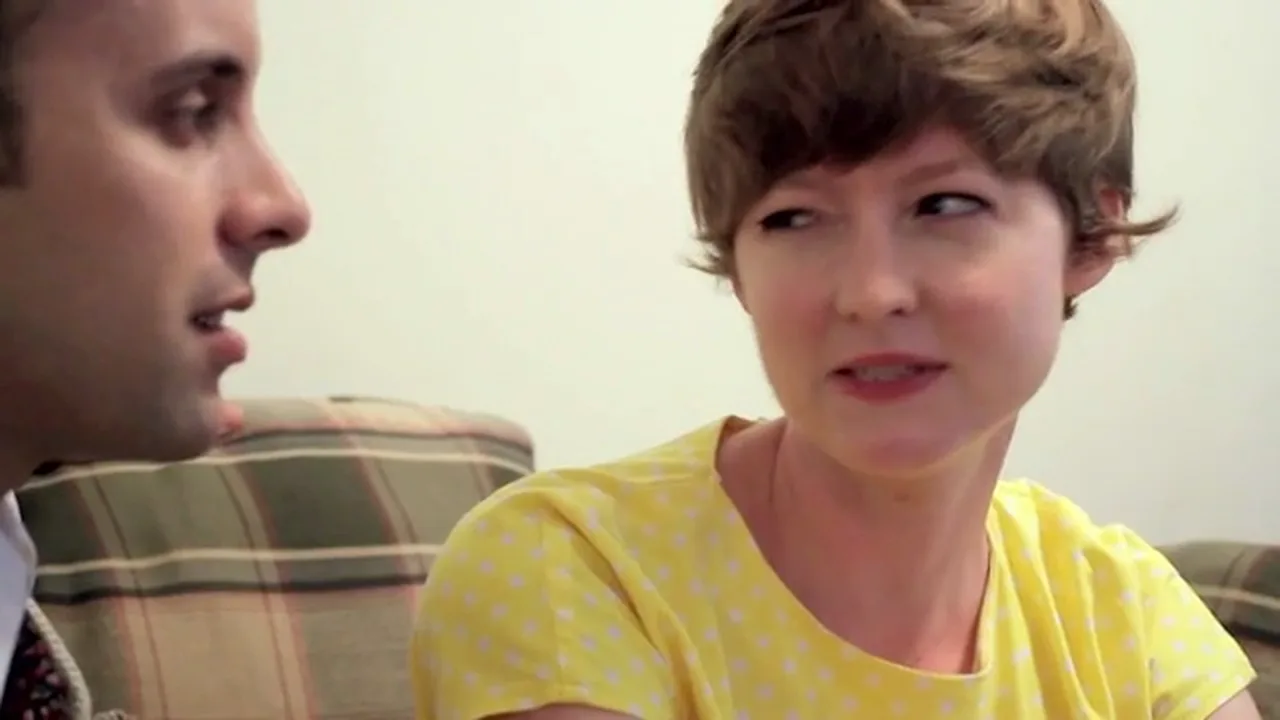
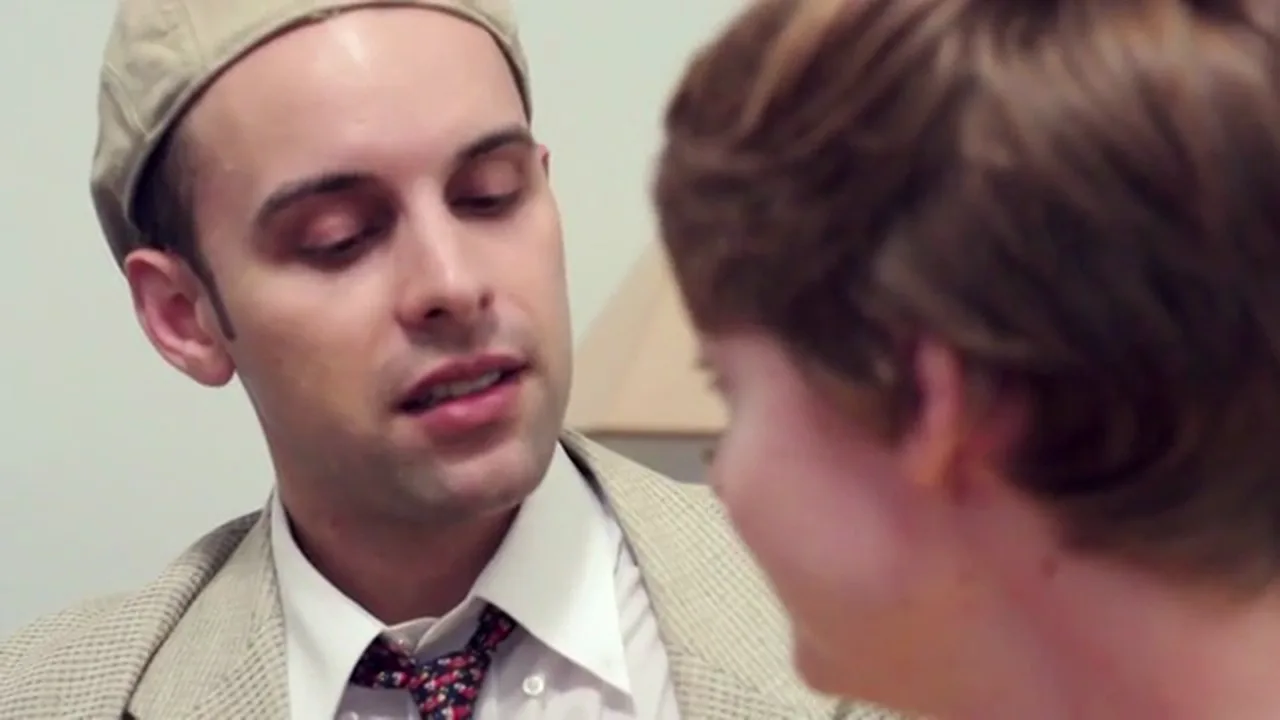
Both shots are taken from the same side of the line: he looks toward screen right and she looks toward screen left, so their eyelines meet across the cut.Still from A Sad State of Affairs (2009), M.A. Lanoue / Squire Films, CC BY-SA 3.0 US.
Eyeline match. In Film Art's definition, the first shot "shows a person looking off in one direction and the second shows a nearby space containing what he or she sees. If the person looks left, the following shot should imply that the looker is offscreen right."
Shot/reverse shot. "Two or more shots edited together that alternate characters, typically in a conversation situation" (Film Art). MIT's lexicon adds that the camera alternates between the two people "from opposite ends of the axis of action," always staying on the same side.
Both work only if the cut doesn't flip left and right, which is why a crossing is most noticeable in dialogue.
The 30-degree rule, and why some textbooks say 45
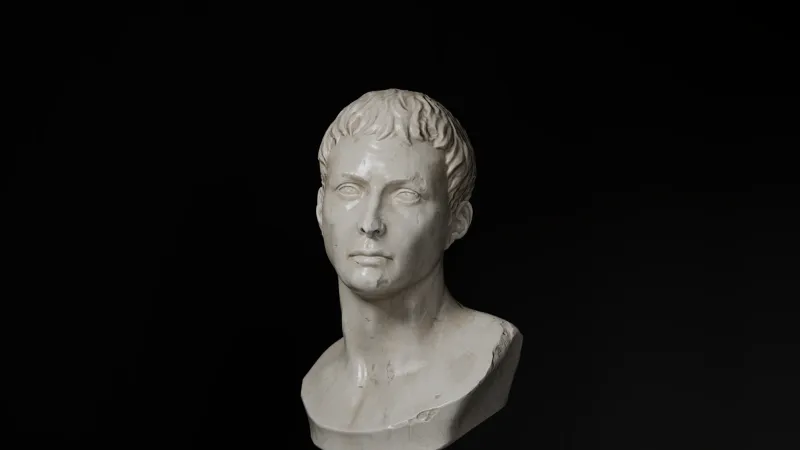
The 180-degree rule tells you which half of the room to shoot from; the 30-degree rule tells you how far to move inside it. MIT's lexicon calls it "a convention in Hollywood editing which holds that the camera must move at least 30 degrees between shots." Cognitive psychologist Tim Smith (Projections 6(1), 2012) adds an alternative: a clear change in shot size. Otherwise the cut reads as a jump cut.
No-Nonsense Filmmaking asks for more: a shot that "isn't at least 45 degrees different from the previous one" creates "an uncomfortable 'jump'." Treat 30 degrees as the minimum.
Shot A · 0°
10°
30°
45°
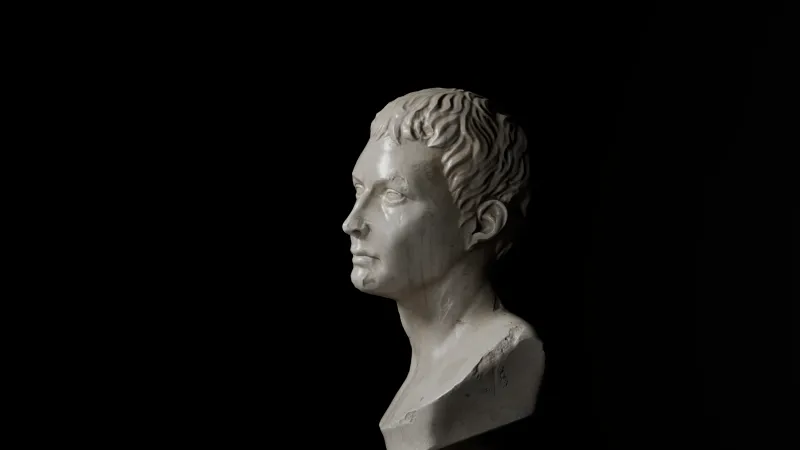
Cutting from shot A to each of the others. The camera swings around the bust at a fixed 2.2 m, with the same 85 mm lens and the same light. At 10° almost nothing changes but the head's angle, which is the "jump" the rule warns about. At 30° the face has turned enough to read as a new shot, and at 45° it is clearly a different view. Rendered in Vinc's virtual camera lab.Bust: Marble Bust 01 by Rico Cilliers; walls and floor: Plastered Wall 04 (Rob Tuytel) and Old Wood Floor (Guillaume Monsergent). All CC0, Poly Haven.
How to cross the 180-degree line: three accepted ways
No-Nonsense Filmmaking lists three ways to cross "without confusing the audience as to screen direction":
The actors move. During the shot, the characters cross the line themselves, which sets up a new one.
The camera moves. During the shot, the camera travels across the line "in an uninterrupted movement," so the audience watches the geography rotate.
A neutral shot. Place the camera "directly on the line, thereby neutralizing it." A shot straight down the axis has no left or right, so the next shot can be on either side.
Working practice adds a fourth, the cutaway: Mark Christiansen (Frame.io) notes that "you can cover a reverse cut with a cutaway". He quotes cinematographer David Mullen, ASC: "The 180-degree rule exists for one reason only. To avoid confusion... If the audience isn't confused as to who is talking to whom, or where they are going, then it's not that critical."
What crossing the line actually does to viewers
Kachkovski, Vasilyev, Kuk, Kingstone and Street filmed short scenes with and without a 180-degree violation ("Exploring the Effects of Violating the 180-Degree Rule on Film Viewing Preferences", Communication Research 46(7), 2019).
Experiment
Participants
Task
Result
1
35 undergraduates, told what a violation is
Press a key at any cut that breaks the rule
Flagged 42% of violating cuts and 8% of matching cuts in clean versions. Detectable, but more than half were missed.
2
62 undergraduates, not told about the rule
Press a key at any confusing or disorienting cut
About 8% of violating cuts flagged, against 6% of the same cuts without a violation
3
92 undergraduates
Choose the preferred video from each pair
Videos with a violation were chosen 51.9% of the time, not significantly different from 50%
The authors' conclusion: violations "can confuse and disorient viewers," but they "did not alter the viewers' liking of a video." The clips were short and staged, but the result supports Mullen: confusion is the main thing a crossing costs.
Breaking the 180-degree rule on purpose: five film examples
Film
Year
Director
Where
What the break does
The Shining
1980
Stanley Kubrick
Jack and Grady in the hotel bathroom
Wides flip sides while the close-ups keep one direction
Films of Yasujirō Ozu, e.g. Tokyo Story, Good Morning
1953, 1959
Yasujirō Ozu
Dialogue and transitional scenes
A whole system of "360-degree" space
In the Mood for Love
2000
Wong Kar-wai
Chow and Chan seated opposite each other
Sides swap with no new rule to replace the old one
Fight Club
1999
David Fincher
The narrator's phone-booth call to Tyler
A near-180° arc crosses the eyeline and crosses back
Requiem for a Dream
2000
Darren Aronofsky
Cut to Harry's first close-up after Tyrone's suggestion
A snap cut across the line marks a shift in tone
The Shining. The most cited example. Mullen: "Kubrick shoots wide shots from both directions, a 180-degree flip, crossing the line," but "he picks a screen direction to match close-ups on." The viewer can follow who is speaking but can't settle on where they are.
Ozu. Ozu worked in a different system. Thompson and Bordwell ("Space and Narrative in the Films of Ozu," Screen, 1976) list a "360-degree shooting space" among his defining features; Bordwell later called it "compass-point cutting (360-degree space, 180-degree reverse shots)", with reverses taken from directly opposite.
In the Mood for Love. Critic Tony McKibbin describes Wong cutting "from Chow sitting screen right and Chan screen left before a cut shows the reverse," then flipping back. Wong "plays havoc with the 180-degree rule without creating a new rule out of its breaking," making time and space feel fluid.
Fight Club. Christiansen: "a nearly 180-degree arc shot crosses his eyeline and then crosses back," the moving-camera method used as a metaphor for the narrator's "imaginary friend".
Requiem for a Dream. Cinematographer Matthew Libatique's snap cut across the line into Harry's first close-up marks the moment when "life has shifted for these characters."
The line in AI-generated video
A video model has no set. Each clip is generated on its own, so nothing guarantees that the woman on the left in the master is still on the left in her close-up.
Kling supports "Shot-Reverse-Shot Dialogue" in Multi-Shot, up to 6 shots and 3 to 15 seconds per generation (July 2026), but doesn't mention the 180-degree rule or eyelines.
Google Veo 3.1's prompting guide (October 2025) shows several shots in one 8-second generation, including "Reverse shot of the explorer's freckled face," with no mention of the line or eyelines.
The plan your prompts have to describe in words: both cameras stay on one side of the line between the two characters, so each keeps their side of the frame from shot to shot.
So name the side of the line in plain words, in every shot (our illustration):
[Shot 1: Wide shot] Two-shot across a kitchen table. MAYA sits screen left facing right; DEV sits screen right facing left.
[Shot 2: Over-the-shoulder] Over DEV's left shoulder onto MAYA, who looks screen right toward him.
[Shot 3: Close-up] DEV, looking screen left toward MAYA. Camera stays on the same side of the table as Shot 1.
For a deliberate break, prompt it as clearly as a camera move, and keep one screen direction for the close-ups, as Kubrick did. Then check each single: is the character still looking toward where the other one sits? If not, regenerate or cut through a neutral shot or cutaway. For how editors weigh this against emotion and rhythm, see our article on Walter Murch's Rule of Six.
How we compiled this
Definitions come from Bordwell and Thompson's Film Art (7th ed.), MIT's Film Lexicon, Columbia's Film Language Glossary and LMU's No-Nonsense Filmmaking; the audience data from the open-access manuscript of Kachkovski et al. (2019). We included only film breaks we could trace to a named cinematographer, critic or scholar, which left out The Two Towers and Spike Lee's films. Model documentation was read on November 18, 2026; Vinc makes an AI film studio.
Sources
David Bordwell and Kristin Thompson, Film Art: An Introduction, 7th ed., McGraw-Hill, 2004, glossary (excerpt hosted by UC Irvine)
Atmosphere, Light Quality and Texture: Hard vs Soft Light, Haze, God Rays, Rain and Practicals
Haze, god rays, rain, moonlight, neon, crushed blacks and wet streets each describe something physical: particles in the air, the sun's angle, a gas's emission lines, a black point or the angle at which water reflects. This article defines each term with figures from meteorologists, physicists, manufacturers and cinematographers, then shows how the Google, LTX, Luma, Kling and Runway prompt guides phrase it.

 Shot