Filmmaking School
A free course from page to final grade: every technical term behind a shot and a prompt, what it physically is, and the numbers behind it. 7 modules, 34 lessons, free.
Start here: your first film in 10 steps
New to filmmaking? Take these ten in order. Each is short and practical, ends with an exercise, and builds one example film, The Letter, alongside yours, from idea and mood board to a finished minute with sound. About 70 minutes of reading in all.
- How to find a film idea and build a mood boardTurn a small idea into a one-sentence premise and a mood board with three reference films.7 min
- How to structure a one-minute filmPlan a one-minute film as one idea and one turn, timed to the second.6 min
- How to write a one-page scriptWrite a one-page script that shows instead of tells, with dialogue cut to the minimum.6 min
- Character design for film: look sheets and locationsDesign a character and a location on reference sheets that stay consistent in every shot.7 min
- How to storyboard a short filmStoryboard a short film panel by panel and time it as an animatic.7 min
- How to block a scene: marks, cameras and the 180° linePlan where actors and cameras go on an overhead plan that respects the 180° line.7 min
- How to make a shot list for a 60-second filmWrite a shot list of 8–12 shots with size, angle, movement, lens feel and seconds.7 min
- How to generate consistent AI shots from a shot listGenerate shots that keep the same character and location, within a credit budget.7 min
- How to edit a short film to 60 secondsCut selects from an assembly to a 60-second film with match cuts and J and L cuts.8 min
- How to add sound to a short filmBuild, mix and export a layered soundtrack for a finished short.7 min
- Make the whole thing with AI: the complete guideEvery step in one guide, from script to festival.Guide
Deep dives and reference
Every lesson in the course, by module. Open a module when you need it; the eight above are the place to start.
01Story and pre-productionFrom the page to a plan for the shoot.9 lessons
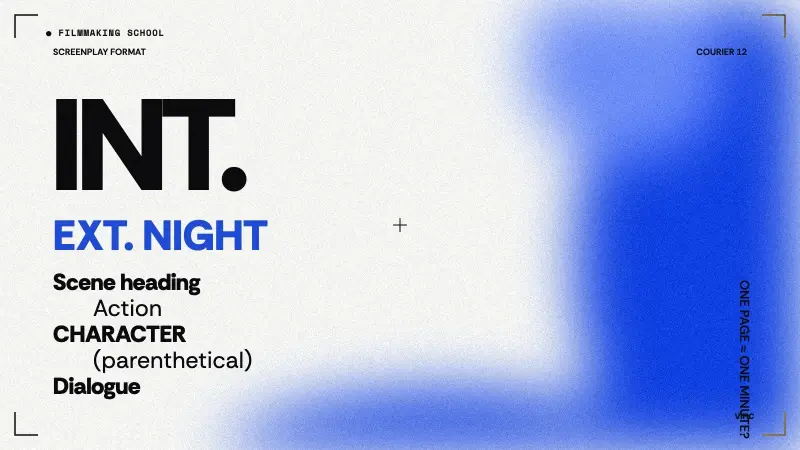
Screenplay Format Explained, With an Example: Elements, Margins, Page Counts and Revision Colours
Screenplay format, with an example scene: Courier 12-point, a 1.5-inch left margin, every element on the page, page-a-minute data and revision colours.
Story Structure Explained: Acts, Sequences, Beats and What the Research Measured
Story structure types compared: Aristotle, Freytag, Syd Field's three-act structure, sequences, Save the Cat's 15 beats, and what film data measured.
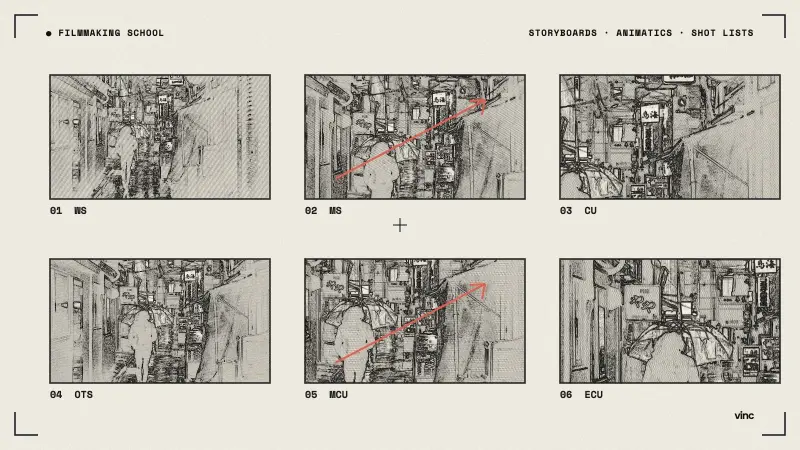
Storyboard vs Shot List: Storyboards, Animatics, Shot Lists and Overheads, With Examples
Storyboard vs shot list: a storyboard draws each shot in order, a shot list is the table you run the shoot day from. With a shot list example and animatics.
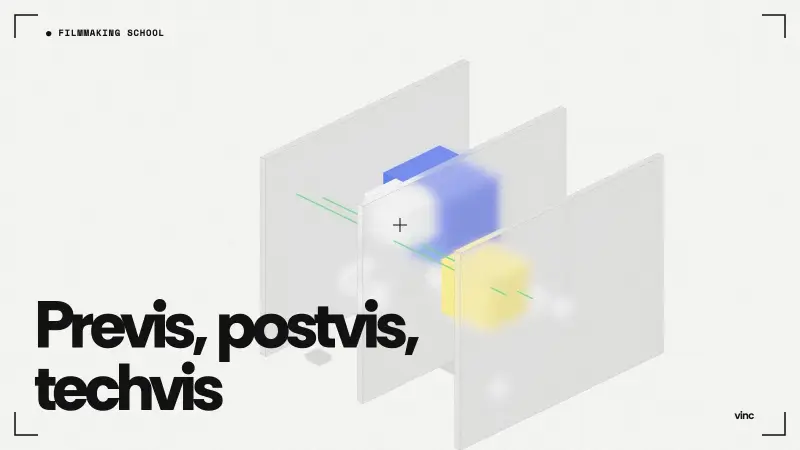
Previs, Techvis, Stuntvis, Postvis and Virtual Production, Explained
Previs (previsualization) is a collaborative process that makes preliminary versions of shots, mostly in 3D. How it differs from techvis, stuntvis and postvis.
Casting Explained: Breakdowns, Self-Tapes, Callbacks and What Union Actors Cost
The casting process for film runs from a breakdown to a self-tape, callback, chemistry read, avail and offer. Each round explained, with SAG-AFTRA's tape rules.
Directing Actors: Objectives, Result Direction, Rehearsals, Marks and Eyelines
Directing actors means giving them something to play: an objective that is a verb, not a result. The acting and set terms, from beats to marks and eyelines.
Production Design Terms Explained: Designer, Art Director, Set Decorator, Props, Swing Gang and Backlots
What is production design in film? The creation of a film's physical world: who designs, builds, dresses and props it, plus backlots, palettes and Oscars.

Costume and Wardrobe Continuity: Who Does What, Bibles, Multiples and Breakdown
Costume continuity keeps a character's look identical across weeks of out-of-order shooting. Who does it, plus the breakdown, continuity bible and multiples.
Film Terms, Visualised (10/10): Film Set Terminology, Production and Crew Roles
Film set terminology defined, from greenlight and call sheet to roll, speed, action and the Abby Singer, plus what the UPM, 1st AD, gaffer and best boy do.
02The frameWhat goes inside the rectangle, and where the camera stands.5 lessons
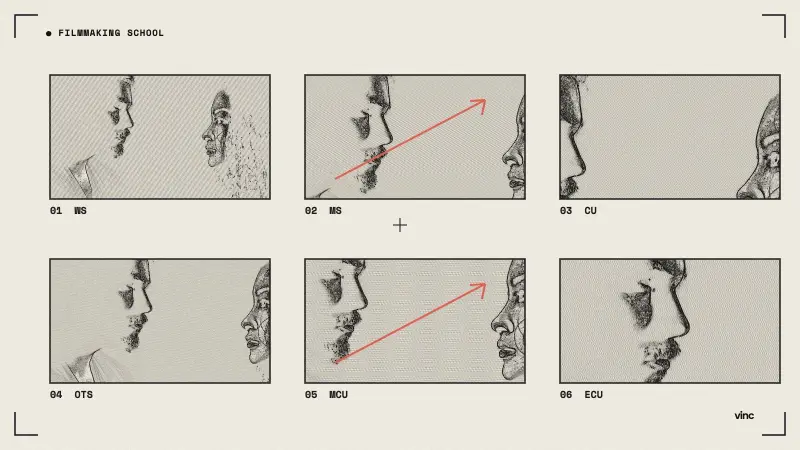
Film Terms, Visualised (1/10): Types of Shots, Shot Sizes and Framing
Types of shots in film, from extreme close-up to extreme wide, plus establishing, master, two-shot and over-the-shoulder shots, defined from film textbooks.
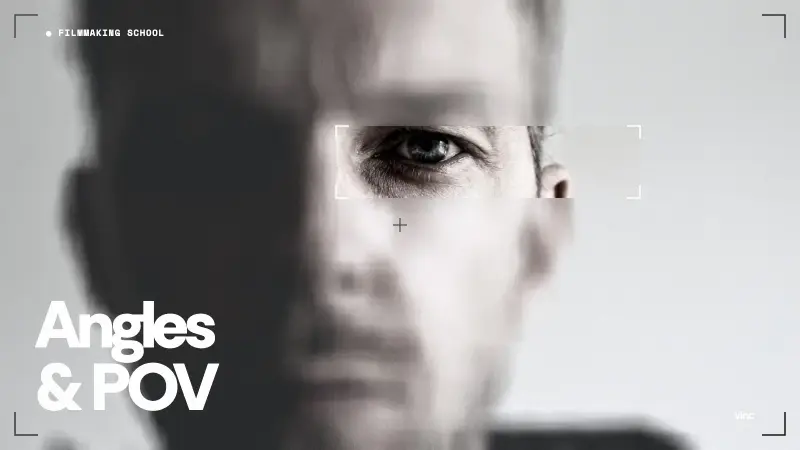
Film Terms, Visualised (2/10): Types of Camera Angles and Point of View
Types of camera angles in film, from eye level, high and low to bird's-eye, worm's-eye, Dutch and POV, with sourced film examples and video-prompt wording.
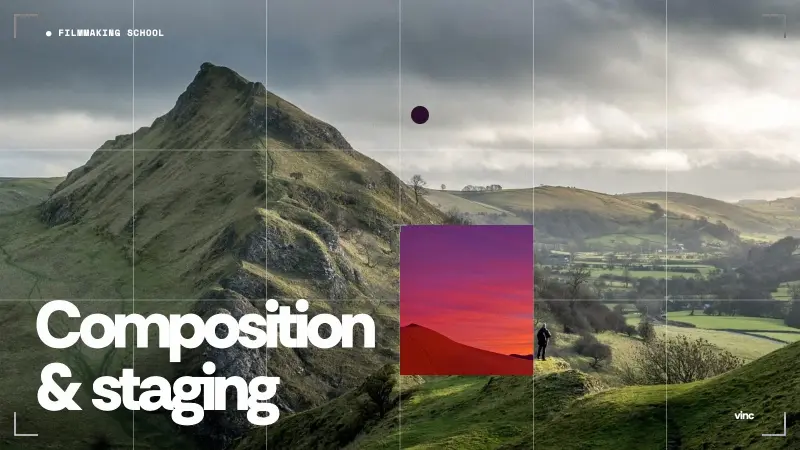
Composition in Film: Rule of Thirds, Headroom, Lead Room, Depth Staging and the Long Take
Composition in film is how the frame is arranged; staging is what moves in it. The rule of thirds, headroom, lead room, Dutch angles, deep focus and long takes.
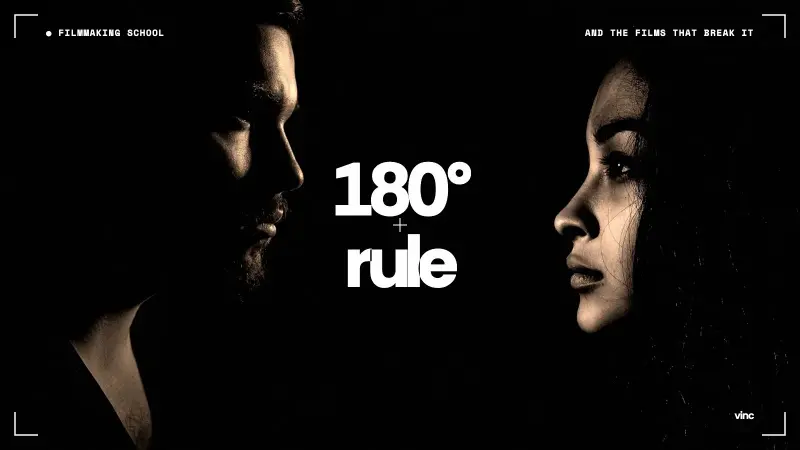
The 180-Degree Rule in Film, and the Films That Break It on Purpose
The 180-degree rule in film keeps the camera on one side of the line between two people so their eyelines meet. How to cross it and five films that break it.
Aspect Ratios in Film Explained: 1.33 to 2.39 and 9:16, With the History and Delivery Specs
Aspect ratios in film are width divided by height. See where 1.375, 1.85, 2.39, 16:9, IMAX and 9:16 came from, and the containers cinemas and Netflix expect.
03Camera and lensSensors, millimetres, movement and exposure.5 lessons
Camera Sensor Sizes Explained: Cinema Cameras, Crop Factor and What 'Shot on Alexa' Actually Means
Camera sensor sizes compared, Super 16 to IMAX: makers' own dimensions, the crop factor formula, and why format changes depth of field but not perspective.
Focal Length and Camera Lens Terms Explained: Angle of View, T-Stops, Depth of Field and Anamorphic
Focal length explained, with angle of view for seven lenses on full frame and Super 35, then every camera lens term: T-stops, depth of field, bokeh, anamorphic and filters.
Film Terms, Visualised (3/10): Types of Camera Movement and the Rigs Behind Them
Types of camera movement, from pan, tilt and dolly to the dolly zoom, and the rigs behind them: crane, Technocrane, Steadicam, gimbal, drone and motion control.
Shutter Angle vs Shutter Speed, Frame Rate and Motion Blur: The Numbers Behind the Film Look
Shutter angle vs shutter speed: at 24 fps a 180° shutter means 1/48 s. The formula, where 24, 25, 29.97 and 23.976 fps came from, and flicker-free settings.
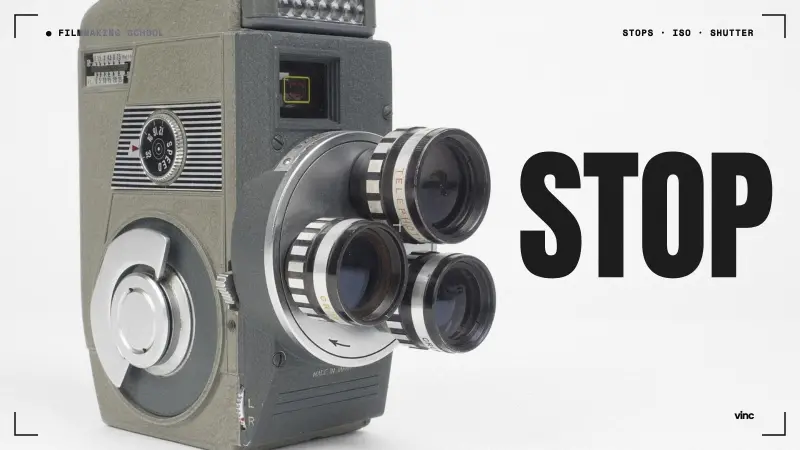
Film Terms, Visualised (5/10): Exposure and the Digital Image, Explained
Exposure explained: stops, the exposure triangle, EI, dynamic range, false colour, log vs Rec.709, bit depth, chroma subsampling and codecs, in numbers.
04Light and lookLighting, the film look and the grade.3 lessons
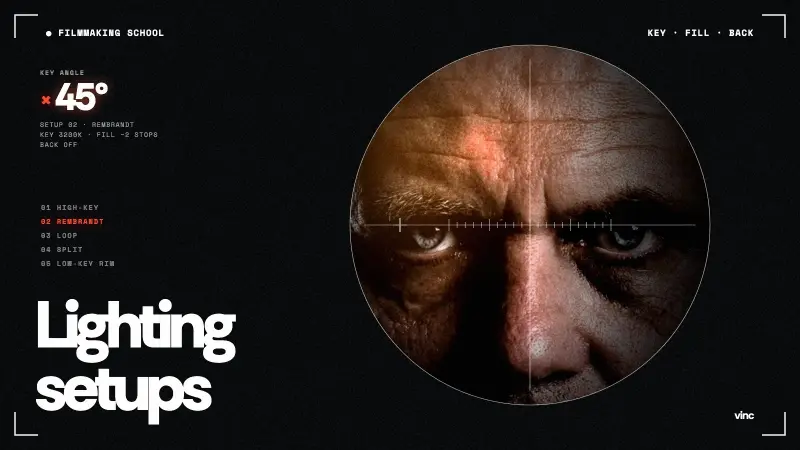
Film Terms, Visualised (6/10): Film Lighting Terms Explained: Three-Point, Rembrandt, Key and Fill, Hard vs Soft Light and Colour Temperature
Film lighting terms explained: key, fill and back light, lighting ratios in stops, Rembrandt, loop, butterfly and split, hard vs soft light, gels, practicals, colour temperature, CRI and golden hour.
Film Grain, Halation and Gate Weave: What the 'Film Look' Is Made Of
The film grain effect is clumped dye clouds, heavier in shadows and faster stocks; halation is a red halo from light bouncing off the film base. Both explained.
Colour Grading Terms Explained: Scopes, Lift Gamma Gain, What a LUT Is, Log, ACES and Looks
Color grading terms defined, from scopes and lift, gamma, gain to what a LUT is, log footage, gamuts, ACES, PQ and HLG, and teal-and-orange, each with its number or standard.
05SoundRecording, design and the mix.3 lessons
Film Terms, Visualised (7/10): Film Sound Terms
Film sound terms defined: boom, lav, room tone, timecode, ADR, Foley, walla, stems, M&E and loudness, from EBU R 128's −23 LUFS to Netflix's 48 kHz spec.
Types of Sound Effects in Film, With Examples to Hear
The types of sound effects in film, from hard effects and Foley to ambience, walla, room tone, designed sounds and stingers, each with a recording to hear. Plus Jack Foley, how famous sounds were made, and how effects sit in the mix.
Sound Design Explained: Designers, Editors, Mixers, Layers, Worldizing and Dolby Atmos
What is sound design in film? Who designs, edits and mixes a soundtrack, the layers it's built from, how the lightsaber was made, and what Atmos means.
06Edit and postCutting, transitions, motion graphics and VFX.6 lessons
Continuity Editing Grammar: Match Cuts, Jump Cuts, the Kuleshov Effect and Cross-Cutting
A match cut joins two shots that look alike; a jump cut looks like one shot with a gap. Examples from 2001 and Breathless, plus Kuleshov and cross-cutting.
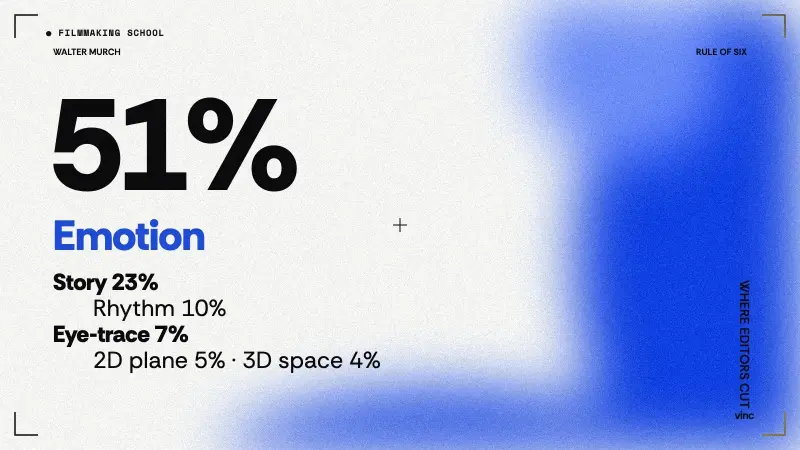
How Editors Decide Where to Cut: Walter Murch's Rule of Six and the Research on Cuts
Walter Murch's Rule of Six ranks six criteria for a cut, giving emotion 51%, more than the other five combined. Eye-tracking research shows why cuts go unseen.
Film Terms, Visualised (8/10): Film Editing and Post-Production Terms
Film editing and post-production terms, from dailies and picture lock to conform, DI, DCP and IMF, plus J-cuts, L-cuts and montage, with the spec behind each.
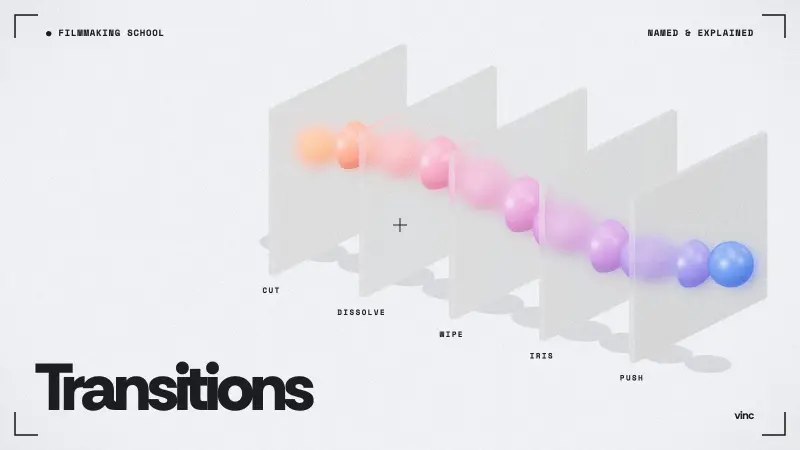
Film Terms, Visualised (13/10+): Types of Transitions in Film Editing, Named and Explained
Types of transitions in film editing, from the hard cut to the glitch: where each came from and what it tells the audience, with Rope, 1917 and the first wipe.
Film Terms, Visualised (12/10+): Motion Graphics and Compositing Terms (After Effects)
Motion graphics terms as Adobe defines them: comps, precomps, nulls, parenting, easy ease, track mattes, blending modes and alpha, through to ProRes 4444.
Film Terms, Visualised (9/10): Visual Effects (VFX) Terms
VFX terms explained: plates, mattes, roto, keying, matchmove, render passes, HDRI, LiDAR and the LED volume, each defined from the documents productions use.
07Animation and documentaryMotion principles and non-fiction.3 lessons
Film Terms, Visualised (14/10+): Disney's 12 Principles of Animation, and How They Apply to Live Action and AI Video
Disney's 12 principles of animation with examples, from squash and stretch to appeal, each mapped to camera work, After Effects easing and AI-generated video.
The Animation Pipeline Explained: Story Reels, Rigging, Layout, Blocking, Splining, Lighting and Rendering
The animation pipeline is the fixed order a feature is built in: story, art, modelling, surfacing, rigging, layout, animation, simulation, lighting, rendering.
Documentary Terms Explained: Nichols' Six Modes, Vérité, Releases, Fair Use and Archive
Nichols' six documentary modes are poetic, expository, observational, participatory, reflexive and performative. Plus vérité, releases, fair use and archive.