Nichols' six documentary modes are poetic, expository, observational, participatory, reflexive and performative. Plus vérité, releases, fair use and archive.
Method. Checked November 18, 2026 against 17 U.S.C. §§105 and 107 and Copyright Office guidance, CMSI's 2005 Documentary Filmmakers' Statement and its results page, EFF and Stanford reports from 2007, an insurer's published E&O clearance procedures, PBS's 2025 editorial standards, NARA's permissions page, British Pathé's licensing page and the Archival Producers Alliance's 2024 GenAI guidelines; Nichols' book itself was not available to us, so his mode definitions are quoted from a cited secondary summary. Vinc makes an AI film studio.
What makes a film a documentary
Documentary vocabulary has two halves: style (Bill Nichols' six modes, vérité, the interview) and the paperwork a distributor needs (releases, fair use, archive licences). This is not legal advice; have an entertainment lawyer review your clearances.
Actuality
Early non-fiction films were "originally called 'actuality films'" and ran "a minute or less in length", according to Wikipedia's history of the form.
Documentary
The term is credited to John Grierson. The Canadian Film Encyclopedia (TIFF) says Grierson "was first to use the term 'documentary,' which he defined as 'the creative treatment of actuality.'" The first use usually cited is his review of Flaherty's Moana in the New York Sun, 8 February 1926 (Wikipedia, citing Curthoys and Lake, 2004, and a 1945 MoMA bulletin).
Bill Nichols' six documentary modes, with examples
The standard way to sort documentaries by style comes from film scholar Bill Nichols. Representing Reality (1992) described "four modes", "later expanded to six modes in Introduction to Documentary" (2001, 2010, 2017).
How Nichols' framework grew, in years after 1990: four modes in Representing Reality, six in each edition of Introduction to Documentary (dates from Indiana University Press and billnichols.net).
Quotes below are Nichols as reproduced in Wikipedia's "Documentary mode" entry. The modes are "not mutually exclusive".
Chronicle of a Summer (Jean Rouch and Edgar Morin)
Reflexive
The process of making documentary itself
Man with a Movie Camera (Dziga Vertov, 1929); ...No Lies (Mitchell Block, 1974)
Performative
The filmmaker's subjective, personal truth
Tongues Untied (Marlon Riggs, 1990)
Poetic mode
The poetic mode favours mood and impression over argument, edited around "associations and patterns that involve temporal rhythms and spatial juxtapositions" (Nichols 2001, as quoted).
Expository mode
In the expository mode a narrator makes an argument and images "illustrate, illuminate, evoke, or act in counterpoint to what is said" (Nichols 2001, p. 107, as quoted). Editing vocabulary is in Film Terms: Editing and Post.
Observational mode
Observational films "simply observe, allowing viewers to reach whatever conclusions they may deduce," avoiding narration, interviews and staged scenes. Lighter cameras and portable sync sound made the mode possible (see Film Terms: Sound).
Participatory mode
In the participatory mode, "the filmmaker does interact with his or her subjects rather than unobtrusively observe them", and that interaction becomes part of the film's meaning. Interviews with the filmmaker present belong here.
Reflexive mode
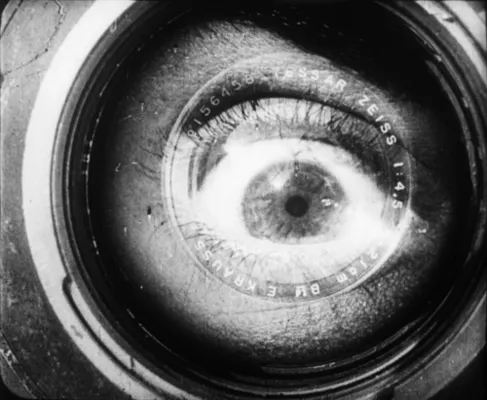
The reflexive mode "considers the quality of documentary itself, de-mystifying its processes". The cited examples are Vertov's Man with a Movie Camera and Mitchell Block's ...No Lies.
Reflexive mode
An eye superimposed on a camera lens, so the film shows its own act of looking.Man with a Movie Camera (1929), Dziga Vertov. Public domain.
Performative mode
The performative mode "constructs subjective truths that are significant to the filmmaker themself," often with the filmmaker on screen.
Vérité, direct cinema and the interview
Direct cinema and cinéma vérité
The two terms are often used interchangeably but began as opposing ideas in the early 1960s. Keith Beattie (Documentary Screens, 2004) quotes Erik Barnouw (1983, p. 255):
"The direct cinema artist aspired to invisibility; the ... cinéma vérité
artist was often an avowed participant. The direct cinema artist played
the role of the involved bystander; the cinéma vérité artist espoused
that of provocateur. Direct cinema found its truth in events available
to the camera. Cinéma vérité was committed to a paradox: that artificial
circumstances could bring hidden truth to the surface."
Direct cinema
Cinéma vérité
Associated with
United States
France (Rouch and Morin)
Filmmaker's stance
"Invisibility", "involved bystander"
"Avowed participant", "provocateur"
Where truth is found
"Events available to the camera"
"Artificial circumstances" that reveal "hidden truth"
Closest Nichols mode
Observational
Participatory
The last row is our mapping; Wikipedia's cinéma vérité entry makes the same link.
The interview set-up
An interview is the simplest participatory device, and where the subject looks is a creative decision. Errol Morris's "Interrotron" (FLM Magazine, Winter 2004) puts his live image on a two-way mirror over the lens, so the subject looks straight down the barrel; he says it creates "the true first person".
Re-creation (re-enactment)
A re-creation stages an event that really happened, with actors, props or graphics. PBS's Editorial Standards and Practices (adopted 10 June 2025) say re-creations "should be as accurate as possible and clearly identified." Disclosure can be verbal, text or "overt stylization techniques, such as the use of different colors or camera speeds". "These requirements also apply when working with any content generated by AI tools or services."
Documentary releases and clearance
Distributors require errors and omissions (E&O) insurance, and insurers want evidence that what's on screen is cleared (full rights chain: Film Rights and Chain of Title). We quote the typical "Clearance Procedures" of Sutton Entertainment's Producers' E&O Application (ed. 01/23).
Appearance release (personal release)
An appearance release is a signed document from a person who appears on screen, giving permission to use their name, face, likeness and voice. Sutton's clause 9 requires that "no names, faces, or likenesses of any recognizable living persons are used unless written releases have been obtained." The exception: a release "is unnecessary if a person is part of a crowd scene or shown in a fleeting background."
Clause 10 says releases must let the producer "edit, modify, add to and/or delete material" and "change the sequence of events or of any questions posed and/or answers". PBS separately asks for "fully informed consent" from subjects at risk of harm.
Location release
A location release is a signed agreement from the owner of a place you film, allowing the filming and later use of the footage. Sutton's clause 13: "If distinctive locations, buildings, businesses, personal property, or products are filmed, written releases must be secured. This is not necessary if non-distinctive background use is made of real property."
Synopsis review (the documentary script clearance)
A synopsis review is the documentary stand-in for a script clearance report: clause 5 asks for "a detailed synopsis" to go to production counsel before filming, flagging any negative statements about people or businesses.
Clip and music licences
Clip licences may be needed from the owner and from those whose work is in the clip (clause 16); music needs "master use, sound recording, synchronization, and performance licenses" (clause 11). See Music Licensing Explained.
A documentary clearance path assembled from an insurer's clearance procedures (Sutton Entertainment, ed. 01/23) and the fair use practice described by CMSI and EFF; the order is our summary.
Fair use
Fair use (17 U.S.C. §107)
Fair use is the US copyright rule that allows some unlicensed use of copyrighted material, for purposes "such as criticism, comment, news reporting, teaching ..., scholarship, or research". Courts weigh four factors:
Factor (§107)
What the Copyright Office says courts look at
1. Purpose and character of the use
Whether it is commercial or non-profit educational, and whether it is "transformative": uses "that add something new, with a further purpose or different character" are viewed more favourably
2. Nature of the copyrighted work
Creative works (novels, movies, songs) are less likely to support fair use than factual ones
3. Amount and substantiality used
Smaller portions favour fair use; large portions cut against it
4. Effect on the market for the original
Whether the use harms the current or a future market
There is "no formula to ensure that a predetermined percentage or amount of a work" can be used without permission: no safe number of seconds. Other countries have their own exceptions, so worldwide sales need advice per territory.
The Documentary Filmmakers' Statement of Best Practices in Fair Use (2005)
The Statement, released 18 November 2005 by five US filmmaker organisations with American University's Center for Media & Social Impact (CMSI), sets out four situations where fair use applies:
Situation
Principle
Key limits
1. Material as the object of critique
"Generally permissible"
Must not become "a market substitute for the work"
2. Quoting pop culture to illustrate an argument
"Should generally be considered as fair use"
Attribute it; draw on several sources; no longer than needed; not just to avoid shooting your own footage
3. Media captured incidentally while filming something else
Protects filmmakers "from being forced to falsify reality"
Not requested or staged by you; integral to the scene; music must not stand in for a licensed sync track (e.g. cutting to its beat)
4. Material in a historical sequence
"Should apply in some instances"
Critical to the film with no substitute; can't be licensed or licensing costs are excessive; no longer than necessary; not relying heavily on one source
Situation 4 matters most for archive-heavy films and is the narrowest: the film must not be "designed around" the material.
Fair use and E&O insurance
Before 2007, insurers typically wanted every clip cleared. After the Statement:
15 February 2007. EFF reported that National Union, "a major insurer, has recently adjusted its policy to extend coverage for fair use", when a copyright attorney attests the use is fair.
27 February 2007. Stanford's Fair Use Project announced reduced-rate coverage with lawyer Michael Donaldson.
Later. CMSI reports "acceptance by all four of U.S. insurance companies for errors-and-omissions insurance of fair use claims", and that IFC's Wanderlust alone saved $400,000 in licensing costs.
A copyright lawyer still has to attest that the use is fair.
Archival footage
Archival licensing
Archive footage is licensed, not bought, priced by platform, territory and licence length. British Pathé's media-industry licences are "calculated per second of footage used", with "a minimum charge of 60 seconds which can be made up from as many different clips as you'd like."
Public domain (US government works)
Section 105 of US copyright law says copyright "is not available for any work of the United States Government". But the National Archives (NARA), with more than 520,400 film reels, warns "not all records in the holdings ... are in the public domain – especially NARA's Special Media holdings," and "responsibility for the subsequent use of the materials lies solely with the end user". Document every public-domain claim.
Archival cue sheet
A cue sheet lists every third-party element in the final cut with timecodes, source and licence terms. The Archival Producers Alliance (APA, September 2024) recommends one for every generative-AI element too, logging prompts, software version, date and timecode.
Generative AI in documentary
The APA's Best Practices for Use of Generative AI in Documentaries (September 2024), endorsed by Ken Burns and others, rests on four principles: value of primary sources, transparency, legal considerations, and ethics of human simulations.
Synthetic archive "is in danger of forever muddying the historical record"; "converting a photograph to a moving image could imply that a moving image camera was at an event when it was not."
Tell the audience, through lower thirds, a distinct frame or narration.
The practical rule, with PBS's 2025 standard: label synthetic shots as you would a re-enactment, and log them like archive.
Everything below was checked on 18 November 2026. We could not open Introduction to Documentary itself, so Nichols is quoted as reproduced in a cited secondary summary. We left out archive price lists and fair-use usage claims because we found no reliable source.
Sources
Bill Nichols, Introduction to Documentary, 3rd ed., Indiana University Press, 2017, 280 pp., ISBN 9780253026859 (chapters 6–7 on modes); 2nd ed., 2010, ISBN 9780253222602; 1st ed., 2001. Not consulted directly; see above.
Keith Beattie, "The Truth of the Matter: Cinéma Vérité and Direct Cinema", in Documentary Screens, Palgrave, 2004, pp. 83–104, quoting Erik Barnouw (1983), p. 255. Springer
Aspect Ratios in Film Explained: 1.33 to 2.39 and 9:16, With the History and Delivery Specs
Aspect ratios in film are width divided by height. See where 1.375, 1.85, 2.39, 16:9, IMAX and 9:16 came from, and the containers cinemas and Netflix expect.