Film editing and post-production terms, from dailies and picture lock to conform, DI, DCP and IMF, plus J-cuts, L-cuts and montage, with the spec behind each.
Method. Sources checked November 18, 2026: the DGA Basic Agreement 2023–2026 (Articles 1 and 7), Netflix Studio Partner Help Center delivery, VFX, colour and QC specifications, The Look and Frame.io workflow guides, and Wikipedia articles on formats and cuts, with their cited sources named. Vinc makes an AI film studio.
Looking for how cuts build meaning (match cuts, jump cuts, Kuleshov)? See [Continuity Editing Grammar](/blog/continuity-editing-grammar). For dissolves, wipes and other transitions, see [Types of Transitions in Film](/blog/film-transitions-explained).
How to use this part
Film editing terms name the stages, files and handoffs between the last shoot day and the finished master. This is part 8 of a 10-part glossary, and the terms follow those handoffs: footage to editorial, a locked cut to sound and VFX, finished shots to the colourist, a master to the distributor. "In a prompt:" notes quote Google's video generation prompt guide where it uses the term; anything else is our illustration.
Dailies, also called rushes, are "the raw, unedited footage shot during the making of a motion picture" (Wikipedia, "Dailies"), once printed overnight for viewing the next day. Netflix calls them "the bridge connecting on-set production to post-production" and wants only primary correction (CDLs and the show LUT) on them, because secondaries "don't always carry over to other software platforms."
Assembly (editor's assembly)
The assembly is the editor's first version of the film, with scenes in script order, built "in accordance with the Director's instructions during the photography of the picture" (DGA Basic Agreement, Paragraph 7-505(a)). Paragraph 7-501 reserves the next cut to the director.
Director's cut
The director's cut is the version the director prepares and presents to the producer, as a guild right. Under the DGA Basic Agreement 2023–2026, Paragraph 7-505(b):
Picture type
Director's cut period
Theatrical feature
10 weeks after the close of principal photography, or one day of editing for every two days of originally scheduled photography, "whichever is greater"
Low-budget theatrical (as defined in Paragraph 3-101)
6 weeks, or one day of editing per one day of scheduled photography, whichever is greater
High Budget SVOD feature, 96 minutes or longer, budget of $22,500,000 or more, photography starting on or after 24 September 2023
10 weeks after the close of principal photography
The clock starts only when the assembly is complete (7-505(c)), and Paragraph 7-504 bans "cutting behind" the director, "including editing by electronic means." It is a protected stage, not a guarantee of final cut.
Minimum director's cut periods under DGA Basic Agreement Paragraph 7-505(b); the longer alternative applies when the shoot schedule is long.
Rough cut
The rough cut is, in Wikipedia's words, "the first stage in which the film begins to resemble its final product." Names vary ("first cut," "editor's cut," and Filmmaking For Dummies (Stoller, 2009, cited in Wikipedia's "Film editing") uses "rough cut" for the first pass), so ask which version someone means.
Editing stages
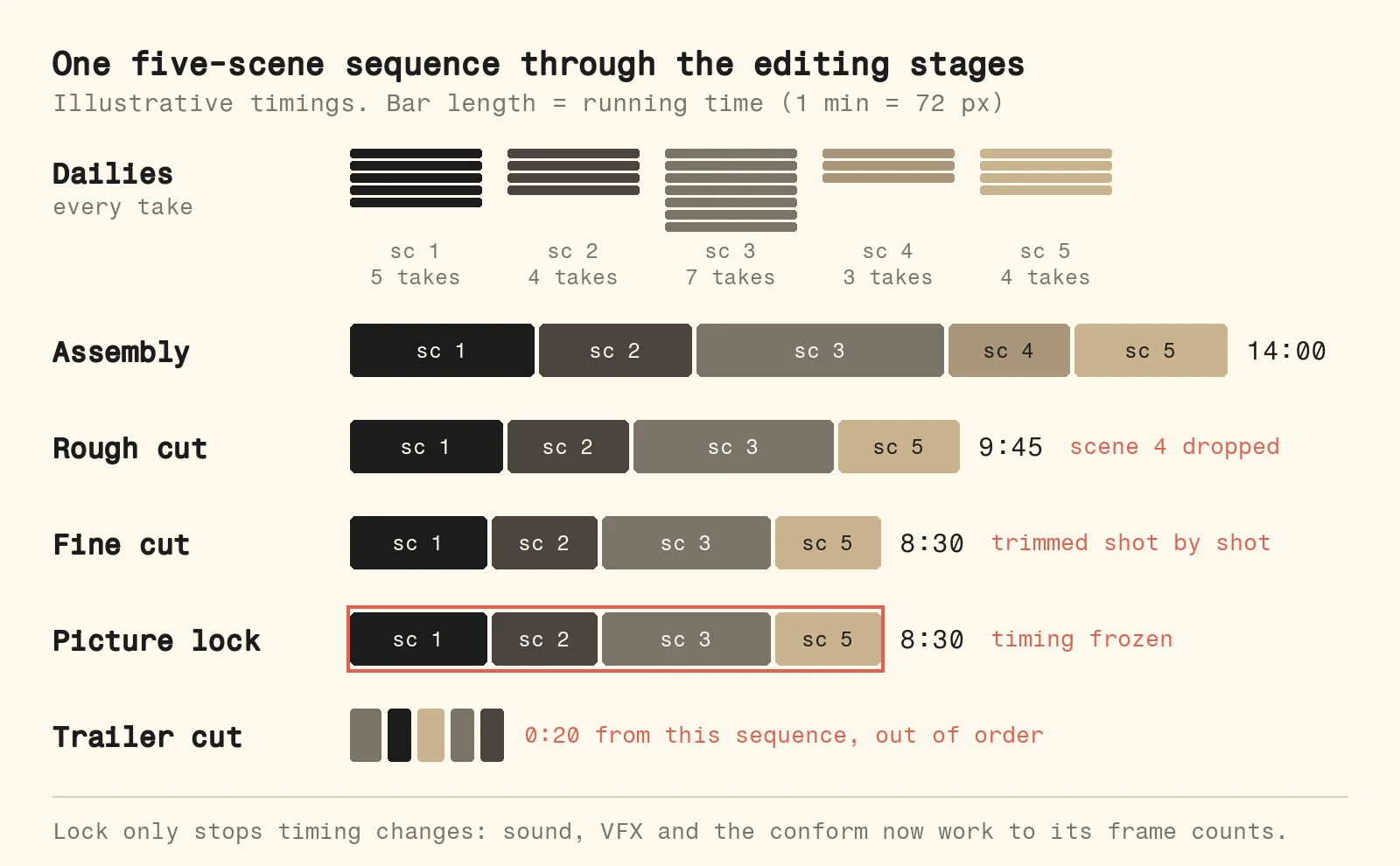
Our illustration, with made-up timings: the same five-scene sequence from dailies to trailer. The assembly keeps every scene in script order, the rough cut drops one, the fine cut trims inside the shots, and picture lock freezes that timing. A trailer takes seconds from across the film, out of order.Our illustration.
Fine cut
The fine cut is the stage between the rough cut and picture lock, where timing is trimmed shot by shot. We found no authoritative definition, so treat it as a working label.
Picture lock
Picture lock is the point at which the timing of the cut stops changing; offline editing ends "culminating in picture lock, after which online editing and audio mixing take place" (Wikipedia). Sound, VFX and conform all work to its frame counts, so later changes mean updating their lists (see also LMU's No-Nonsense Filmmaking).
Trailer cut
A trailer is "a short advertisement, originally designed for a feature film" (Wikipedia), once run after, or "trailing," the feature. The MPA maximum is 2 minutes 30 seconds; since January 2014 US cinema owners (Cinema United) have voluntarily asked that trailers "run no longer than two minutes."
Offline, online and the files between them
Offline and online editing
Offline editing is "the creative storytelling stage" (Wikipedia, citing Arundale and Trieu, Modern Post, 2015), where editors try versions until picture lock; online rebuilds the cut from full-quality media. The terms date from tape, when the CMX 600 output an edit decision list to drive the online.
Offline to online: edit on light proxies, export the edit list, then conform it back to the camera originals for grading and finishing.
Proxy
A proxy is a lightweight copy of the camera media used for editing and review. Netflix says proxies "should only be used for reference during editing and work-in-progress reviews, and not for final delivery or inclusion in the conform."
Camera original
Quarter-res proxy
The same detail, enlarged equally. Left: the camera original. Right: a quarter-resolution, compressed proxy of it, fine for judging timing and performance but too soft for grading, VFX or delivery.Our illustration, made in Vinc's virtual camera lab (CC0 assets).
Conform
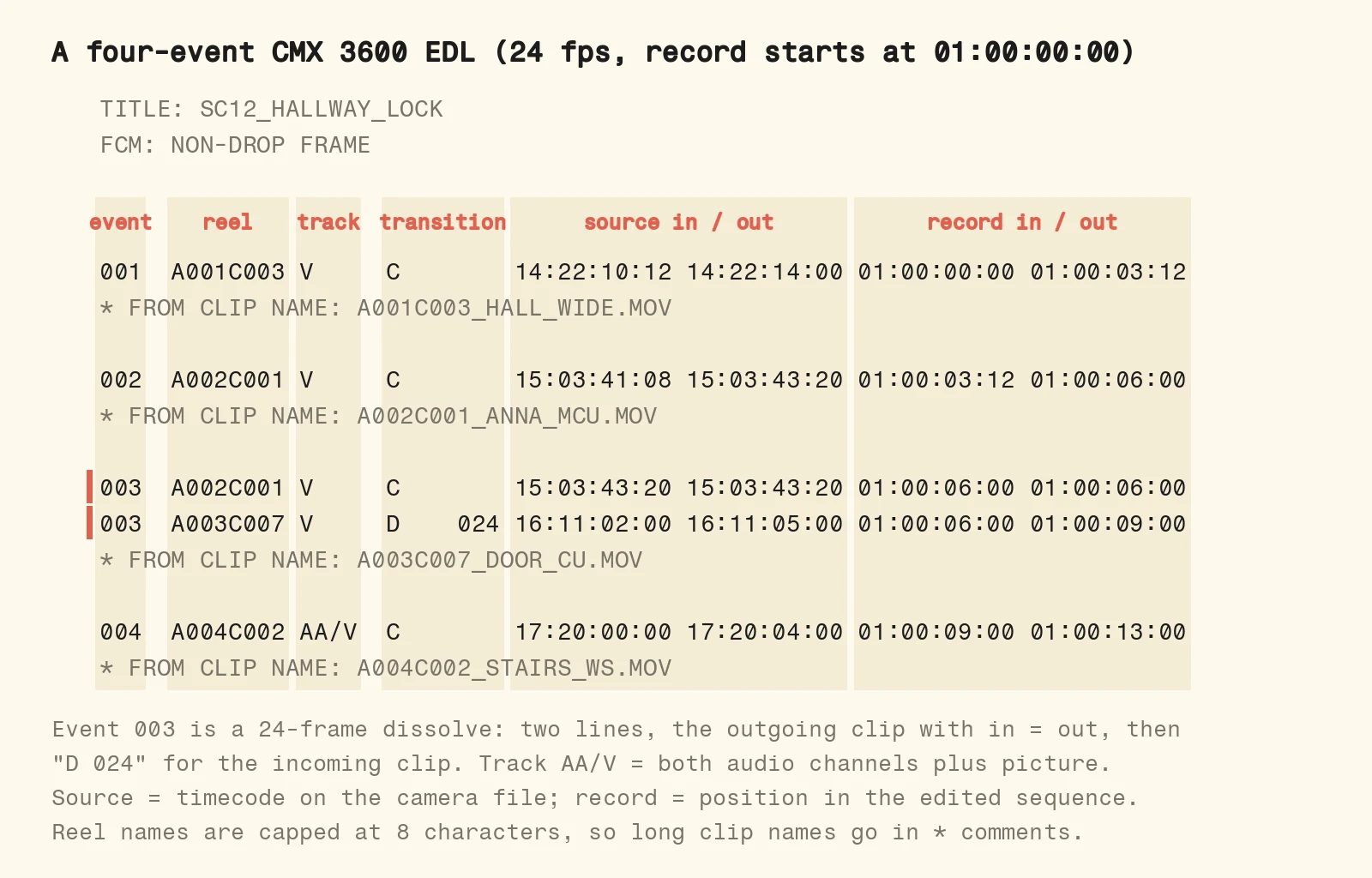
Conforming rebuilds the locked cut from the original camera files at full resolution for grading and finishing, driven by the edit list (EDLs are "used in post-production to conform the final cut"). Frame.io lists the usual failures: clip names cut to CMX 3600's 8 characters, dissolves without handles, and flattened composites; it also advises handing over the project file (.avb or .prproj).
EDL, XML, AAF and OTIO
EDL, XML, AAF and OTIO are the formats that carry an edit from one system to another:
Format
What it is
Origin and limits
EDL
"An ordered list of reel and timecode data representing where each video clip can be obtained" (Wikipedia)
Can carry more complex edits than an EDL (Wikipedia, "Edit decision list")
AAF
Advanced Authoring Format: media plus metadata describing how to combine it
Released 1998 by a vendor group led by Avid; replaced OMF
OTIO
OpenTimelineIO (.otio)
Listed by Netflix as a supported edit list format
Netflix's turnover specification accepts all four; the edit list must match the reference video delivered with it.
CMX 3600 EDL
Our illustration: a four-event CMX 3600 EDL with its columns labelled. Each event names a source reel, a track, a transition (C for cut, D 024 for a 24-frame dissolve) and two timecode pairs: where the clip comes from, and where it lands in the cut.Our illustration.
Timecode
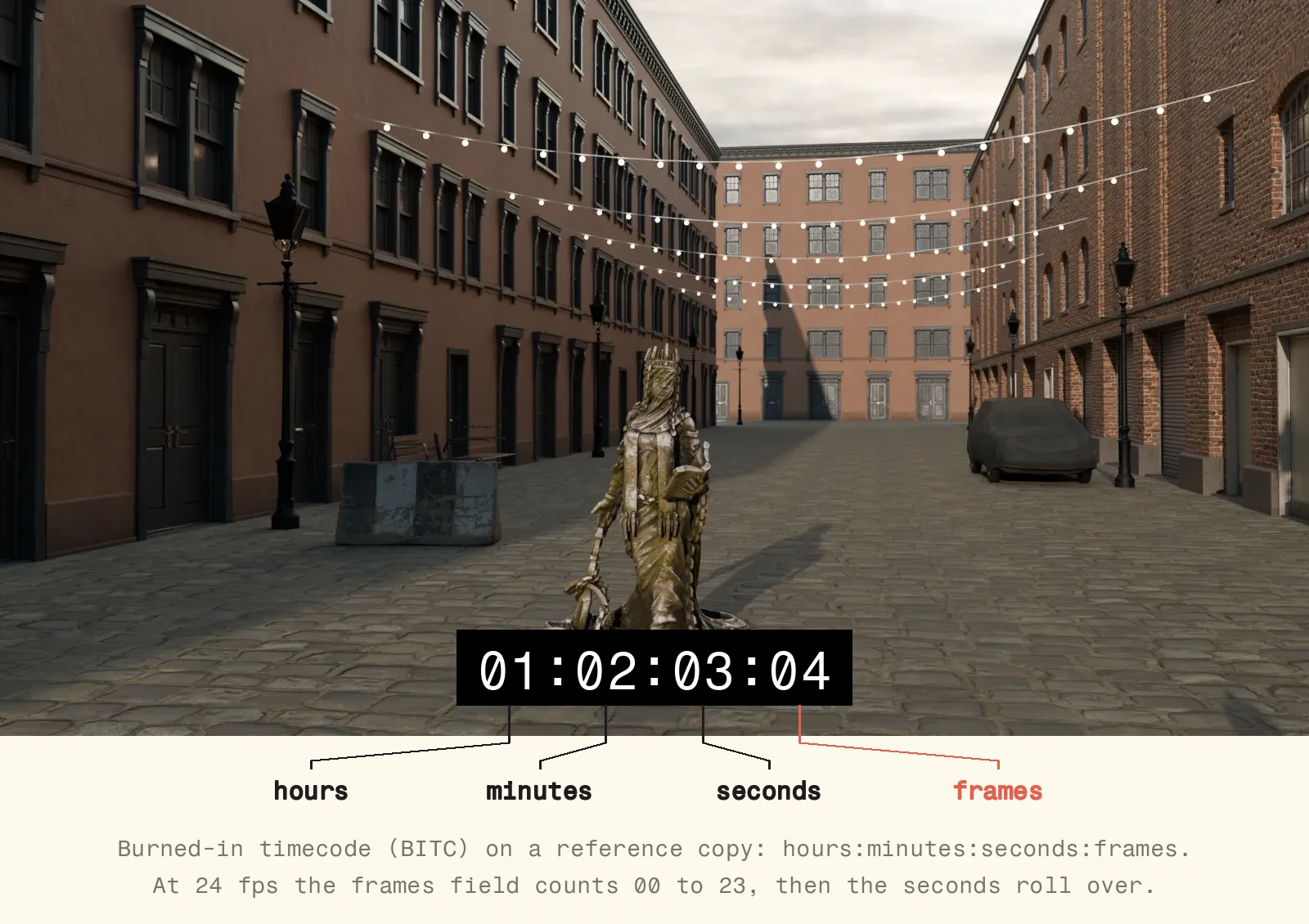
Timecode labels every frame as hours:minutes:seconds:frames, for example 01:02:03:04, standardised as SMPTE 12M (Wikipedia, "SMPTE timecode"). Drop-frame timecode, for 29.97 fps, drops no frames: it skips frame numbers 00 and 01 each minute except every tenth.
Burned-in timecode
A reference frame with burned-in timecode, the window editors send with every turnover so anyone can name an exact frame.Our illustration, made in Vinc's virtual camera lab (CC0 assets).
Frame-accurate
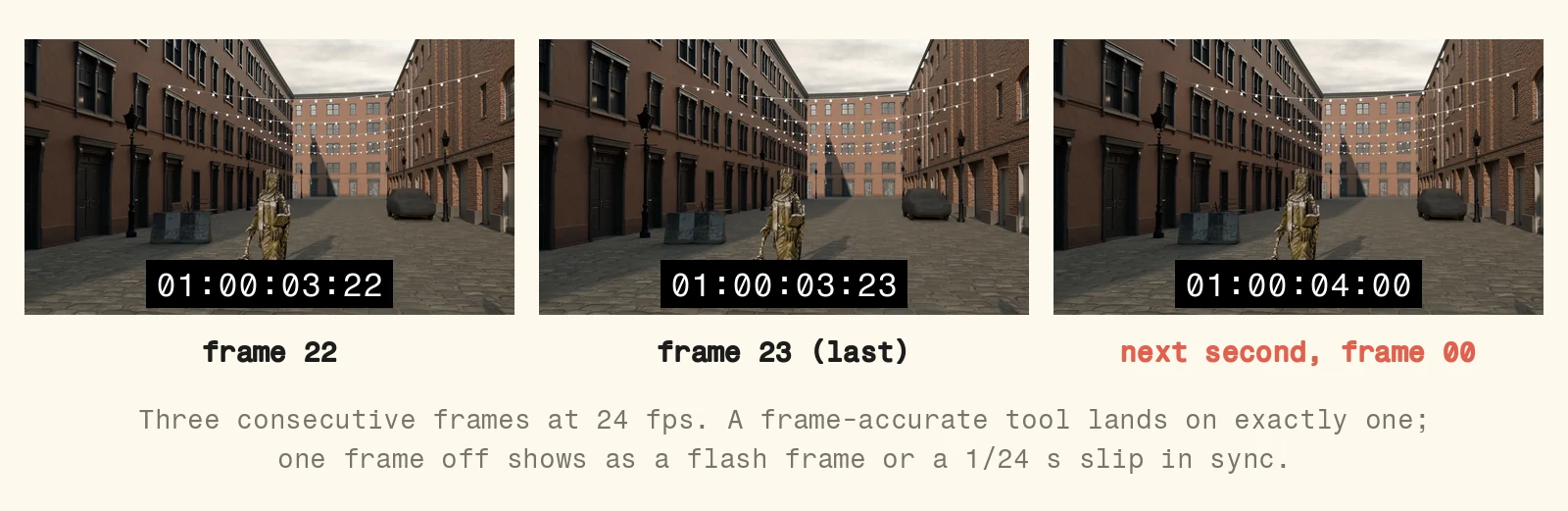
A process is frame-accurate when it identifies and reproduces the exact frame, with no drift. Timecode "introduced frame precision" to video editing (Wikipedia), and specs depend on it: Netflix requires 29.97 or 59.94 IMF segments to hold a frame count divisible by 5.
Three frames
Three consecutive frames at 24 fps: 03:22, 03:23, then 04:00, because the frame count rolls over after 23. Frame-accurate means landing on one of these, not the one next to it.Our illustration, made in Vinc's virtual camera lab (CC0 assets).
In a prompt: models don't read timecode; describe the action that lands on the cut ("the cut lands as the door closes"). (Our illustration.)
Handing over to VFX and finishing
Turnover
A turnover is the package editorial hands to the next department, such as sound, VFX or the finishing facility. The Look, a London post house, expects an EDL and AAF, an offline reference with burned-in timecode, the Avid project, the shot-tracking spreadsheet and a marker list of conform, grade and online notes.
A VFX turnover: the locked cut goes out as a package, the facility pulls the plates, and finished shots come back to the conform.
VFX pulls
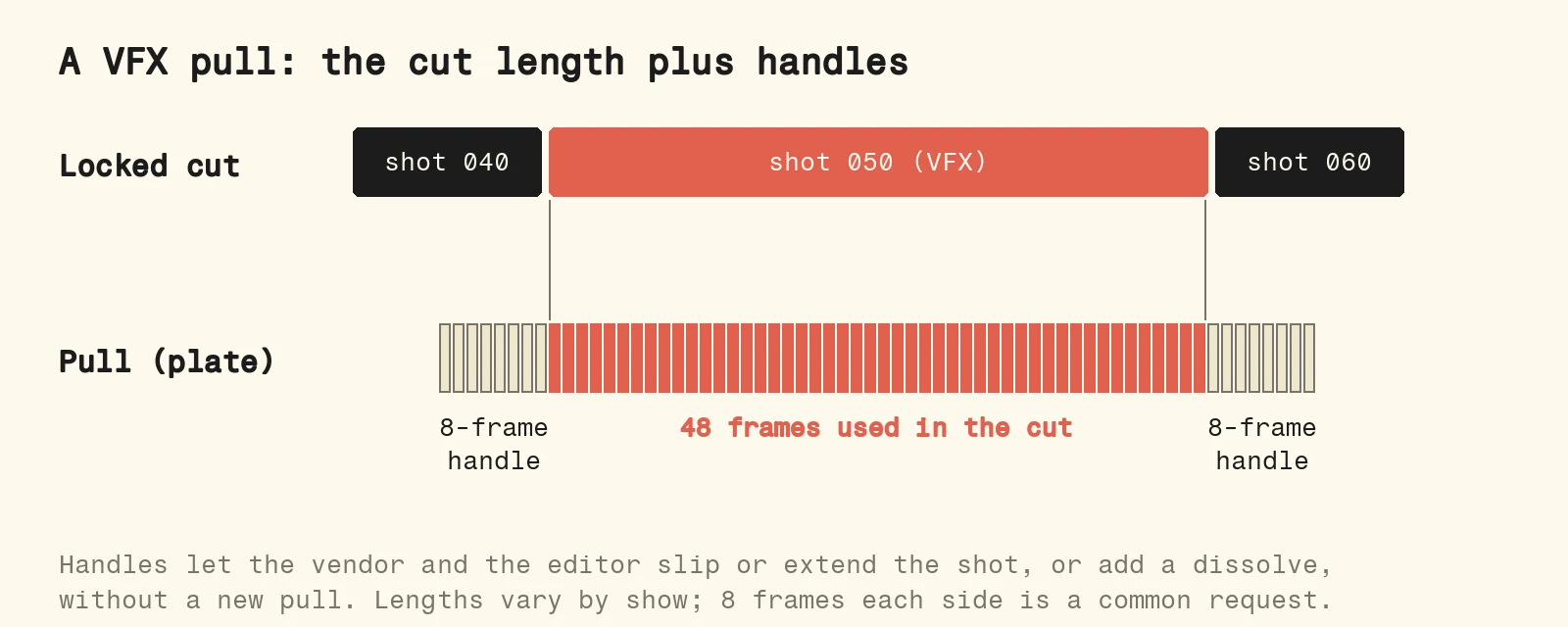
A pull is the extraction of exactly the frames a VFX vendor needs from the original camera files, usually with extra frames at each end ("handles"). Netflix's rules:
debayer to "a standardized color space (such as ACES)," at least UHD (3840 pixels) wide
send the dailies colour reference, but pre-grades "should never be baked in"
deliver 16-bit EXR (ACES or linear) or DPX (log); "LOG EXRs will not be accepted"
Plate names add a plate number and version: AGM_104_065_010_PL01_v001 is the first pull of plate 1.
Pull with handles
Our illustration: a 48-frame VFX shot pulled with 8-frame handles at each end, so the plate is 64 frames long. Handle length varies by show.Our illustration.
Digital intermediate (DI)
A digital intermediate is "a motion picture finishing process which classically involves digitizing a motion picture and manipulating the color and other image characteristics" (Wikipedia). O Brother, Where Art Thou? (2000) was the first first-run Hollywood film finished entirely this way; today "the DI" usually means the facility and the final grade.
Colour pipeline
Netflix defines a colour pipeline as "the essential color space definitions, transforms, and deliverables for a project." It has four parts:
Stage
What it is
Netflix's examples
Input colour space
How the camera or source encoded the image
Sony S-Log3/S-Gamut3.Cine, RED Log3G10, ARRI LogC
Working colour space
Where grading and VFX happen
Camera log or ACES
Output transform
The agreed transform, or "viewing LUT", from working to display
A show LUT, or ARRI's 709 LUT
Display colour space
What the monitor shows
Rec. 709/BT.1886, PQ P3-D65, Rec. 2020
Netflix asks that VFX deliver ungraded shots to the DI. Grading vocabulary is in the colour grading glossary.
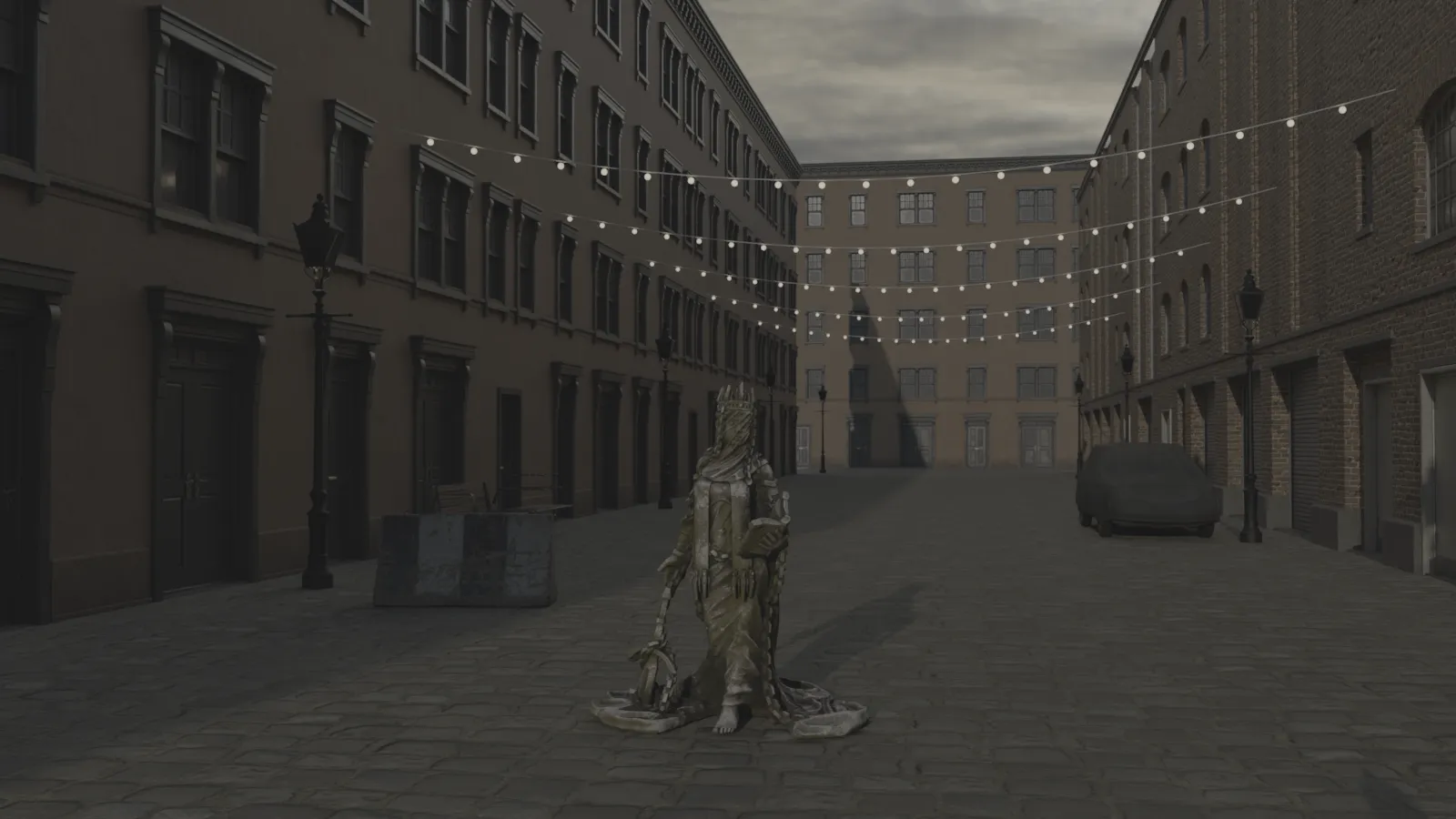
Input: LogC4
Display: Rec.709
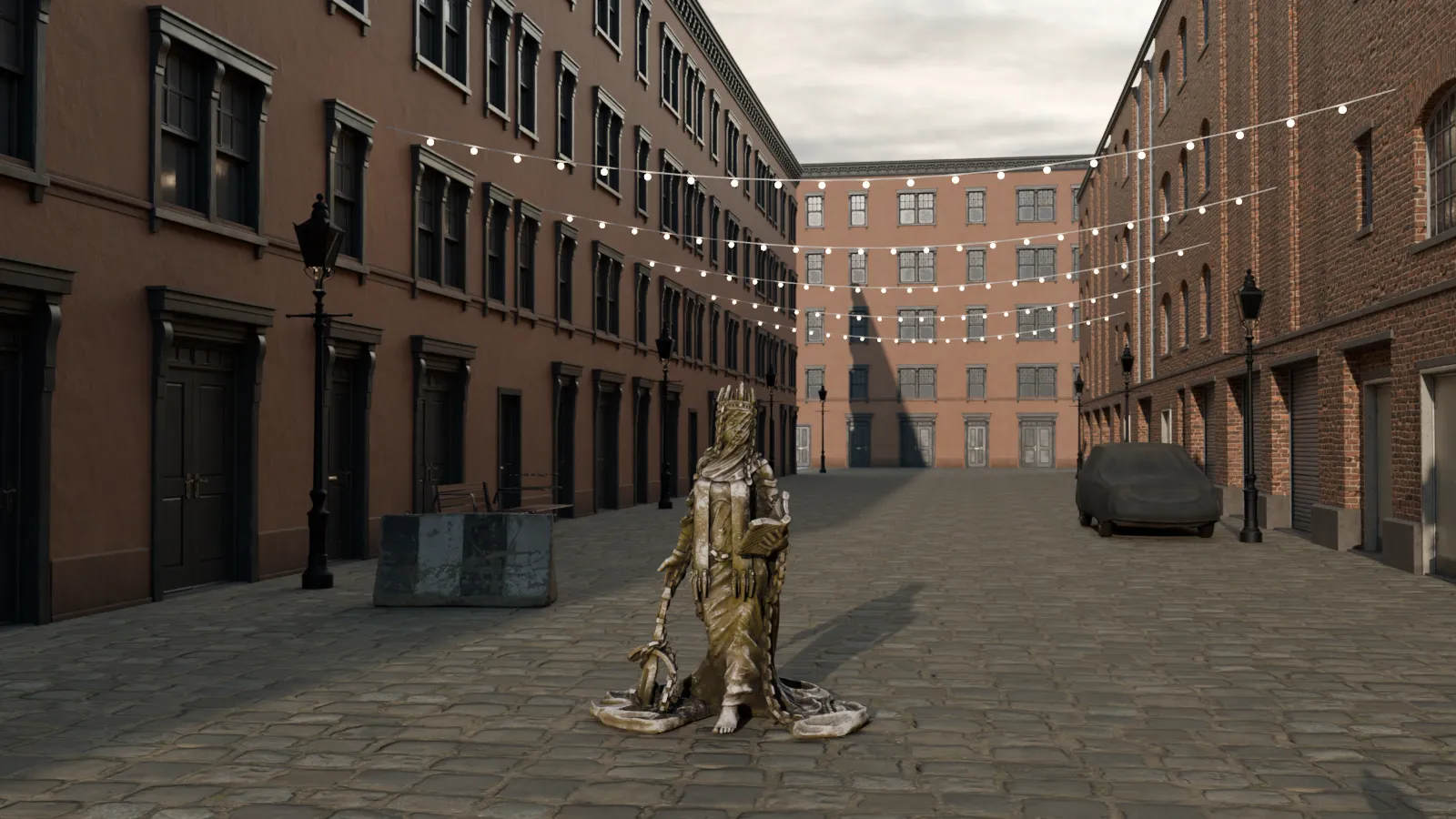
One render at two points in the pipeline. Left: the input colour space, encoded with ARRI's published LogC4 formula and viewed with no transform. Right: the same data through an output transform to a Rec.709 display (Blender's AgX, not an ARRI LUT).Scene: CC0 Poly Haven assets (Gothic Statue by Benny Weimer; facades by James Ray Cock; Evening Road 01 sky by Jarod Guest and Sergej Majboroda).
Masters and delivery: DCP, IMF and QC
Deliverables
Deliverables are the contractual list of files and documents a production owes its distributor; Netflix sets them per production in a Delivery Requirements List covering IMF, audio, DCP, archive masters, turnovers and more.
DCP (Digital Cinema Package)
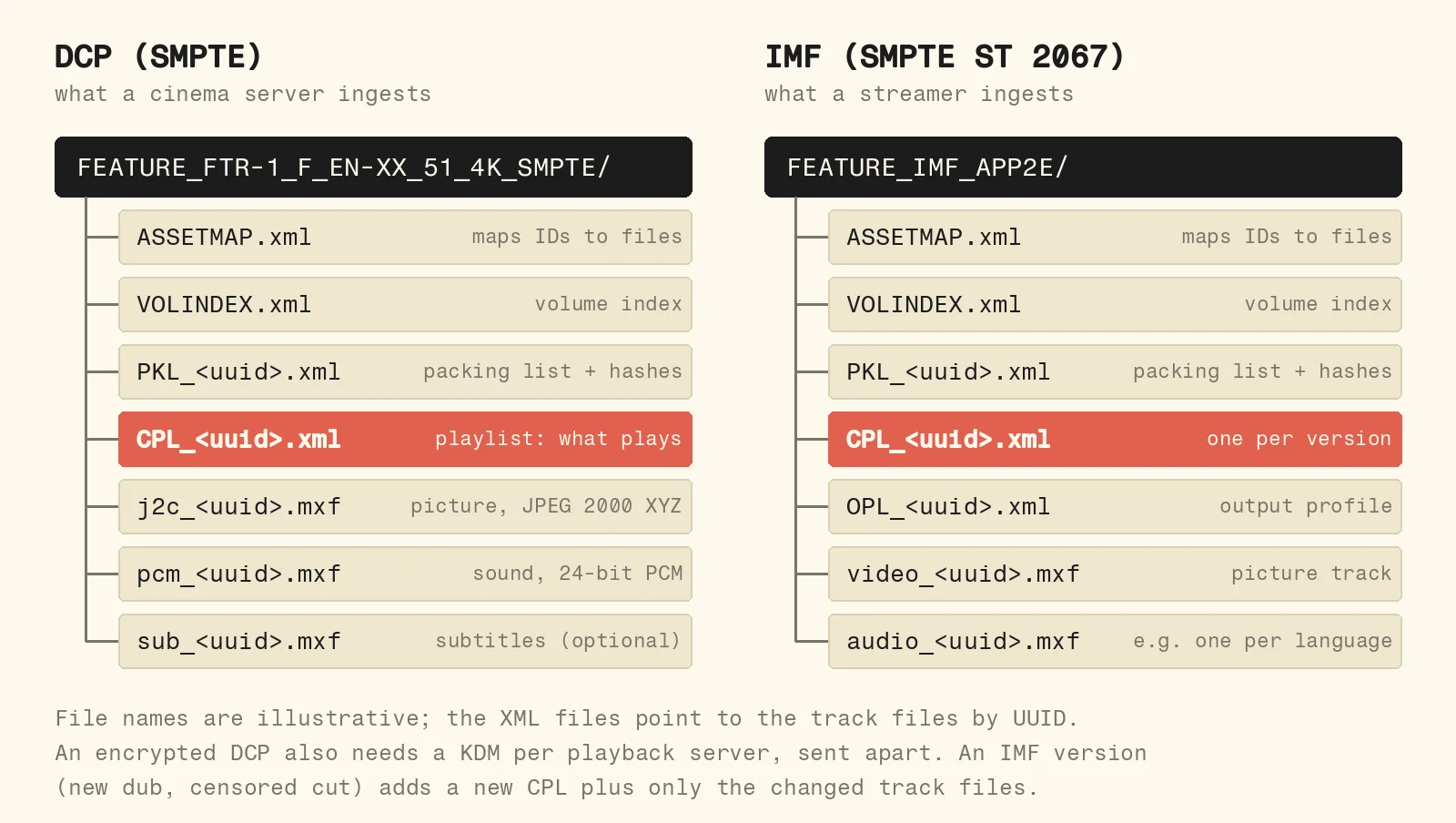
A DCP is the set of files a cinema server plays: MXF track files for picture, sound and subtitles, a Composition Playlist (CPL) for playback order, a Packing List and an Asset Map. Picture is JPEG 2000 in XYZ colour, and encrypted DCPs need a Key Delivery Message (KDM) naming which systems may play them and when (Wikipedia). SMPTE DCP (ST 429-2, 2009) isn't backward compatible with the older Interop.
Netflix requires SMPTE DCP for high frame rate, Atmos and HDR, and a DCI 4K container of 3996 × 2160 flat (1.85) or 4096 × 1716 scope (2.39): "Do not crop or 'blow-up' the image to fill the container." Ratio history is in Aspect Ratios Explained.
DCP and IMF
Our illustration: what is inside a SMPTE DCP and an IMF package. Both use an asset map, packing list and Composition Playlist (CPL) pointing to MXF track files; IMF adds an Output Profile List and a new CPL for each version. File names are illustrative.Our illustration.
IMF (Interoperable Master Format)
IMF is the master format streamers ask for, the SMPTE ST 2067 family (2013 on). Track files sit separately, lined up by an XML Composition Playlist, so a new version needs only the changed tracks. Netflix requires Application #2E: UHD 3840 × 2160 JPEG 2000, with HDR masters in Dolby Vision P3-D65 PQ at 12 bits and SDR in Rec. 709 at 10 bits.
QC (quality control)
QC is the technical check of footage or masters against a specification. Netflix's Production QC Glossary gives each fault a code so that labs and productions report it the same way:
Code
Name
Netflix's description
G-100
Camera bump/vibration
"The unintended movement of the image due to camera operator error or camera support"
I-202
Incorrect crop/extraction
The crop "is not set as agreed for the input format on the show"
I-304
Banding
"Low color bit depth results in defined 'stepping'" between gradations
V-205
LED wall moiré
Interference between the LED pattern and the camera's photosites
Cuts and transitions: J-cut, L-cut, montage and more
A split edit is a transition in which "transition of the audio and video happen at different times" (Wikipedia, "Split edit"). In an L-cut the outgoing sound carries over the incoming picture; in a J-cut the incoming sound starts early. Barry Salt, studying 33 American films from 1936 to 2014, found J-edits now about as common as L-edits.
J-cut: the next shot's sound starts before its picture. In an L-cut the overlap runs the other way.
Our illustration, sound only. Imagine an indoor crowd scene cutting to a street at 0:05. In the straight cut both change together; in the J-cut you hear the street two seconds before the picture would change.Edit by Vinc of recordings by xkeril and Liljendal, Freesound, CC0.
Sound bridge
A sound bridge is overlapping sound that carries the audience across a change of scene; Wikipedia treats it as another name for a split edit. Google's prompt guide doesn't cover sound across a cut, so build bridges in the edit.
Sound bridge
Our illustration, picture only (clips play muted): a marble bust in a dark room cuts to a daylit street at 2.8 seconds. The red labels track the soundtrack below, where the street's traffic fades in under the bust about 1.5 seconds before the picture cuts.Our illustration, made in Vinc's virtual camera lab (CC0 assets).
The sound of the clip above. Quiet room tone plays under the bust; from 0:01.3 the street traffic fades in, so you hear the next scene before you see it.Edit by Vinc of "Room tone with computer noise" by stomachache and "Day Traffic - City Life" by Liljendal, Freesound, CC0.
Cross-cut
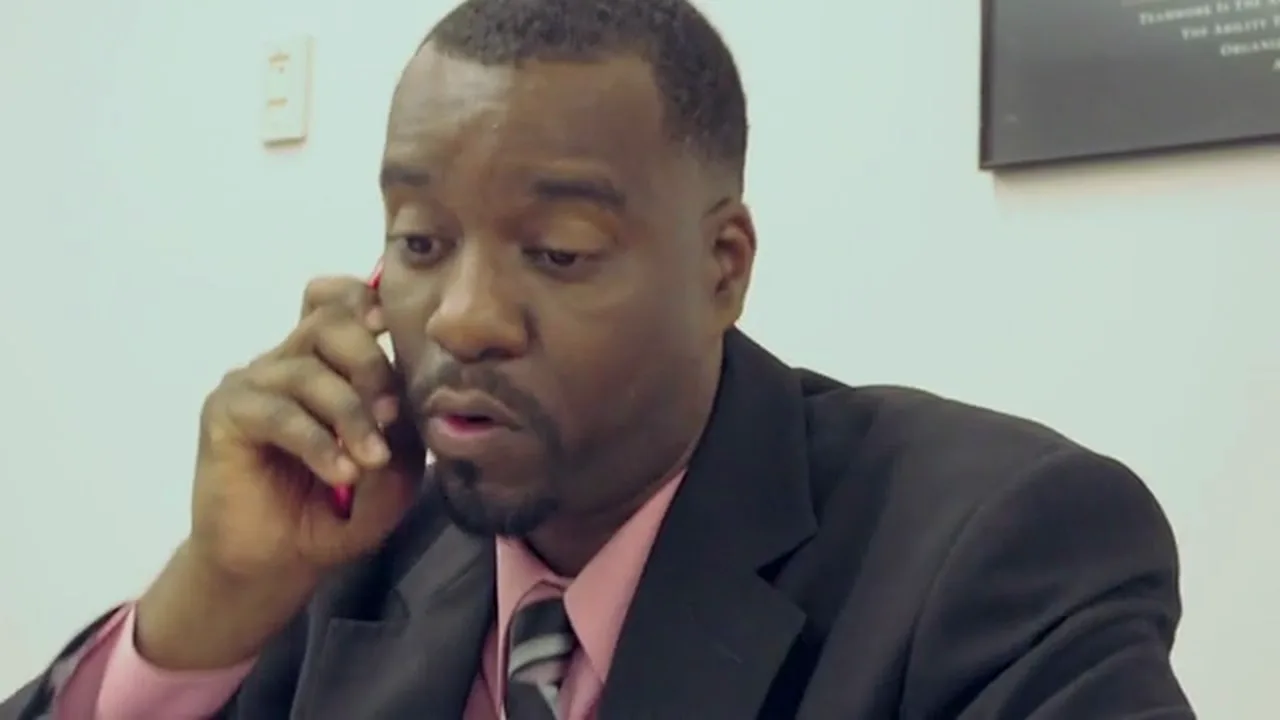
Cross-cutting alternates between actions in different places, usually happening at the same time (Wikipedia, "Cross-cutting"). Wikipedia cites D. W. Griffith's A Corner in Wheat (1909), which cuts between wealthy speculators and poor people queuing for bread.
Place A
Place B
Place A again
A phone call cut across two places: she sits at an outdoor table, he sits in an office, and the edit alternates between them.Still from A Sad State of Affairs (2009), M.A. Lanoue / Squire Films, CC BY-SA 3.0 US.
Cross-cutting: shots of two places alternate on the timeline, implying the actions happen at the same time.
Montage
Montage has two meanings. In Soviet film theory it is the meaning made by joining shots, combined "based on principles of association" (the LMU textbook, dating it to Eisenstein in the 1920s). In Hollywood usage it is "a series of short shots... sequenced to condense space, time, and information" (Wikipedia), like the training montage in Rocky (1976).
Odessa steps
The stone lions
Left: on the Odessa steps the film cuts every second or so between a shouting student, an old man stooping over a body, a baby in its pram and the crowd. Right: after the battleship's shells hit, three shots of three different stone lions, sleeping, raising its head and sitting up, are cut so that one lion seems to rise.Battleship Potemkin (1925), Sergei Eisenstein. Public domain (US).
In a prompt: Google's prompt guide lists "montage" among its cinematic terms.
Match cut
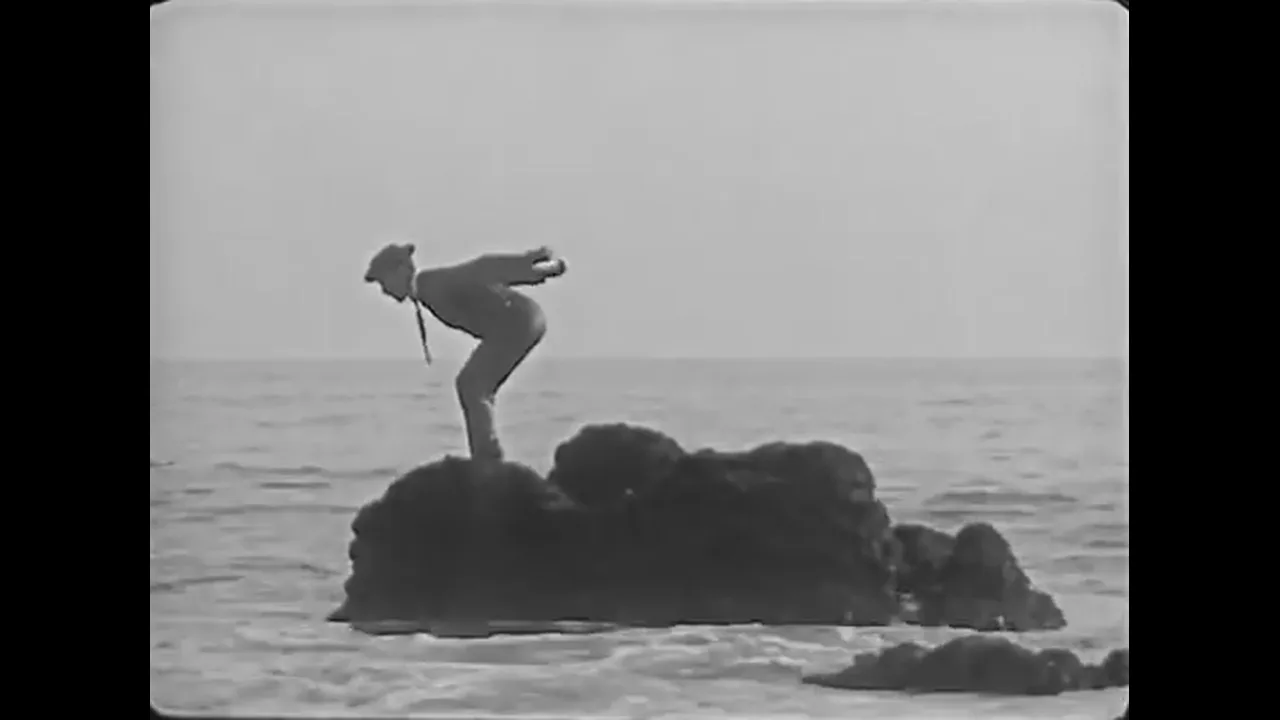
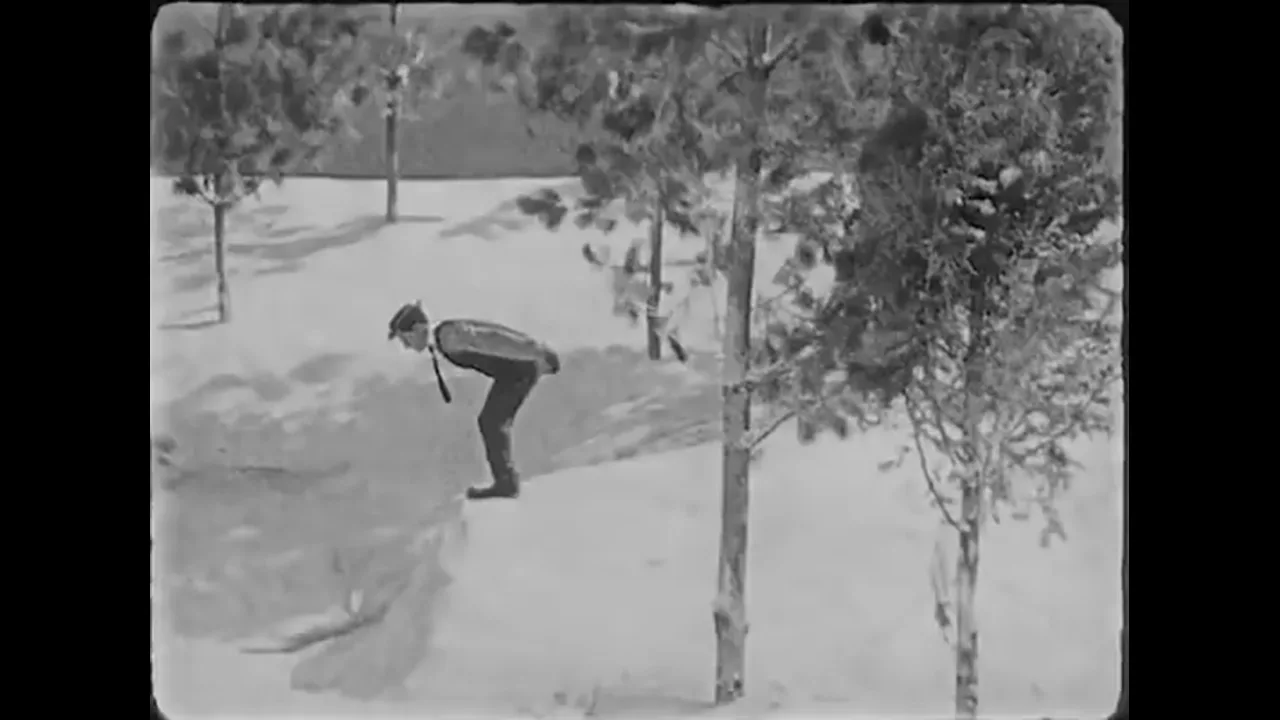
A match cut joins two shots whose composition matches through shape, movement or subject (Wikipedia, "Match cut"). The standard example is from 2001: A Space Odyssey (1968), where a bone thrown into the air cuts to an orbiting satellite.
Shot A
Shot B
Keaton's diving pose and position in the frame match across the cut while the setting changes from sea to snow.Sherlock Jr. (1924), Buster Keaton. Public domain (US).
A match cut: the outgoing and incoming shots share a shape or movement across the edit point.
In a prompt: "match cut" appears in Google's prompt guide list of cinematic terms.
Smash cut
A smash cut is an abrupt cut "for aesthetic, comedic, narrative, or emotional purpose" (Wikipedia), usually where no cut is expected, between scenes of sharply different mood or volume. In Indiana Jones and the Last Crusade, Indiana insists Marcus Brody will never be found, and the film cuts straight to Brody lost in a bazaar.
Smash cut
Our illustration: two still seconds on a marble bust, half its face in shadow against black, then a hard cut to the sunlit Odessa Steps, where people fall and run among the bodies.Our illustration, edited from a Vinc lab render (CC0 assets: see ASSETS) and Battleship Potemkin (1925), Sergei Eisenstein. Public domain (US).
In a prompt: Google's guide doesn't list "smash cut"; generate the two shots separately and make the cut yourself (our illustration).
How we compiled this
Contract terms come from the DGA Basic Agreement 2023–2026, cross-checked against the DGA's creative-rights summary; delivery, pull, colour and QC terms from Netflix's Studio Partner Help Center; turnover and conform practice from The Look and Frame.io; format histories and standards we couldn't open from Wikipedia. Prompt notes quote Google's prompt guide, and everything was checked on 18 November 2026.
Aspect Ratios in Film Explained: 1.33 to 2.39 and 9:16, With the History and Delivery Specs
Aspect ratios in film are width divided by height. See where 1.375, 1.85, 2.39, 16:9, IMAX and 9:16 came from, and the containers cinemas and Netflix expect.