Film sound terms defined: boom, lav, room tone, timecode, ADR, Foley, walla, stems, M&E and loudness, from EBU R 128's −23 LUFS to Netflix's 48 kHz spec.
Method. Checked November 18, 2026 against EBU R 128 (2023), ATSC A/85:2013 with Corrigendum 1, Netflix's Studio Partner sound specifications and production guidelines, DPA Microphones' Mic University, cited reference summaries and Google's Veo prompt guide; sample-rate and bit-depth arithmetic is ours. Vinc makes an AI film studio.
Looking for who designs a soundtrack and how it is layered? See [Sound Design Explained](/blog/sound-design-explained). For each type of effect with recordings, see [Types of Sound Effects](/blog/sound-effects-explained).
Recording sound on set: boom, lav and room tone
Film sound terms name the people, tools and files that take a soundtrack from the set to the final mix. Sound is usually recorded separately from the picture and rejoined in post, so much of the vocabulary is about microphones, sync and the material editors need later.
At a glance
Term
What it means
When to use it
Production sound
Everything recorded on set: dialogue, effects, ambience
The base track, later combined with music, effects, Foley and ADR
Boom
A pole with a microphone on the end, held just out of frame
Getting the mic as close to the action as the frame allows
Shotgun microphone
A highly directional mic, usually the one on the boom
Picking up sound in a narrow pattern
Lavalier
A small mic worn on the body, wired to a radio transmitter
Dialogue, alongside the boom
Plant mic
A mic hidden in the set
Dialogue, alongside the boom
Room tone
A recording of a location's "silence"
Laying under dialogue edits so the track never goes dead
Wild track
Audio recorded on set without the camera rolling
Lines that couldn't be recorded cleanly during the take
Production sound
Production sound is everything recorded on set or on location while shooting: dialogue, effects, ambience. It is recorded by the production sound mixer (also called the location sound recordist) and later combined with music, effects, Foley and any re-recorded dialogue.
Netflix's production sound best practices recommend at least a three-person sound crew for scripted content, at least 8 seconds of pre-roll on every take, and a daily sound report. Its default track layout:
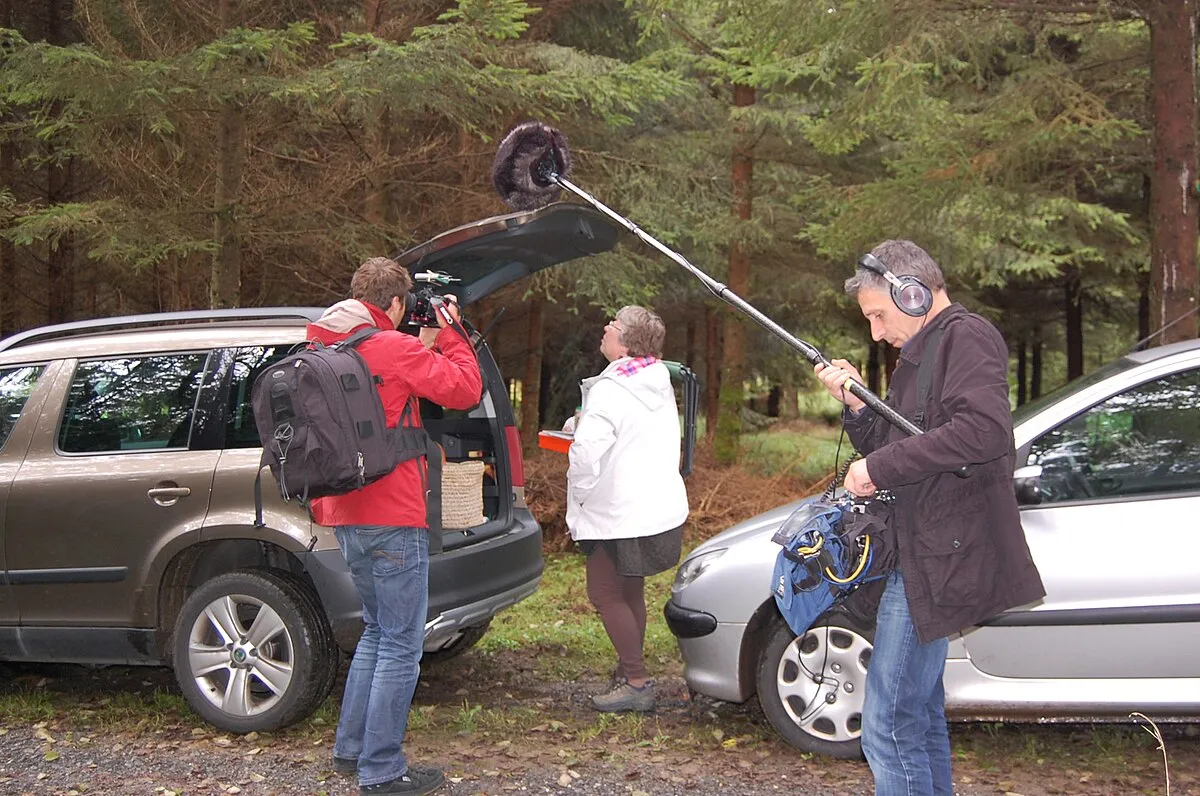
A boom is a pole (often called a fishpole) with a microphone on the end. The boom operator, or first assistant sound, holds it "as close to the actors or action as possible without allowing the microphone or boom pole to enter the camera's frame."
Boom
On a woodland location, a boom operator in headphones holds a microphone on a pole over the scene.Photo: Lucyin, Wikimedia Commons, CC BY-SA 4.0.
An early recorded use came on The Wild Party (1929), when Dorothy Arzner had technicians rig a microphone onto a fishing rod so Clara Bow could move freely.
Shotgun microphone
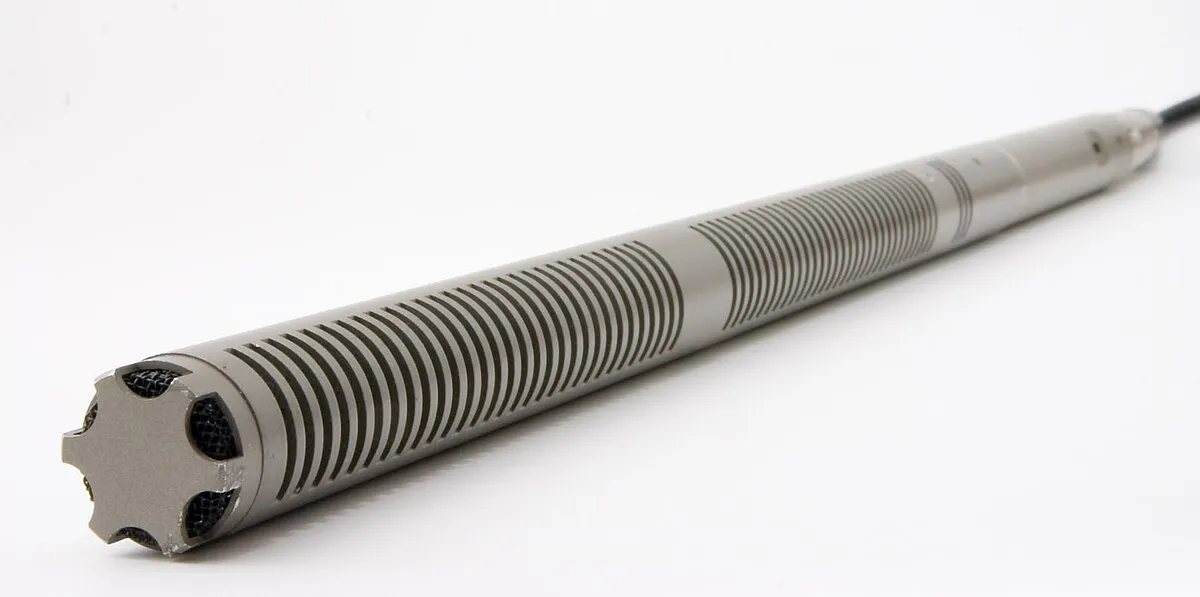
A shotgun is a highly directional microphone, usually the mic on the boom, that picks up sound in a narrow pattern. Its long slotted interference tube makes sound arriving from the sides partly cancel out. Electro-Voice introduced its Academy Award-winning shotgun microphone in 1963.
Shotgun microphone
A long shotgun microphone with the slots of its interference tube running along the barrel.Photo: PJ and Piko, Wikimedia Commons, CC BY-SA 3.0.
Lavalier
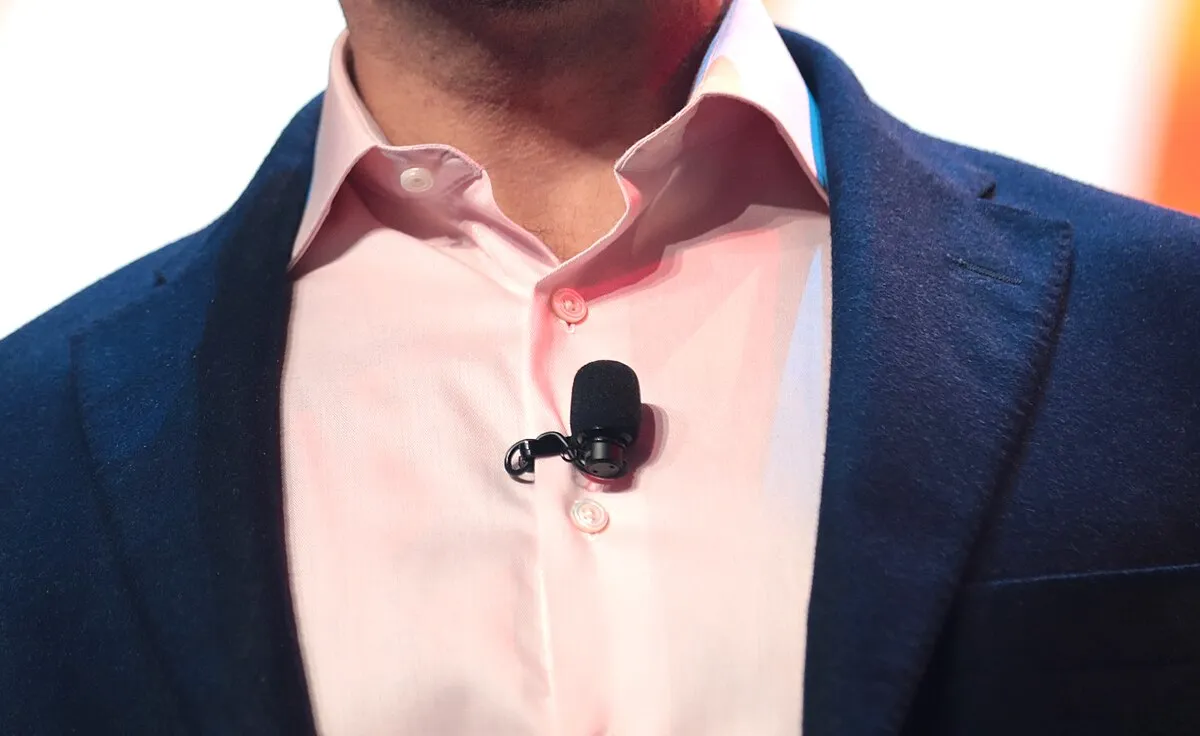
A lavalier (lav, lapel or body mic) is a small microphone worn on the body, clipped, taped or hidden on clothing, with the cable running to a radio transmitter in a pocket or on a belt. Netflix's guidance has the costume department help with placement, wind protection and avoiding noisy fabrics.
Lavalier
A small lavalier microphone clipped to the front of a shirt.Photo: Gage Skidmore, Wikimedia Commons, CC BY-SA 2.0.
Plant mic
A plant mic is a microphone hidden in the set, instead of on a boom or on an actor. DPA Microphones lists the usual dialogue chain as "a shotgun on a boom pole" combined with "a bodyworn hidden lavalier or ... a hidden plant mic."
Room tone
Room tone (also called presence) is a recording of the "silence" in a location with nobody speaking. Editors lay it under dialogue edits so the track never goes completely dead, which an audience hears as a fault. It is recorded like the dialogue, with the mic in the same position.
Two rooms, nobody speaking. Each has its own hum and hiss, which is why room tone is recorded at every location. Both are raised to about −20 LUFS so you can hear them; under dialogue they sit far lower.Recordings by mzui and stomachache, Freesound, CC0.
Wild track
A wild track (wild sound, wild lines) is audio recorded on set without the camera rolling, meant to be synced or laid in later. Wild lines are often recorded when dialogue couldn't be captured cleanly during the take, for example because a wind machine was running.
Syncing sound: slate, timecode and sample rate
Slate (clapperboard) and sync
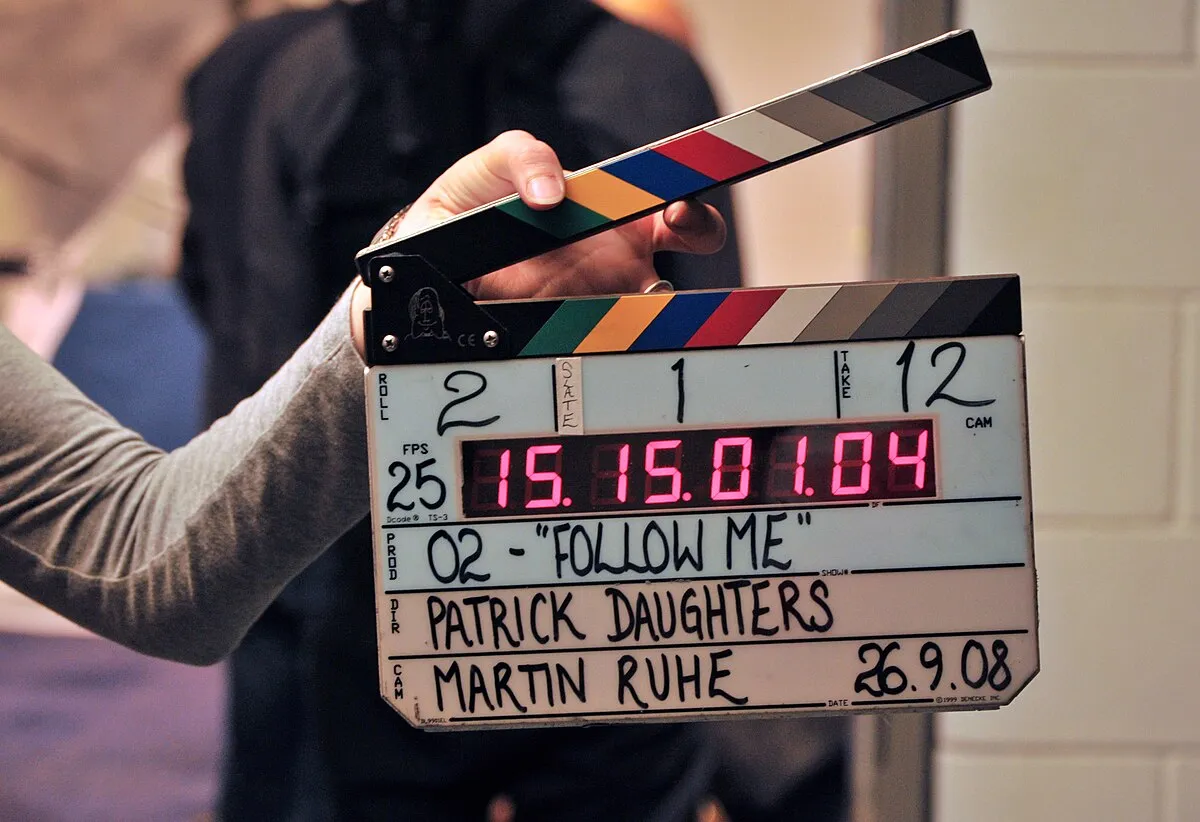
The slate, or clapperboard, is a board with the production, scene and take written on it and hinged sticks across the top. A camera assistant snaps the sticks shut in frame, and the frame where they close lines up with the clap on the audio, so an editor can sync picture and sound.
Slate
A timecode slate held in shot, showing roll, scene and take, the running timecode and the director's name.Photo: Mattbr, Wikimedia Commons, CC BY 2.0.
Professional cinema still records double-system, with sound and picture on separate devices, which is why the slate survives.
Timecode
Timecode labels every frame with hours:minutes:seconds:frames, as defined by SMPTE (the 12M standard, revised as 12M-1 and 12M-2 in 2008). When the camera and sound recorder are fed the same timecode, editorial software can sync them automatically. Frame-rate history is covered in Frame Rate, Shutter Angle and Motion Blur.
Sample rate and bit depth
Sample rate is how many times per second the audio is measured; bit depth is how many bits store each measurement. Film and TV work at 48 kHz and 24-bit:
Spec
Requirement
Netflix production sound
Location dialogue as 24-bit polyphonic WAV/BWAV at 48 kHz. Ambience and effects at 48 kHz "or a higher sample rate."
Netflix mix delivery
48 kHz / 24-bit for original-language and M&E mixes, stems and mix masters. No lossy or lossless compression.
Blackmagic URSA Cine camera audio
48 kHz, 24-bit
What the numbers mean (our arithmetic, using standard rules):
48,000 samples/s → highest recordable frequency = 48,000 / 2 = 24 kHz
24 bits → 2^24 = 16,777,216 levels per sample
dynamic range ≈ 6.02 dB × bits → 24-bit ≈ 144 dB (16-bit ≈ 96 dB)
Real converters fall well short of the 24-bit theoretical figure, around 123 dB as of 2011.
Post-production sound: ADR, Foley and the mix
A typical order of work in sound post: the production tracks are edited and replaced or supplemented, then mixed into stems and a final mix, from which the M&E is made.
Term
What it means
When to use it
ADR (automated dialogue replacement)
Re-recording dialogue in a studio after the shoot, in sync with the picture
When the production recording is unusable or lines change
Foley
Everyday sound effects performed to picture in a studio
Replacing sounds that don't record well on set, or adding ones that were never there
Walla
Background crowd murmur, recorded in post by a loop group
Crowd scenes; kept on a separate track so dubbing teams can replace it
Dialogue, music and effects stems
Separate sub-mixes of each category of sound
Replacing the dialogue language, adapting effects or changing music
M&E (music and effects)
The complete mix with the original-language dialogue removed
Dubbing into other languages
Mix and loudness standards
Balancing every element into the final soundtrack, at a set loudness
Delivery, for example −23 LUFS for EBU R 128
ADR (automated dialogue replacement)
ADR is re-recording dialogue after the shoot, in a studio, usually by the original actor and in sync with the picture, when the production recording is unusable or lines change. Early sound films played a loop of film for each line while the actor performed, which is why it is still called "looping".
Foley
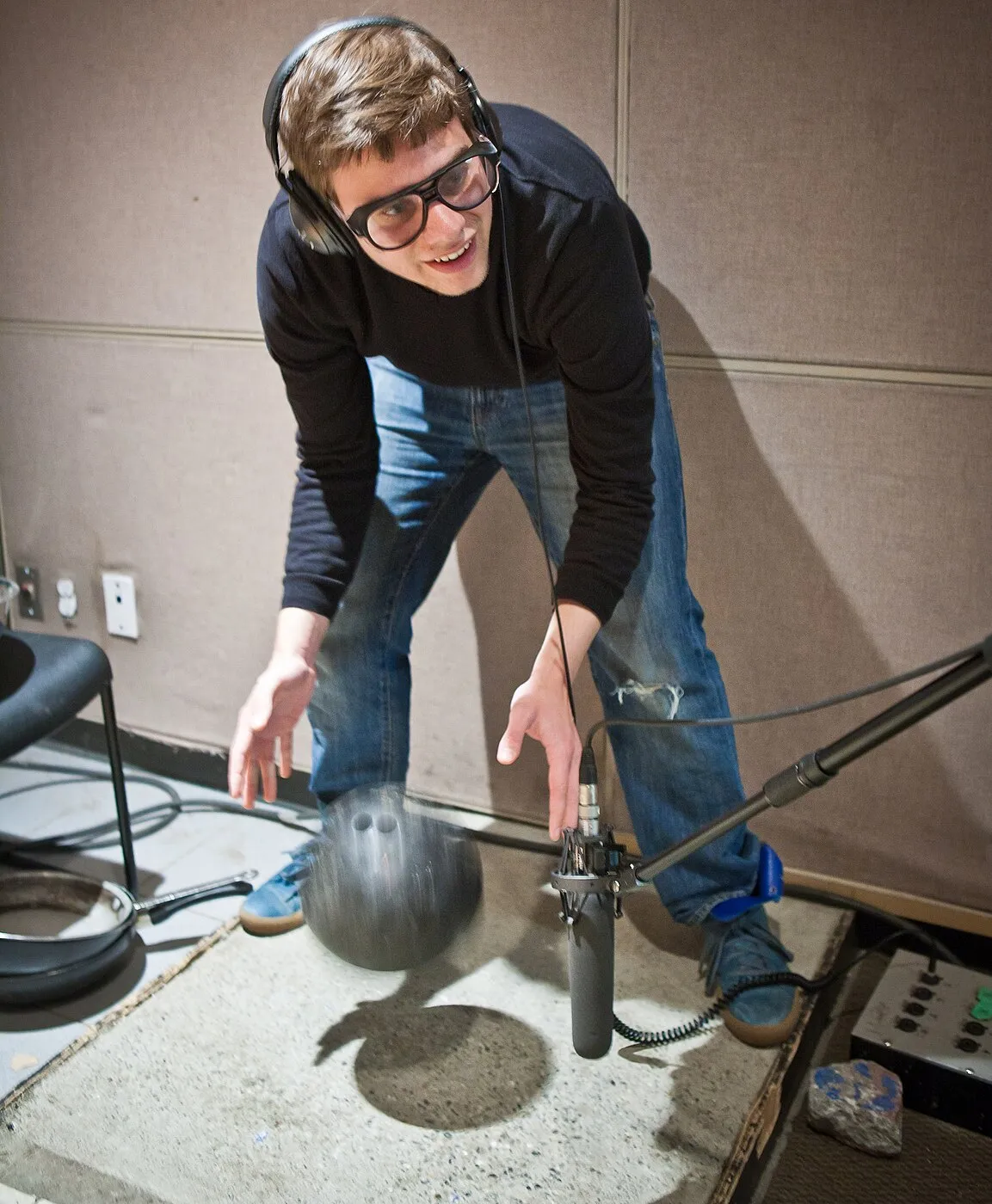
Foley is everyday sound effects performed to picture in a studio: footsteps, clothing rustle, props, door handles, punches. It is named after Jack Foley of Universal, who recorded effects live for Show Boat (1929) while the film was projected.
Foley
In a Foley room, a performer in headphones handles a ball just above the floor, next to a microphone on a stand.Photo: Vancouver Film School, Wikimedia Commons, CC BY 2.0.
Foley replaces sounds that don't record well on set, because props and costumes often don't sound like the real things, and adds effects that were never there, like a staged punch.
The three things a Foley stage performs: footsteps, cloth movement and props. Each was recorded close and clean, so it can be laid exactly in sync with picture.Recordings by FoleyMakers, khenshom and TRP, Freesound, CC0.
Walla
Walla is the murmur of a crowd in the background, recorded in post by a walla group or loop group improvising real conversation in the right language. Netflix's M&E guidelines put language-specific walla on a separate optional track, so dubbing teams can replace it.
Crowd murmur with no line you can follow. The second has real French and English conversation in it, the kind of language-specific walla Netflix asks to keep on its own track.Recordings by IENBA and xkeril, Freesound, CC0.
Dialogue, music and effects stems
A stem is a sub-mix of one category of sound. Dialogue, music and effects ("D-M-E") reach the final mix as separate stems, so the dialogue can be replaced with another language or the music changed. Netflix requires stems along with the mix masters at 48 kHz / 24-bit.
M&E (music and effects)
The M&E is the complete mix with the original-language dialogue removed, so dubbing studios can lay translated dialogue over it. Netflix asks for a "fully-filled" M&E: effects and Foley lost along with the dialogue track must be rebuilt so it plays like the original mix.
Mix and loudness standards
The mix (or re-recording mix) balances every element into the final soundtrack, the printmaster, at a loudness set by delivery specifications. All three below are measured with ITU-R BS.1770; LUFS is equivalent to LKFS.
Standard
Target
Tolerance
True-peak max
EBU R 128 (European broadcast; revised 2023)
−23.0 LUFS, programme loudness
±0.5 LU (±1.0 LU for live)
−1 dBTP
ATSC A/85 (US digital TV; 2013 edition)
−24 LKFS for content exchange without metadata
about ±2 dB measurement variation
−2 dBTP
Netflix branded near-field mix
−27 LKFS, dialogue-gated
±2 LU
−2 dBTP
Netflix's −27 is measured only over dialogue, the broadcast figures over the whole programme, so they aren't directly interchangeable. ATSC published a new A/85 edition in July 2026; the figures above are from the 2013 edition.
Loudness targets, shown as distance below full scale
EBU R 128−23 LUFS/LKFS
ATSC A/85−24 LUFS/LKFS
Netflix (dialogue-gated)−27 LUFS/LKFS
EBU R 128 (2023 revision); ATSC A/85:2013 with Corrigendum 1; Netflix Sound Mix Specifications (dialogue-gated). Bars show the target as a positive number; each target is negative (for example −23 LUFS). A longer bar means a quieter target.
One piano excerpt at two levels, 7 LU apart. We measured both files with ffmpeg's ebur128 filter (ITU-R BS.1770); the quieter one is close to the EBU R 128 target of −23 LUFS. Loudness here is measured over the whole 12 seconds, not dialogue-gated.Erik Satie, Gymnopédie No. 1, performed by Kevin MacLeod, Wikimedia Commons, CC BY 3.0. Levels set by Vinc.
Sound in the story: diegetic sound, split edits and score
Term
What it means
When to use it
Diegetic and non-diegetic sound
Sound the characters could hear, versus sound only the audience hears
Deciding whether music or narration lives in the story world
J-cut and L-cut
Split edits: the sound starts before (J) or continues after (L) the picture cut
Smoothing single-camera dialogue edits, or using one take's picture with another's sound
Sound bridge
Sound carried across a cut to join two shots or scenes
Pulling the audience forward (J) or letting a scene linger (L)
Score vs source music
Music composed for the film, versus music from a source in the scene
Score is normally non-diegetic; source cues are diegetic
Needle drop
A pre-existing recording, usually a licensed song
Placing a known song on the soundtrack
Temp track
Existing music laid into the edit
Guiding tempo and mood until the real score arrives
Diegetic and non-diegetic sound
Diegetic sound comes from inside the story world, so the characters could hear it: dialogue, a car radio, footsteps. Non-diegetic sound is heard only by the audience: most score and voice-over narration. Baby Driver reverses the norm, setting many action scenes to music the characters themselves play.
Our illustration. The first plays full-range, as score would. For the second we filtered the same recording to sound like a small speaker, added short room reflections and laid room tone under it, so it seems to come from inside the scene.Gymnopédie No. 1 performed by Kevin MacLeod, Wikimedia Commons, CC BY 3.0; room tone by stomachache, Freesound, CC0. Processing by Vinc.
J-cut and L-cut (the sound side)
J-cuts and L-cuts are split edits, where picture and sound cut at different times. In a J-cut the next scene's sound starts before its picture; in an L-cut the current scene's sound continues over the next picture.
Split edits let an editor use one take's picture with another's sound and smooth single-camera dialogue edits. Barry Salt studied 33 American films and found J-cuts had increased "to a proportion roughly equal to that of L-edits."
J-cut: the audio of the next shot starts before its picture.
L-cut: the audio of the outgoing shot runs under the next picture.
Our illustration, sound only. Imagine an indoor crowd scene cutting to a street at 0:05. In the straight cut both change together; in the J-cut the street fades in two seconds before the picture would change.Edit by Vinc of recordings by xkeril and Liljendal, Freesound, CC0.
Sound bridge
A sound bridge is sound that carries across a cut and joins two shots or scenes: a split edit used to link scenes rather than smooth dialogue. A J-cut bridge pulls the audience forward; an L-cut bridge lets the last scene linger.
Score vs source music
Score is music composed for the film, normally non-diegetic. Source music, or a source cue, comes from a source on screen or implied by the scene, so it is diegetic, as with Frankie Valli's "Can't Take My Eyes Off You" in The Deer Hunter.
Needle drop
A needle drop is a pre-existing recording, usually a licensed song, placed into a film's soundtrack. The AV Club called Triple Frontier's needle drops "laughably literal-minded", citing "Run Through the Jungle" playing over men moving through the jungle.
Temp track
A temp track (temp score, scratch music) is existing music laid into the edit to guide tempo and mood until the real score arrives. Directors can grow so attached that they keep it: Kubrick used existing classical recordings in 2001: A Space Odyssey instead of the score Alex North wrote.
In a prompt: Google's Veo prompt guide says to "clearly specify if you want audio" and to describe it "in separate sentences", covering sound effects, ambient noise and dialogue. Our illustration:
A medium shot in a quiet kitchen at night.
Audio: the low hum of a refrigerator, a clock ticking, no music.
The woman says: You're late.
How we compiled this
Delivery numbers come from EBU R 128 (2023), ATSC A/85:2013 and Netflix's Studio Partner specifications; microphone practice draws on DPA Microphones. History and definitions come from the encyclopaedic summaries below, and the sample-rate arithmetic is ours. Everything was checked on 18 November 2026.
Aspect Ratios in Film Explained: 1.33 to 2.39 and 9:16, With the History and Delivery Specs
Aspect ratios in film are width divided by height. See where 1.375, 1.85, 2.39, 16:9, IMAX and 9:16 came from, and the containers cinemas and Netflix expect.