Types of camera movement, from pan, tilt and dolly to the dolly zoom, and the rigs behind them: crane, Technocrane, Steadicam, gimbal, drone and motion control.
Method. Definitions checked on 18 November 2026 against the LMU open textbook, Jay Holben's 2024 American Cinematographer columns and Wikipedia's articles on each rig; rig history from Chapman/Leonard, ARRI, Panavision, the Academy, the Academy Museum, the National Inventors Hall of Fame and the Cinémathèque française; prompt wording quoted from Google, LTX, Luma and Kling documentation. Vinc makes an AI film studio and did not fund or co-author any of the sources.
Three kinds of movement
Types of camera movement in film are named for what the camera physically does during a shot. Every move does one of three things:
It rotates in place. The lens turns, but the camera's position stays the same: pan, tilt, roll.
It travels. The camera itself moves through space: dolly, truck, pedestal, crane, arc, tracking.
It changes the lens. Nothing moves, but the focal length changes: zoom.
Rigs (dolly, crane, Steadicam, gimbal, drone, motion control) are ways of carrying the camera, not directions, and get their own section below. The distinction that matters most is parallax: when the camera travels, near and far objects shift against each other; when it only rotates or zooms, they don't (CameraBench, NeurIPS 2025).
Rotations: the camera turns about a fixed point; its position does not change.
Pan
LMU's No-Nonsense Filmmaking defines a pan as "left-to-right (or right-to-left) movement from a fixed axis point," whether on a tripod or by "holding the camera and rotating your body." It adds: "You can only pan right or left. You cannot pan up or down."
Pan
The bandits jump from the locomotive and run down the embankment, and the camera swings on its tripod to keep them in frame.The Great Train Robbery (1903), Edwin S. Porter. Public domain (US).
In a prompt: Google's video generation prompt guide: "the camera rotates horizontally left or right from a fixed position. For example, 'slow pan left across a city skyline at dusk.'"
Tilt
A tilt, in LMU's words, is "up and down movement from a fixed axis point ... You can only tilt up or down."
In a prompt: Google's guide: "tilt down from the character's shocked face to the revealing letter in their hands."
Roll
A roll is a rotation around the lens axis: the horizon turns, as if the frame were a steering wheel. A roll held still is a Dutch angle, which Wikipedia defines as the camera "rotated around the axis of the lens" (see part 2).
Whip pan (swish pan, flash pan)
A whip pan is "a type of pan shot in which the camera pans so quickly that the picture blurs into indistinct streaks" (Wikipedia, "Whip pan"). It is "commonly used as a transition between shots", and the blur hides the cut. Because it is a rotation, it adds no parallax.
Whip pan
Our render of a whip pan: the camera holds on the statue, swings about 80° in a third of a second, with the wall smearing into horizontal streaks, and lands on the marble bust facing it. 50 mm, 24 fps, 180° shutter.Rendered in Vinc's virtual camera lab (CC0 assets: see ASSETS).
In a prompt: Google's guide: "an extremely fast pan that blurs the image, often used as a transition or to convey rapid movement or disorientation."
Travelling moves: dolly, truck, tracking and crane
Travelling moves: the camera's position changes, so foreground and background shift against each other.
Dolly in, dolly out
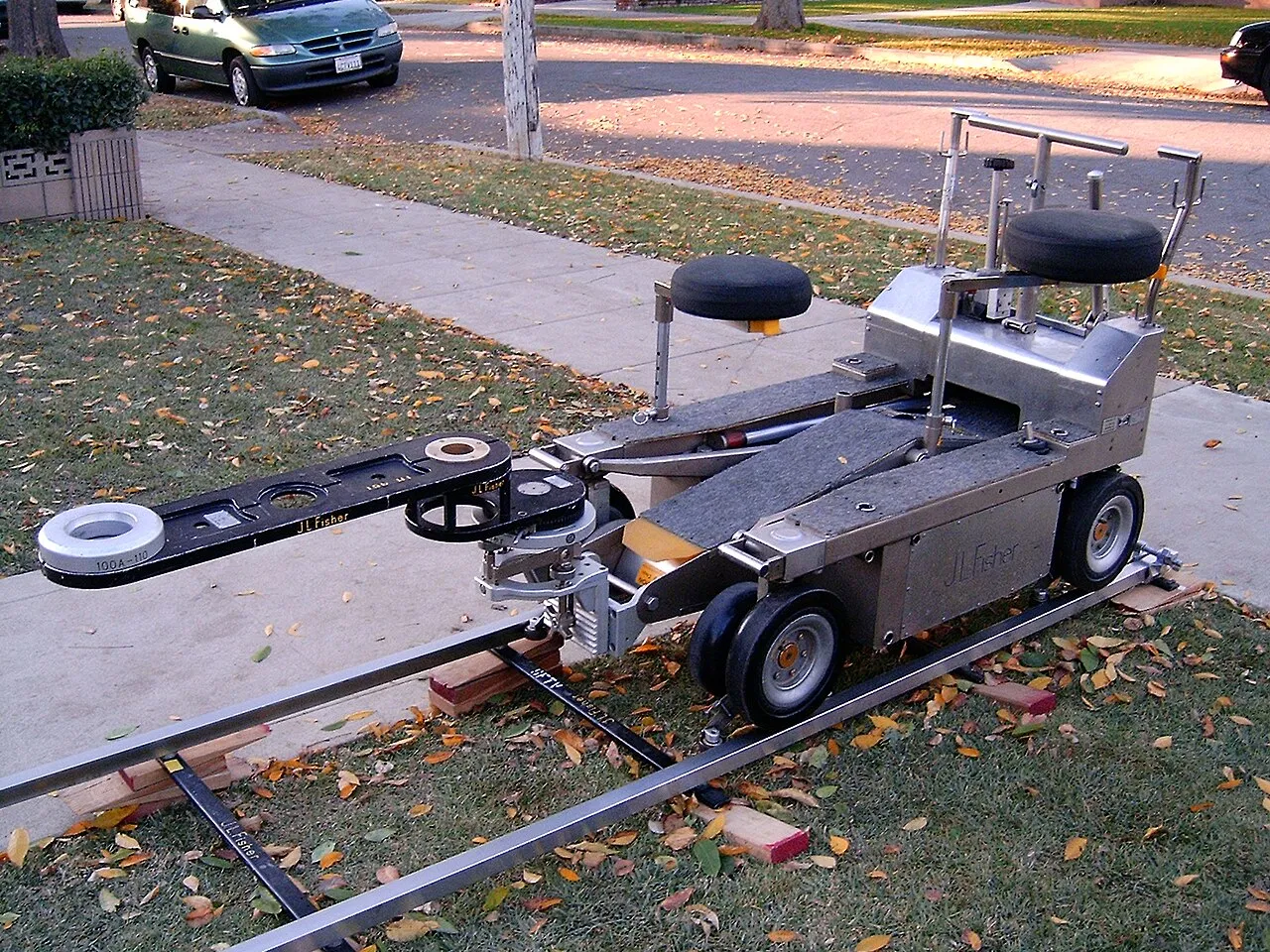
A dolly in or out is, in LMU's words, "in-and-out movement with the camera mounted on a moving apparatus ... You can only dolly in or out." The apparatus is a dolly, a wheeled cart pushed by a dedicated dolly grip, often on track.
Camera dolly
A camera dolly with seats and an extended head sits on a short length of track.Photo: Eliot Lash, Wikimedia Commons, CC BY 2.5.
Keep dolly for in and out and truck for sideways, as LMU does.
Dolly track
Dolly track is the rail laid under a dolly when the floor is uneven or a move has to repeat exactly. Modern dollies carry a hydraulic column, so they can also boom up or down mid-move. From Chapman/Leonard's history:
Year
Equipment
What changed
1953
Hercules Mobile Crane
Levelling and six-wheel crabbing
1973
Hustler dolly
Hydraulic lift, on or off track
1980
PeeWee dolly
On and off track without changing wheels
Push-in
A push-in is a slow dolly in toward one person. LMU: "Imagine a slow dolly in on a character as they come to a realization"; Holben (American Cinematographer, 2024) calls it a "slow creep-in" for moments of crisis.
Pull-out (pull-back)
A pull-out is the reverse of a push-in: the camera dollies away from the subject, revealing more of the space around it, often to leave a character small and alone.
Truck, crab
A truck is, in LMU's words, "a rightward or leftward movement with the camera mounted on a moving apparatus." "Crab" comes from crab steering, in which "the front wheels steer in the same direction as the rear wheels" (Wikipedia, "Camera dolly").
In a prompt: Google's guide: "the camera physically moves horizontally (sideways) left or right, often parallel to the subject or scene."
Tracking shot, follow shot
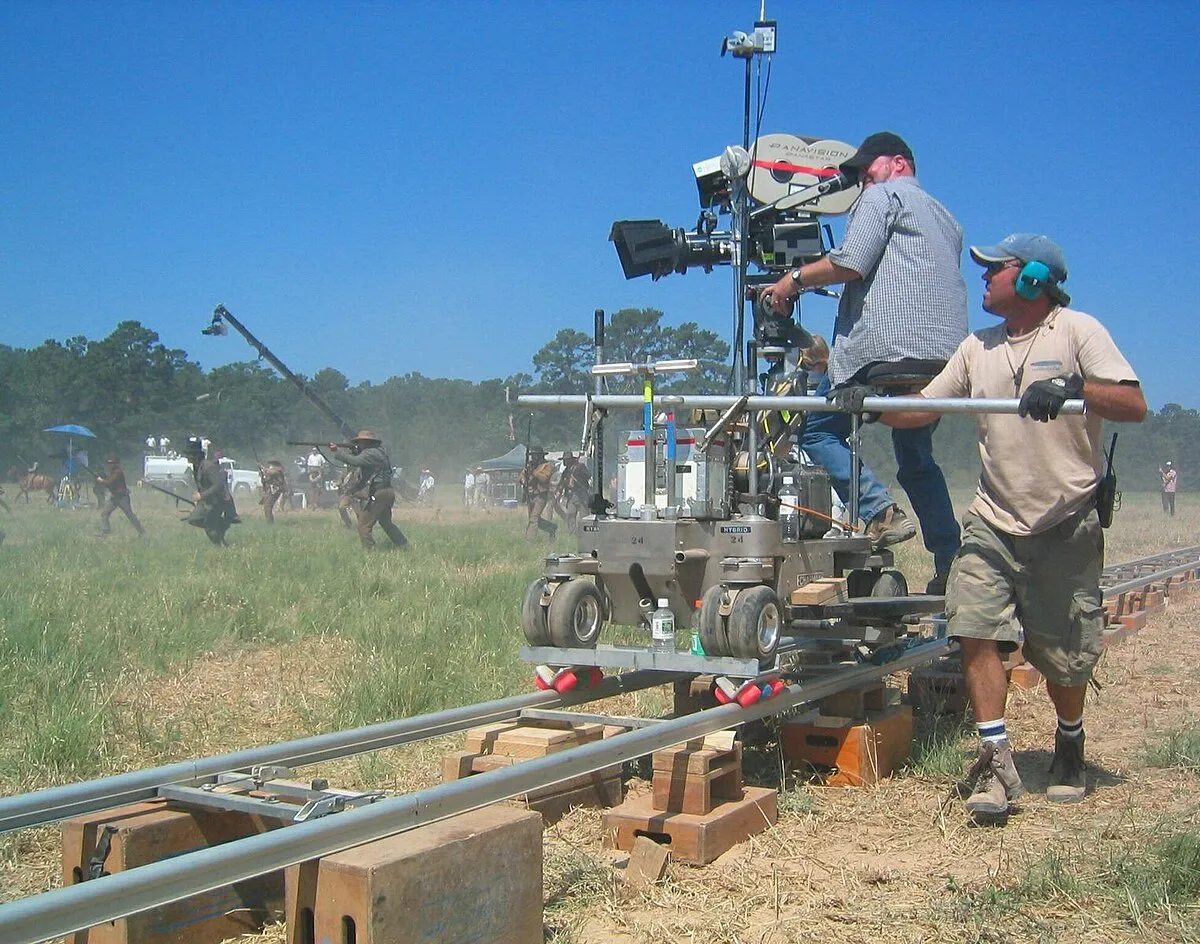
A tracking shot is "any shot where the camera follows backward, forward or moves alongside the subject being recorded" (Wikipedia). Historically the camera rode a dolly on rails, which gave the shot its name.
Tracking shot
Crew ride and push a camera dolly along a long track laid across a field location.Photo: Sean Devine, Wikimedia Commons, CC BY-SA 3.0.
Tracking shot
The camera travels beside the moving tender, keeping it the same size in frame while Keaton, on foot beside the track, heaves a length of timber and the trees slide past behind.The General (1926), Buster Keaton and Clyde Bruckman. Public domain (US).
LMU treats track and truck as one move, so say whether you mean sideways or following.
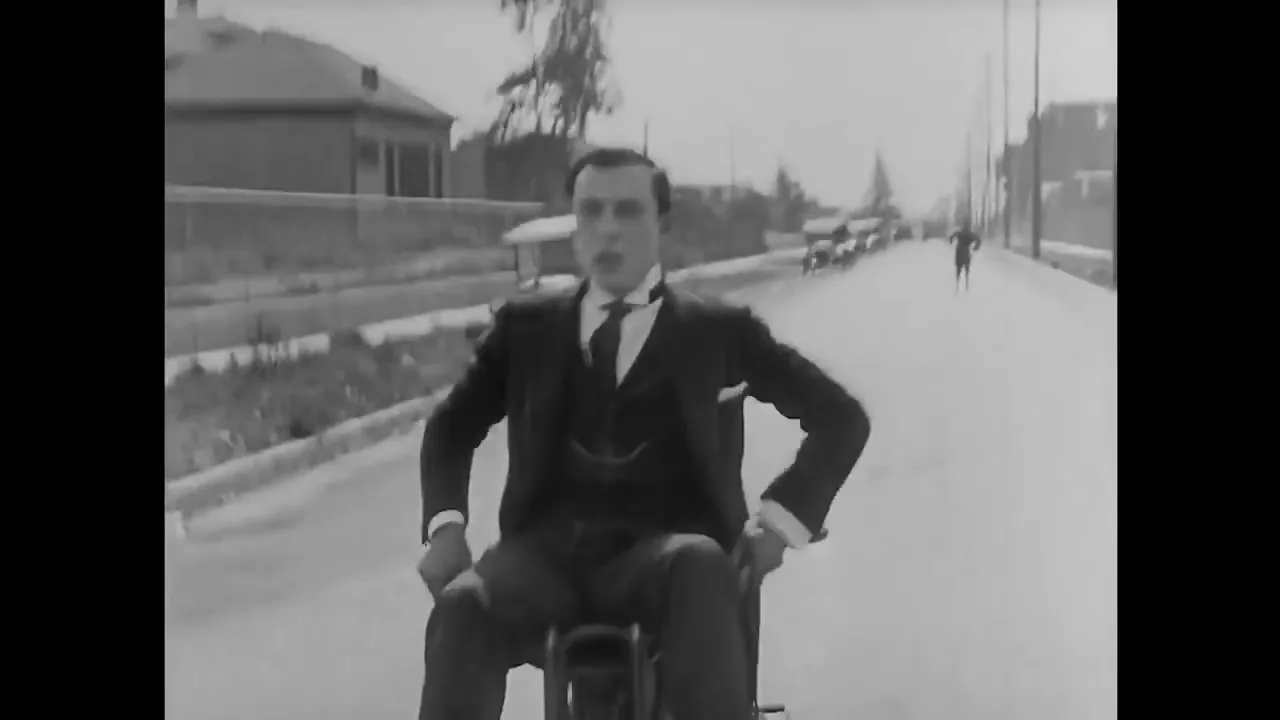
Lead (leading shot)
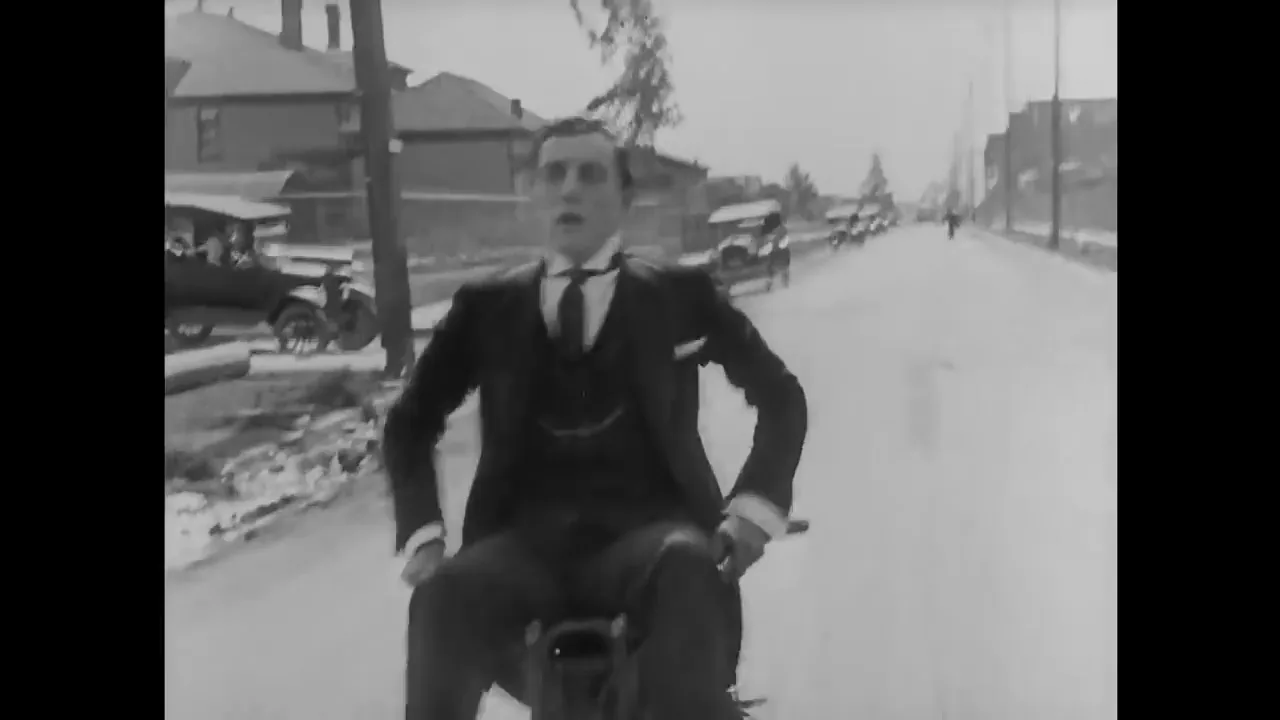
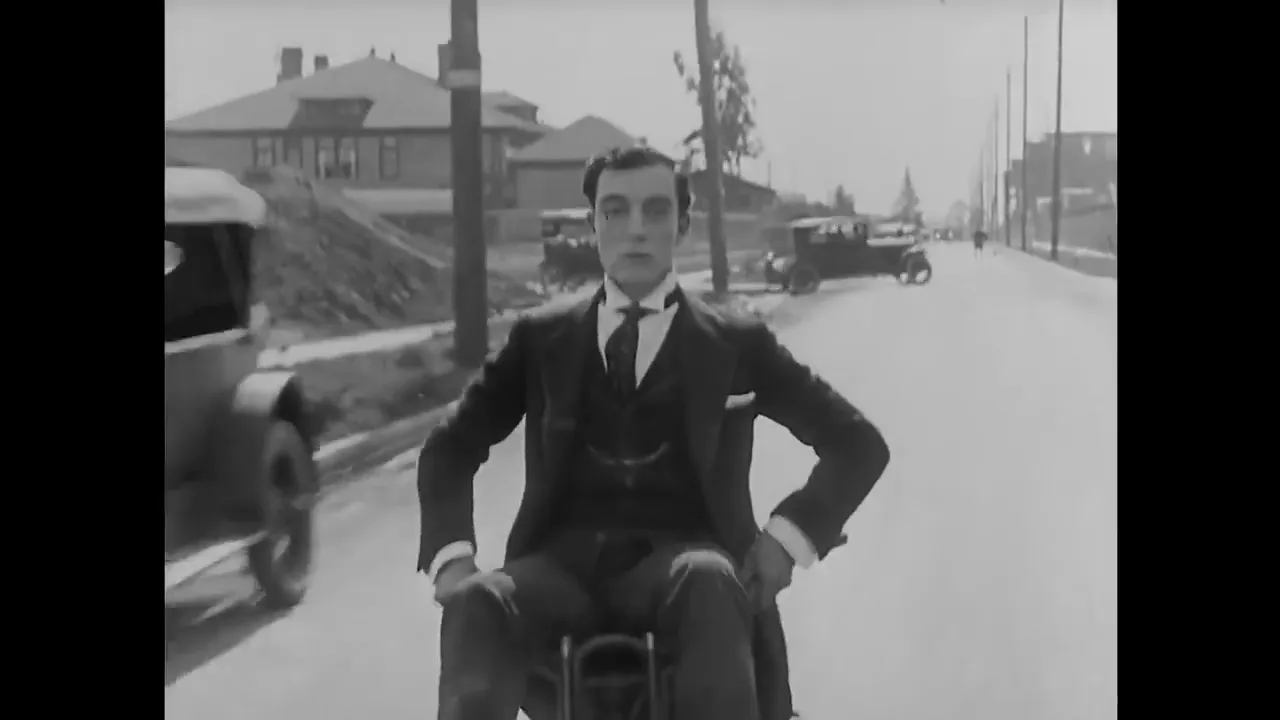
A leading shot is a tracking shot in which the camera travels ahead of the subject and looks back at them. There's no textbook definition, so in a prompt describe the direction: "camera moves backward ahead of her as she walks toward it."
Start
Middle
End
The camera travels ahead of Keaton on the motorcycle and looks back at him. He stays the same size in frame while the street slides past behind him.Sherlock Jr. (1924), Buster Keaton. Public domain (US).
Arc, orbit
The Wikipedia glossary defines an arc as "a dolly shot where the camera moves in an arc along a circular or elliptical radius in relation to the subject ('arc left' or 'arc right')."
Pedestal
A pedestal is, in LMU's words, "the up and down movement that occurs when the camera itself moves up and down," unlike a tilt, where the axis point stays fixed.
In a prompt: Google's guide: "the camera physically moves vertically up or down while maintaining a level perspective."
Boom, jib, crane
A crane puts the camera "on the end of a long shaft with a fulcrum positioned far from the camera" (Holben, American Cinematographer, 2024), counterweighted so it can rise, fall and swing in arcs bigger than a dolly column allows. Holben says "small (6′–12′) cranes are often called jibs," and "boom up" and "boom down" mean raising and lowering the arm.
Crane up
Our render of a crane move: the camera starts at eye height (1.5 m) on the statue, then rises to 7 m while pulling back and tilting down, so the cobbled street, the lamps, the parked car and the strings of lights open up beyond the statue. 24 mm, 24 fps, 180° shutter.Rendered in Vinc's virtual camera lab (CC0 assets: see ASSETS).
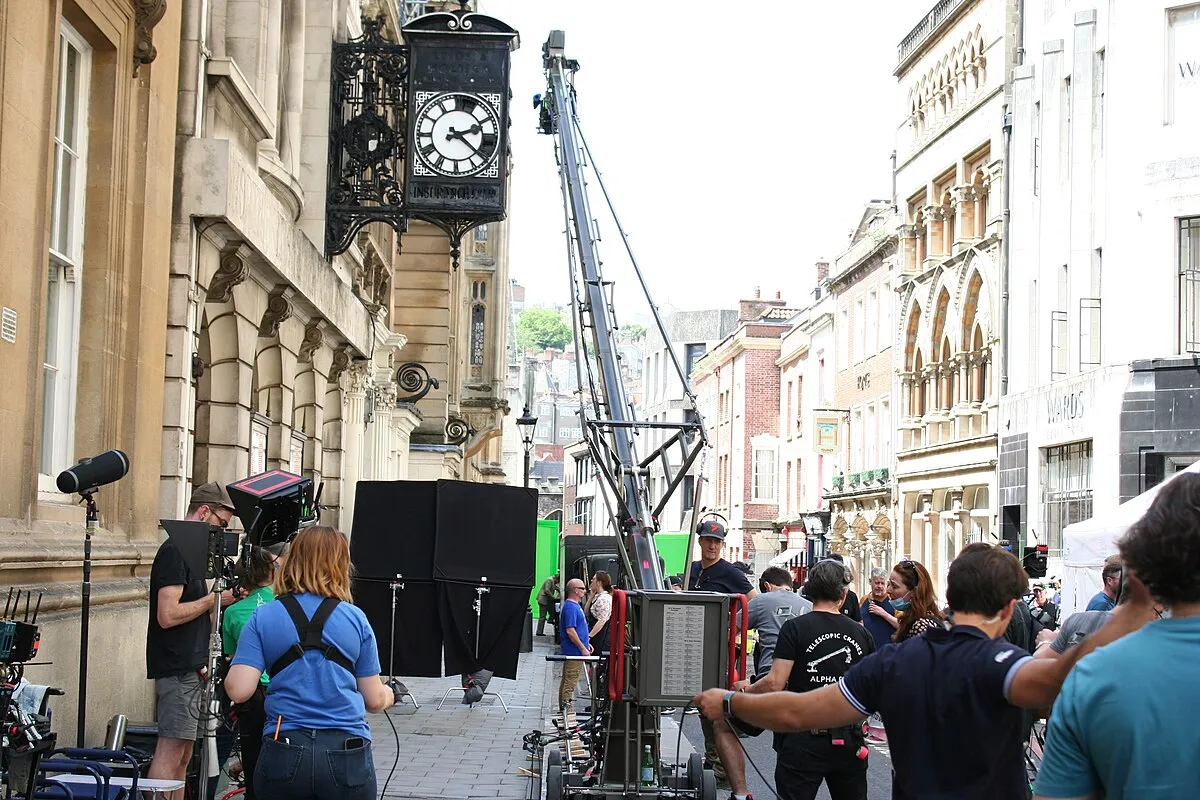
Camera crane
Crew raise a camera crane arm above a street location while onlookers watch.Photo: Captain Galaxy, Wikimedia Commons, CC BY 4.0.
Moves that need a column or an arm: a pedestal rises straight up, a crane sweeps the camera on an arc around its pivot, and an arc circles the subject.
Wikipedia's "Crane shot" article credits D. W. Griffith with the first camera crane, built for Intolerance (1916). Holben cites the opening long take of Touch of Evil (1958), shot on a Chapman crane.
In a prompt: Google's guide: "moves vertically (up or down) or in sweeping arcs, often used for dramatic reveals or high-angle perspectives."
Technocrane
A Technocrane is a crane with a telescoping arm that extends and retracts during the shot. A fixed arm always moves the camera in an arc around its pivot; a telescoping one lets the camera travel in a straight line from high up or out over a set. In 2005 the Academy gave Gyula Mester and Keith Edwards a Scientific and Engineering Award for it, saying it had "redefined the state-of-the-art in camera crane technology."
Zoom vs dolly: moving the lens instead of the camera
Zoom
A zoom is "a shot taken from a stationary position using a special zoom lens that magnifies or de-magnifies the center of the image" (Wikipedia glossary). The camera doesn't move; only the angle of view changes. An early cinema use is the opening of It (1927).
Parallax
Parallax is the shift in an object's apparent position seen along two lines of sight (Wikipedia). When the camera trucks, a foreground lamp post slides past faster than the hills behind, which is why travelling shots look three-dimensional. Rotations and zooms produce none.
Zoom versus dolly
Confusing the two is the most common mistake. CameraBench's 100-plus-person study found "a novice may confuse zoom-in (a change of intrinsics) with translating forward (a change of extrinsics)"; experts were more than 15% more accurate.
Dolly in
Zoom in
Camera position
Changes
Fixed
Focal length
Fixed
Increases
Parallax between foreground and background
Yes
None
Perspective (size relationships between near and far objects)
Changes
Unchanged; the whole image is magnified
Subject versus background
Subject grows faster than the background
Subject and background grow at the same rate
Only moving the camera changes perspective (lenses lesson).
A dolly moves the camera; a zoom changes the lens from a fixed position.
Zoom 24 → 60 mm
Dolly in, 24 mm
The same 2.5× growth of the statue, two ways, over 3 s. Left: the camera stays 10 m away and the lens zooms from 24 to 60 mm, so everything grows together like a crop and nothing slides past anything else. Right: a 24 mm lens dollies from 10 m to 4 m. The statue grows the same amount, but the lamps and walls sweep past it and the street end barely grows. That is parallax. Full frame, f/5.6. Rendered in Vinc's virtual camera lab.Scene: CC0 Poly Haven assets (Gothic Statue by Benny Weimer; Modular Urban Apartments and Factory Facades by James Ray Cock; Evening Road 01 sky by Jarod Guest and Sergej Majboroda).
Dolly zoom (Vertigo effect, contra-zoom)
A dolly zoom combines the two in opposite directions: the camera dollies toward or away from the subject while the lens zooms the other way, "in such a way as to keep the subject the same size in the frame" (Wikipedia, "Dolly zoom"). The background appears to stretch or compress around them.
Number. For the subject to stay the same size, focal length has to change in proportion to distance:
image size ∝ focal length ÷ subject distance
so to hold the subject: new focal length = old focal length × (new distance ÷ old distance)
e.g. 50 mm at 2 m → dolly back to 4 m → zoom to 100 mm
(Our arithmetic.) Irmin Roberts, Hitchcock's second-unit cameraman, created it for Vertigo (1958) (Wikipedia, Videomaker). In Jaws (1975), on Chief Brody: "The camera dollies away from him while zooming in" (Holben).
Dolly zoom: the camera moves back while the focal length increases, keeping the subject the same size as the background grows.
Camera back, lens longer: the subject holds its size while the background rescales.
Dolly zoom, 24 → 100 mm
The formula above, rendered. Over 3.5 s the camera dollies back from 3.2 m to 13.3 m from the statue while the focal length rises from 24 mm to 100 mm (distance = 0.133 × focal length), so the statue keeps its size. The building at the end of the street, about 66 m behind, swells to fill the frame. Full frame, f/4, eased start and stop. Rendered in Vinc's virtual camera lab.Scene: CC0 Poly Haven assets (Gothic Statue by Benny Weimer; Modular Urban Apartments and Factory Facades by James Ray Cock; Evening Road 01 sky by Jarod Guest and Sergej Majboroda).
Camera rigs: handheld, Steadicam, gimbal, drone and motion control
Locked-off (static)
A locked-off shot doesn't move at all: "the camera focus and angle stay completely still, usually with a locked off tripod, and the scene continues motion" (Wikipedia glossary).
Handheld
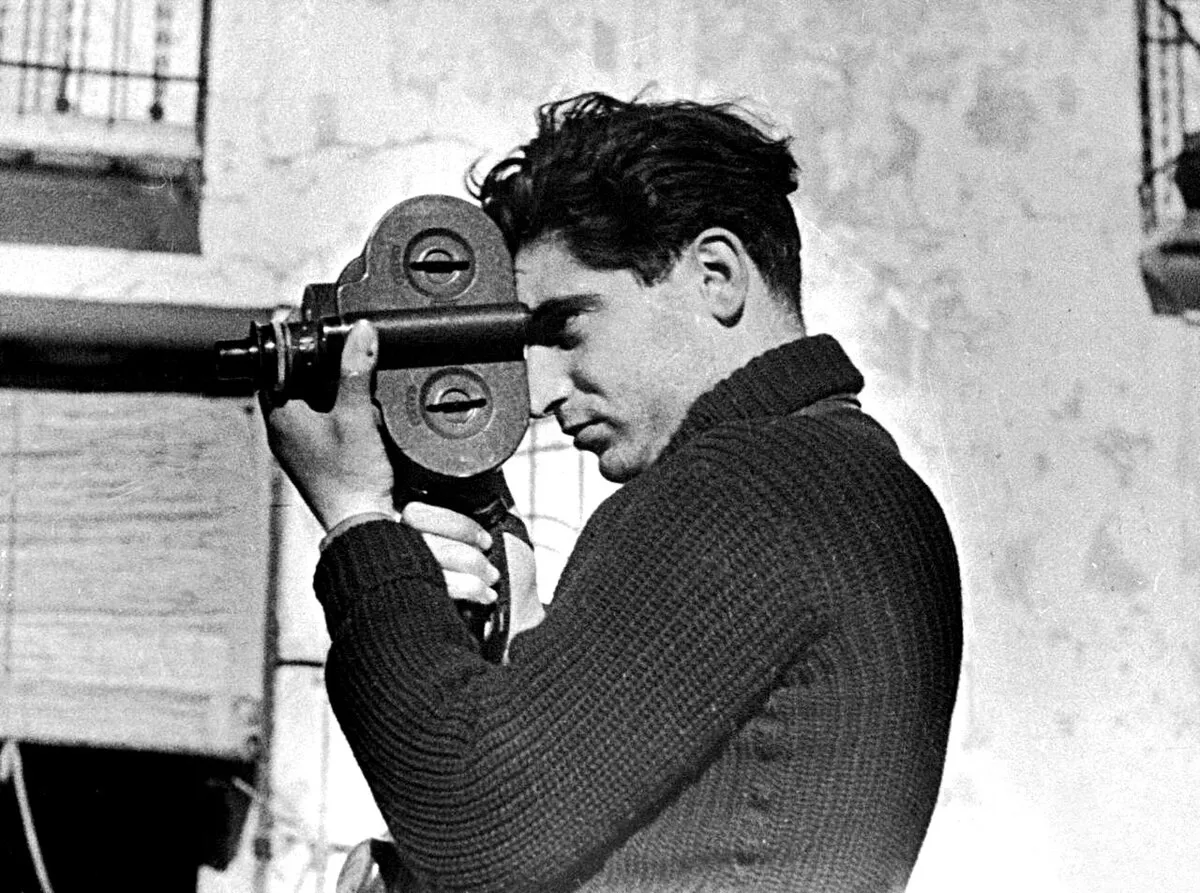
Handheld means the operator carries the camera with no rig, "on your shoulder, in your hands, cradled in your arms" (Holben). It is fast and cheap, though LMU calls it "the most difficult of all camera movements." Light cameras made it practical: ARRI's ARRIFLEX 35 (1936) and Panavision's 1972 Panaflex, "the first 35mm, self-blimped, hand-holdable studio reflex camera".
Handheld
Robert Capa holds a film camera to his eye with both hands, with no tripod or support.Gerda Taro, 1937. Public domain.
Handheld
Barbra presses against a headstone, then a handheld camera lurches and tilts as two men grapple among the graves, struggling to keep them in frame.Night of the Living Dead (1968), George A. Romero. Public domain (US).
In a prompt: Google's guide: "Handheld or shaky cam ... less stable, often jerky movements that can convey realism, immediacy, or unease."
Steadicam
Steadicam is "a brand of camera stabilizer mounts" invented by Garrett Brown and "introduced in 1975 by Cinema Products Corporation" (Wikipedia, "Steadicam"): a vest and a "spring-loaded arm working to minimize the effects of camera movement." The general term is a body-worn stabiliser.
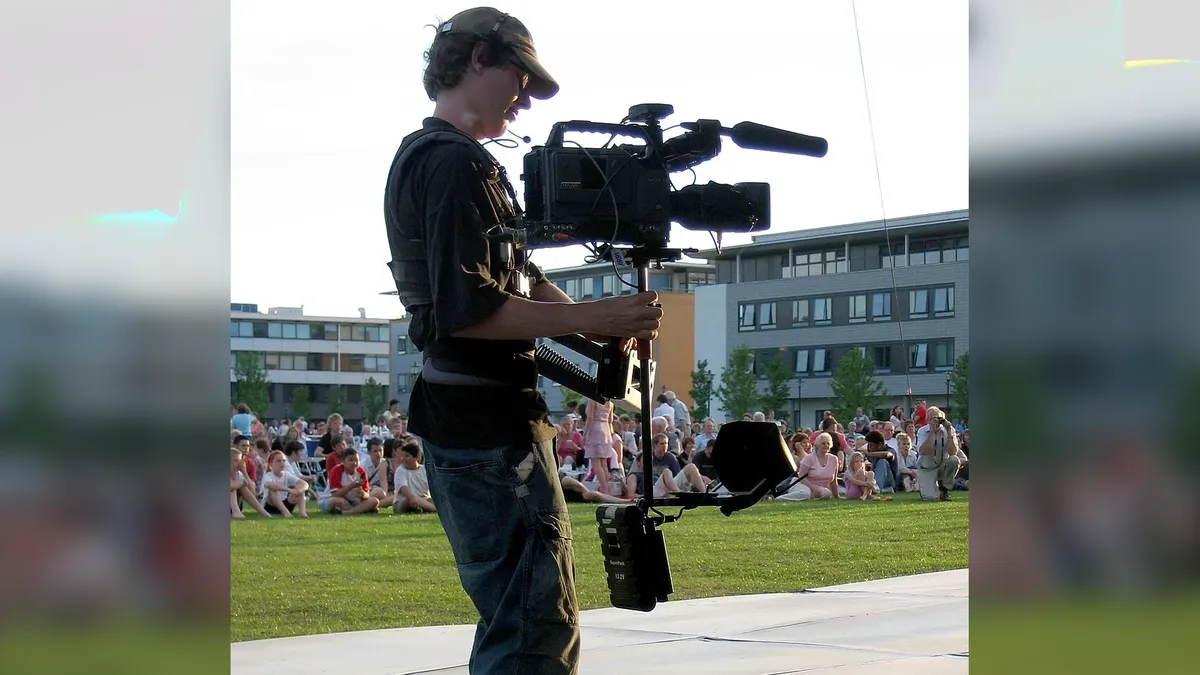
Steadicam
An operator wears a Steadicam vest and arm, with the camera carried on the sled in front of him.Photo: Mike1024, Wikimedia Commons, public domain.
In the frame, the camera follows a walking subject through doors and up stairs with continuous parallax but no footstep bounce. Brown patented it in 1974 (Cinémathèque française), operated the Rocky steps run himself and the maze shots in The Shining (1980), and won an Academy Award of Merit in 1978.
Gimbal
A gimbal is "a computer-controlled and counterbalanced multi-axis head" (Holben) that cancels jitter with motors on three axes instead of a counterweighted arm. The Creator (2023) was shot on a handheld gimbal; in 2025 the Academy honoured Freefly's Mōvi gimbals for letting one operator get shots that once needed a dolly or crane.
SnorriCam (body mount, chestcam)
A SnorriCam is "rigged to the body of the actor, with the camera facing the actor directly so that they appear in a fixed position in the center of the frame" (Wikipedia), while the world moves around them. Named after Einar and Eiður Snorri (1996), it was popularised by Aronofsky's π and Requiem for a Dream.
Drone
Holben: "Drones allow for a wide range of shots, including some formerly accomplished with helicopters and cranes," and they have replaced many crane uses "due to lower cost" (Wikipedia). DJI's Inspire 3 cinema drone records 8K full frame for about 28 minutes.
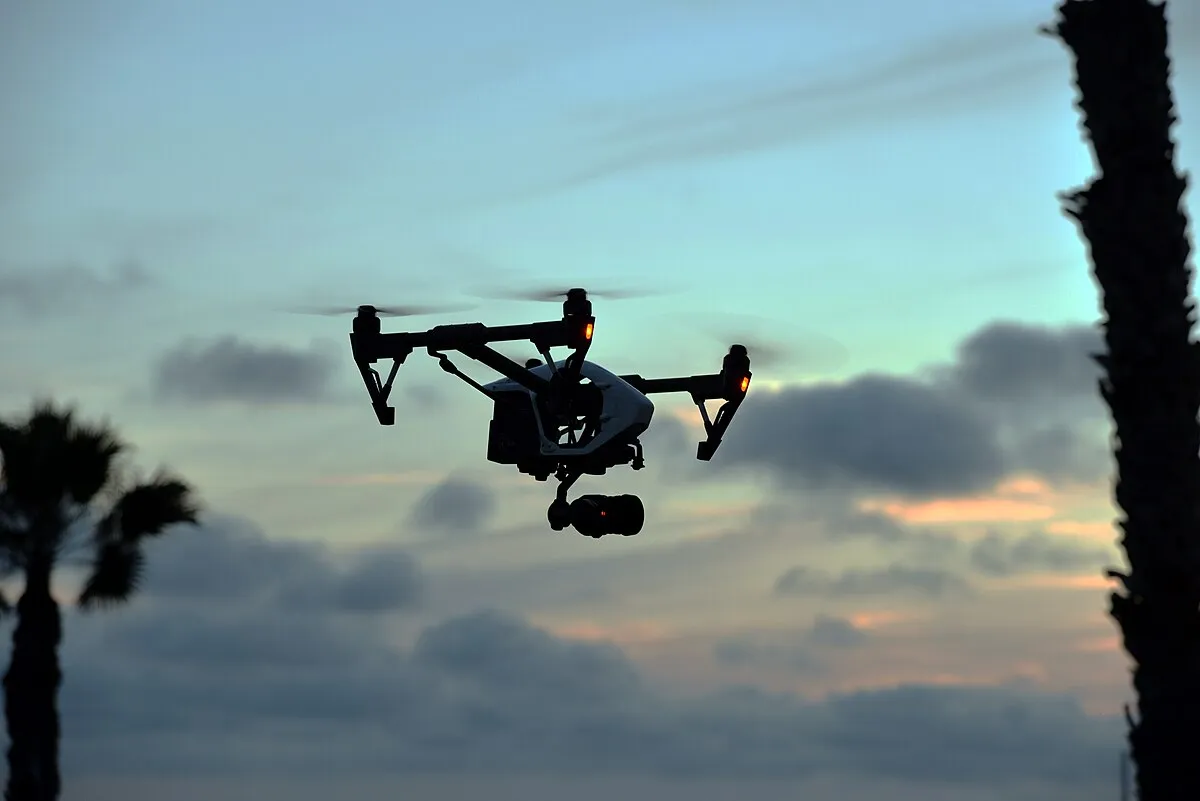
Drone
A camera drone with its gimbal-mounted camera hangs in the sky at dusk.Photo: Don Ramey Logan, Wikimedia Commons, CC BY 4.0.
Drone
A drone glides above the institute's rooftops and car park, looking down at an angle so the buildings, trees and town beyond slide under the frame.NASA Scientific Visualization Studio, drone footage of the Space Telescope Science Institute. Public domain.
Motion control
Motion control "enables precise control of, and optionally also allows repetition of, camera movements" (Wikipedia, "Motion control photography"). Because the move can be repeated exactly, separate passes can be composited: a miniature, a background, or the same actor twice in one moving shot.
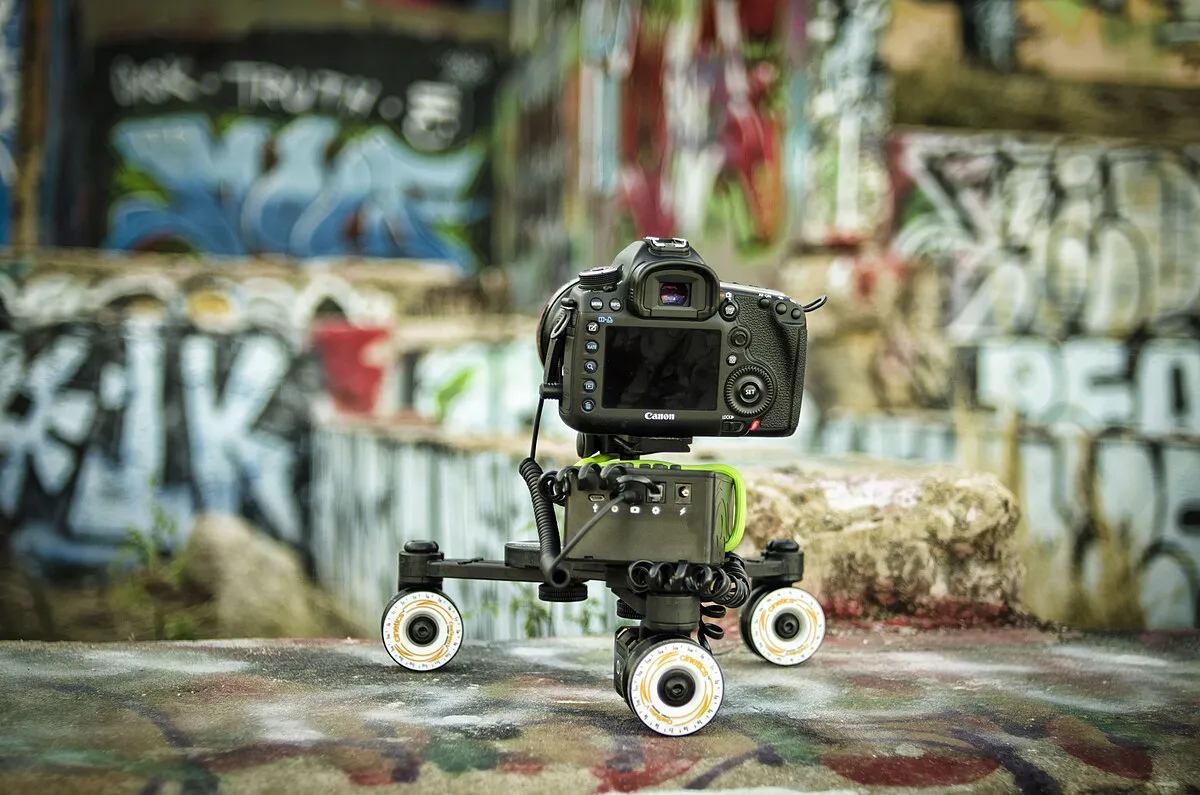
Motorised dolly
A small motor-driven camera dolly carries a DSLR in front of a graffiti-covered wall.Photo: Justin Jensen, Wikimedia Commons, CC BY-SA 3.0.
Star Wars (1977) was "the first large-scale application of motion control": ILM's Dykstraflex filmed each miniature on its own pass (Academy Museum).
How the prompt guides phrase each move
Google's guide (Veo and Gemini Omni Flash, updated 17 November 2026) defines each move with an example; LTX lists verbs; Luma publishes camera-motion strings and warns "there can be mismatches sometimes"; Kling's 4.0 manual lists push-in, pull-out, pan, tracking and orbit.
Move
Google (quoted examples)
LTX (camera language list)
Other vendor wording
Dolly / push-in
"dolly out from the character to emphasize their isolation"
"Pushes in / pulls back"
Kling example: "subtle 3% push-in"
Truck / tracking
"truck (left/right)", parallel to the subject
"Follows", "Tracks"
Kling example: "a wider tracking shot alongside the sports car"
Pedestal / crane
"pedestal up to reveal the full height of an ancient, towering tree"; "crane shot revealing a vast medieval battlefield"
"Tilts upward" (rotation, not crane)
Arc / orbit
"arc shot around a couple embracing in the rain"
"Circles around"
Luma: "camera orbit left"
Zoom
"slow zoom in on a mysterious artifact on a table"
Dolly zoom
"vertigo effect (dolly zoom) on a character standing at the edge of a cliff"
Luma concept key "dolly_zoom"
Handheld
"handheld camera shot during a chaotic marketplace chase"
"Handheld movement"
Kling: "subtle irregular shake, and framing corrections"
Whip pan
"whip pan from one arguing character to another"
Kling: "Whip pans follow vehicle and character movements"
Aerial
"sweeping aerial drone shot flying over a tropical island chain"
Our illustration, not a vendor's: given the CameraBench finding, describe the parallax as well as the move name.
slow dolly in toward the woman at the table; the chairs in the foreground
slide out of frame past the camera, the window behind her grows only slightly

slow zoom in on the woman at the table from a fixed position; nothing in the
room shifts relative to anything else, the frame simply tightens
Quick reference
Term
Rotates
Travels
Lens changes
Parallax
Pan, tilt, roll, whip pan
Yes
No
No
No
Dolly, push-in, pull-out
No
Toward / away
No
Yes
Truck / crab, tracking, lead
No
Sideways or with the subject
No
Yes
Arc / orbit
Yes (to keep the subject)
Around the subject
No
Yes
Pedestal, boom, crane
Sometimes
Vertically or in sweeps
No
Yes
Zoom
No
No
Yes
No
Dolly zoom
No
Yes
Yes, opposite way
Yes
How we compiled this
Definitions come from LMU's No-Nonsense Filmmaking (2025), Wikipedia and Jay Holben's 2024 American Cinematographer columns; rig history from the makers, the Academy and the sources listed; perception findings from CameraBench; prompt wording from Google, LTX, Luma and Kling. The dolly-zoom formula and example prompts are ours. Checked 18 November 2026.
The renders. Clips captioned "Rendered in Vinc's virtual camera lab" are simulations, path-traced in Blender's Cycles from CC0 Poly Haven assets with a physical full-frame camera. They show the geometry of each move, not lens breathing or aberrations.
Aspect Ratios in Film Explained: 1.33 to 2.39 and 9:16, With the History and Delivery Specs
Aspect ratios in film are width divided by height. See where 1.375, 1.85, 2.39, 16:9, IMAX and 9:16 came from, and the containers cinemas and Netflix expect.