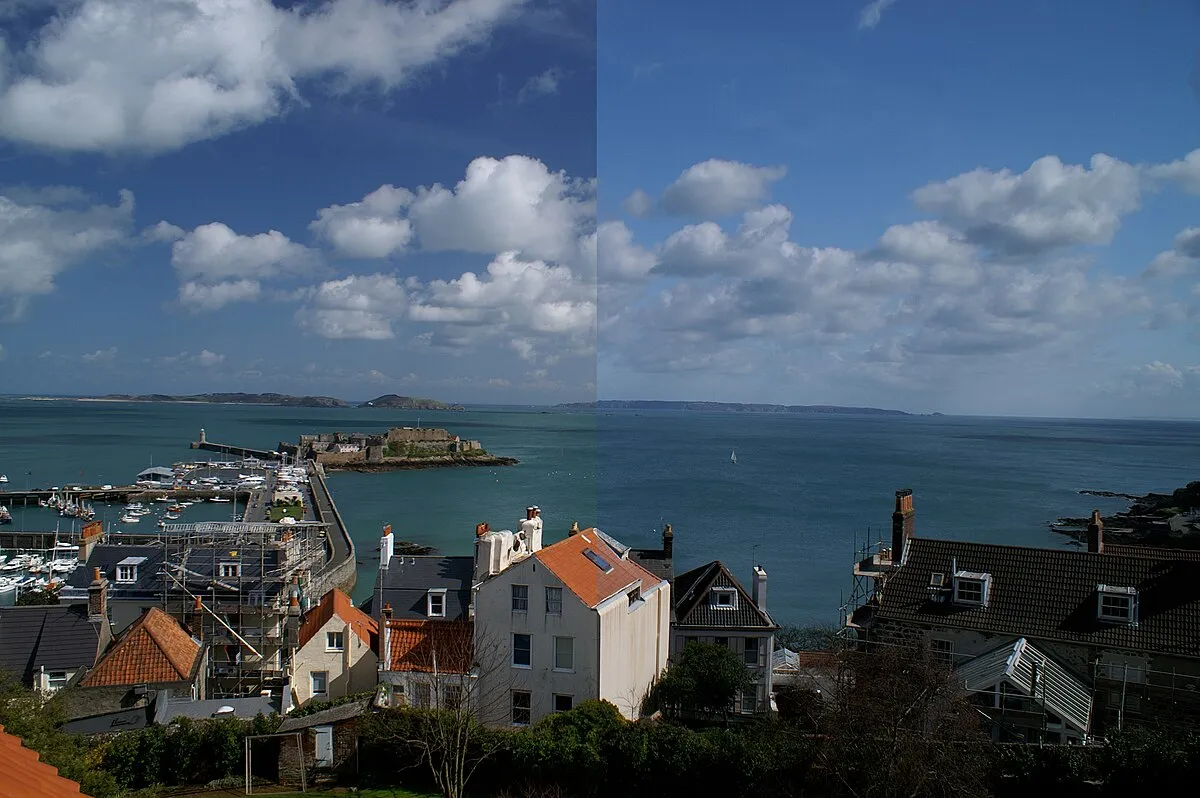
Focal length explained, with angle of view for seven lenses on full frame and Super 35, then every camera lens term: T-stops, depth of field, bokeh, anamorphic and filters.
Method. Checked on 18 November 2026 against Cooke Optics, ARRI, RED and Panavision specifications, MovieLabs, American Cinematographer, Steve Yedlin, the Cinémathèque française, Wikipedia's optics articles and Google's and LTX's prompt guides; angle-of-view, hyperfocal, T-stop and ND tables are our arithmetic. Vinc makes an AI film studio.
How to read the numbers on a lens
A cinema lens carries three scales: focal length in millimetres, a T-stop ring and a focus scale. This lesson (part 4 of the glossary) defines each lens term a cinematographer or a video prompt uses, from depth of field to anamorphic squeeze. For how sensor size changes the numbers, see Cameras and Sensors Explained.
Focal length and angle of view
Focal length
Focal length is the millimetre number on a lens: for a thin lens, "the distance between the lens and its focal points" (Wikipedia), where a "longer focal length ... leads to higher magnification and a narrower angle of view." It is fixed by the design: "a 12mm lens is always a 12mm lens" (Film and Digital Times). What changes with the camera is how much of the image the sensor records, so "35mm" in a prompt is only half a statement.
Angle of view
Angle of view is how much of the scene a lens takes in across one dimension of the sensor, and it depends on two numbers, focal length and sensor size. For an ordinary (rectilinear) lens at infinity focus:
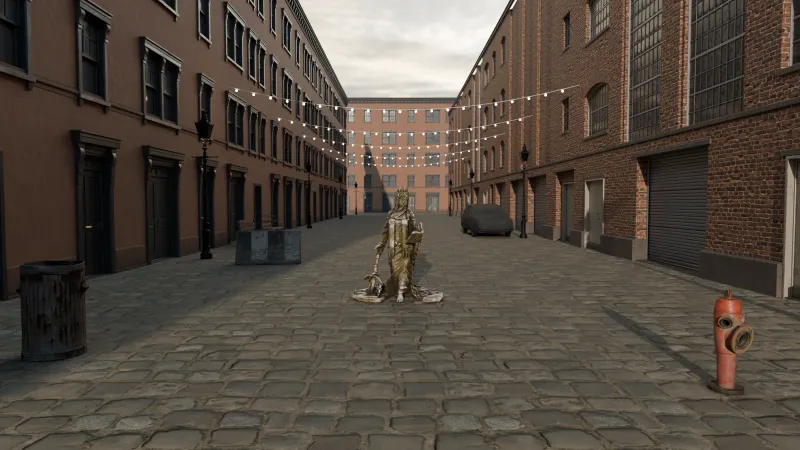
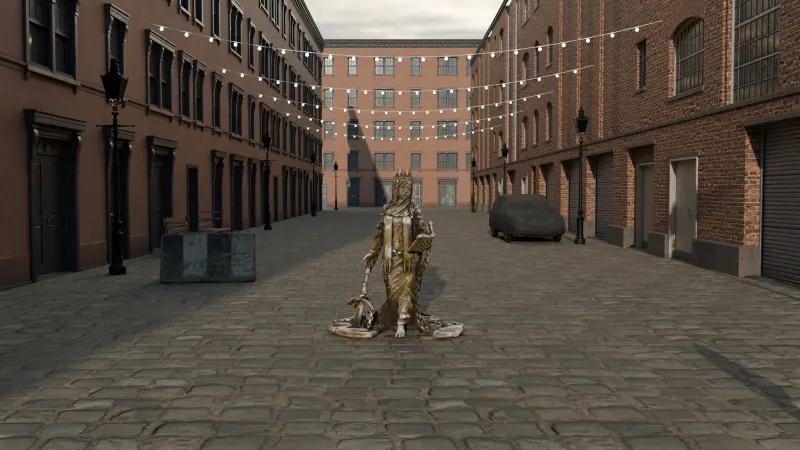
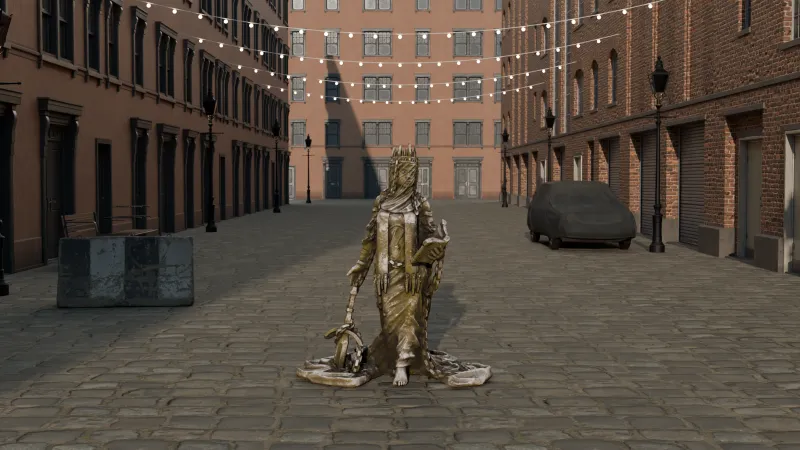
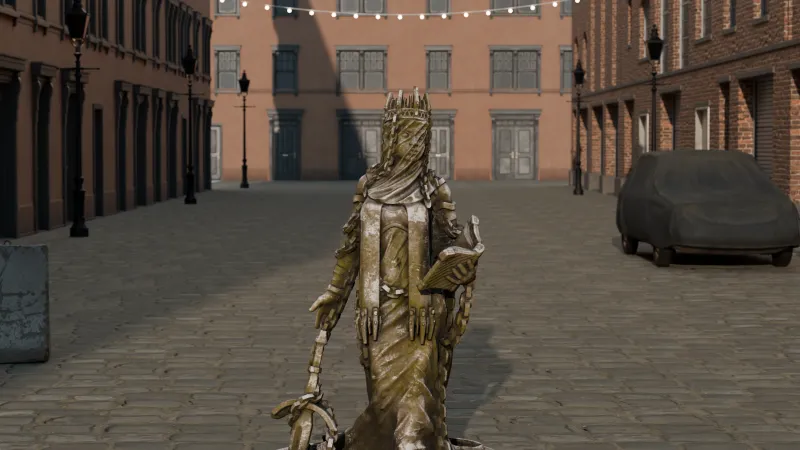
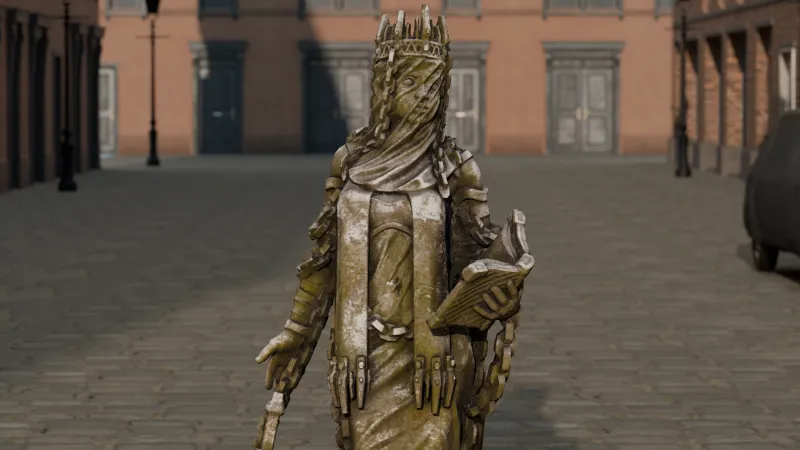
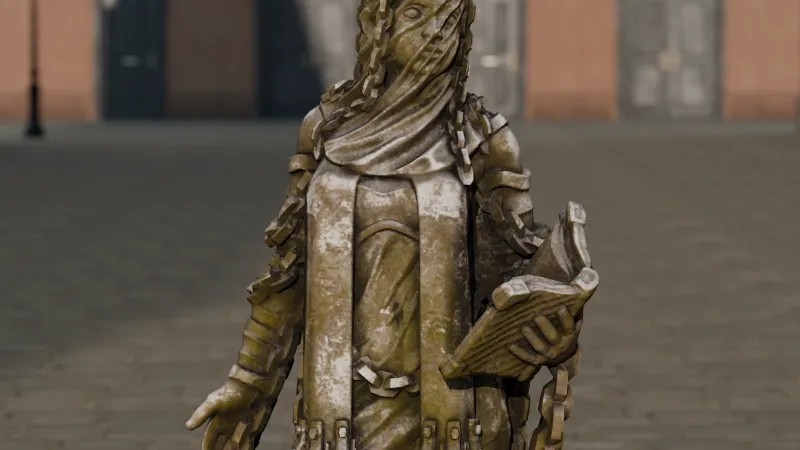
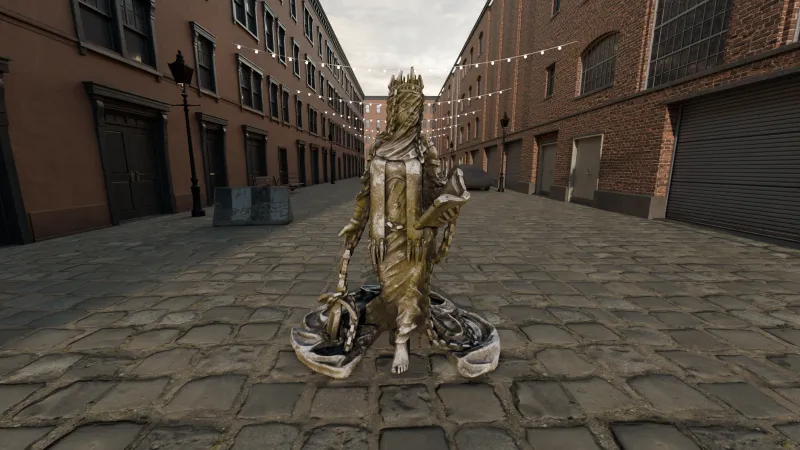
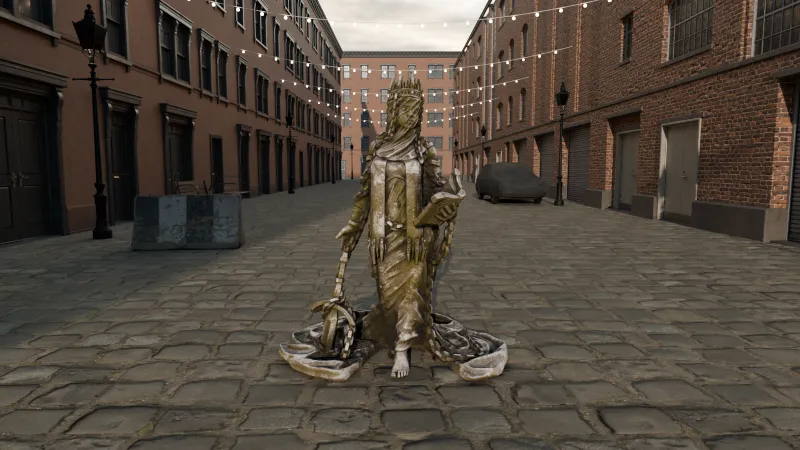
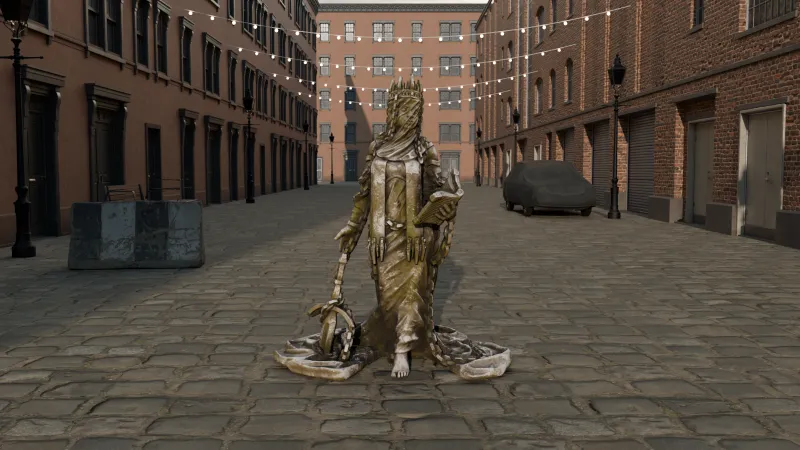
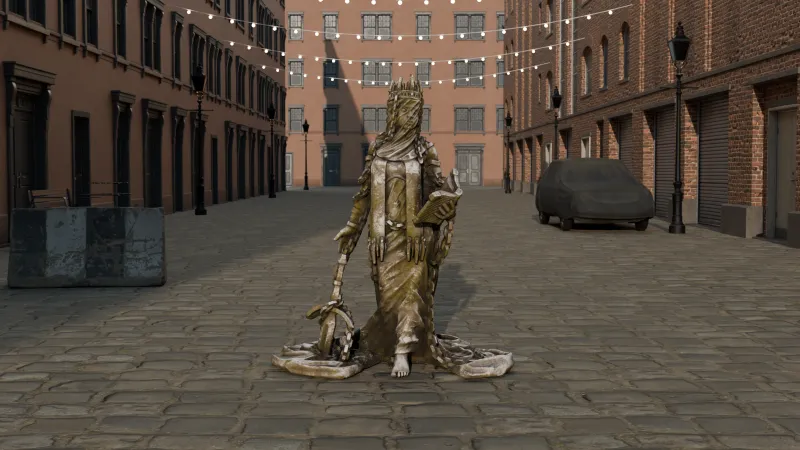
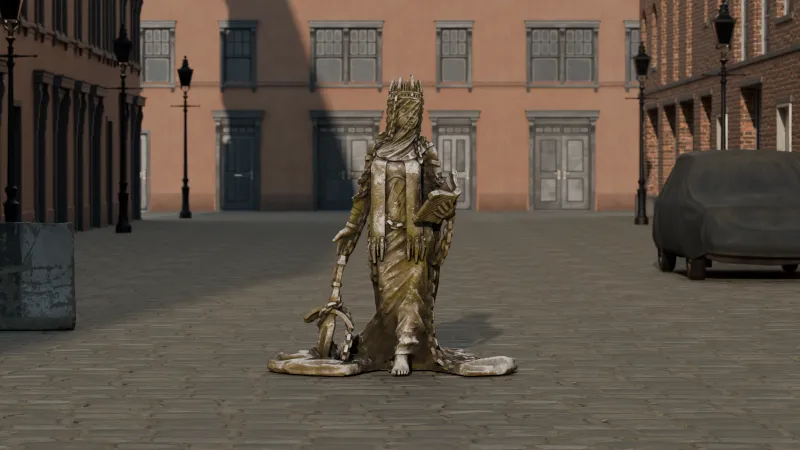
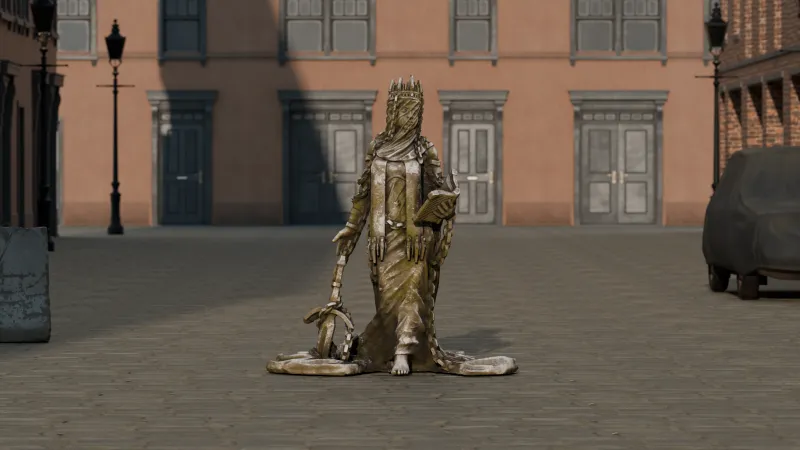
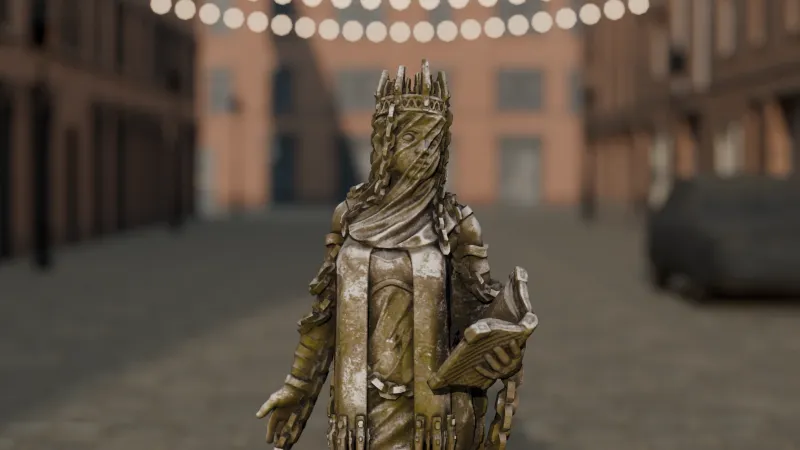
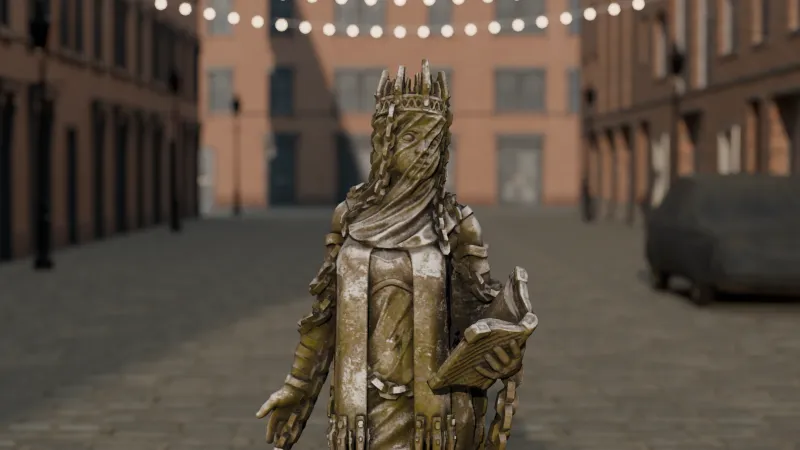
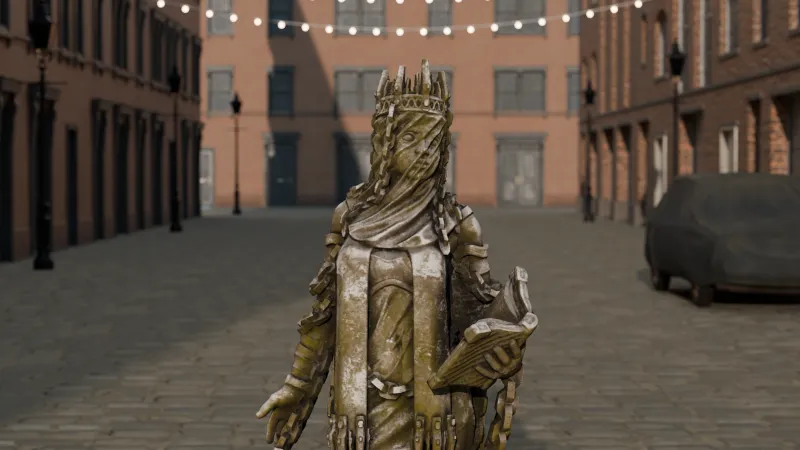
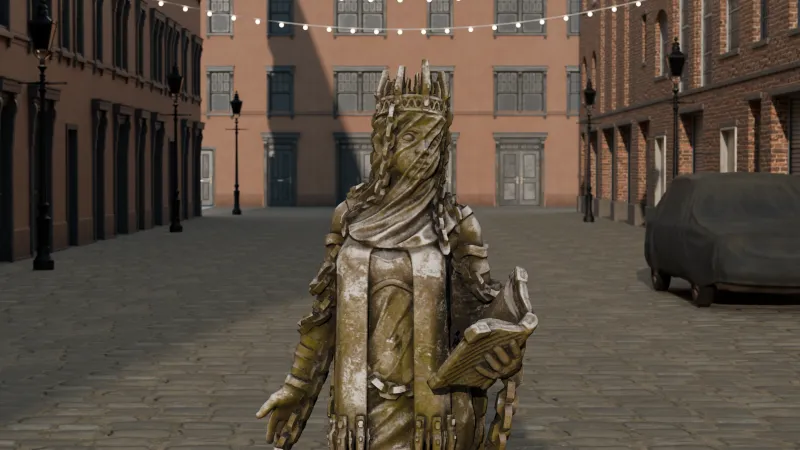
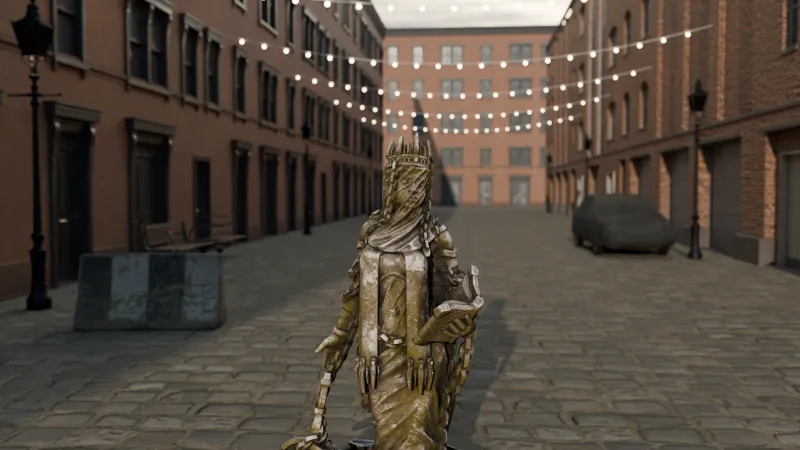
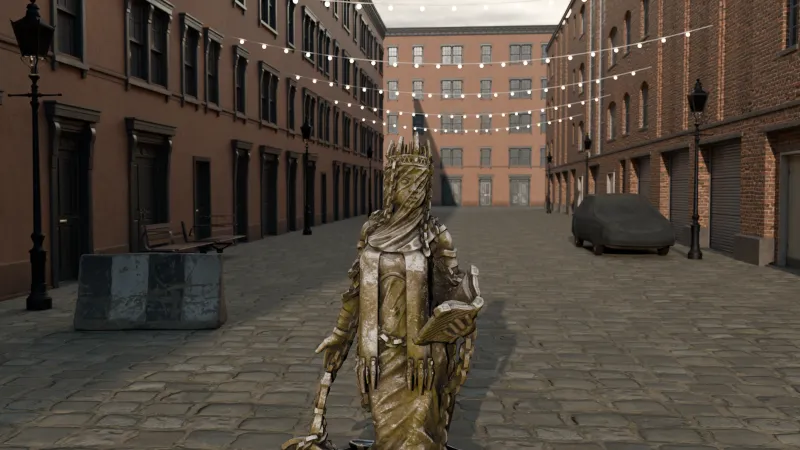
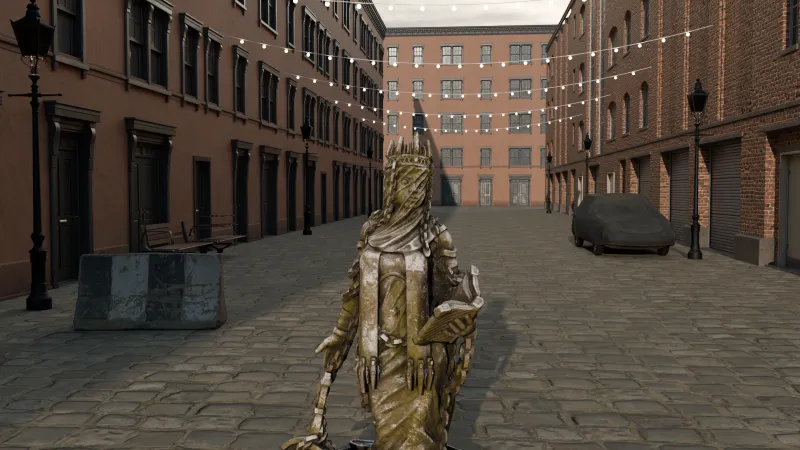
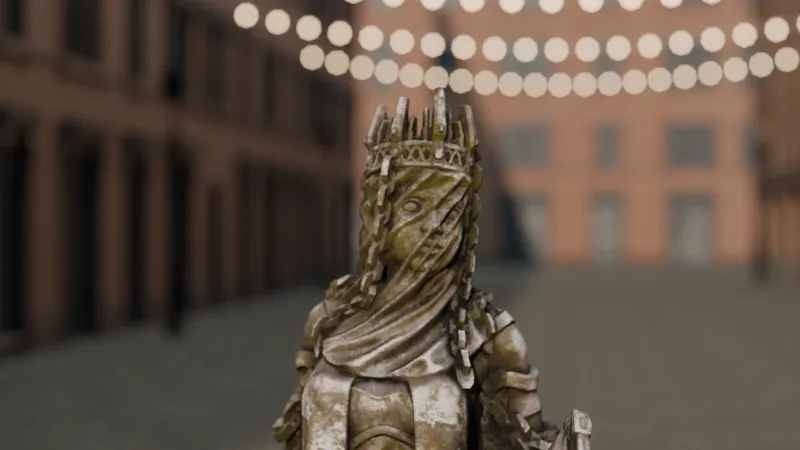
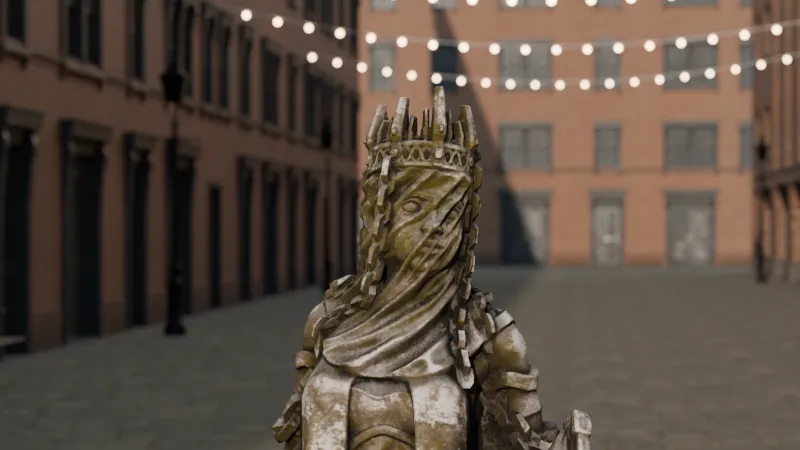
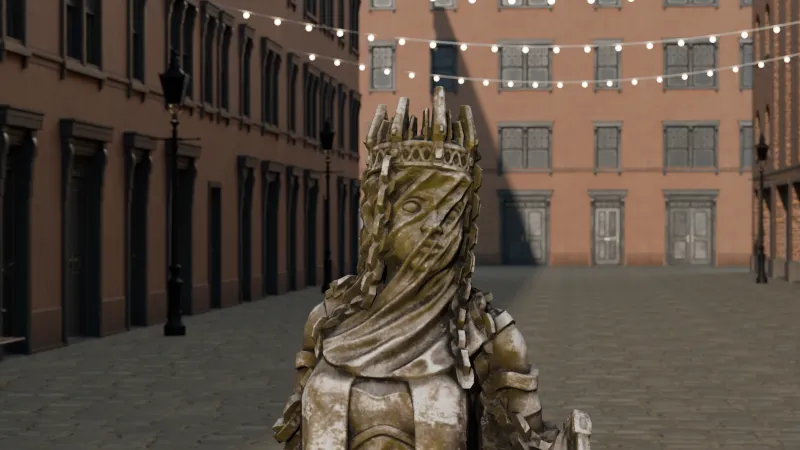
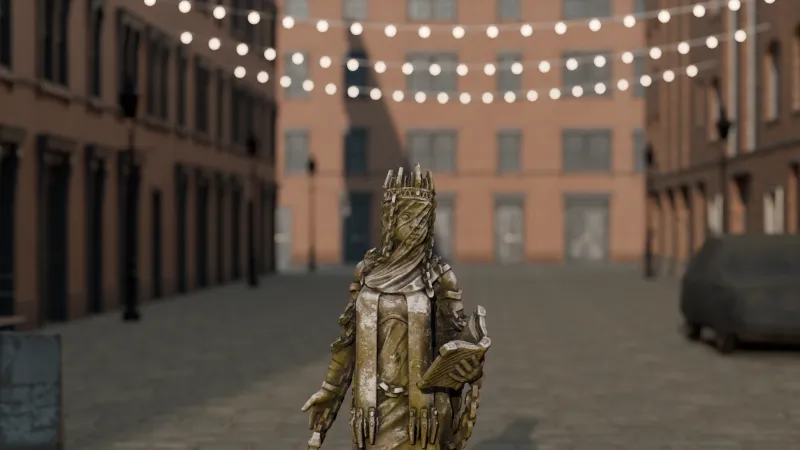
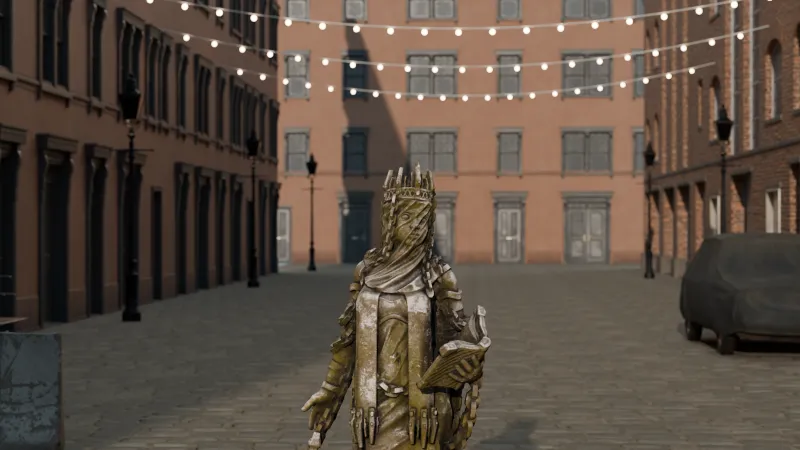
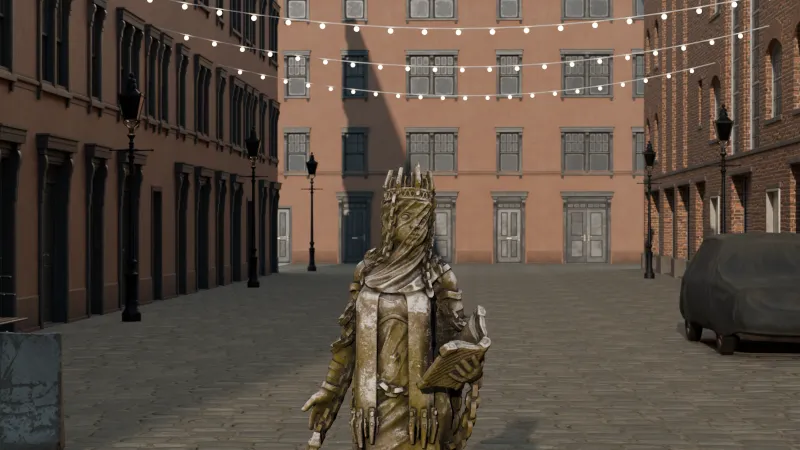
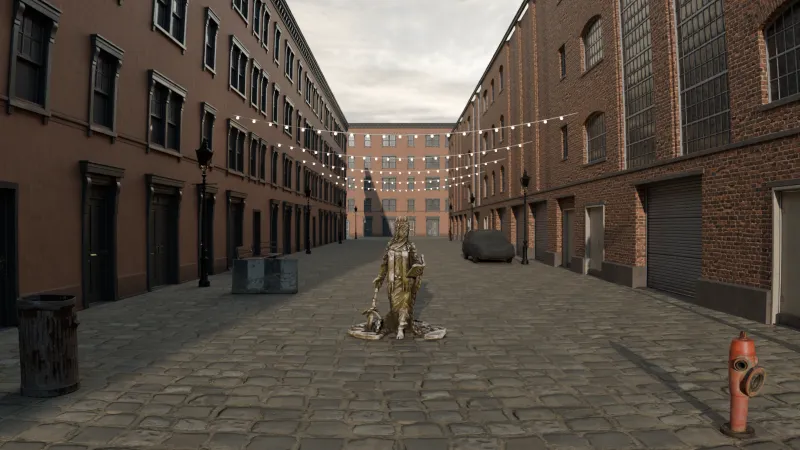
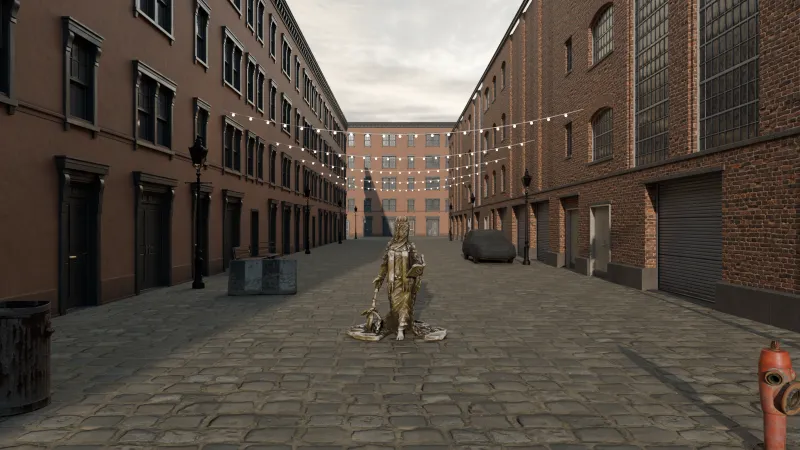
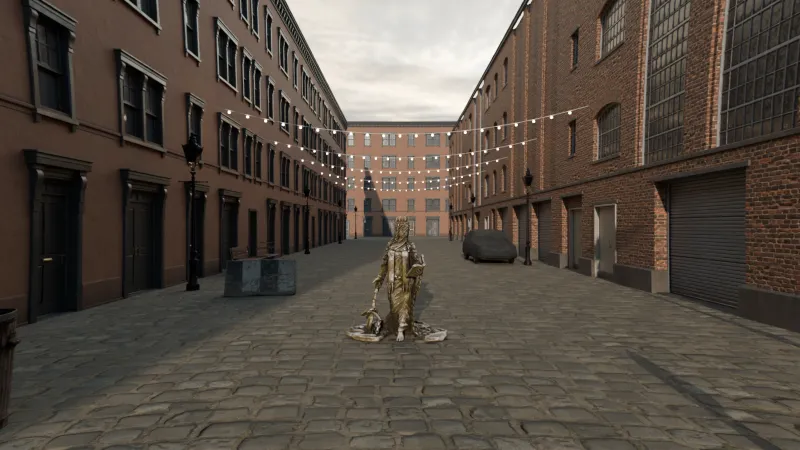
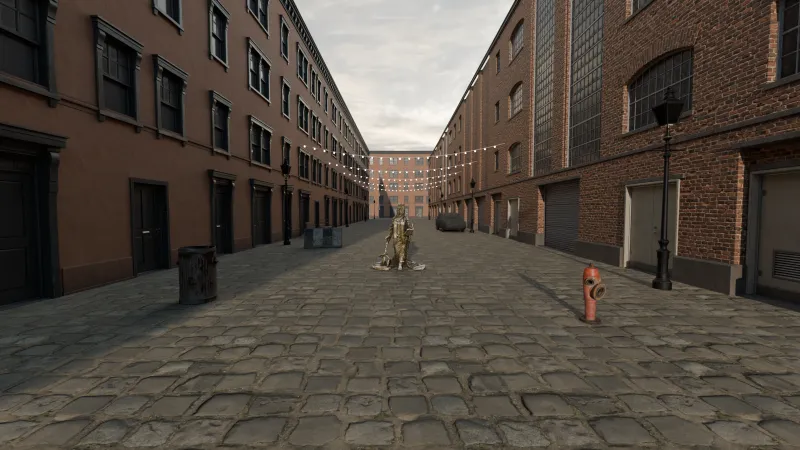
Same camera position, four lenses: full frame (16:9 extraction, 36 × 20.25 mm), camera 1.5 m high and 8 m from the statue, f/8. Only the field of view changes. Rendered in Vinc's virtual camera lab.Scene built from CC0 Poly Haven assets: Gothic Statue (Benny Weimer), Modular Urban Apartments and Factory Facades (James Ray Cock), Cobblestone Floor 05 (Rob Tuytel), Evening Road 01 sky (Jarod Guest, Sergej Majboroda) and others.
85 mm
135 mm
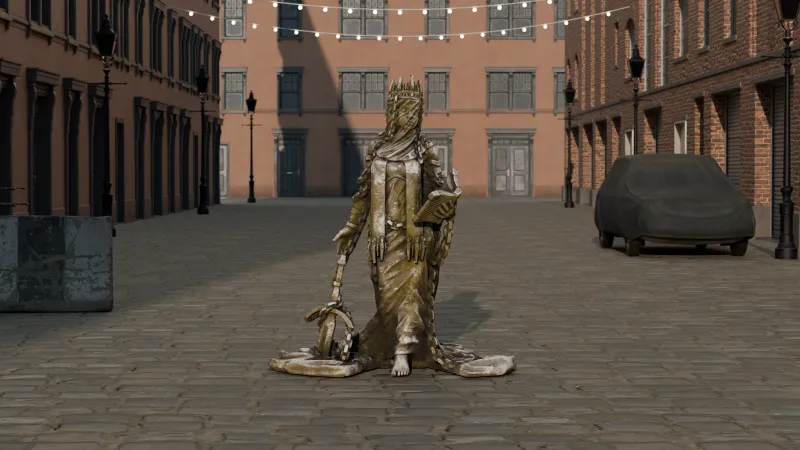
200 mm
The longer lenses from the same spot. At 200 mm the 16:9 frame is 10.3° wide and covers about 1.4 m at the statue's distance of 8 m. Rendered in Vinc's virtual camera lab.Scene: CC0 Poly Haven assets (see the figure above).
Use sensor width for the horizontal angle, height for the vertical (Scantips; it fails at macro distances and for fisheyes). Full frame is 36 × 24 mm; the ARRI ALEXA 35's Super 35 open gate is 27.99 × 19.22 mm:
Focal length
Full frame, horizontal
Full frame, vertical
ALEXA 35 (Super 35), horizontal
ALEXA 35 (Super 35), vertical
14 mm
104.3°
81.2°
90.0°
68.9°
18 mm
90.0°
67.4°
75.7°
56.2°
24 mm
73.7°
53.1°
60.5°
43.6°
35 mm
54.4°
37.8°
43.6°
30.7°
50 mm
39.6°
27.0°
31.3°
21.8°
85 mm
23.9°
16.1°
18.7°
12.9°
135 mm
15.2°
10.2°
11.8°
8.1°
Horizontal angle of view on full frame (36 mm wide)
14mm104.3°
18mm90.0°
24mm73.7°
35mm54.4°
50mm39.6°
85mm23.9°
135mm15.2°
Computed with 2·arctan(18 ÷ focal length), rectilinear lens at infinity focus.
The same angles drawn to scale on full frame (36 mm wide), 24 mm highlighted. Computed with 2·arctan(18 ÷ focal length).
The scale isn't linear. 14 to 24 mm narrows the full-frame view by about 31°; 85 to 135 mm by under 9°.
The same lens is tighter on a smaller sensor. A 50 mm on the ALEXA 35 covers what about 64 mm covers on full frame, a crop factor of about 1.29. Benjamin B's ASC "Practical Optics" puts Super 16 at about half of Super 35, which is almost two-thirds of full frame. Cooke quotes its S4/i 50 mm at 34° diagonal on Super 35.
Perspective (lens compression)
Perspective is how near and far objects relate in size, and it comes from camera distance, not focal length. Telephotos are said to "compress" space and wide lenses to "distort" faces, but Jay Holben's 2024 American Cinematographer article "Understanding Lens Distortion" corrects both: "It is not the focal length of the lens that creates perspective distortion."
Same framing, different distance: the wider lens forces the camera closer.
14 mm · 1.8 m
24 mm · 3.1 m
35 mm · 4.5 m
50 mm · 6.4 m
The same test as Holben's, rendered: the camera moves back for each lens so the 1.74 m statue keeps the same height in frame (2.6 m of frame at the statue). Labels give focal length and camera-to-statue distance. Full frame, camera 1.2 m high, f/8. Rendered in Vinc's virtual camera lab.Scene: CC0 Poly Haven assets (Gothic Statue by Benny Weimer; facades by James Ray Cock; others listed in our lab notes).
85 mm · 10.9 m
135 mm · 17.3 m
200 mm · 25.7 m
Further back on longer lenses. The statue is unchanged, but the building at the end of the street, about 66 m behind it, grows from a strip at 14 mm to a wall that fills the frame at 200 mm. That is the "compression": the ratio of the two distances, not the lens. Rendered in Vinc's virtual camera lab.Scene: CC0 Poly Haven assets.
Holben frames a nurse identically on a 100, 50, 25 and 10 mm lens, so the camera stands at 52, 26, 13 and about 5.5 ft. A doctor 20 ft behind her looks far away at 10 mm and stacked against her at 100 mm: the lens forced the distance, and the distance made the look. A beam-splitter test in the same article found "the sense of perspective is exactly the same" on Super 35 and 65 mm at matched framing, and Steve Yedlin agrees.
In a prompt: Google's guide says a telephoto "compresses perspective." Fine as a cue, but describe the distances too: a subject seen from far away, a background looming behind.
Prime and zoom lenses
A prime is "a fixed focal length photographic lens (as opposed to a zoom lens)" (Wikipedia, "Prime lens"). Primes tend to be sharper, faster and lighter. A zoom changes focal length continuously; the first production cine zoom was the 1932 Bell and Howell Cooke "Varo" 40–120 mm (Wikipedia, "Zoom lens").
Lens families
A lens family is a matched set of primes (sometimes zooms) whose colour, contrast and exposure hold when lenses are swapped. Three names that come up in prompts:
Cooke S4/i. 12–300 mm, T2 (300 mm T2.8), all covering Super 35. Cooke doesn't define "the Cooke Look" in measurable terms, so we don't either.
Panavision C Series (1968). 2× anamorphic primes used on Jaws and the original Star Wars.
Panavision Primo (1988): "the first completely matched family of primes and zooms designed for the motion-picture industry."
Macro
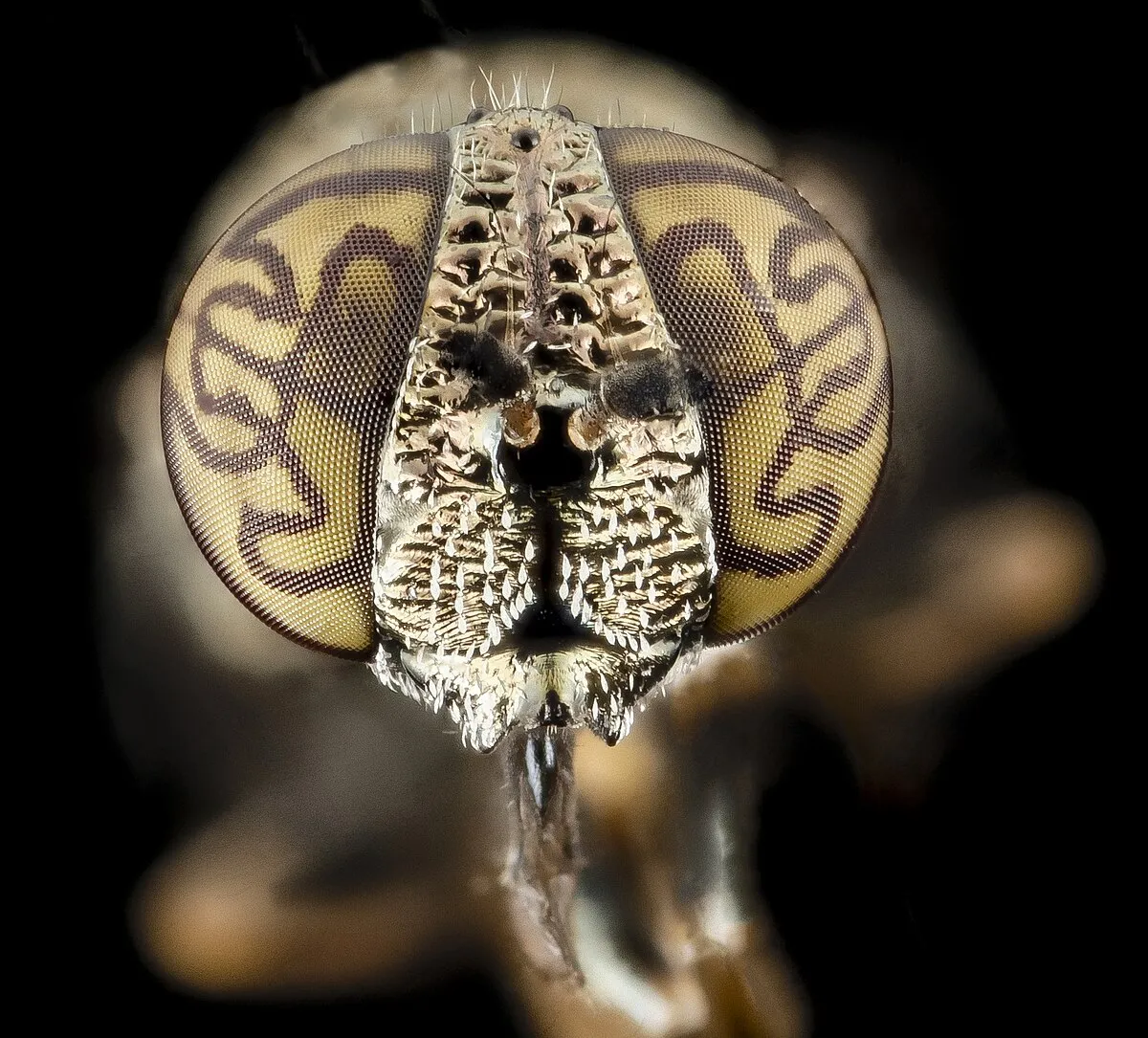
Strictly, a macro image is one in which the image on the sensor is "life-size or larger (i.e., optical reproduction ratio ≥ 1:1)" (Wikipedia, "Macro photography"). Many lenses sold as "macro" reach only 1:2; a typical non-macro lens reaches about 1:10.
Macro
A small fly's face fills the frame, with the patterned compound eyes resolved in detail.Photo: Sam Droege, USGS Bee Inventory and Monitoring Lab. Public domain (US government work).
A cheaper route is a close-up lens ("diopter") on the front of an ordinary lens; its power is the reciprocal of its focal length in metres, so a +2 diopter is 0.5 m (Wikipedia, "Close-up lens").
Minimum focus distance (MOD)
Minimum focus distance is the closest the lens can focus, stated by cinema makers as the minimum marked object distance (MOD) from the focal plane. Cooke's S4/i 50 mm has a MOD of 550 mm.
Cooke S4/i minimum marked object distance (MOD), mm
18 mm250 mm
25 mm250 mm
32 mm325 mm
50 mm550 mm
75 mm800 mm
100 mm950 mm
135 mm850 mm
180 mm1,300 mm
300 mm2,100 mm
Source: Cooke Optics S4/i specifications, checked 18 November 2026. The 135 mm focuses closer than the 100 mm.
Aperture: f-stop vs T-stop
Aperture
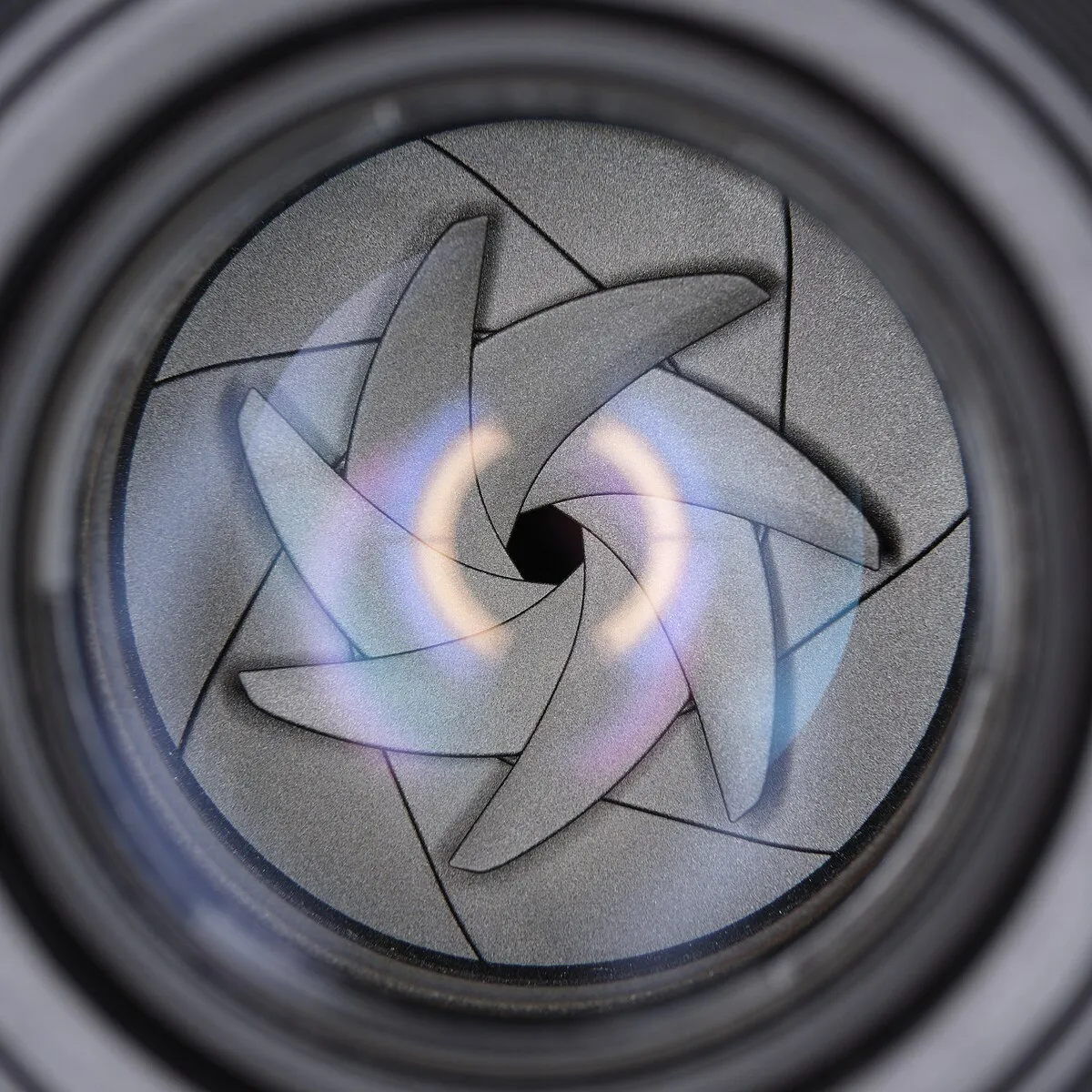
The aperture is "the hole or opening that primarily limits light propagated through the system" (Wikipedia, "Aperture"). In a cine lens it is an adjustable iris: opening it lets in more light and reduces depth of field.
Aperture
Looking into a lens: the curved iris blades close down to a small opening in the centre.Photo: D-Kuru, Wikimedia Commons, CC BY-SA 4.0.
Iris openings across the standard stop scale; each step halves the light.
f-stop (f-number)
The f-number is the focal length divided by the entrance pupil diameter (Wikipedia; MovieLabs uses the same definition). The scale runs in powers of √2, f/1.4, 2, 2.8, 4, 5.6, 8, 11, 16, and each step halves the light.
Example. Stanley Kubrick bought three of the ten Carl Zeiss Planar 50mm f/0.7 lenses made for NASA, which let him shoot scenes in Barry Lyndon lit only by candlelight (Wikipedia).
T-stop
A T-stop is "an f-number adjusted to account for light transmission efficiency" (Wikipedia): it corrects the geometric f-stop for light the glass absorbs, so it is never lower than the f-number (MovieLabs agrees):
T = N ÷ √(transmittance)
e.g. an f/2.0 lens transmitting 75% of the light: T = 2.0 ÷ √0.75 ≈ T2.3
Cinema lenses are marked in T-stops so two lenses at the same stop match exposure across a cut (Yedlin). Depth of field still follows the f-stop (Fstoppers). In a prompt, "T2" and "f/2" mean nearly the same thing.
Aperture is one of three exposure controls, alongside shutter and sensitivity; on cinema lenses it is set in T-stops.
Depth of field, focus and sharpness
Depth of field (DOF)
Depth of field is "the distance between the nearest and the farthest objects that are in acceptably sharp focus" (Wikipedia, "Depth of field"). An approximation:
DOF ≈ 2 u² N c ÷ f²
u = subject distance, N = f-number, c = circle of confusion, f = focal length
Shallow depth of field
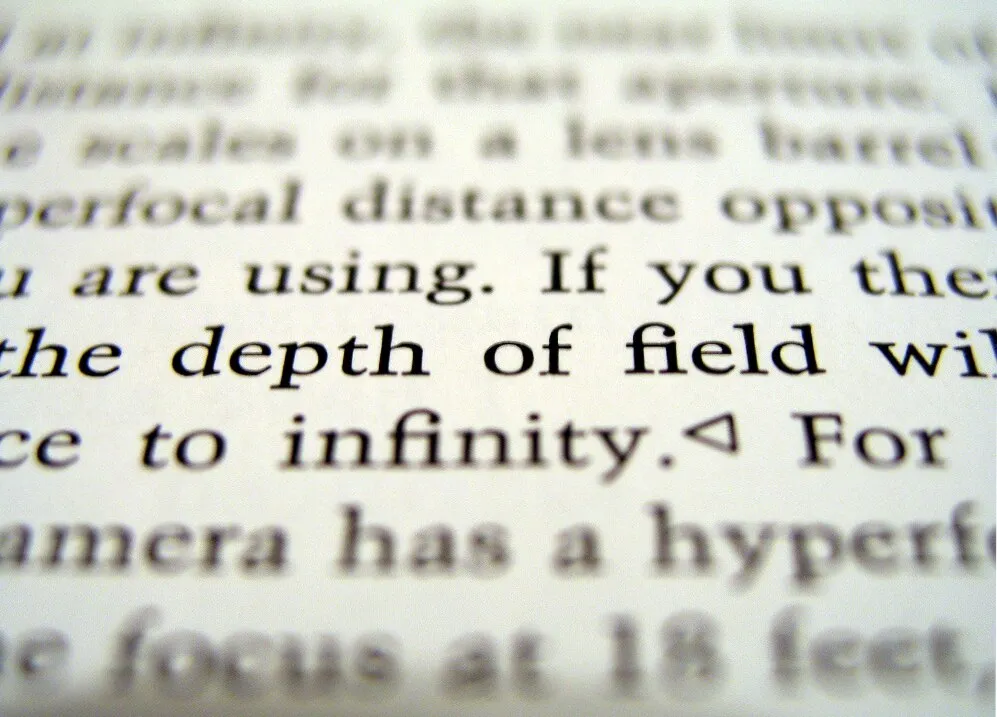
Only one line of the printed page is sharp; the lines above and below fall quickly out of focus.Photo: PiccoloNamek, Wikimedia Commons, CC BY-SA 3.0.
It grows with the square of distance and shrinks with the square of focal length, but only changes linearly with f-number, so distance matters more than aperture. Sensor size enters through c (cameras and sensors).
f/1.4
f/2.8
f/5.6
f/16
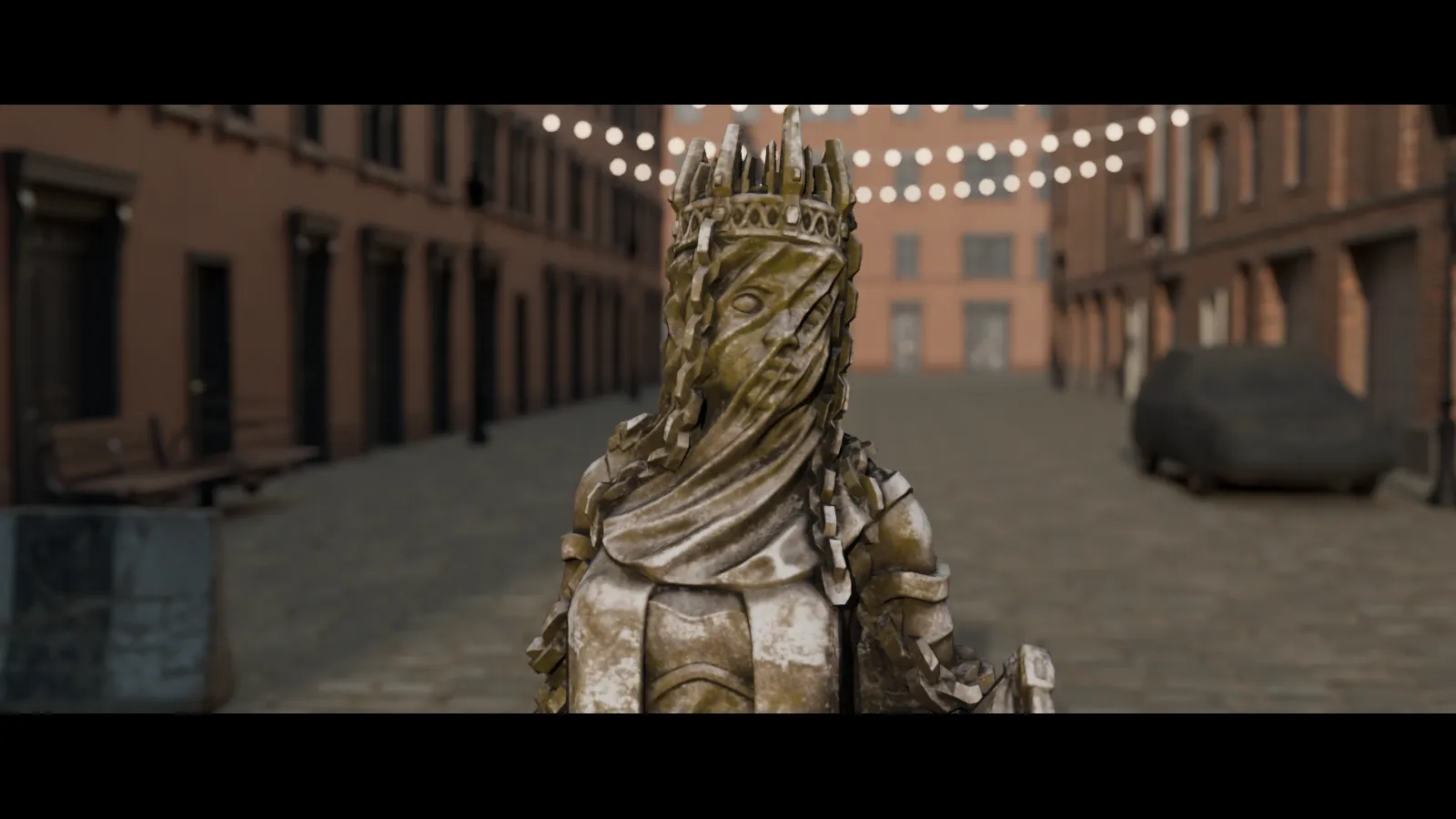
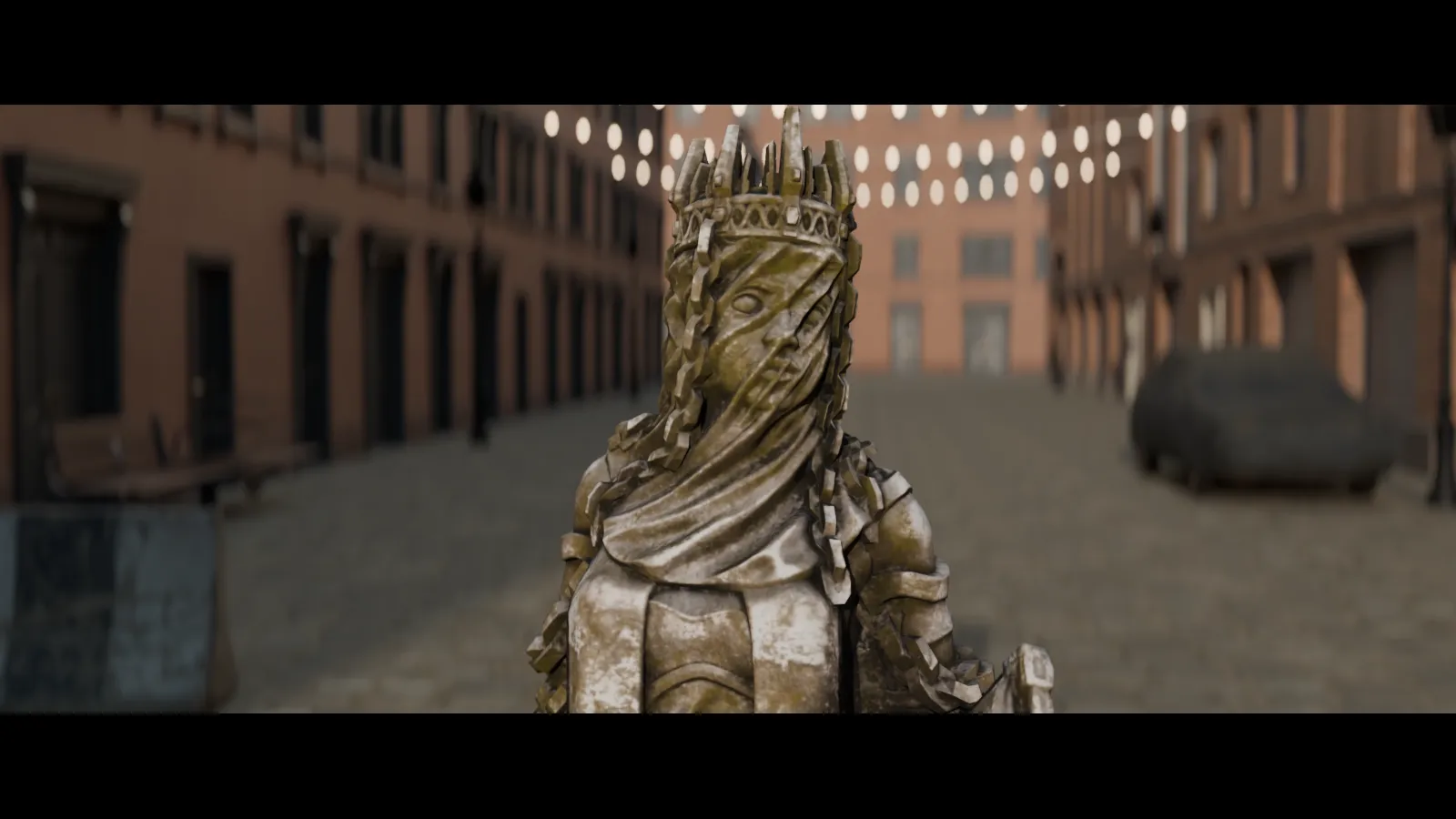
One variable changed: the f-number. 85 mm on full frame, focused on the statue's face 5.0 m away; the end of the street is about 70 m behind it. Exposure is held constant so only the blur changes (on a real camera each stop down would also halve the light). Rendered in Vinc's virtual camera lab with a 9-blade iris.Scene: CC0 Poly Haven assets (Gothic Statue by Benny Weimer; facades by James Ray Cock; others listed in our lab notes).
35 mm · 3 m · f/2
35 mm · 3 m · f/5.6
35 mm · 3 m · f/16
Row 1: 35 mm, statue 3 m away. Even at f/2 the background is only slightly soft. Rendered in Vinc's virtual camera lab.Scene: CC0 Poly Haven assets (Gothic Statue by Benny Weimer; facades by James Ray Cock; Fire Hydrant by Gonçalo Felício).
85 mm · 3 m · f/2
85 mm · 3 m · f/5.6
85 mm · 3 m · f/16
Row 2: 85 mm, same 3 m. Now f/2 dissolves the background and f/16 brings it back. Rendered in Vinc's virtual camera lab.Scene: CC0 Poly Haven assets (Gothic Statue by Benny Weimer; facades by James Ray Cock; Fire Hydrant by Gonçalo Felício).
85 mm · 7 m · f/2
85 mm · 7 m · f/5.6
85 mm · 7 m · f/16
Depth of field as a grid: each row changes focal length or distance, each column the f-number. Focus is on the statue's face, the camera is on full frame, and the street end is about 70 m behind. Rows from the top: 35 mm at 3 m, 85 mm at 3 m, 85 mm at 7 m. Going from 35 to 85 mm at the same distance does more to the background than going from f/5.6 to f/2. Rendered in Vinc's virtual camera lab.Scene: CC0 Poly Haven assets (Gothic Statue by Benny Weimer; facades by James Ray Cock; Fire Hydrant by Gonçalo Felício).
Deep focus. Gregg Toland shot most Citizen Kane interiors "at apertures not greater than f:8 — and often smaller," on 24–35 mm lenses (American Cinematographer, 1941).
Depth of field: the zone between the near and far limits that looks acceptably sharp around the plane of focus.
Circle of confusion (CoC)
A circle of confusion is the blur spot a point of light makes when it isn't in perfect focus (Wikipedia); depth of field depends on how large that spot may be before it looks blurred. Cooke's tables use 0.025 mm, stills photographers 0.029–0.033 mm for full frame: a viewing convention, not a constant.
Hyperfocal distance
Hyperfocal distance is the focus setting that gives the most depth of field reaching to infinity: everything "from half of the hyperfocal distance out to infinity" is sharp (Wikipedia):
H = f² ÷ (N × c) + f
f = focal length (mm), N = f- or T-number, c = circle of confusion (mm)
With c = 0.025 mm (our arithmetic):
Focal length
f/2.8
f/4
f/5.6
f/8
18 mm
4.6 m
3.3 m
2.3 m
1.6 m
25 mm
9.0 m
6.3 m
4.5 m
3.1 m
35 mm
17.5 m
12.3 m
8.8 m
6.2 m
50 mm
35.8 m
25.1 m
17.9 m
12.6 m
Rack focus, pull focus
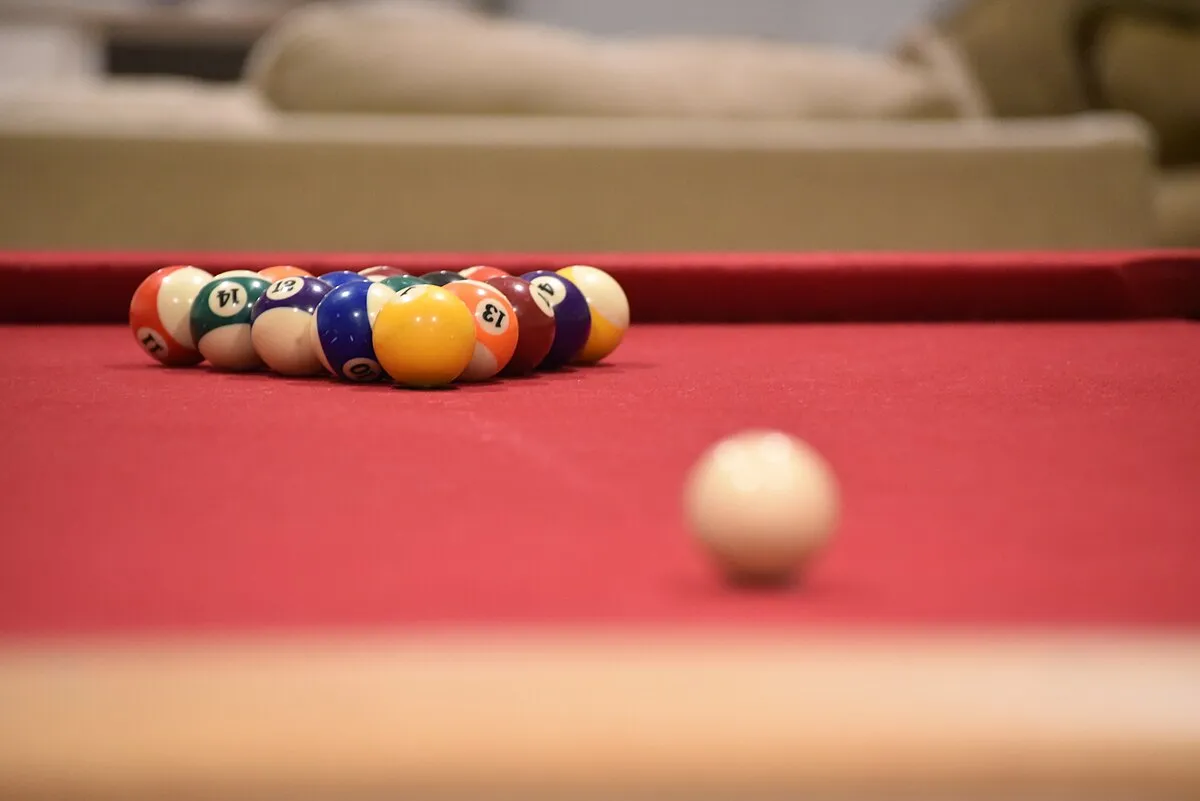
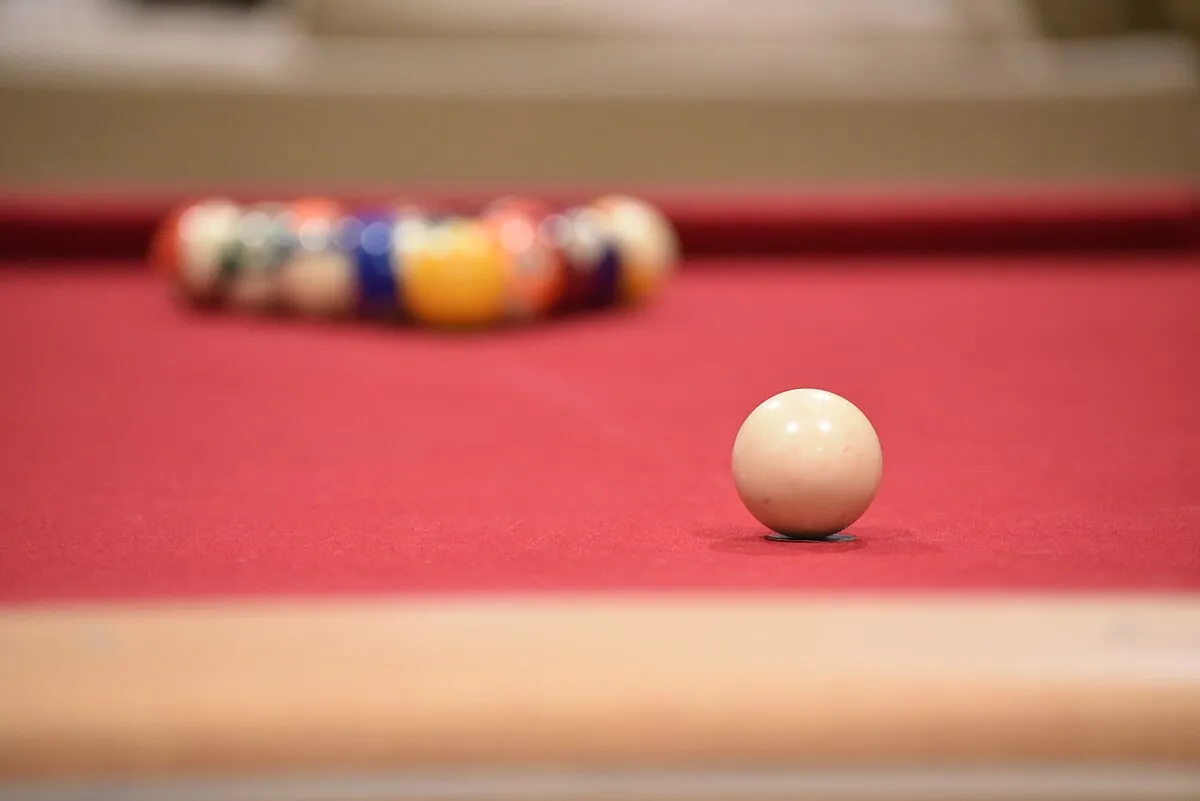
To pull focus is to keep the lens's focus distance matched to a moving subject (Wikipedia, "Focus puller"). A rack focus deliberately shifts focus from one subject or plane of depth to another during a single shot.
Focus on the rack
Focus on the cue ball
The same framing with focus on the far rack of balls (left) and then on the cue ball in front (right).Photos: Candeadly, Wikimedia Commons, CC BY 4.0.
Focus puller (first assistant camera, 1st AC)
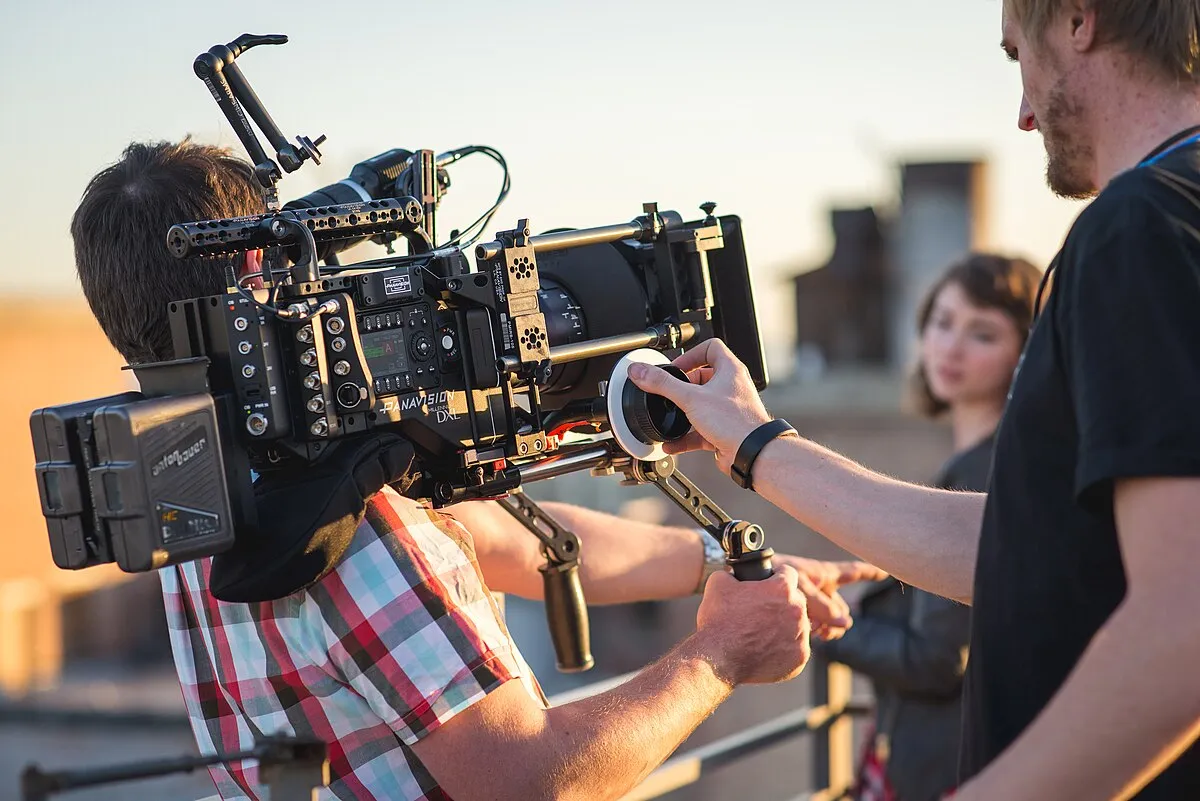
The focus puller is the camera department member "whose primary responsibility is to maintain the camera lens's optical focus" (Wikipedia). The 1st AC measures the distance to each actor's mark and marks it on a follow-focus disc.
Focus puller
As the operator frames on a shoulder rig, an assistant beside him turns the follow-focus wheel on the lens.Photo: Elio Yañez, Wikimedia Commons, CC BY 2.0.
Lens breathing
Breathing is a change in field of view when a lens changes focus (Wikipedia, "Breathing (lens)"): during a focus pull the frame appears to zoom slightly.
Split diopter
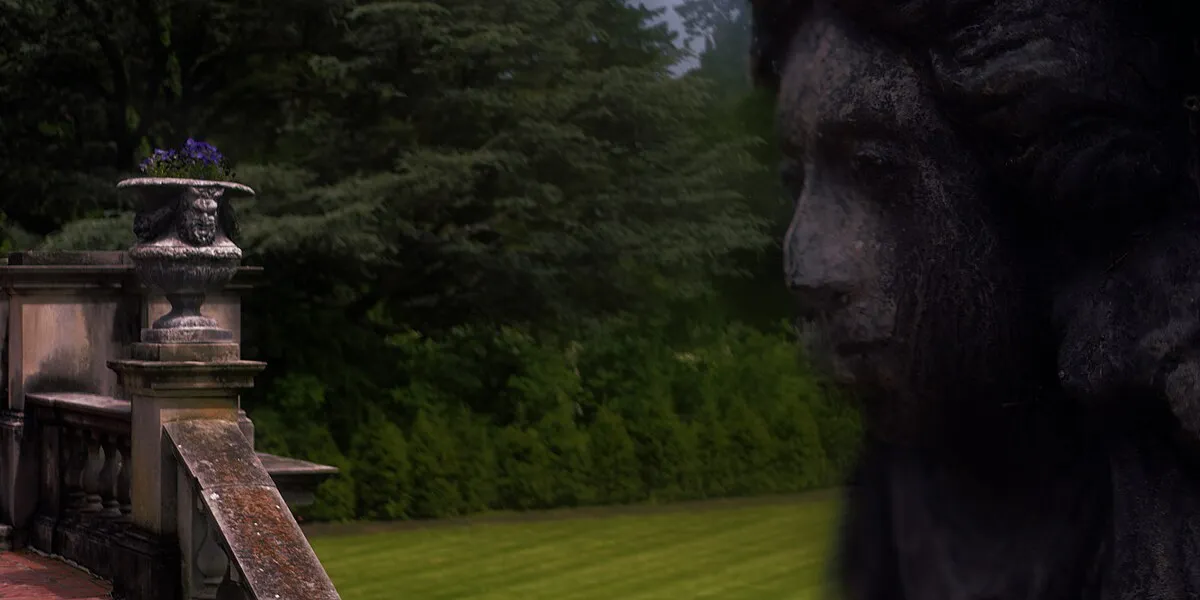
A split diopter is a close-up lens cut in half and placed in front of the main lens, so one half of the frame focuses close and the other far: "the illusion of deep focus" without stopping down (Wikipedia, "Deep focus").
Split diopter
A stone face close to the lens on the right and the garden terrace on the left are both sharp, with a soft seam between them.Photo: SavidgeMichael, Wikimedia Commons, CC BY 4.0.
Tilt-shift
Tilt-shift lenses change "the orientation or position of the lens with respect to the film or image sensor" (Wikipedia), so you can move the plane of focus or straighten converging lines without moving the camera.
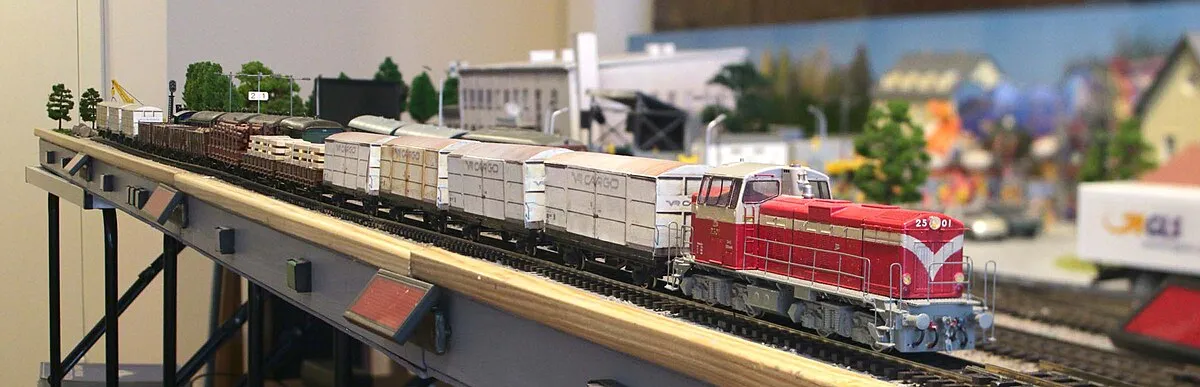
Tilt rotates the plane of focus (the Scheimpflug principle): focus along a tabletop, or a thin band for the "miniature" look.
Shift slides the lens parallel to the sensor, keeping verticals parallel in architecture.
Tilt lens
A tilted lens keeps the whole length of the model train sharp, from the near wagons to the locomotive.Photo: Janke, Wikimedia Commons, CC BY-SA 4.0.
The character of a lens: bokeh, flare, distortion and more
Bokeh
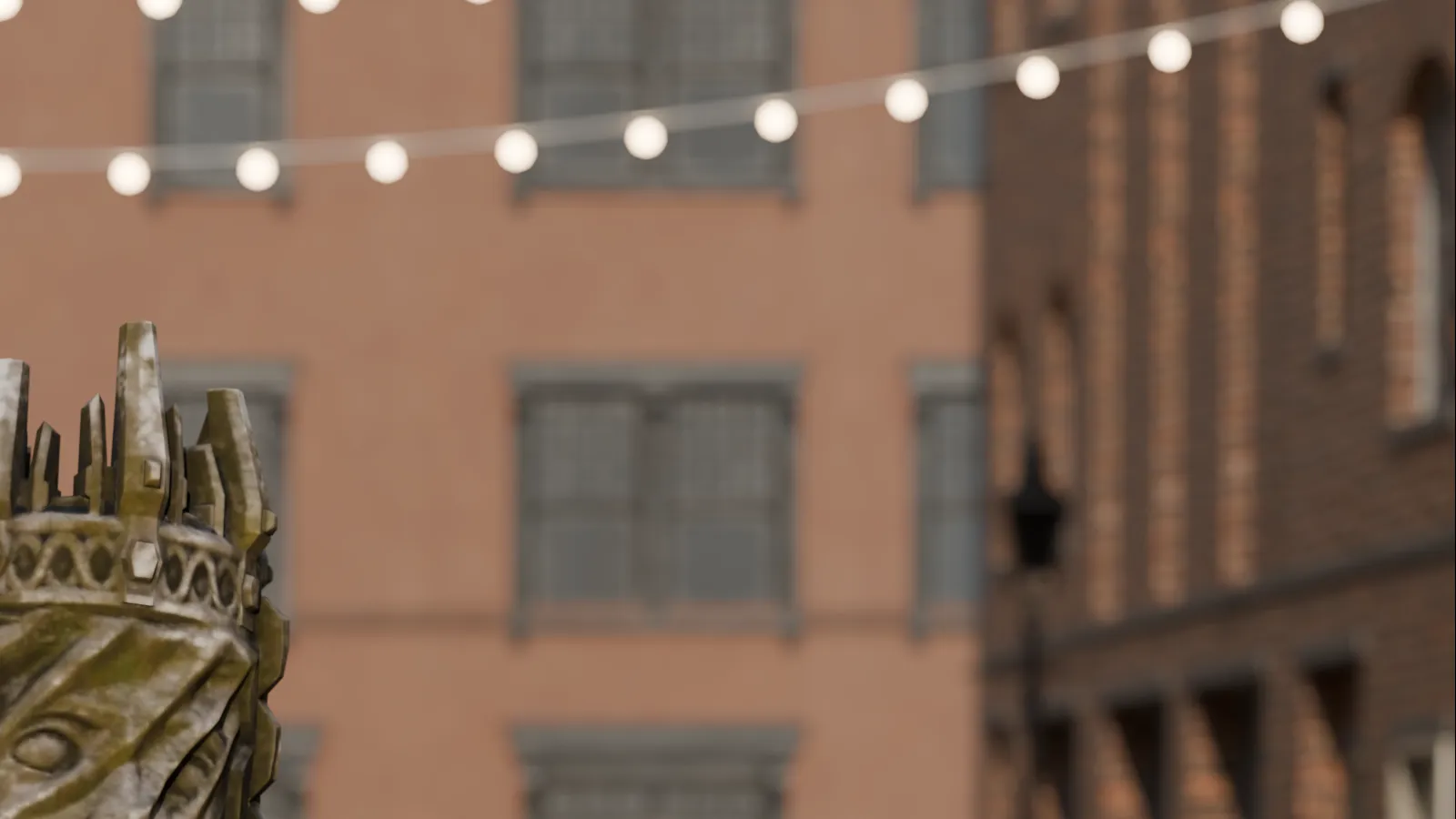
Bokeh is the quality, not the amount, of the out-of-focus areas of an image. The word comes from the Japanese boke, "blur" or "haze" (Wikipedia, "Bokeh"). Out-of-focus highlights follow the iris shape, so bladed irises give polygons and anamorphic lenses give ovals.
Bokeh
Behind the girl, out-of-focus highlights in the foliage melt into soft round discs.Photo: carlosluis, Wikimedia Commons, CC BY 2.0.
f/1.4
f/5.6
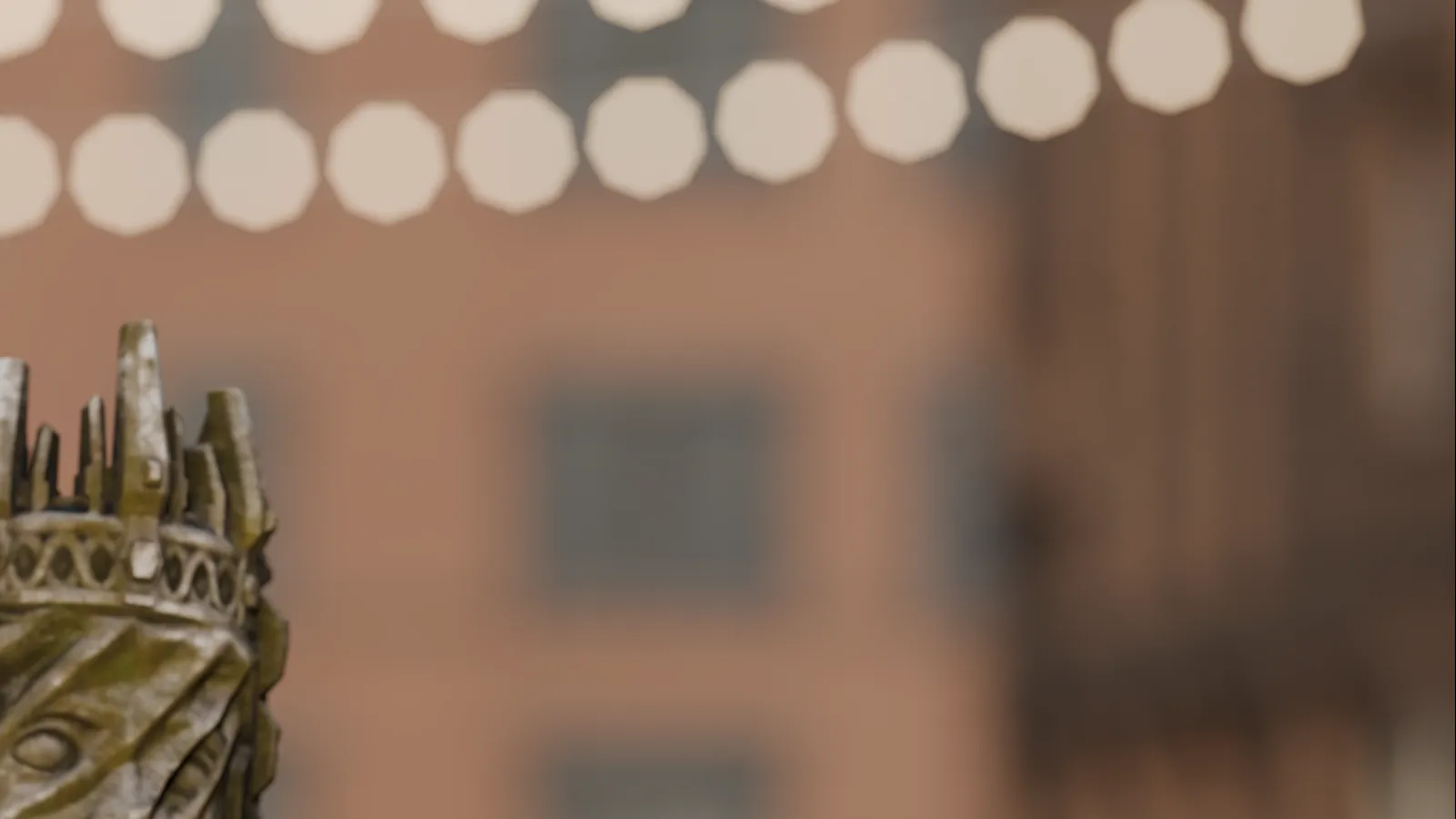
Close-up of the same 85 mm frames (top right third, rendered at 3× resolution): festoon bulbs 9–36 m behind a statue in focus at 5 m. At f/1.4 each bulb becomes a nine-sided disc, the shape of a 9-blade iris. At f/5.6 the discs shrink to small, still slightly soft spots. Rendered in Vinc's virtual camera lab.Scene: CC0 Poly Haven assets (Gothic Statue by Benny Weimer; facades by James Ray Cock).
Lens flare
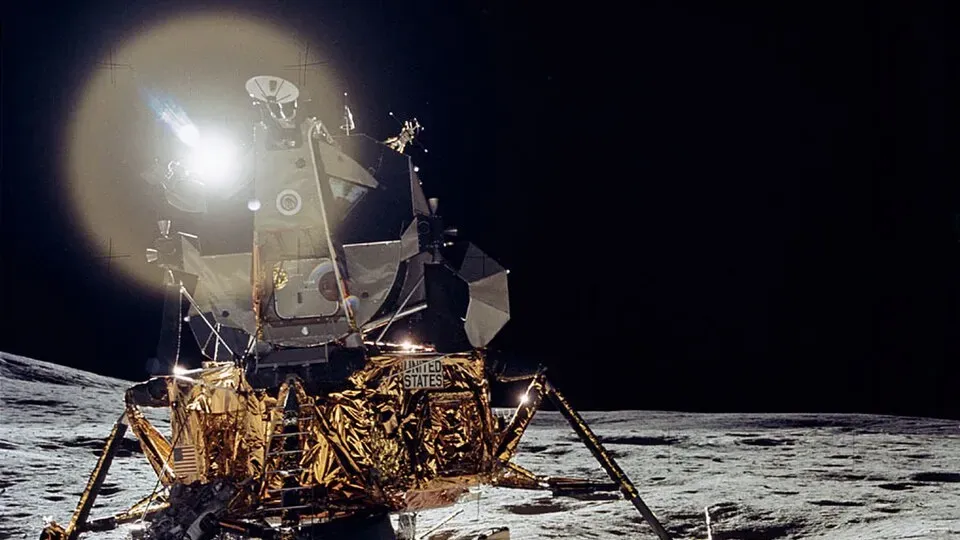
Flare is light scattering inside a lens (Wikipedia, "Lens flare"). It shows as veiling glare, which lowers contrast across the whole frame, or as visible ghosts, often iris-shaped. Many-element zooms flare more; a hood or matte box reduces it.
Lens flare
The sun behind the lunar module spreads into a large, bright flare in the lens.NASA photograph. Public domain (US government work).
Vignetting
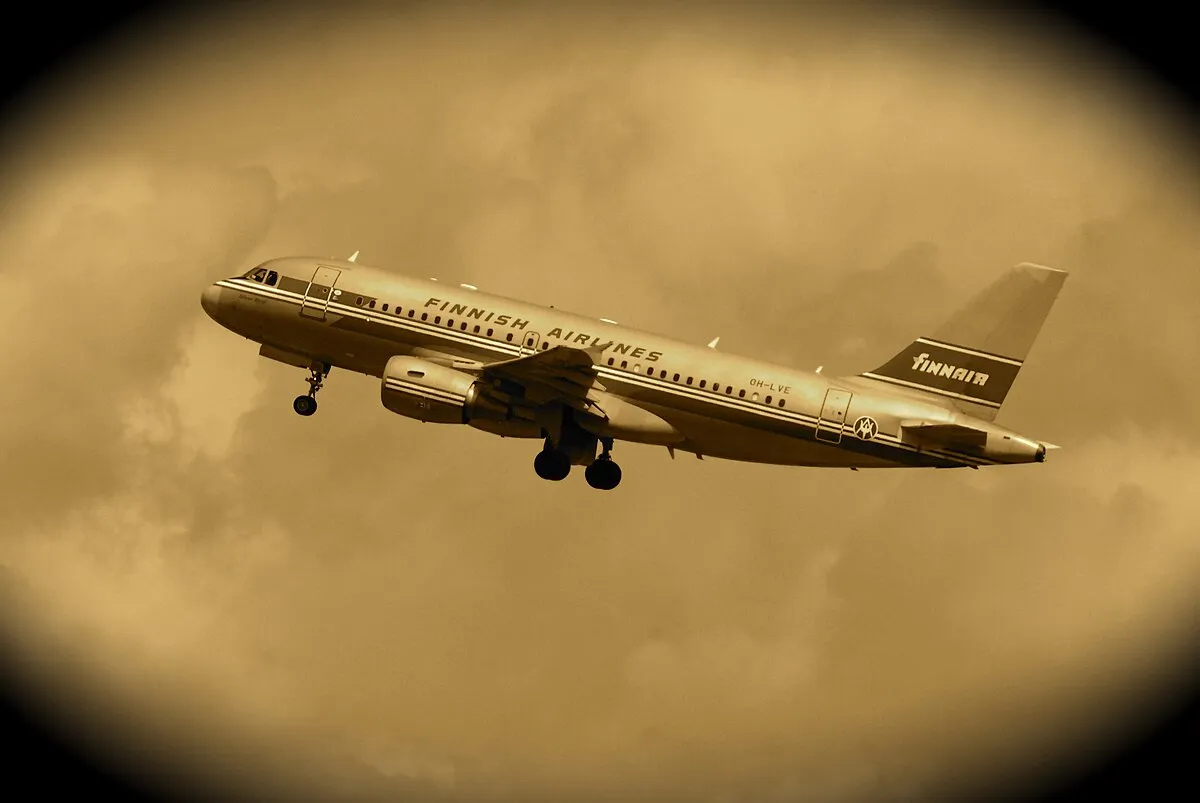
Vignetting is a darkening or desaturation toward the frame edges (Wikipedia). Mechanical vignetting comes from stacked filters or a wrong hood; natural falloff follows the "cosine fourth" law and doesn't go away when you stop down.
Vignetting
The frame darkens strongly toward the corners around an aircraft in the centre.Photo: Aero Icarus, Wikimedia Commons, CC BY-SA 2.0.
Chromatic aberration
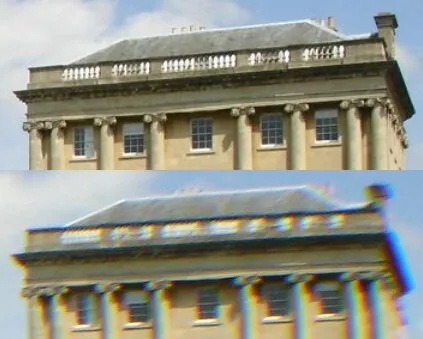
Chromatic aberration is "a failure of a lens to focus all colors to the same point" (Wikipedia), seen as colour fringes on high-contrast edges. Axial fringing shrinks when you stop down; lateral fringing shows toward the frame edges.
Chromatic aberration
The same building shot twice: the bottom version, through an added wide-angle lens, shows coloured fringes along the edges.Photo: Stan Zurek, Wikimedia Commons, CC BY-SA 3.0.
Distortion: barrel and pincushion
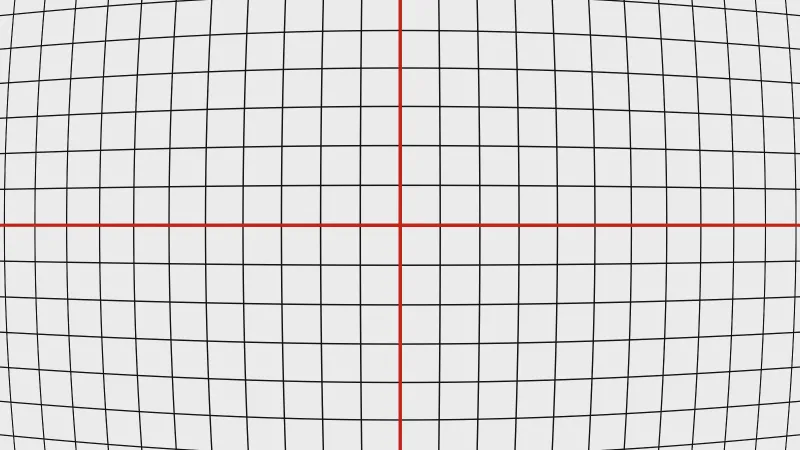
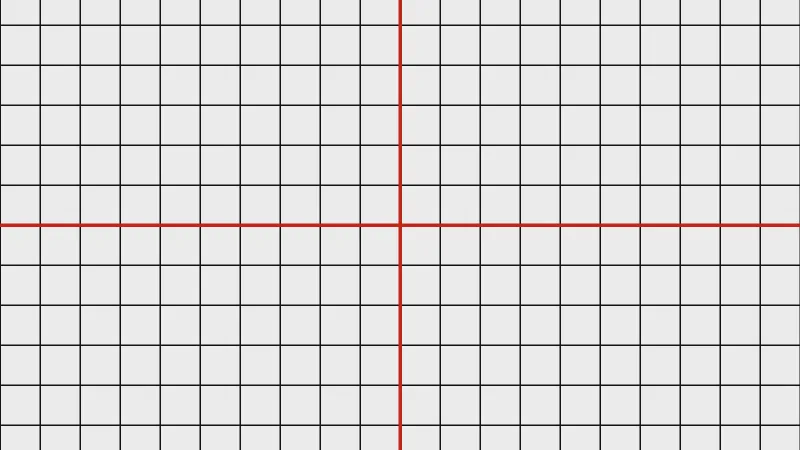
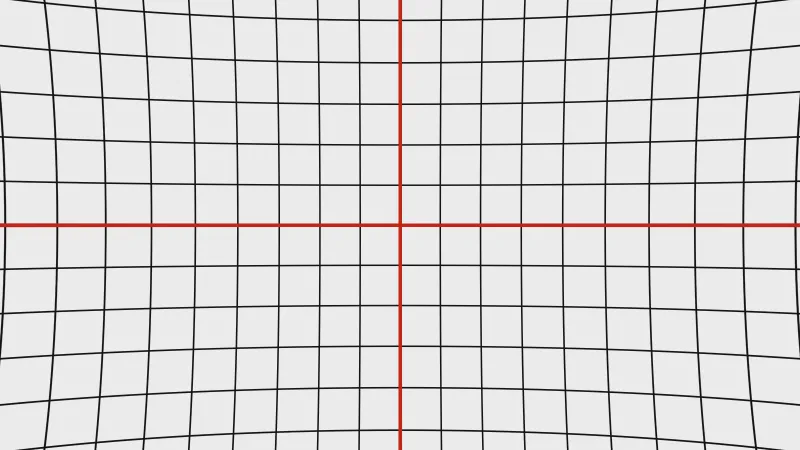
Barrel and pincushion are the two common radial distortions (Wikipedia, "Distortion (optics)"): with barrel, magnification falls toward the edges and straight lines bow outward (fisheyes, the wide end of zooms); with pincushion it rises and they pinch inward. Holben calls this "a property of the glass elements," unlike perspective, which depends only on where the camera stands.
Barrel
Rectilinear
Pincushion
A flat grid chart through three lenses, simulated with the first radial term of the Brown–Conrady model: r_source = r × (1 + k1·r²), with r measured from the centre and normalised to the half-diagonal. Barrel uses k1 = +0.15, pincushion k1 = −0.12. Lines through the centre (red) stay straight in all three. Simulated by Vinc.Grid chart generated by Vinc.
Barrel
Rectilinear
Pincushion
The same three lenses on a street: a 24 mm view on full frame, rendered with 30% extra field and then remapped with the k1 values above. Watch the building edges and the festoon wires. They bow outward with barrel and pinch inward with pincushion, while the perspective (where the camera stands) is identical in all three. Rendered in Vinc's virtual camera lab.Scene: CC0 Poly Haven assets (Gothic Statue by Benny Weimer; facades by James Ray Cock; Fire Hydrant by Gonçalo Felício).
Anamorphic squeeze
A spherical lens records the image at true proportions; an anamorphic lens uses cylindrical optics "to horizontally compress or 'squeeze' the image during recording", and it is stretched back out in projection or post (Wikipedia). The squeeze factor is usually 2× for cinema.
Spherical 31 mm
2× anamorphic 50 mm
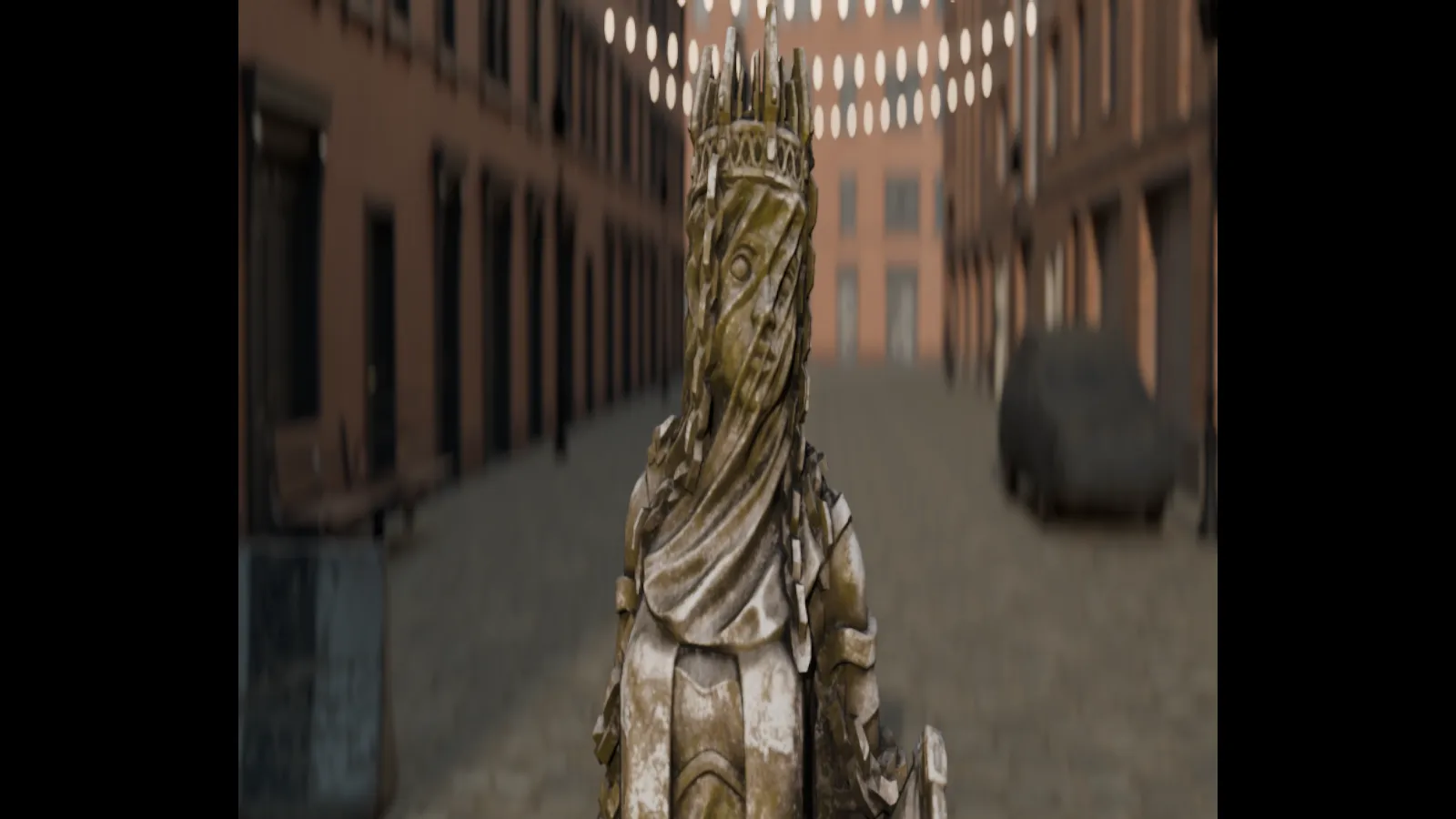
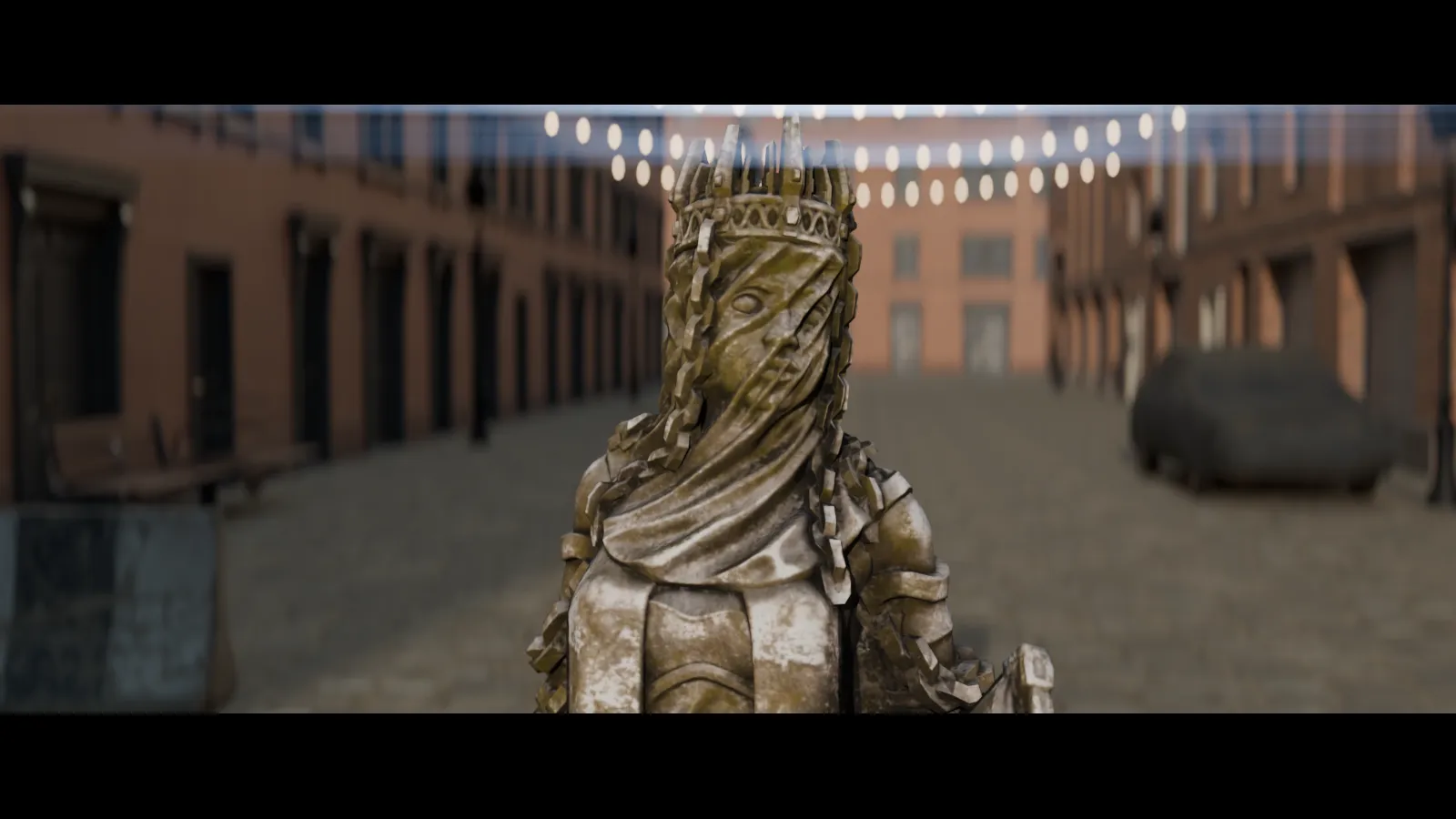
Matched horizontal view (44° across a 2.39:1 frame), same spot, f/1.8, focused on the statue 1.9 m away. Left: a 30.8 mm spherical lens on Super 35 (24.88 mm wide). Right: a 2× anamorphic 50 mm on the ALEXA 35's 3.3K 6:5 area (20.22 × 16.95 mm), desqueezed. The anamorphic keeps a 50 mm's vertical view and depth of field, so the festoon bulbs blur into tall ovals rather than round discs. Rendered in Vinc's virtual camera lab with a 9-blade iris and a 2:1 oval entrance pupil.Scene: CC0 Poly Haven assets (Gothic Statue by Benny Weimer; facades by James Ray Cock; others listed in our lab notes).
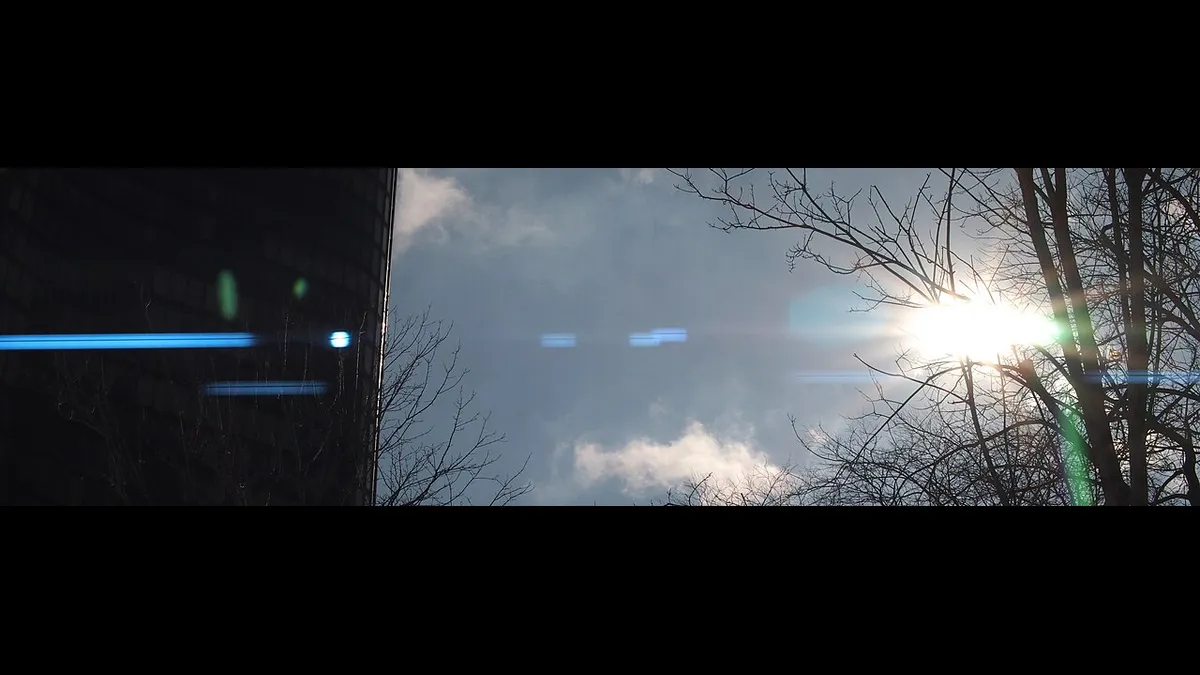
"A 50mm anamorphic lens with a 2x squeeze will have the horizontal view of a 25mm spherical lens, while maintaining the vertical view and depth of field of a 50mm" (Wikipedia). RED's guide lists the visible results: elongated bokeh, bluish horizontal flare streaks across the frame, and "a shallower, more cinematic depth of field."
A 2x anamorphic lens squeezes the scene horizontally onto the sensor; de-squeezing restores a frame twice as wide.
As recorded (squeezed)
Desqueezed + streak effect
Left: the same anamorphic frame as the sensor records it, 2× squeezed, before the desqueeze. Right: the desqueezed frame with a horizontal blue streak added to the brightest highlights. The streak is a labelled post effect that imitates the flare of a cylindrical front element, not a simulation of real lens glass. Rendered in Vinc's virtual camera lab.Scene: CC0 Poly Haven assets.
Anamorphic flare
Through a 2× anamorphic lens, the sun behind bare branches throws thin blue horizontal streaks across the frame.Photo: Chad Kainz, Wikimedia Commons, CC BY 2.0.
CinemaScope
CinemaScope is the 2× anamorphic system 20th Century Fox launched in 1953 with The Robe, built on Henri Chrétien's Hypergonar lens patented in 1927 (Cinémathèque française). Its ratio wavered between 2.55 and 2.66:1 before settling at 2.35:1. Panavision's 1958 Auto Panatar lenses "eliminated the distortions created by early CinemaScope optics".
Filters
ND (neutral density) filter
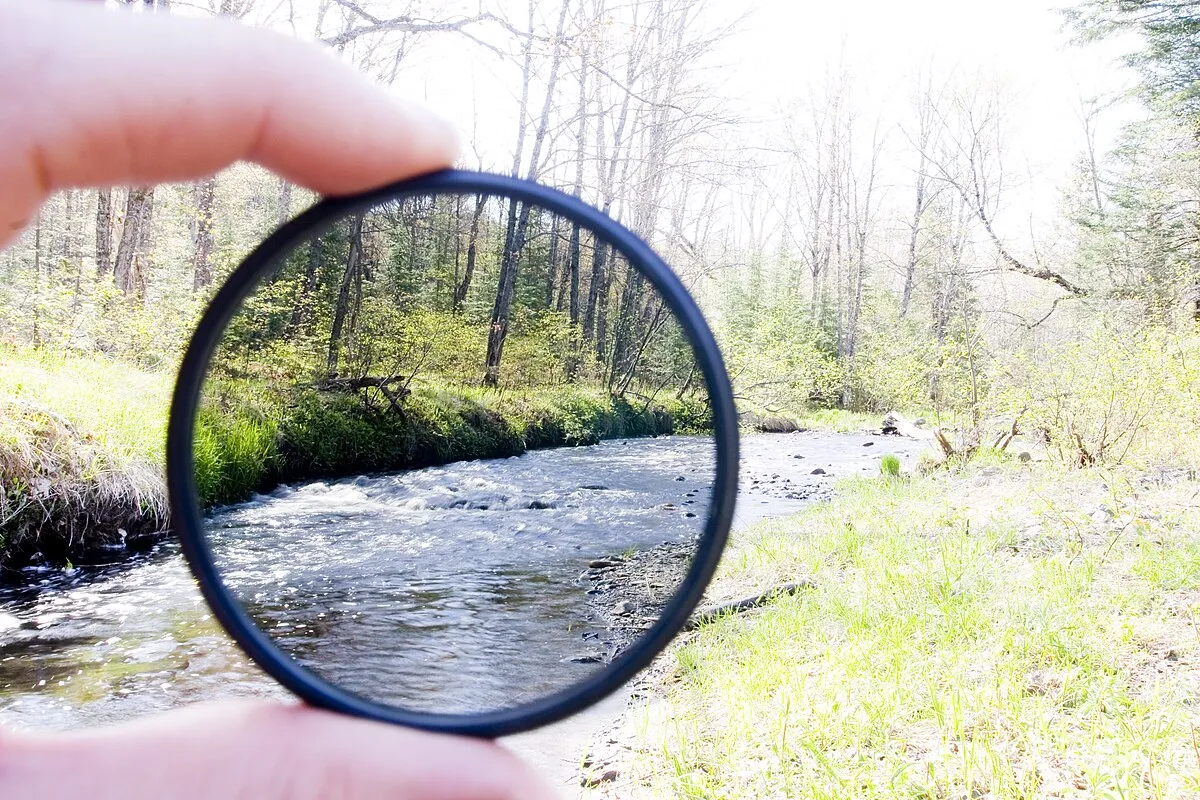
An ND filter cuts "all wavelengths, or colors, of light equally" (Wikipedia), so you can keep a wide aperture or a standard shutter angle in bright light. Each 0.3 of density is about one stop:
Density
Light transmitted
Stops
ND 0.3
50%
1
ND 0.6
25%
2
ND 0.9
12.6%
3
ND 1.2
6.3%
4
ND 1.8
1.6%
6
ND 2.1
0.8%
7
ND filter
Seen through the filter held up to the stream, the scene is darker but its colours are unchanged.Photo: Robert Emperley, Wikimedia Commons, CC BY-SA 2.0.
Polariser
A polarising filter is used "to darken skies, manage reflections, or suppress glare from the surface of lakes or the sea" (Wikipedia). Rotating it removes partly polarised reflections from non-metallic surfaces; circular polarisers keep autofocus working.
Polariser
Two halves of the same view: on the left, with the polariser turned for full effect, the sky is a deeper blue.Photo: Angus MacRae, Wikimedia Commons, CC BY 2.0.
Diffusion filters
A diffusion filter is placed "between the camera and the subject for a hazy effect" (Wikipedia, "Diffuser (optics)"). It softens fine detail, makes highlights bloom and lowers contrast, in grades from light to heavy (Tiffen's Black Pro-Mist is a common example).
How to phrase lenses in a prompt
Google's prompt guide (Veo and Gemini Omni Flash, updated 17 November 2026) has wide-angle, telephoto, shallow depth of field, fisheye, lens flare and rack focus examples, but warns that "some advanced camera lenses are not officially supported." LTX's guide lists "lens flares". Our illustration, not a vendor's: give focal length and format, then the visible result.
24mm on full frame, about 74° across: the camera is close to the actor,
the room behind her stays large and visible

135mm on full frame, about 15° across: the camera is far down the street,
the buildings behind him look stacked close, shallow depth of field

2x anamorphic, 2.39:1, oval out-of-focus highlights,
a thin blue horizontal flare from the headlights
If the model ignores the number, the described result is still in the prompt.
How we compiled this
Definitions come from Wikipedia and MovieLabs, checked against maker pages (Cooke, RED, ARRI, Panavision), American Cinematographer, Steve Yedlin, the Cinémathèque française and the Google and LTX guides. Angle, hyperfocal, T-stop and ND figures are our arithmetic. Checked 18 November 2026. Vinc makes an AI film studio.
The renders. "Rendered in Vinc's virtual camera lab" images are path-traced in Blender's Cycles from CC0 Poly Haven assets, with real sensor widths and focal lengths and a thin lens with a 9-blade iris. They show what the optics predict, not lens aberrations, noise or any maker's colour science.
Aspect Ratios in Film Explained: 1.33 to 2.39 and 9:16, With the History and Delivery Specs
Aspect ratios in film are width divided by height. See where 1.375, 1.85, 2.39, 16:9, IMAX and 9:16 came from, and the containers cinemas and Netflix expect.

 14 mm