The film grain effect is clumped dye clouds, heavier in shadows and faster stocks; halation is a red halo from light bouncing off the film base. Both explained.
Method. Kodak VISION3, Ektar and 2383 data sheets, Kodak's Essential Reference Guide for Filmmakers, American Cinematographer, Zeiss, Imatest, CineStill, Dehancer, FilmConvert and official Google, LTX, Kling and Luma prompt guides, checked November 18, 2026. Vinc makes an AI film studio.
What is film grain? Dye clouds, not noise
Film grain is the texture the eye reads in thousands of tiny, overlapping dye clouds left in developed film. Colour negative starts as silver halide crystals in gelatin, and Kodak's Essential Reference Guide for Filmmakers says crystal size and sensitivity set the film's speed: "the faster the film, the greater the apparent graininess of the image."
In development, colour couplers form cyan, magenta and yellow dye around each exposed crystal, then the silver is bleached away, leaving "colored dyeclouds where film grains used to be." Conservator Tim Vitale, drawing on Kodak publication H-1, puts the crystals at roughly 0.2 to 2.0 µm and the dye clouds at about 1 to 10 µm. No single cloud is visible on screen; the grain you see is their random clumping.
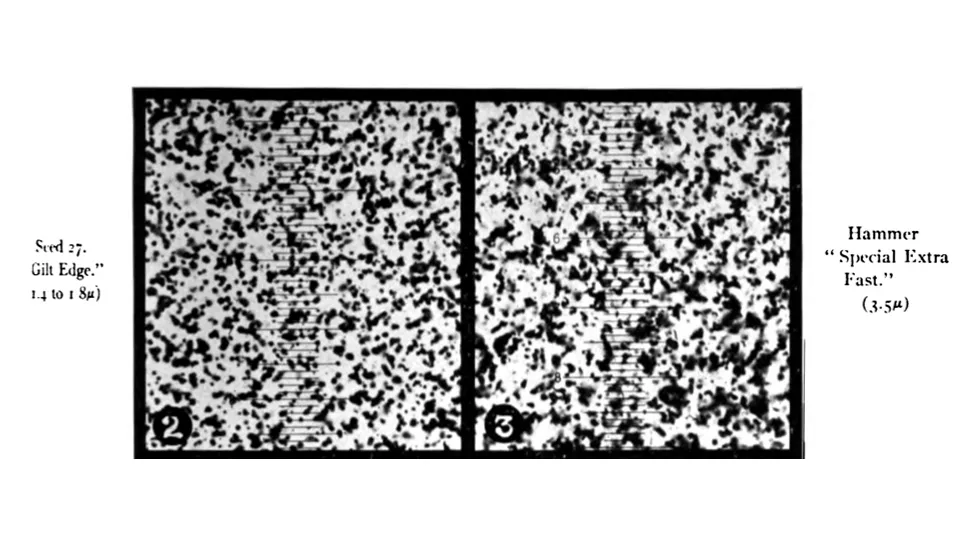
Silver grain
Developed silver grain in two photographic plates under a microscope: the plate labelled “Special Extra Fast” (3.5 µm) shows coarser clumps than the one labelled 1.4 to 1.8 µm.Robert James Wallace, The Astrophysical Journal (1904), Plate VII. Public domain (US).
Each colour record can have up to three layers (fast, medium and slow), and the fastest crystals are the largest. So, in Kodak's words, "graininess is more obvious in shadow areas and underexposed areas because the fastest, largest grains are predominantly exposed." Convincing grain is heavier in the shadows and midtones than in clean highlights.
How grain is measured, and why small formats look grainier
Kodak separates graininess, the visual impression, from granularity, the measurement: a microdensitometer with a 48-micron aperture reads density fluctuations at a net diffuse density of 1.00 above base, and the standard deviation multiplied by 1,000 gives the rms granularity. Values usually fall between 5 and 50, graded from "micro fine" (5 or less) through "fine" (16 to 20) to "very coarse" (45 to 55).
Kodak's current VISION3 data sheets plot granularity as curves rather than one number, and describe it in words:
Stock
Balanced for
Exposure index
With conversion filter
Kodak's grain wording
Source
VISION3 50D 5203
Daylight 5500K
50
12 tungsten (80A)
"Kodak's finest grain motion picture film"
H-1-5203, March 2022
VISION3 250D 5207
Daylight 5500K
250
64 tungsten (80A)
"noticeably reduced grain in shadows"
H-1-5207, March 2022
VISION3 200T 5213
Tungsten 3200K
200
125 daylight (85)
"measured granularity is exceptionally low"; "image structure of a 100-speed film"
Kodak brochure, 2025
VISION3 500T 5219
Tungsten 3200K
500
320 daylight (85)
"noticeably reduced grain in shadows"
H-1-5219, March 2022
Exposure index of Kodak VISION3 camera negatives in their native light
50D 520350
200T 5213200
250D 5207250
500T 5219500
Kodak technical data sheets H-1-5203, H-1-5207 and H-1-5219 (March 2022) and the VISION3 200T brochure (2025). Higher EI means faster film and, as a rule, larger crystals.
Format matters as much as stock. Kodak's glossary notes that a 16 mm frame is one quarter the size of a 35 mm frame, so it is enlarged twice as much in each direction to fill the same screen, grain included. Kodak's Ektar 100 still-film data sheet shows the effect with the Print Grain Index, where 25 is the threshold of visible grain and 4 units is a just-noticeable difference for 90 percent of observers:
Kodak Ektar 100 technical data, E-4046 (January 2025). The 4 × 6 in print from 35 mm, rated under 25, is left out because Kodak gives no exact value.
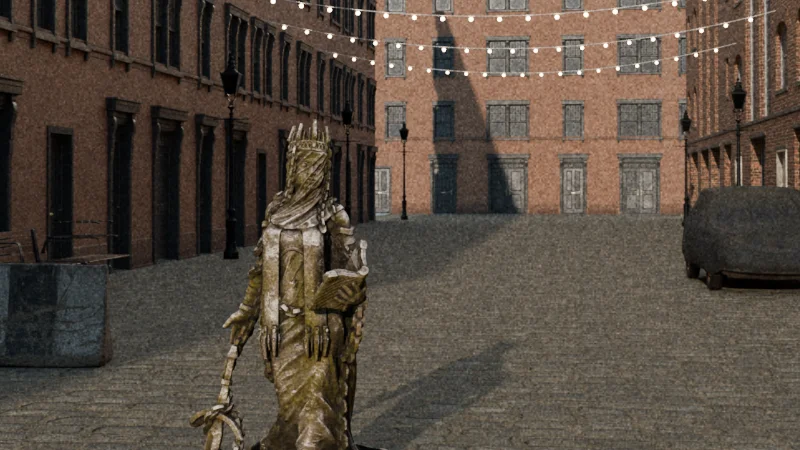
Same emulsion, different enlargement: the 16 x 20 print scores 38 from the bigger negative and 66 from 35 mm. "Super 8 grain" and "16mm grain" in a prompt ask for that magnification effect.
Super 8
16 mm
Super 35
65 mm
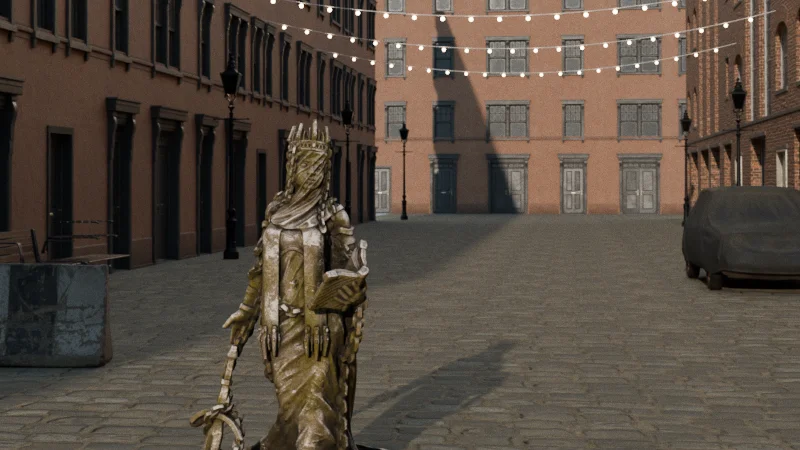
Simulation of the enlargement effect, shown as same-size crops of a 1,600-pixel-wide frame. One grain pattern is laid on the film at the same density in every gauge: random exposure variation on a 6-micron grid, of an assumed strength rather than a measured stock. Only the frame width changes: 5.79 mm (Super 8), 10.26 mm (16 mm), 24.89 mm (Super 35) and 52.48 mm (65 mm). Smaller gauges spread fewer grains across the same screen, so the grain looks bigger and stronger. Rendered in Vinc's virtual camera lab.Scene: CC0 Poly Haven assets (Gothic Statue by Benny Weimer; facades by James Ray Cock).
What is halation? Light that bounces off the back of the film
Halation is a glow around bright objects, caused by light reflecting off the film base back into the emulsion. Kodak: "Light penetrating the emulsion of a film can reflect from the base-emulsion interface back into the emulsion, causing a secondary exposure around images of bright objects." Kodak lists three ways to stop it:
Rem-jet, a removable black carbon layer on the back of the film with four jobs: antihalation, antistatic, lubrication and scratch protection. Labs strip it off before the developer.
An antihalation undercoat, a silver or dyed gelatin layer beneath the emulsion, cleared in processing.
A dyed base, a neutral grey tint, used mainly on black-and-white stocks.
Left: the anti-halation backing absorbs light that passes through the emulsion. Right: without it, light reflects off the back of the base into the emulsion and exposes a halo.
The 2022 VISION3 data sheets list "an acetate safety base with rem-jet backing," but American Cinematographer reported in September 2025 that Kodak is replacing rem-jet, which it invented in 1934, with an Anti-Halation Undercoat (AHU) on 5219, 5213, 5207 and 5203 in every format from Super 8 to 65 mm. Kodak said the new layer is dark brown and glossy rather than black and matte, sits within the same 5-micron thickness range, and will be available in limited volume at first.
Why red? Dehancer, which makes film emulation software, explains that the blue-sensitive layer sits nearest the lens, then green, and "the last and the deepest layer captures the red light." Reflected light reaches the red layer first; very bright sources also expose green, pushing the halo towards orange near the highlight.
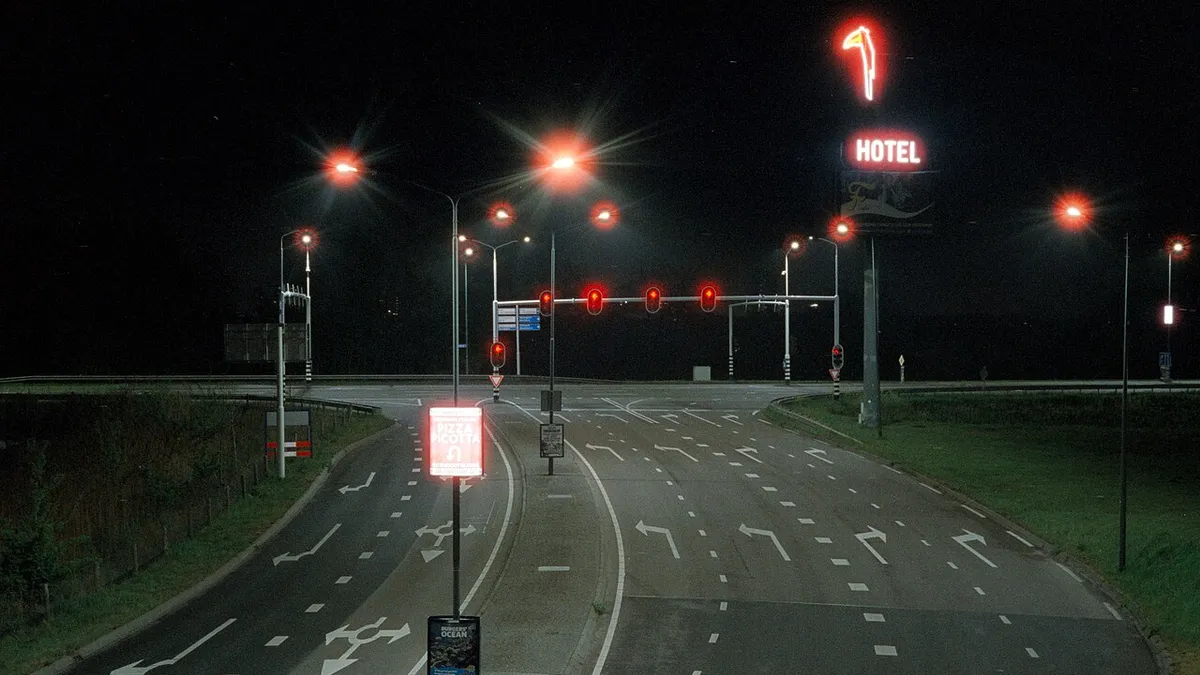
Remove the antihalation layer and the effect becomes the look. CineStill 800Tungsten is a tungsten-balanced 800-speed film "based on the same gold standard motion picture technology" used in cinema, with "no remjet adhesive layer," so it runs through standard C-41 still-film chemistry.
Halation
Shot on CineStill 800T: the street lamps, red traffic lights and neon hotel sign each carry a red-orange glow into the dark sky around them.Photo: Arandomphotographer, Wikimedia Commons, CC BY 4.0.
Dehancer's halation tool ships each profile in standard and no-remjet versions, noting that halation on films without rem-jet "is usually excessively pronounced."
None
Light
Heavy (no-rem-jet style)
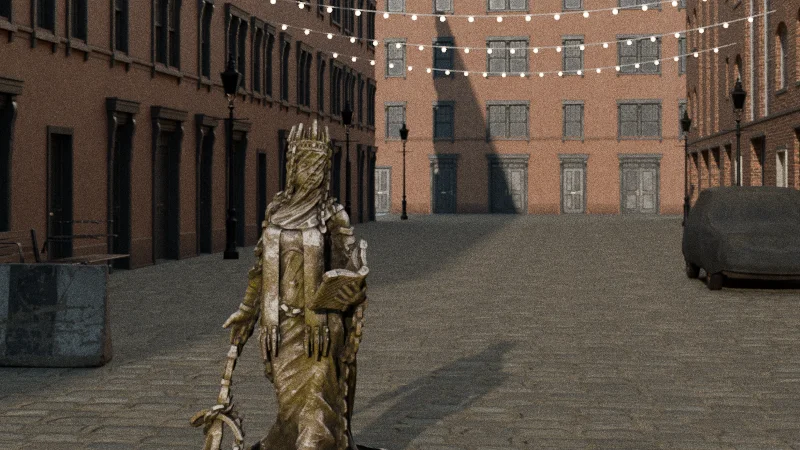
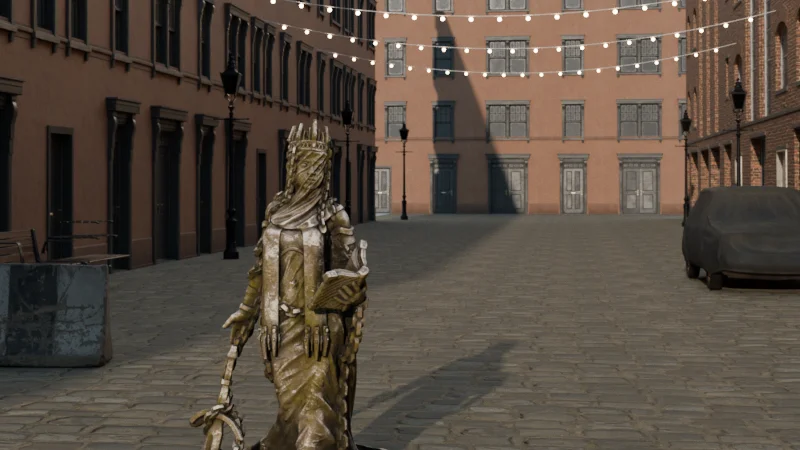
A simulation of halation strength on one lab render. Light above a threshold (scene-linear 1.5, about 3 stops above an 18% grey card at 0.18) is spread with a Gaussian 1.2% of the frame wide and added back in red-orange (1.0, 0.28, 0.06), the deep red layer first, as Dehancer describes. Strengths are 0, 0.3 and 0.8. The festoon bulbs and the bright sky edge pick up the fringe. Rendered in Vinc's virtual camera lab.Scene: CC0 Poly Haven assets (Gothic Statue by Benny Weimer; facades by James Ray Cock).
Bloom is a different glow
Emulation tools treat bloom and halation as separate controls. Dehancer: "Bloom almost always comes with Halation (although these effects are of different physical nature)." Halation happens inside the film stock and is coloured by the layer order; bloom is a soft, broad glow around bright areas, not tied to a colour layer.
Optics can glow before light reaches the film. Zeiss's coatings article (Vladan Blahnik and Benjamin Voelker, March 2016) shows light reflected inside a lens scattering as veiling glare that lowers shadow contrast, and Kodak notes soft-focus filters are used "to give the illusion of another time." In a prompt, "bloom" means a soft white glow; "halation" means a red-orange fringe hugging light sources.
Bloom
Halation
The two glows side by side, simulated on the same render. Bloom (left) is neutral: the whole image is blurred with a Gaussian 3% of the frame wide and mixed in at 20%, which veils the shadows and widens every highlight. Halation (right) is applied only above a highlight threshold, and in red-orange. Rendered in Vinc's virtual camera lab; these are image-processing simulations, not film scans.Scene: CC0 Poly Haven assets.
Gate weave and film breath: the frame never sits still
Film is pulled through the camera gate, held still, exposed and pulled on, 24 times a second. Kodak's glossary defines unsteadiness as "an objectionable amount of vertical motion in the screen image."
Gate weave is, in Dehancer's words, "the mechanical swinging of a film strip while it is being pulled through a frame window." It comes from imperfect mechanics and worn perforations and is "particularly noticeable" with amateur Super 8, 8 mm and 16 mm cameras.
Film breath changes the image, not its position: "an accidental change in exposure, contrast and colour from frame to frame", caused by uneven emulsion coating, shutter speed accuracy and processing deviations such as uneven rem-jet removal. Dehancer says it is "most pronounced on Super 8 film" and slight in modern 35 mm.
Both are small and random. A regular rhythm looks like a broken projector, not film.
Lens flare and chromatic aberration happen before the film
These get listed as "film" effects, but they come from the lens; a digital camera shows them too.
Lens flare. Every air-to-glass surface reflects light: Zeiss gives 4 to 10 percent per uncoated surface, around 7 percent on average, and about 0.2 percent with modern multi-layer coatings. A ghost needs two reflections, so intensities multiply: 2.5 × 10⁻³ of the source uncoated (5 percent each) against 4 × 10⁻⁶ multi-coated (0.2 percent each), about 625 times weaker. The number of possible double-reflection ghosts is
ghosts = (n² + n) / 2, where n = number of refractive surfaces
The first anti-reflection coating patent went to Alexander Smakula at Zeiss on 1 November 1935. "Vintage lens flare" in a prompt usually means more, brighter ghosts, which is what fewer or older coatings produce.
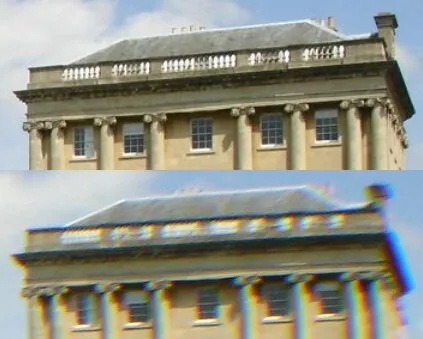
Chromatic aberration. Glass bends wavelengths by different amounts. Imatest, which makes lens-testing software, separates longitudinal CA (colours focus on different planes) from lateral CA, where "the magnification of the image differs with wavelength." Lateral CA is "most visible near corners of images" and worst in ultra-wide, long telephoto and extreme zoom lenses. Fringes spread evenly across the whole frame do not come from any real lens.
Chromatic aberration
The same building shot twice: the bottom version, through an added wide-angle lens, shows coloured fringes along the edges.Photo: Stan Zurek, Wikimedia Commons, CC BY-SA 3.0.
The film look in emulation tools and AI video prompts
Dehancer offers grain profiles for 8, 16, 35 and 65 mm, halation, bloom, film breath, gate weave, film damage, and Kodak 2383 and Fujifilm 3513DI print film emulation. FilmConvert describes halation as "a red glow or 'halo'" around strong light sources, and says Nitrate's grain models "the amount of grain required for each color and exposure" rather than laying one grain plate over the image.
Video model guides use plainer language:
Google (Veo and Gemini Omni Flash): under tone and mood, "Vintage/retro: Sepia tone, grainy film, specific era aesthetics"; under style, "shot on 35mm film"; and a lens flare example, "cinematic lens flare as the sun dips below the horizon behind a silhouetted couple."
LTX: lists "Film grain" and "Lens flares" as film characteristics.
Kling 4.0: writes texture as a finishing line, for example "Soft vintage optical character, old-photograph texture, subtle film grain, slight halation and natural motion blur." Instead of "Vintage feel" it recommends visible detail: "Yellowed walls, worn furniture edges, and warm incandescent lighting."
Luma: one of its 50 example prompts reads "Late afternoon golden light. 8mm film grain. Warm color palette."
Our illustration combining the physics and the vendors' advice (not a vendor example):
Night street lit by tungsten lamps and neon signs. Fine 35mm grain,
heavier in the shadows. Thin red-orange halation around the brightest
bulbs only. Faint gate weave. No digital sharpening.
How we compiled this
We read Kodak's VISION3 data sheets and brochure, the 2383 and Ektar 100 data sheets and the Essential Reference Guide for Filmmakers, plus American Cinematographer, Zeiss, Imatest, Dehancer, FilmConvert, CineStill and the official Google, LTX, Kling and Luma prompt guides. All sources were checked on 18 November 2026. Kodak's VISION3 sheets give granularity only as curves, so we quote Kodak's wording rather than reading values off the graphs.
How these images were made. Images captioned "Rendered in Vinc's virtual camera lab" are simulations, not photographs. They are path-traced in Blender's Cycles renderer, in a street scene built from CC0 Poly Haven models and a Poly Haven sky (named in each credit). The camera is physical: real sensor widths and focal lengths, a thin lens with a 9-blade iris, shutter-angle motion blur, and exposure set from an 18% grey card at the subject. Grain, halation and bloom are image-processing simulations with the parameters stated in each caption, not scans of film. They show what the optics predict. They don't model lens aberrations, sensor noise or any camera maker's colour science. The scripts and asset list are in our repository under scripts/blog-renders.
Aspect Ratios in Film Explained: 1.33 to 2.39 and 9:16, With the History and Delivery Specs
Aspect ratios in film are width divided by height. See where 1.375, 1.85, 2.39, 16:9, IMAX and 9:16 came from, and the containers cinemas and Netflix expect.

 Silver grain