Film lighting terms explained: key, fill and back light, lighting ratios in stops, Rembrandt, loop, butterfly and split, hard vs soft light, gels, practicals, colour temperature, CRI and golden hour.
Method. Kodak's Essential Reference Guide for Filmmakers, glossary and 500T data sheet, Lee Filters and Rosco product pages, ARRI's SkyPanel S60-C data sheet, American Cinematographer's 1976 Barry Lyndon interview, CIE 13.3, ISO/CIE 11664-2, EBU Tech 3355 and R 137, HyperPhysics, The Photographer's Ephemeris, StudioBinder's lighting guides, cited reference summaries and the official Google, Kling, LTX and Luma prompt guides, checked November 18, 2026; mired shifts not published by a maker are calculated and marked. Vinc makes an AI film studio.
Three-point lighting and the patterns on a face
Three-point lighting uses a key, a softer fill and a back light; film names a light by its job, not the lamp. Kodak describes any light by intensity, colour, quality (hard or soft) and angle, and a good prompt sets all four. Portrait patterns are named after the nose shadow: moving the key around the head steps through butterfly, loop, Rembrandt, then split.
Key light, fill light and lighting ratio
The key light is the principal source and sets the exposure, usually 30–45° to one side of the camera and 30–45° above the subject. The fill "illuminates the shadow areas"; its job, in Kodak's words, "is to reduce contrast."
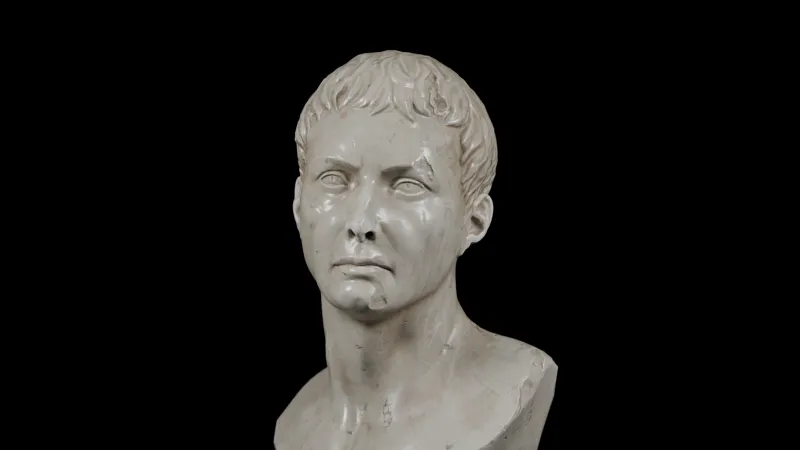
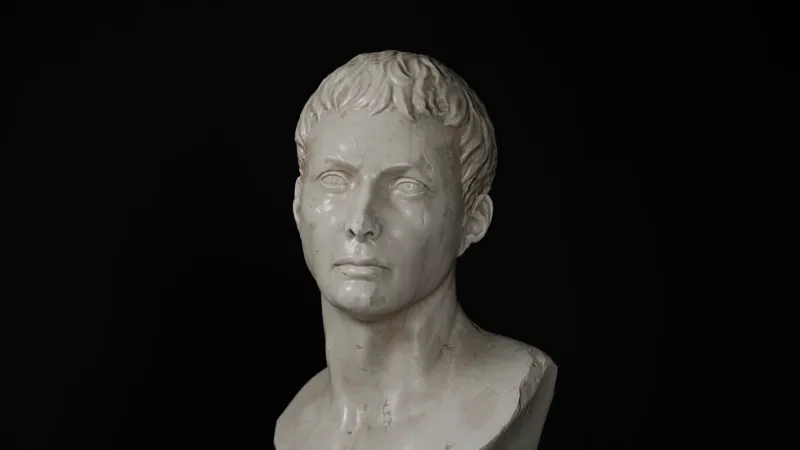
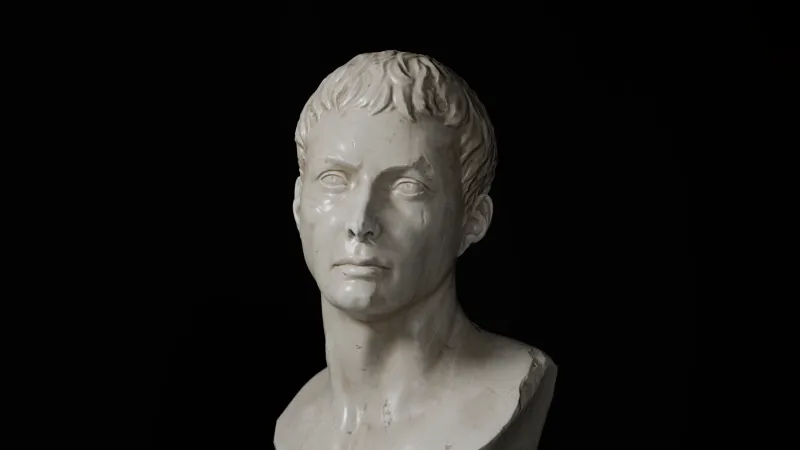
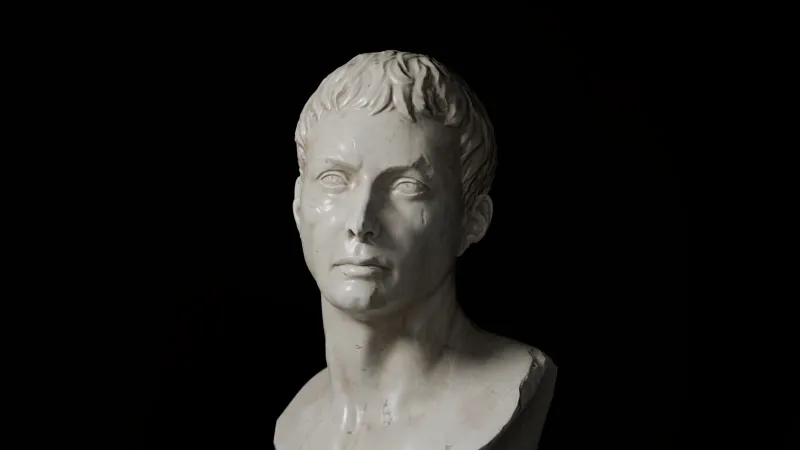
The lighting ratio compares the lit side of a face with the shadow side. Each stop doubles the light: 1 stop is 2:1, 2 stops 4:1, 3 stops 8:1 (ratio = 2^stops). Kodak's chart reads the key at T5.6 and a fill at T2.8 as 4:1, the fill "always the 1 in the ratio." The ASC and Kodak's glossary instead use (key + fill) : fill, so equal key and fill give 2:1, not 1:1. Ask which one a cinematographer means.
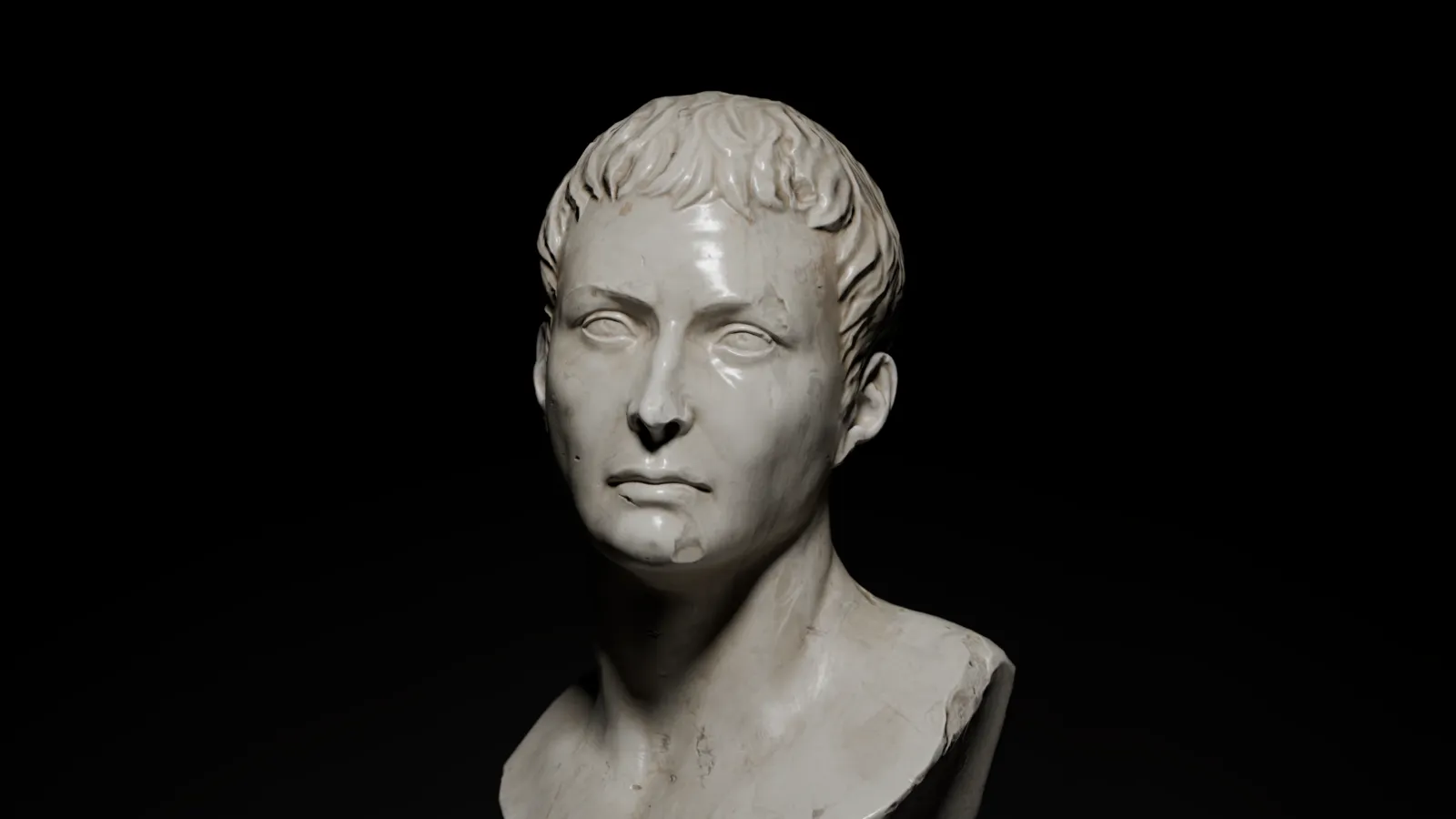
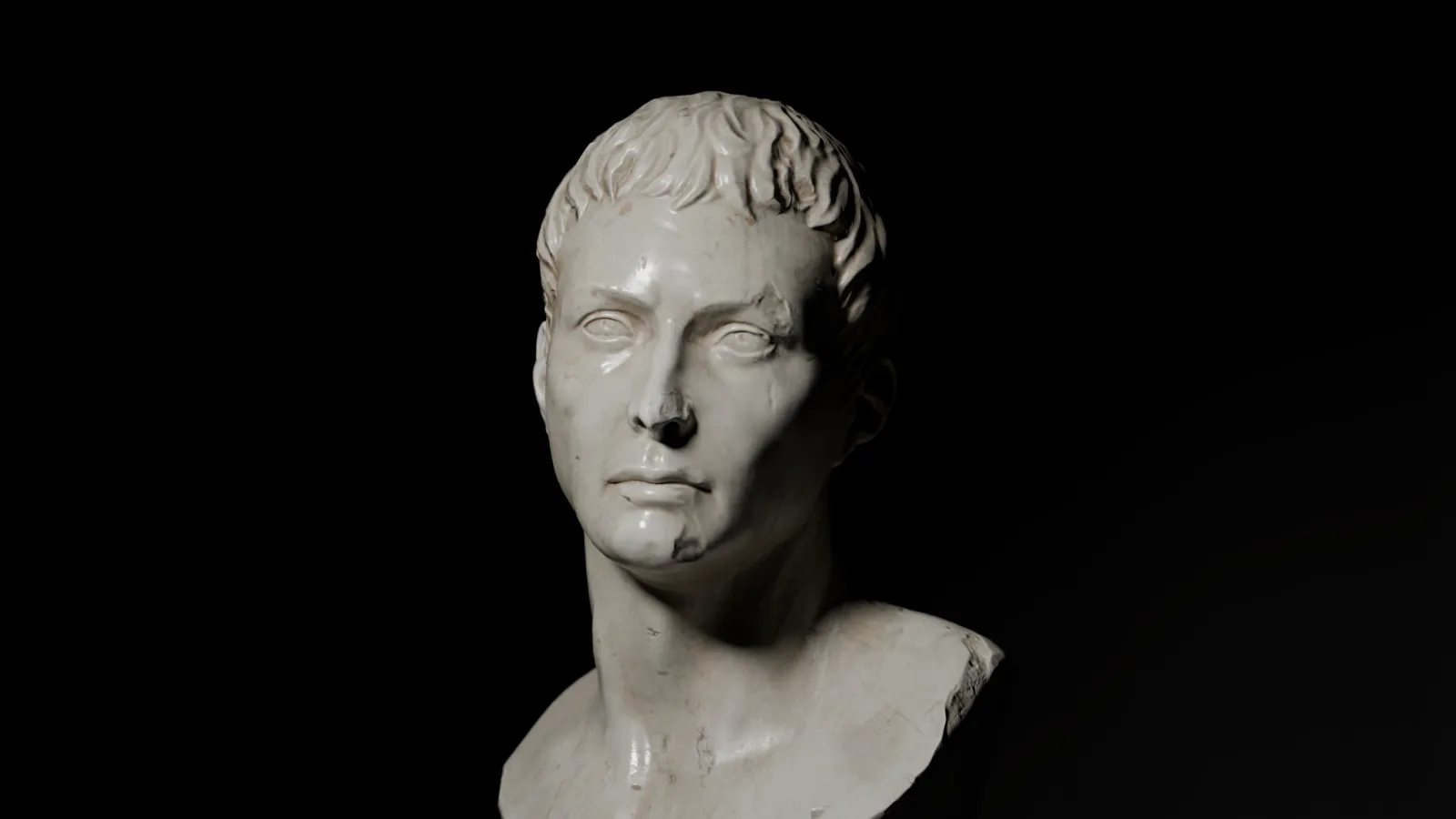
The same face at four lighting ratios. 85 mm on full frame at f/5.6, 1.7 m from the bust in a dark studio, with gridded softboxes 1.5 m from the face. The key is a 60 cm softbox 60° to camera left and 25° up. The fill is a 60 cm softbox beside the camera, with its power set so that (key + fill) : fill is 2:1, 4:1 or 8:1 on an incident meter facing the camera. For 1:1 a second, equal softbox is mirrored 60° to the right, so both sides read the same. Exposure is set from that meter reading. Rendered in Vinc's virtual camera lab.
Bust: Marble Bust 01 by Rico Cilliers; walls and floor: Plastered Wall 04 (Rob Tuytel) and Old Wood Floor (Guillaume Monsergent). All CC0, Poly Haven.
Three-point lighting: key to one side and above, fill on the other side and softer, back light behind the subject.
Kodak's three jobs in plan view: the key lights the subject, the fill opposite it lifts the shadows, and the back light from behind separates subject from background.
1:1
2:1 · 1 stop
4:1 · 2 stops
8:1 · 3 stops
Ratios on one face, in Kodak's glossary convention, (key + fill) : fill. The key is a gridded 60 cm softbox 60° to camera left and 25° up, 1.5 m away. The fill sits beside the camera, its power set so an incident meter facing the camera reads 2:1, 4:1 or 8:1. 1:1 uses two equal softboxes at 60° left and right. The bust is shot on 85 mm, full frame, f/5.6. Rendered in Vinc's virtual camera lab.Bust: Marble Bust 01 by Rico Cilliers; walls and floor: Plastered Wall 04 (Rob Tuytel) and Old Wood Floor (Guillaume Monsergent). All CC0, Poly Haven.
Butterfly (Paramount) lighting
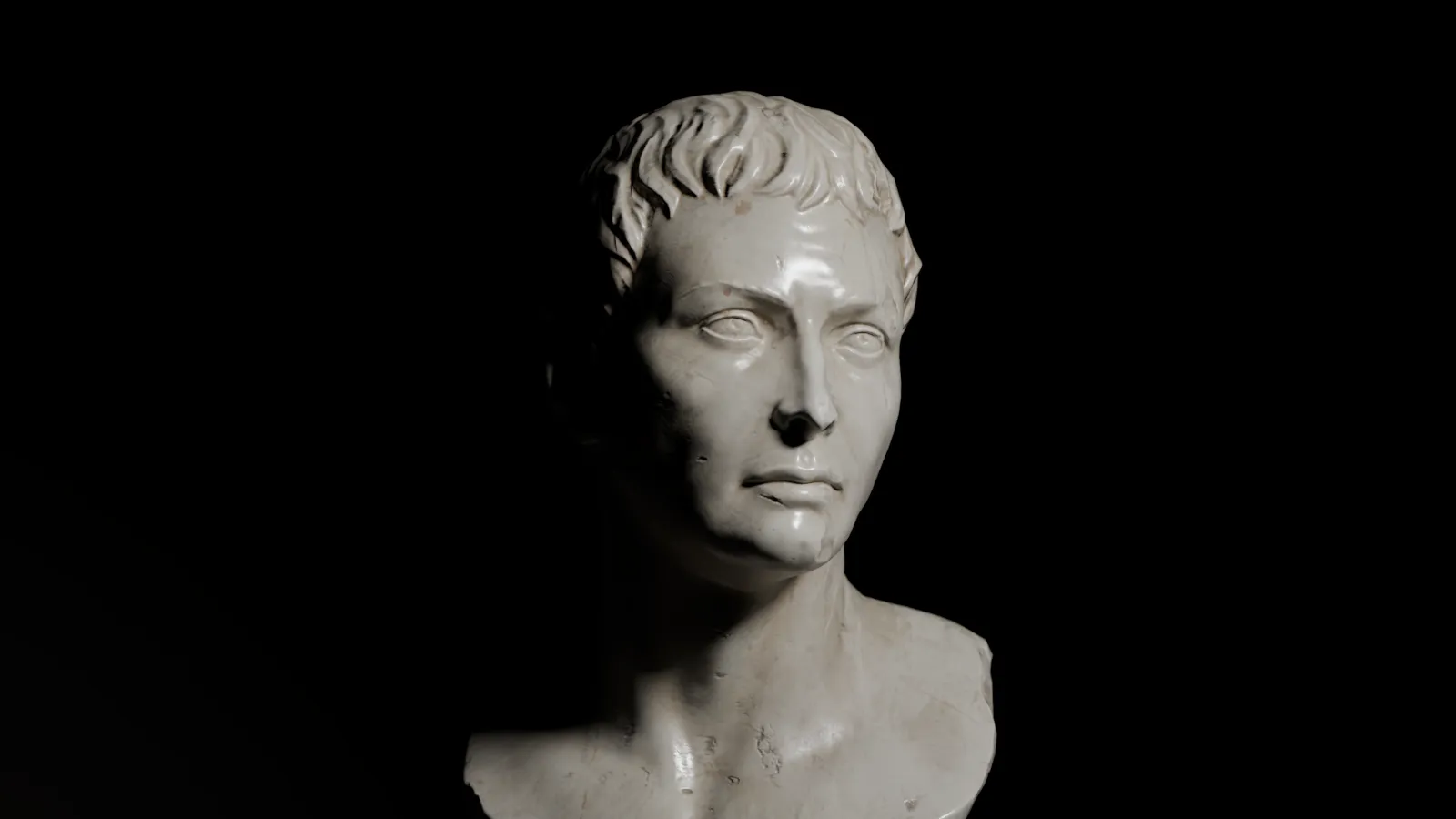
The key is high and directly in front of the face, above or just behind the camera. It lights the forehead, nose bridge and upper cheeks, and casts a small shadow under the nose that "often looks rather like a butterfly." The name traces to Paramount glamour portraits such as Marlene Dietrich in Shanghai Express (1932).
Butterfly lighting: key high and on the camera axis, shadow directly under the nose.
Butterfly
Butterfly lighting, rendered: key on the camera axis, 40° up. The forehead, nose bridge and cheekbones are lit, and a small shadow falls directly under the nose. Key only (a gridded 30 cm softbox 1.5 m from the face), no fill; 85 mm on full frame at f/5.6, exposed one stop over an incident reading toward the key. Rendered in Vinc's virtual camera lab.Bust: Marble Bust 01 by Rico Cilliers; walls and floor: Plastered Wall 04 (Rob Tuytel) and Old Wood Floor (Guillaume Monsergent). All CC0, Poly Haven.
Loop lighting
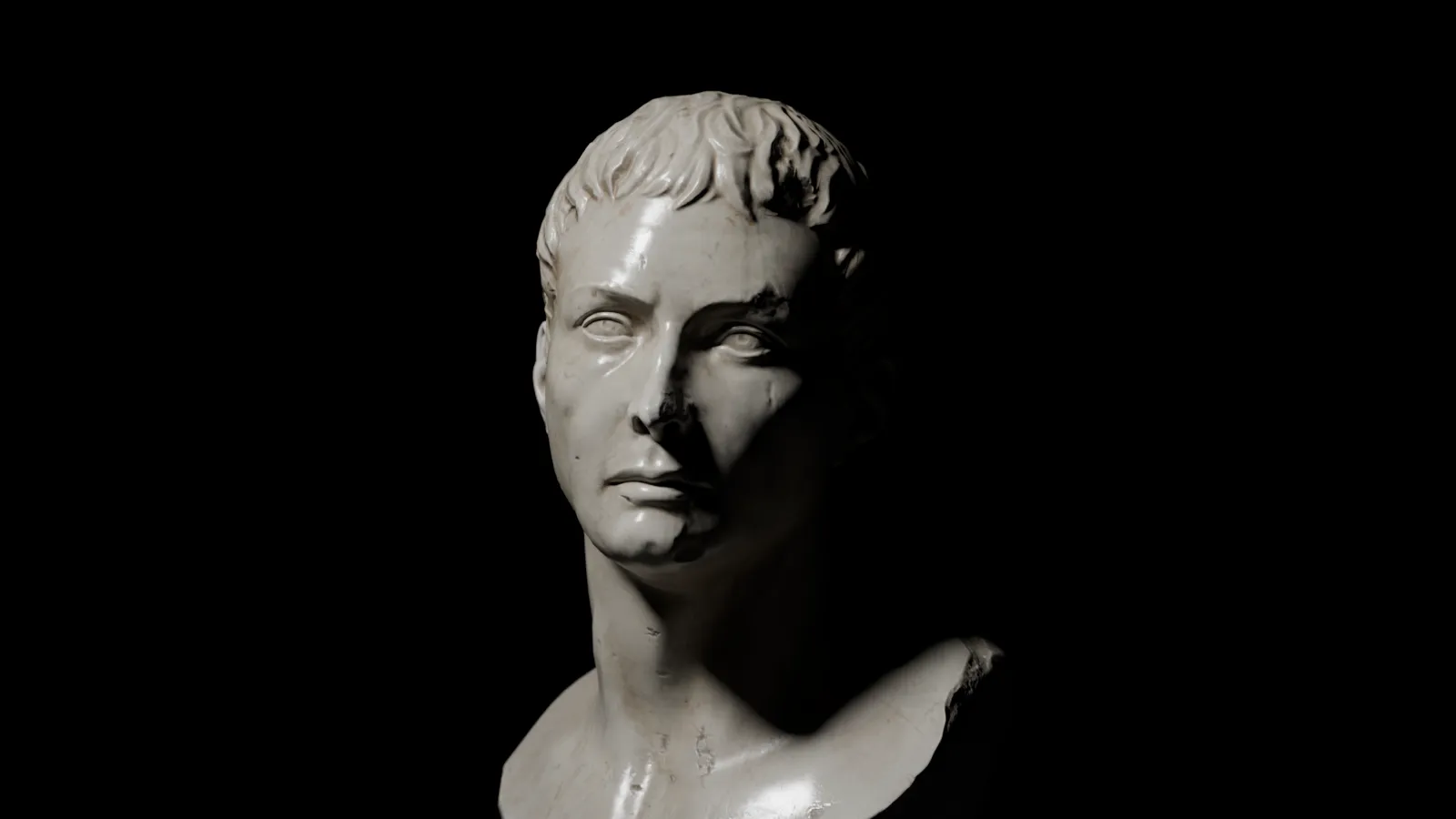
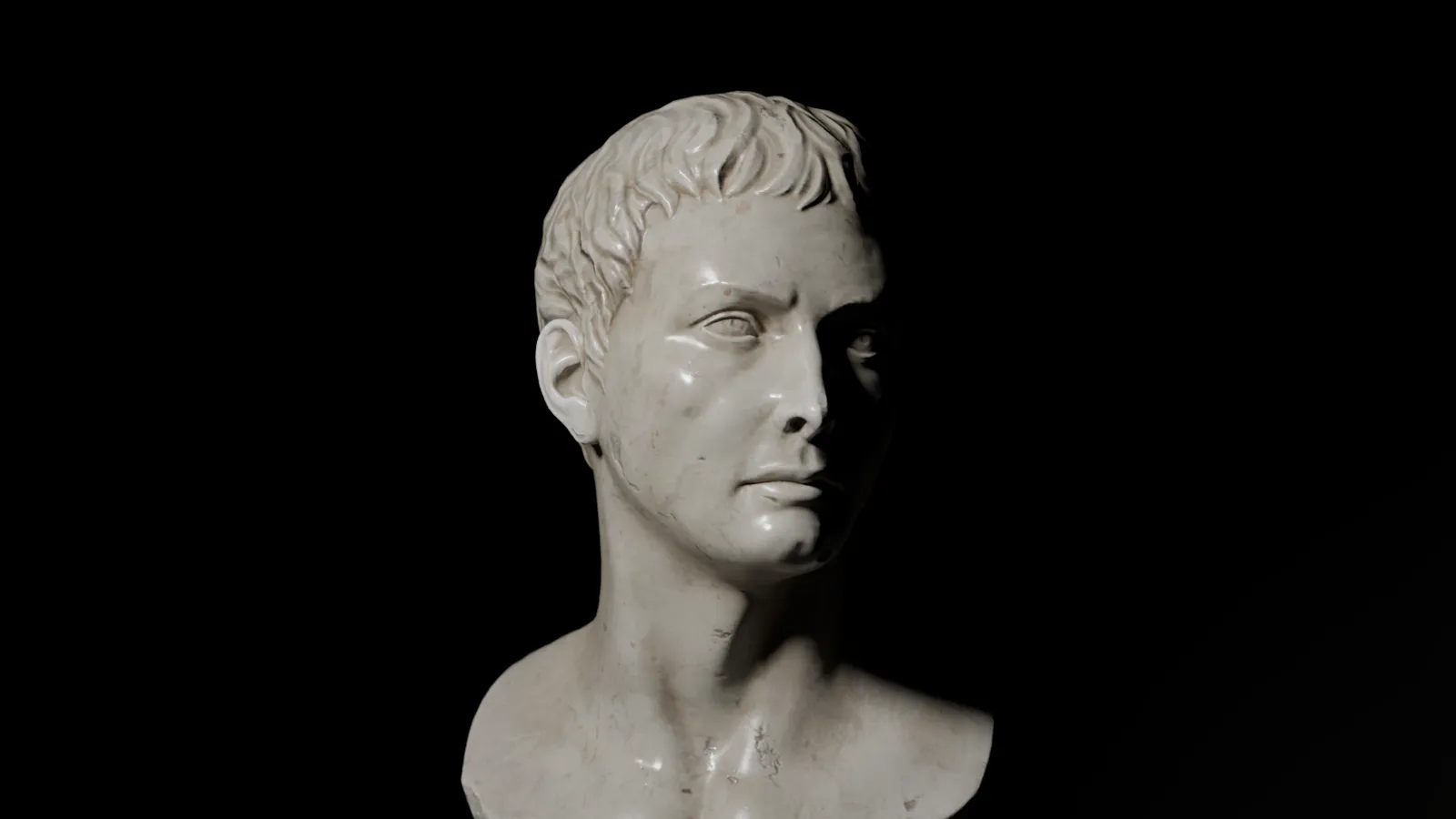
Loop lighting moves the key from butterfly to roughly 45° and just above eye level, so the nose shadow falls as a small loop without joining the cheek shadow. StudioBinder calls it a good default for standard headshots.
Loop
Loop lighting, rendered: key 35° to camera left and 30° up. The nose shadow drops down and toward the far cheek without joining it. Key only (a gridded 30 cm softbox 1.5 m from the face), no fill, exposed one stop over an incident reading toward the key. Rendered in Vinc's virtual camera lab.Bust: Marble Bust 01 by Rico Cilliers; walls and floor: Plastered Wall 04 (Rob Tuytel) and Old Wood Floor (Guillaume Monsergent). All CC0, Poly Haven.
Rembrandt lighting
Rembrandt lighting has the key higher and further to the side than loop, so the nose shadow joins the shadow on the far cheek, leaving an "illuminated triangle" under the eye no longer than the nose and no wider than the eye.
Rembrandt lighting
The key comes from frame left; on the darker cheek a small patch of light sits under the eye, bounded by the shadow of the nose.Photo: Jacopo188, Wikimedia Commons, CC BY-SA 3.0.
Cecil B. DeMille is credited with the term, on The Warrens of Virginia (1915).
Rembrandt lighting: key high and about 45° to the side; the nose and cheek shadows meet, leaving a triangle of light under the far eye.
Rembrandt
Rembrandt lighting, rendered: key 55° to camera left and 45° up. The nose shadow joins the shadow of the far cheek, leaving a small lit triangle under the eye. Key only (a gridded 30 cm softbox 1.5 m from the face), no fill; 85 mm on full frame at f/5.6, exposed one stop over an incident reading toward the key. Rendered in Vinc's virtual camera lab.Bust: Marble Bust 01 by Rico Cilliers; walls and floor: Plastered Wall 04 (Rob Tuytel) and Old Wood Floor (Guillaume Monsergent). All CC0, Poly Haven.
Split lighting
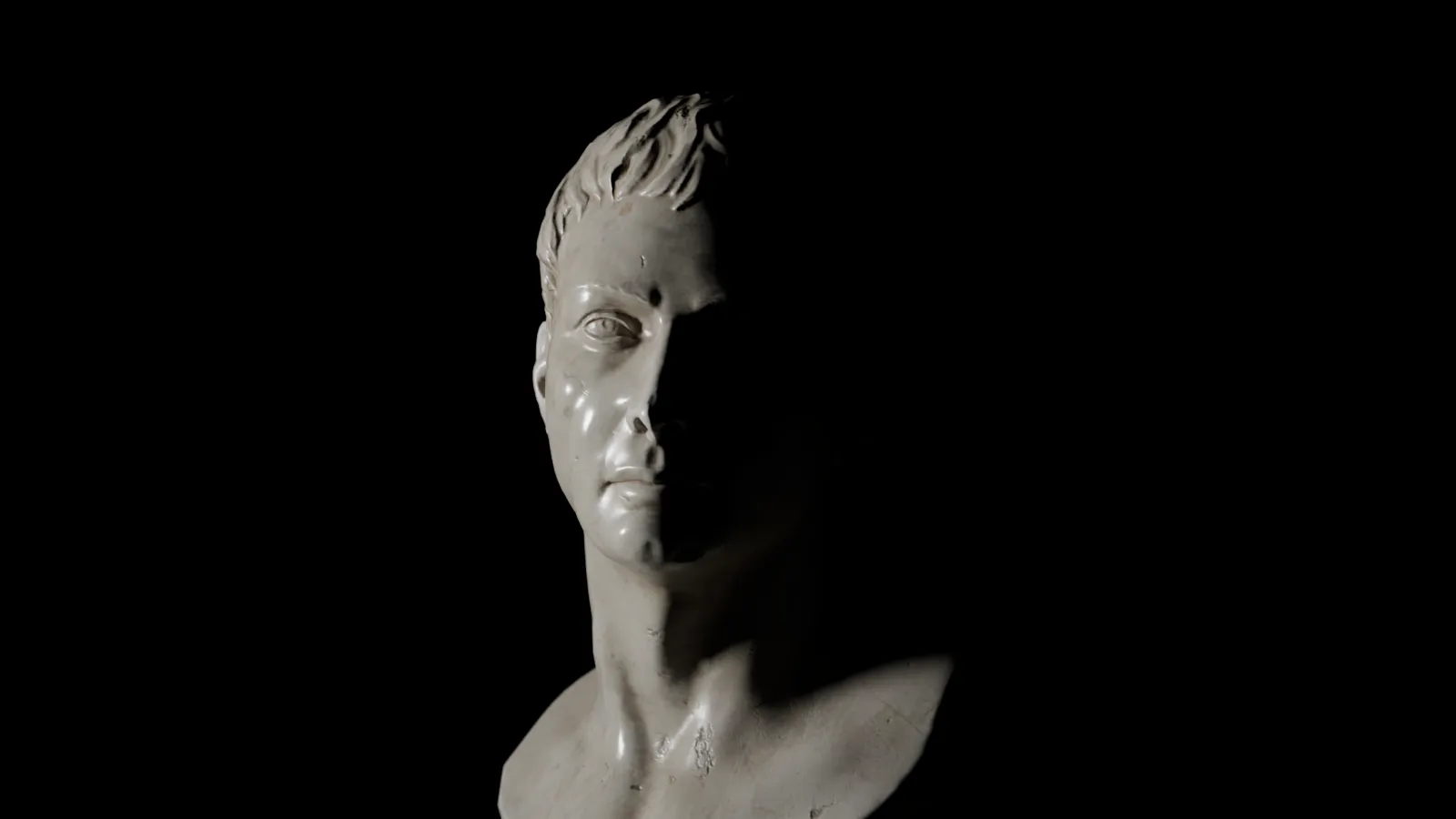
Split lighting puts the key at 90° to the face, so one half is lit and the other is in shadow, divided down the line of the nose. StudioBinder calls it inherently high-contrast and dramatic; a reflector on the dark side softens it.
Split lighting: key at 90° to the face; the nose divides the lit half from the shadow half.
Split
Split lighting, rendered: key 90° to camera left at eye level. The line of the nose divides the lit half from the dark half. Key only (a gridded 30 cm softbox 1.5 m from the face), no fill; 85 mm on full frame at f/5.6, exposed one stop over an incident reading toward the key. Rendered in Vinc's virtual camera lab.Bust: Marble Bust 01 by Rico Cilliers; walls and floor: Plastered Wall 04 (Rob Tuytel) and Old Wood Floor (Guillaume Monsergent). All CC0, Poly Haven.
Broad vs short lighting
Broad and short describe which side of a turned face gets the key, and any pattern above can be done either way. Broad lighting lights the side nearer the camera, so more of the face is bright; short lighting lights the far, narrow side, which StudioBinder calls high-contrast and moody.
Broad
Short
The same head turned 30° to camera right, lit two ways. Broad (left): the key, 45° to camera left, lights the side of the face nearer the camera. Short (right): the key, 45° to camera right, lights the far, narrow side and leaves the near side in shadow. Key only (a gridded 30 cm softbox 1.5 m from the face), no fill; 85 mm on full frame at f/5.6, exposed one stop over an incident reading toward the key. Rendered in Vinc's virtual camera lab.Bust: Marble Bust 01 by Rico Cilliers; walls and floor: Plastered Wall 04 (Rob Tuytel) and Old Wood Floor (Guillaume Monsergent). All CC0, Poly Haven.
Back light, rim light and kicker: lights that separate the subject
Back light, hair light and rim light
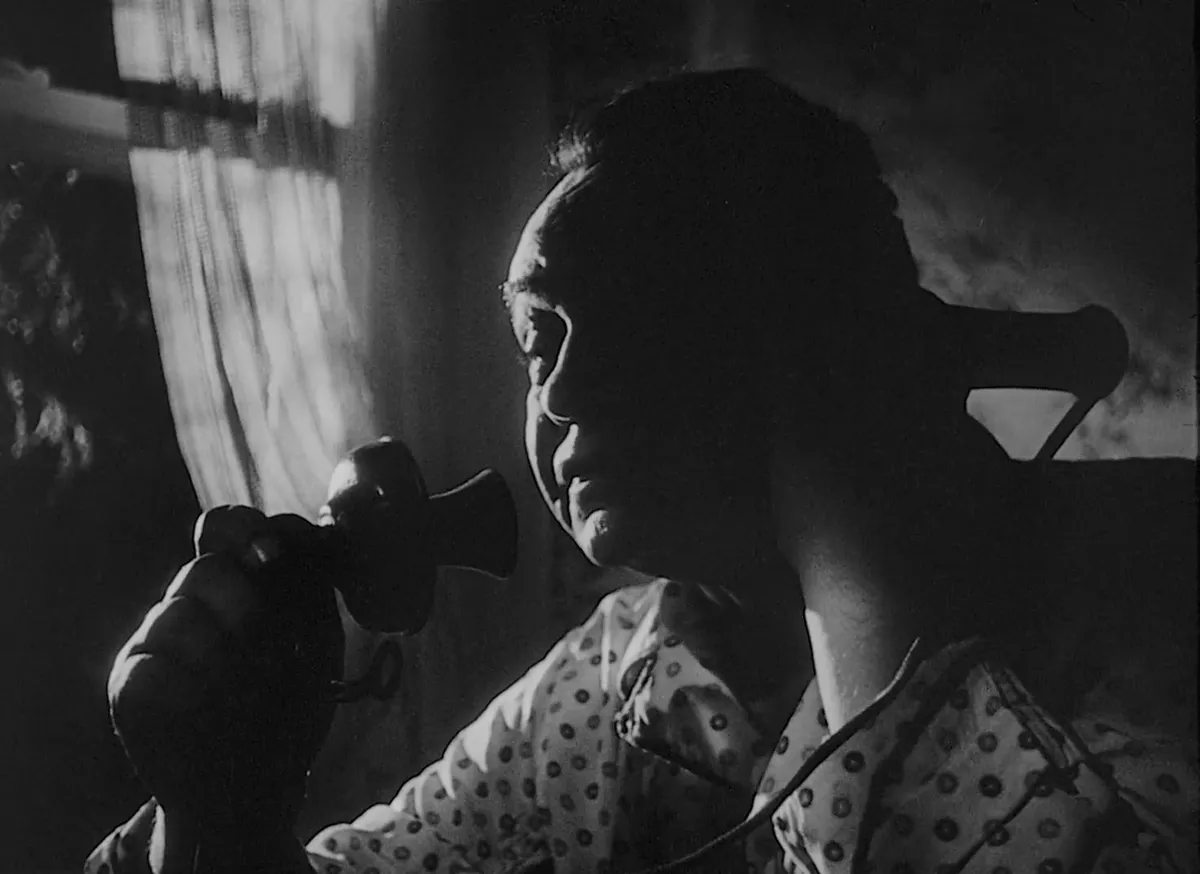
The back light shines on the subject from behind, usually from above and opposite the lens, and "provides the subject a rim of light" that separates it from the background and adds depth. "Hair light" and "rim light" are names for the same light, stressing the hair or the outline.
Rim light
Light from the window behind him traces a bright edge along his forehead, nose, cheek and neck, while the front of his face stays dark.The Stranger (1946), Orson Welles. Public domain (US).
Kicker
A kicker is a back light set to the side so it catches the edge of the face: "an angelic rim of light," in StudioBinder's words.
Hard light vs soft light
Hard light and soft light
Kodak defines hard light as direct light that "travels in an aligned, focused path," and soft light as indirect light on "a non-aligned, diffuse path." Hardness "has nothing to do with the intensity": a match flame is hard and dim.
Softness comes from the source's size as seen from the subject. Our illustration, from similar triangles:
A 1 m frame at 10 m is nearly a point, so "large soft source close to the face" is a more precise prompt than "soft light."
Shaping and controlling light
These tools bounce, soften, cut or colour light that already exists.
Bounce
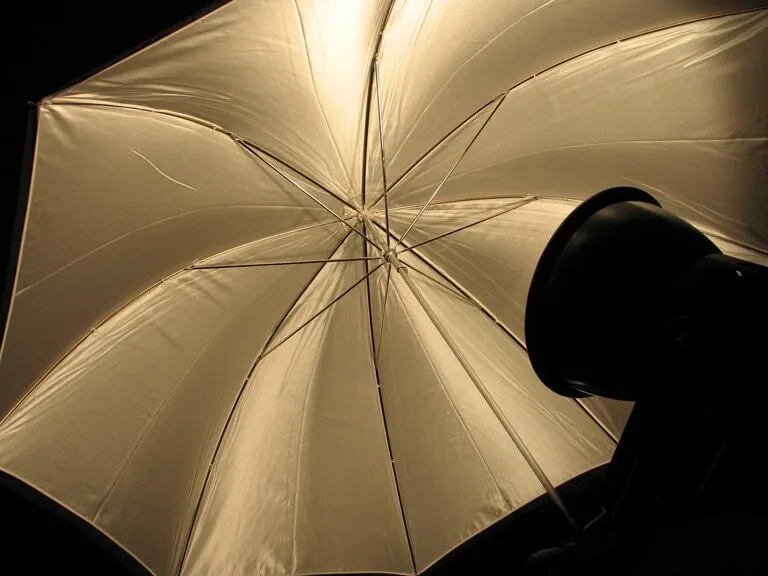
Bounce light is light redirected off a reflector, white board or wall onto the subject instead of pointing a lamp straight at it, most often as fill: the key or the sun bounced back into the shadow side of the face.
Bounce
A lamp points into a large umbrella reflector, so the light reaches the subject only after bouncing off it.Photo: David Vasquez, Wikimedia Commons, CC BY-SA 3.0.
Negative fill
Negative fill removes light from the shadow side with a black flag or frame; in open shade, blocking one side makes the other read as a key.
Flag
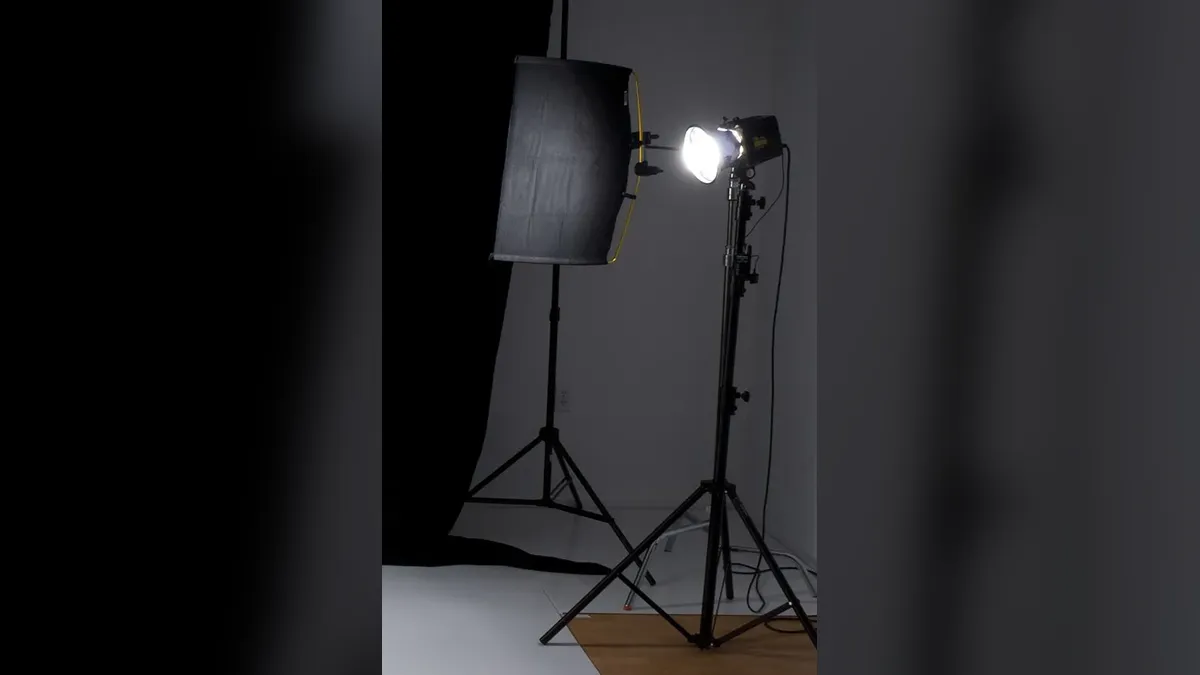
A flag is an opaque panel that blocks light to cast a shadow, give negative fill or keep flare off the lens. Most are a wire frame covered in black duvetyne on a C-stand, placed by the grips in the US.
Flag
A black fabric flag on its own stand is positioned beside a lamp to cut part of its beam.Photo: Tim Johnson, Wikimedia Commons, CC BY 2.0 (cropped).
Scrim
A scrim is a wire-mesh screen in front of a lamp that cuts output without dimming, which would turn tungsten orange: a single cuts half a stop, a double a full stop (Kodak). Outdoors, "nets" on large frames do the same.
Diffusion, silks and butterflies
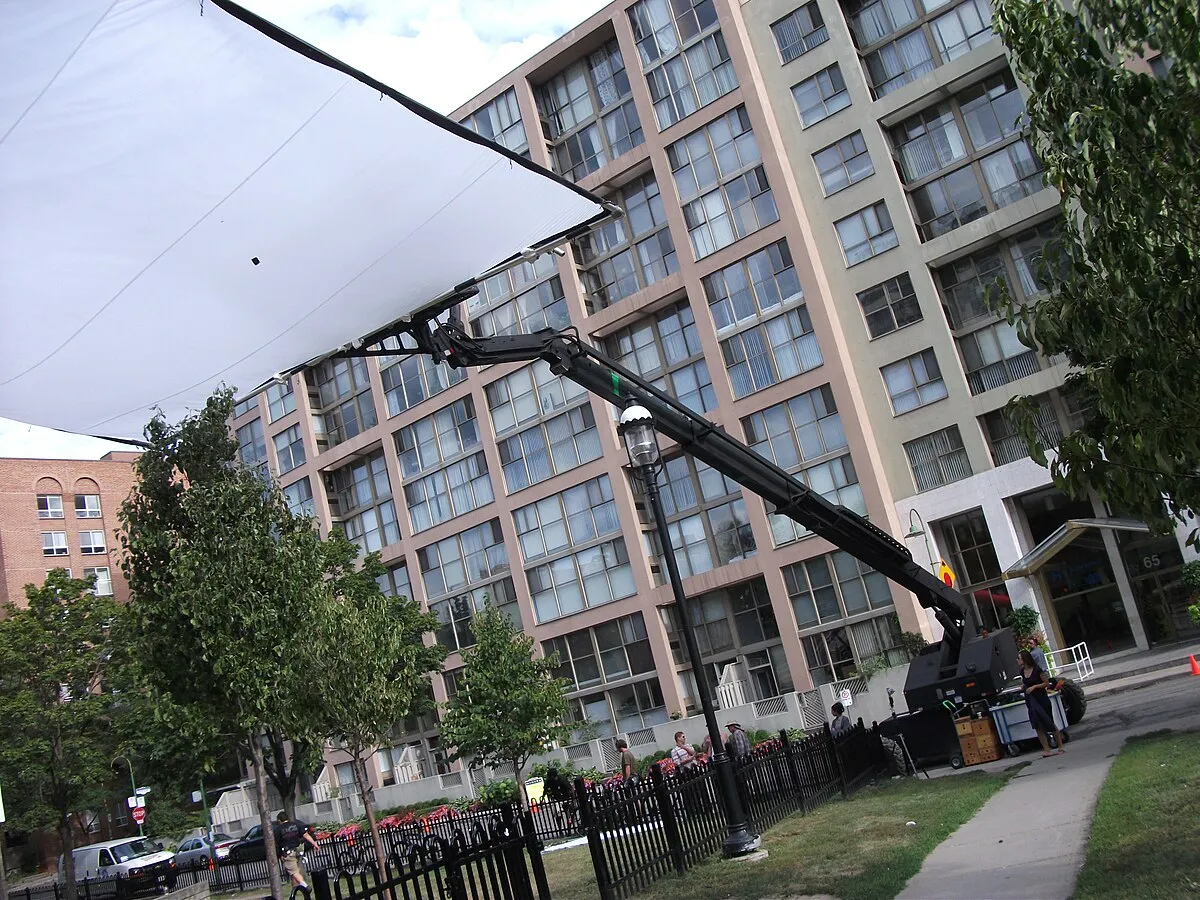
Diffusion is translucent white material that scatters light, making a source larger and softer while lowering its output. Butterflies (overheads) are large frames, typically 6 × 6 ft to 20 × 20, that hold diffusion, nets or solid black over a scene to control sunlight.
Overhead frame
A crane holds a large white fabric frame high over a street location to soften the sunlight below.Photo: Geo Swan, Wikimedia Commons, public domain.
Diffusion costs light. ARRI's SkyPanel S60-C at 3 m and 5600 K:
S60-C front
Lux at 3 m
Foot-candles at 3 m
Intensifier
2,431
226
Lite diffusion
1,561
145
Standard diffusion
1,535
143
Heavy diffusion
1,213
113
Intensifier to heavy diffusion halves the output: one stop.
Gel, CTO and CTB (with mired shift)
A gel is a coloured filter over a light. Correction gels shift a source between tungsten and daylight; CTO warms, CTB cools. Strength is given in mireds (1,000,000 ÷ kelvin), because an equal mired shift looks similar at any starting temperature.
Gel
Maker's stated conversion
Mired shift
Transmission
Lee 204 Full CT Orange
6500 K daylight to 3200 K tungsten
+159 (stated)
55.4%
Lee 201 Full CT Blue
3200 K to 5700 K
−137 (stated)
34%
Rosco 3407 RoscoSun CTO
5500 K to 2900 K
≈ +163 (calculated)
47%
Rosco 3202 Full Blue CTB
3200 K to 5500 K
≈ −131 (calculated)
36%
Rosco 3204 Half Blue CTB
3200 K to 4100 K
≈ −69 (calculated)
52%
Rosco's mireds are our calculation from its kelvin figures (6500 K → 3200 K is 312.5 − 153.8 = +158.7, matching Lee's +159). Full CTB passes about a third of the light, roughly 1.5 stops.
Colour temperatures used in this section: SkyPanel's lower and upper limits (2800 K and 10,000 K), tungsten (3200 K), Rosco's daylight figure (5500 K), nominal HMI (5600 K) and Lee's daylight reference (6500 K).
Film lights: Fresnel, HMI, LED and practicals
Tungsten Fresnel
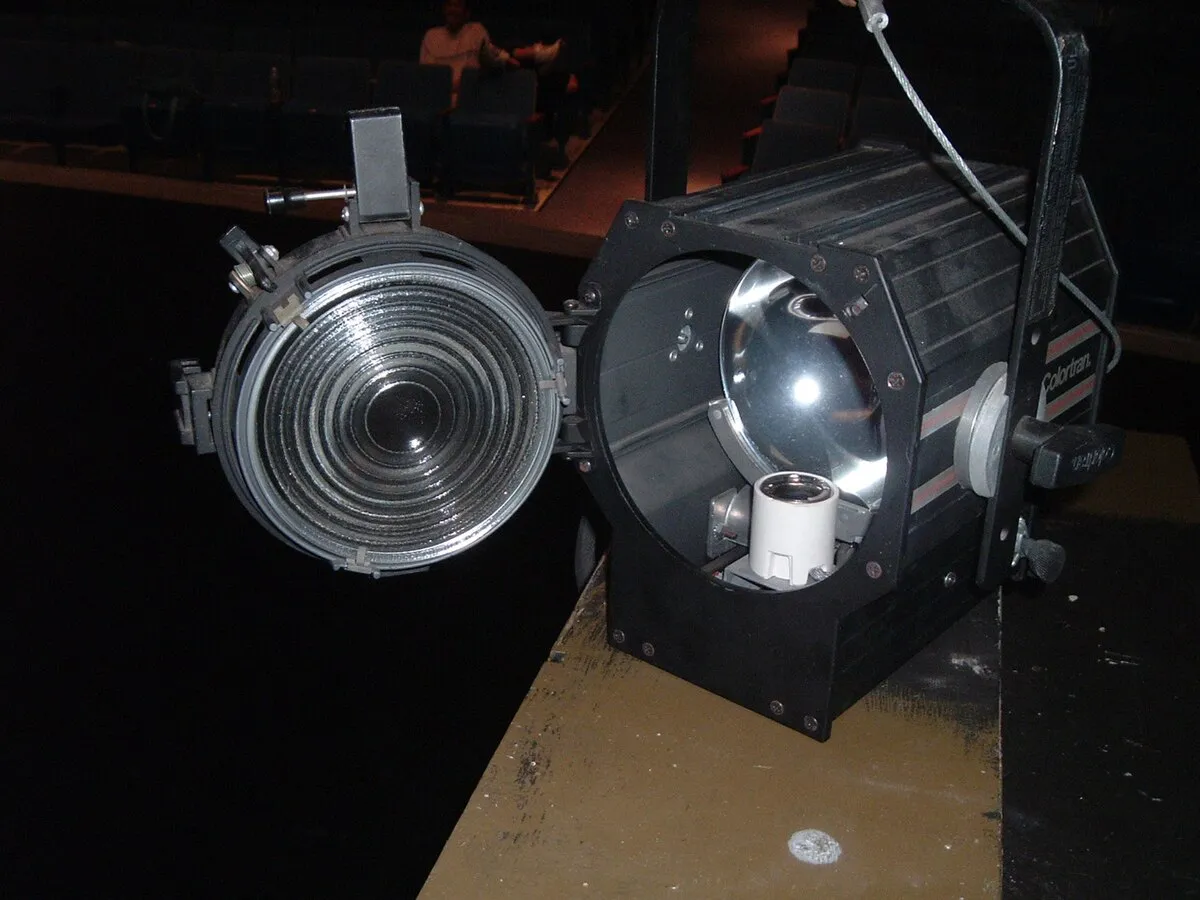
A Fresnel is a lamp with a stepped Fresnel lens in front of the bulb and reflector, giving a soft-edged, fairly even beam. Moving the bulb toward or away from the lens changes the beam between spot and flood.
Fresnel
A Fresnel lantern opened up, with its stepped glass lens on the left and the bulb and reflector inside the housing.Photo: KeepOnTruckin, Wikimedia Commons, CC BY-SA 3.0.
Film Fresnels run from 2 to 24 inch lenses and 150 W to 24,000 W; tungsten is balanced near 3200 K.
HMI
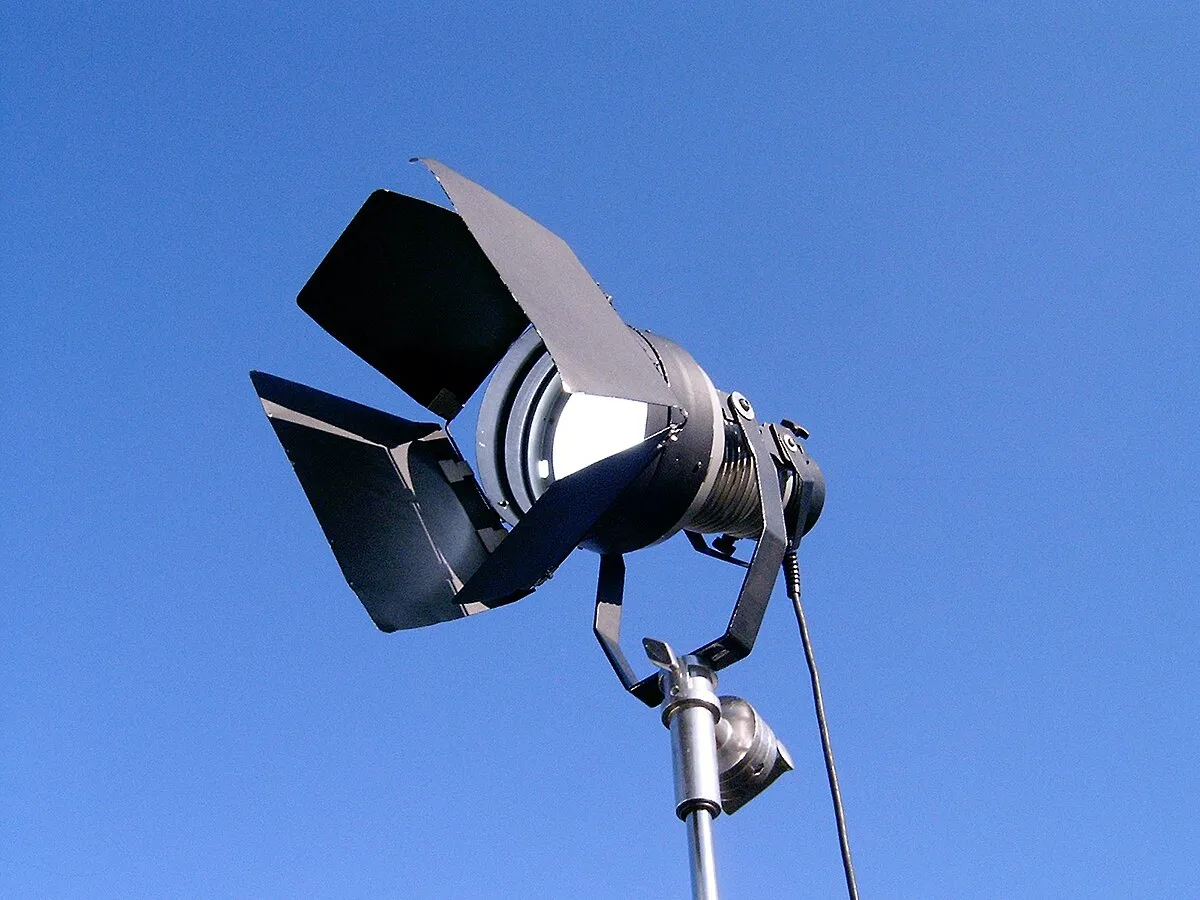
HMI stands for hydrargyrum (mercury) medium-arc iodide, a metal-halide arc lamp Osram developed in the late 1960s for German television, to replace carbon arcs. It is the standard daylight-balanced film light.
HMI
An HMI head with barn doors on a tall roller stand, set against the sky.Photo: Eliot Lash, Wikimedia Commons, CC BY 2.5.
It runs at about 5600–6000 K and 85–108 lumens per watt, roughly four times incandescent. Magnetic ballasts can flicker on camera; electronic ones avoid it (see Frame Rate, Shutter Angle and Motion Blur).
LED panel and LED tube
An LED panel is a flat array of LEDs behind diffusion; an LED tube is the same in a long, thin fixture. The SkyPanel S60-C draws up to 400 W and is "continuously variable" from 2,800 K to 10,000 K, so gel corrections are dialled in.
Practicals
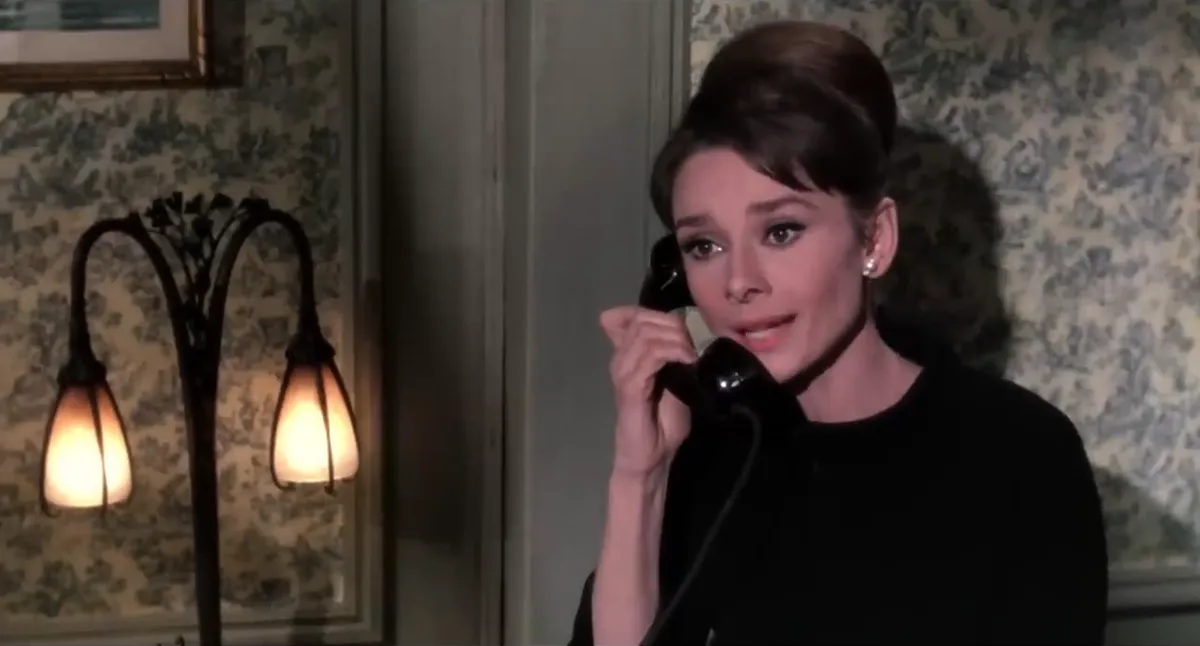
Practicals are working light sources visible in frame as part of the set: table lamps, candles, TV screens, headlights, neon signs. StudioBinder defines practical lighting as "using light sources that are seen within the frame of a shot," to motivate the lighting and add depth.
Practicals
A lit two-shade lamp stands in the frame at left while she talks on the telephone.Charade (1963), Stanley Donen. Public domain (US).
Household bulbs (2,650–2,900K, Kodak) read orange in a 3200K scene. The extreme case is Barry Lyndon (1975): John Alcott told American Cinematographer the candlelit scenes were lit "entirely by the candles," on a Zeiss 50 mm f/0.7 made for NASA, at "roughly, three foot-candles" (about 32 lux).
Motivated light
Motivated lighting gives every light an apparent reason to exist, such as a window or a lamp: an off-screen unit copies the practical's direction and colour. Kodak calls this naturalism; pictorialism backlights both actors in a two-shot "simply because it looks better."
Colour temperature and colour rendering
Colour temperature (kelvin)
Colour temperature describes a light's colour by the temperature, in kelvin, of a heated object that glows the same colour; a higher number means bluer light. Kodak's films are balanced for tungsten (3200K) or daylight (5500K); 500T rates 500 under tungsten and 320 in daylight through an 85 filter.
Colour temperature of common light sources
Candle flame1,850K
Sunrise or sunset2,000K
100 W household bulb2,900K
Studio tungsten lamp3,200K
One hour after sunrise3,500K
Late afternoon sun4,300K
Summer noon sun, Washington DC5,400K
Overcast sky6,000K
Average summer shade8,000K
Kodak, The Essential Reference Guide for Filmmakers, 'Color Temperature for Various Light Sources'. Sunlight is the sun alone; daylight is sunlight plus skylight.
Kelvin "refers only to the visual appearance of a light source" (Kodak); for fluorescent, HMI or LED it is a correlated colour temperature. Skylight alone runs 9,500–30,000K, which is why shade looks blue. D65, "average daylight" at about 6500K (ISO/CIE 11664-2), is the reference white of BT.709 and BT.2020.
CRI and TLCI
Kelvin says what colour a source looks, not whether colours look right under it. Two indices measure that:
Index
Standard
How it scores
Rule of thumb
CRI (Ra)
CIE 13.3-1995
Colour shift of 8 test samples (plus 6 extras, incl. a strong red and skin)
SkyPanel S60-C: above 95 (Panavision)
TLCI-2012
EBU Tech 3355
Simulates "a complete television camera and display" on 18 patches, 0–100
85+ needs "little or no adjustment" (Gossen); 50 is the limit of correctable
The EBU built TLCI because "the CRI was never intended for use in the television industry." A prompt can't set CRI, but it can ask for a low score's symptom, such as the green spike of fluorescent and sodium-vapour light.
Styles and times of day
High key and low key
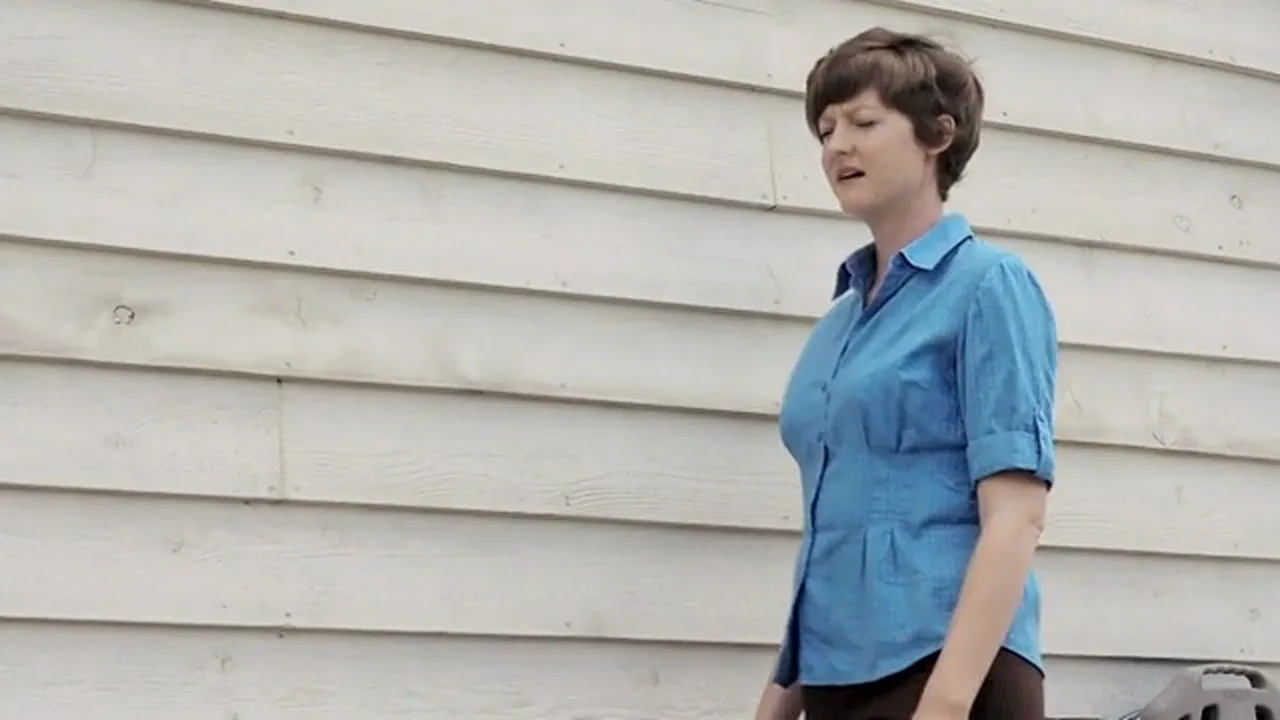
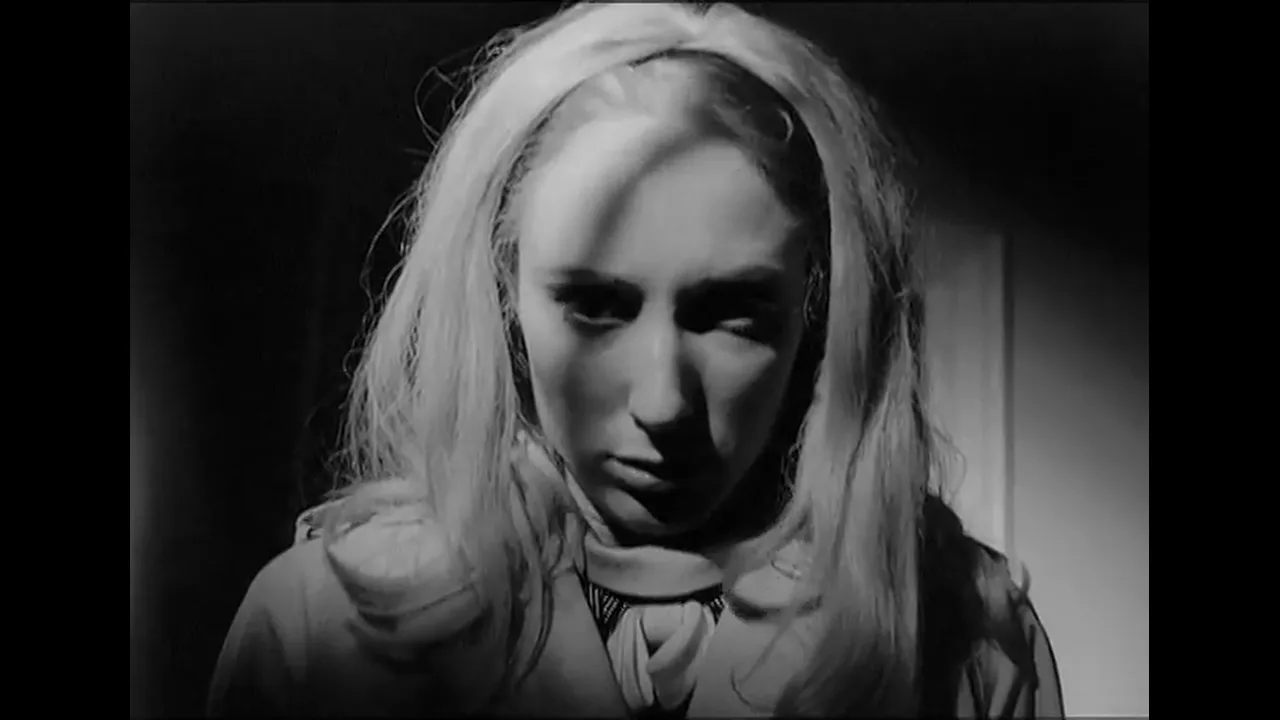
High key and low key describe a whole scene's lighting ratio, the balance between key and fill: high key is bright and even with few shadows, low key dark with deep ones. Both describe contrast, not mood: a bright noon street with deep shadows is low-key.
High key
Low key
Left: bright, even daylight with few dark shadows. Right: a single hard source picks out her face against near-black surroundings.Left: Still from A Sad State of Affairs (2009), M.A. Lanoue / Squire Films, CC BY-SA 3.0 US. Right: Night of the Living Dead (1968), George A. Romero. Public domain (US).
High key: a ratio that "can approach 1:1" (Kodak); classical Hollywood's house style, now common in comedy, commercials and interviews.
Low key: for night, a fill "at least two stops darker than the key", 4:1 or more. Film noir is the classic example; Blade Runner 2049 a modern one.
Low key: a single dominant source and little fill, giving a high lighting ratio and deep shadows.
Chiaroscuro
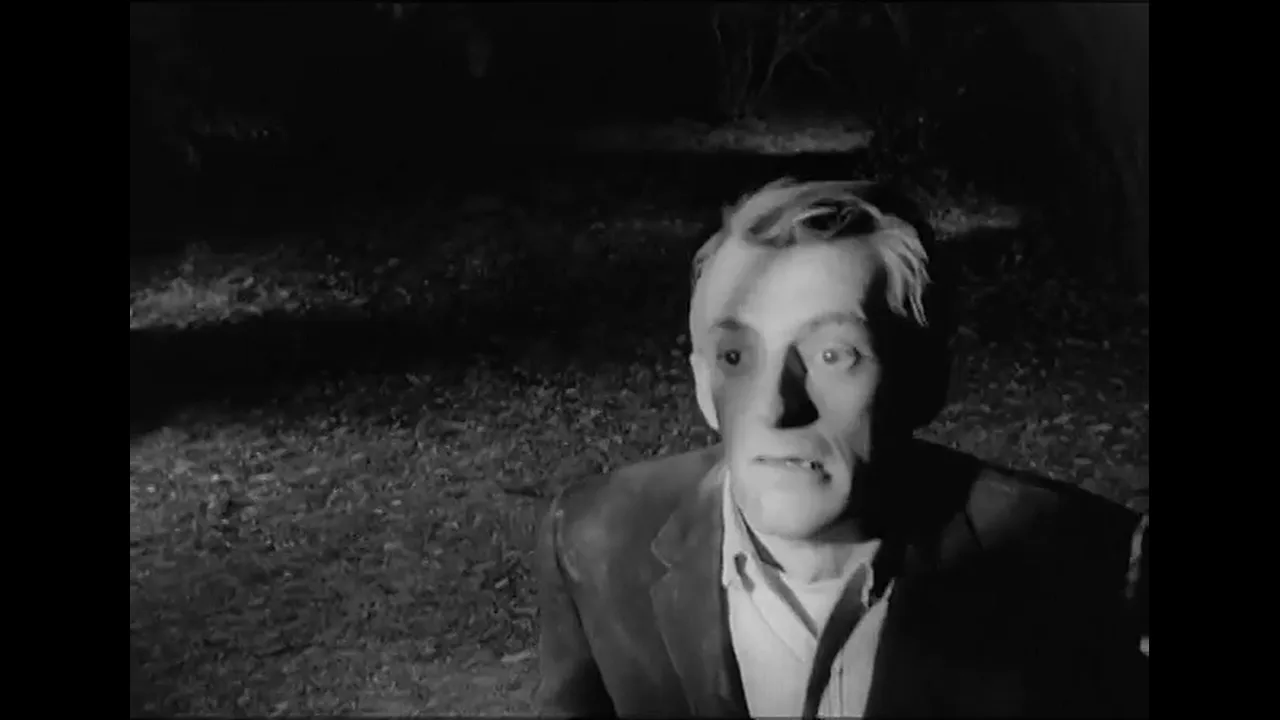
Chiaroscuro, Italian for "light-dark", means strong contrasts of light and shadow across a whole composition, usually from low-key lighting and hard, directional sources, as in The Cabinet of Dr. Caligari (1920) and Nosferatu (1922).
Chiaroscuro
A hard light carves his face out of the dark, with deep shadow across half of it and black all around.Night of the Living Dead (1968), George A. Romero. Public domain (US).
Day for night
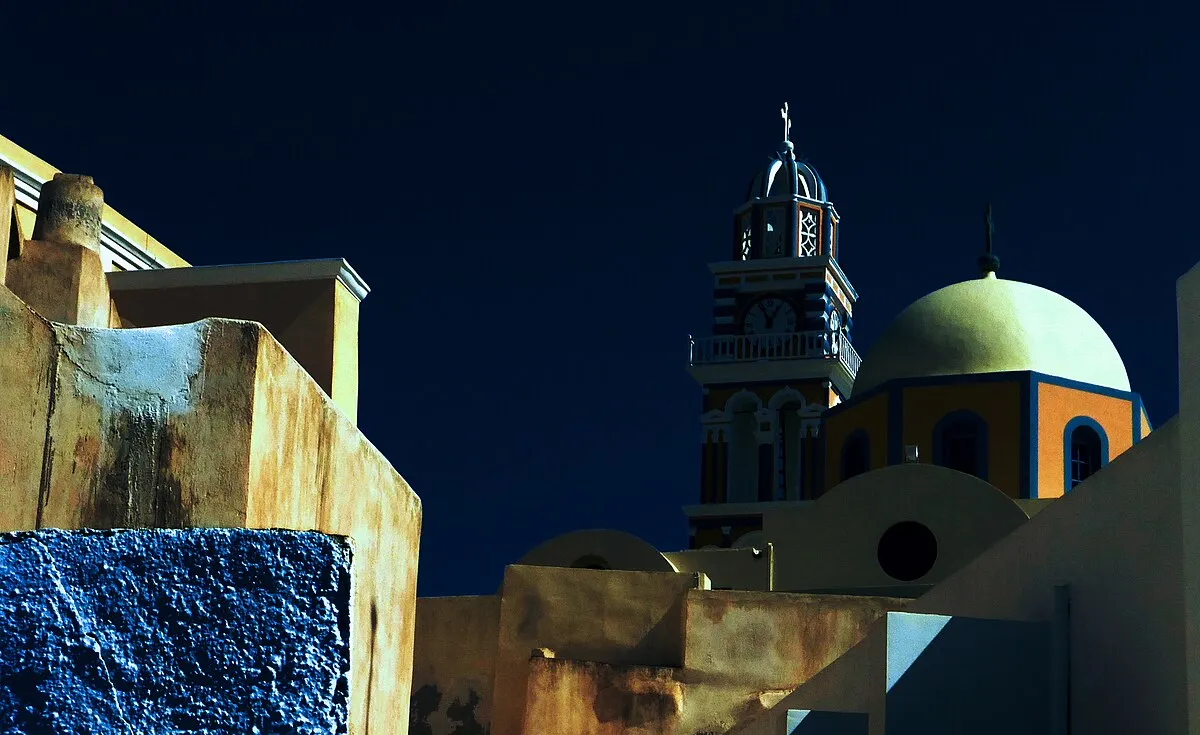
Day for night means shooting night scenes in daylight and making them read as night with exposure, filters and grading. The traditional method underexposes about two stops on tungsten-balanced film, so unlit areas render "moonlight blue."
Day for night
A sunlit view of a church and walls, darkened and shifted blue so the sky reads as night.Photo: Jim Stinson, Wikimedia Commons, CC BY-SA 3.0.
Mad Max: Fury Road (2015) overexposed its night scenes instead, then darkened them in the grade to keep shadow detail.
Golden hour and magic hour
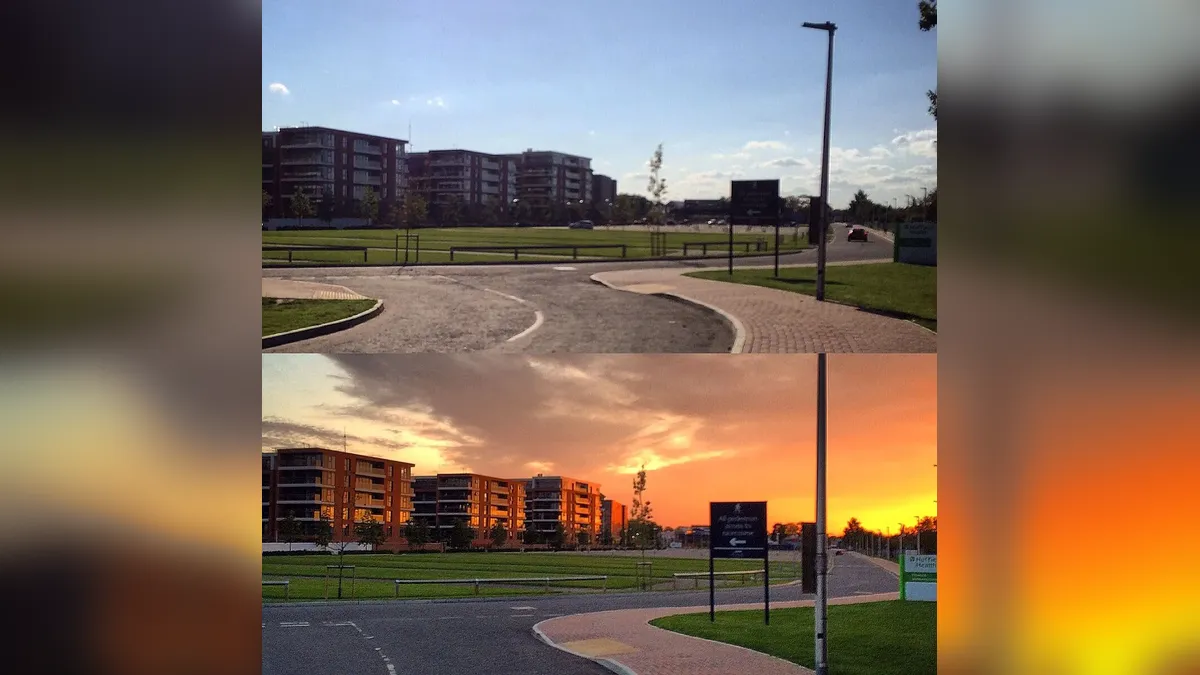
Golden hour is the time shortly after sunrise and before sunset, when sunlight is redder and softer than at noon: about 2,000K at sunset, 3,500K an hour after sunrise. It has no official definition; The Photographer's Ephemeris found it "impossible to pin down" across five apps and uses the sun between 0° and +6°.
Golden hour
The same road and buildings in ordinary daylight (top) and at sunset (bottom), when the light turns warm and low.Photo: TudorTulok, Wikimedia Commons, CC BY-SA 4.0.
"Magic hour" means the same window to some and sunset-to-dark to others. Néstor Almendros, who shot much of the Oscar-winning Days of Heaven (1978) then, called it "not an hour but around 25 minutes at the most."
Blue hour
Blue hour is the twilight when only high-kelvin skylight remains, put anywhere from −4° to −10° of sun elevation. Civil twilight is 0° to −6°, nautical −6° to −12°, astronomical −12° to −18°.
Measuring light: lux, foot-candles and the inverse-square law
Lux and foot-candle
Both measure illuminance, the light falling on a surface: lux is one lumen per square metre, a foot-candle one per square foot (1 fc = 10.764 lux).
Inverse-square law
A point source's output spreads over a sphere of area 4πr², so illuminance falls with the square of distance (E = I / d², HyperPhysics). Double the distance and a quarter of the light arrives, two stops darker. The SkyPanel's 1,535 lx at 3 m becomes 171 lx at 9 m.
At 2× the distance the light covers 4× the area, at 3× it covers 9×; the SkyPanel's 1,535 lx at 3 m becomes 171 lx at 9 m.
ARRI SkyPanel S60-C, standard diffusion, 5600 K: illuminance by distance
3 m1,535 lx
5 m553 lx
7 m282 lx
9 m171 lx
ARRI SkyPanel S60-C data sheet (September 2022). Values in lux; divide by 10.764 for foot-candles.
So a lamp close to an actor leaves the background dark, while a distant source lights both almost equally. A large soft panel up close falls off less steeply than the formula predicts.
The same light spread over more area: at twice the distance a quarter of the light arrives, two stops darker; at three times, a ninth.
How the model guides phrase lighting
Google (Veo, Gemini Omni Flash): "high-key lighting for a bright, cheerful scene", "low-key lighting for a dark, mysterious mood", "rembrandt lighting on a portrait", "golden hour glow", "backlighting to create a silhouette."
Kling 4.0 gives lighting its own section: "Soft daylight from the large window on frame-right is the single motivated key source," with "The direction, colour temperature, haze density and exposure remain unchanged across every cut."
LTX: "use one coherent light logic per shot; mixed light sources confuse the result."
Luma names direction and hardness: "Single point light source from above left."
Our illustration, setting all four properties:
Night interior. Hard key from a bare 2,700K desk lamp on frame-left,
the motivated source. Fill side about two stops darker, low-key.
Cool blue moonlight through the window as a back light. The lamp
is in shot as a practical.
How we compiled this
Figures come from Kodak's guides, glossary and 500T data sheet; the CIE, ISO/CIE, EBU and ITU-R standards; Lee, Rosco, ARRI, Panavision, Gossen and American Cinematographer; HyperPhysics and The Photographer's Ephemeris. Patterns come from StudioBinder, history from the encyclopaedic summaries below, prompts from the official Google, Kling, LTX and Luma guides. Where a gel maker gives only kelvin we calculated mireds; the penumbra formula and prompt fragment are our own. Checked 18 November 2026.
How these images were made. The ratio and pattern images are path-traced in Vinc's virtual camera lab (Blender Cycles): a CC0 marble bust, physically sized area lights, exposure from an 18% grey incident reading. Marble is glossier than skin, so real faces show the same shadows with softer edges.
Aspect Ratios in Film Explained: 1.33 to 2.39 and 9:16, With the History and Delivery Specs
Aspect ratios in film are width divided by height. See where 1.375, 1.85, 2.39, 16:9, IMAX and 9:16 came from, and the containers cinemas and Netflix expect.

 1:1
 2:1
 4:1
 8:1