Film set terminology defined, from greenlight and call sheet to roll, speed, action and the Abby Singer, plus what the UPM, 1st AD, gaffer and best boy do.
Method. Sources checked November 18, 2026: DGA Basic Agreement 2023–2026 (Articles 1 and 13), the DGA Assistant Directors Training Program, the PGA Code of Credits, Netflix's on-set imaging guidance, No-Nonsense Filmmaking (LMU, 2025), and Wikipedia for crew titles, the slate and the stripboard. Vinc makes an AI film studio.
How to use this part
This last part of the 10-part glossary covers how a film gets approved, scheduled and shot, and who does what on set. Duties come from the Directors Guild of America Basic Agreement 2023–2026 and the Producers Guild of America's Code of Credits; set procedure from the LMU open textbook No-Nonsense Filmmaking (Livingstone and Livingstone, 2025). Budgets as money are in Film Budgets and Schedules.
The stages of a production; the greenlight is the approval that moves a project out of development.
Development
Development is "the stage during which you refine your ideas into thoughtful outlines, treatments, proposals, and screenplays" (No-Nonsense Filmmaking). Who owns the underlying rights is covered in Film Rights and Chain of Title.
Greenlight
To greenlight a project is to approve its production financing so it can go ahead (Wikipedia, "Greenlight"). At the major US studios the final call usually belongs to the studio's president, chairman or chief executive.
Pre-production
Pre-production is "the stage during which you make your movie before you make your movie" (No-Nonsense Filmmaking), when "your project is broken down into its elements, both creative and technical."
Breakdown and scheduling paperwork
The DGA Basic Agreement assigns this paperwork by job: the UPM or first AD does the breakdown, the first AD the stripboard, shooting schedule and day out of days (Paragraph 1-303), the second AD the call sheets and production report (Paragraph 1-304).
Script breakdown
A breakdown lists every element each scene needs: cast, extras, props, wardrobe, vehicles, effects. It is the first step toward a schedule.
Stripboard (production board)
A stripboard is a chart of colour-coded strips, one per scene, rearranged into shooting order (Wikipedia, "Production board"). The usual colour convention:
Strip colour
Meaning
White
Day interior
Yellow
Day exterior
Blue
Night interior
Green
Night exterior
Black
Day separator
Orange
Week separator
Movie Magic Scheduling swaps the two night colours, so check the legend before reading someone else's board.
Eighths of a page
Script length on a stripboard is "commonly counted in eighths of a page" (Wikipedia, "Production board"), so a scene is listed as, say, 1 3/8 pages. It is common practice; we found no guild document defining it.
Shooting schedule
The shooting schedule is the day-by-day order in which scenes will be filmed. The DGA agreement describes it as the first AD's job, kept "within time limitations imposed by budget, cast availability and the requirement of complete coverage of the script" (Paragraph 1-303).
One-liner (one-line schedule)
The one-liner is the shooting schedule condensed to a single line per scene. The DGA agreement lists "one line schedules" among documents available to the guild for audits (Paragraph 13-218).
Day out of days (DOOD)
A day out of days is a grid of which performer works on which day, used to "determine cast and crew calls" (DGA, Paragraph 1-303). It also sets cast cost; Film Budgets and Schedules notes SAG-AFTRA asks to see it before clearing a low-budget production.
Call sheet
The call sheet tells cast and crew where and when to report for a shoot day: call times, scenes, location, weather and safety notes. The second AD prepares it, and it usually goes out no later than 12 hours before the workday starts (Wikipedia).
Production report
The production report is the official record of each day's work, "showing work covered and the status of the production" (DGA, Paragraph 1-302).
Running the set: on-set terms from blocking to wrap
Blocking and rehearsal
Blocking is working out "how the camera and actors move and interact within the space" (No-Nonsense Filmmaking). Every shot follows BLRTS: block, light, rehearse, tweak, shoot. "Do not shoot the rehearsals."
In a prompt: State the start position, the movement and the end position ("she crosses from the door to the window, then turns to camera"). (Our illustration.)
Setup and take
A setup is one camera position and framing. A take is one attempt at it. No-Nonsense Filmmaking gives the naming convention: "scene 3B, take 2" means "the second take of the second shot for scene 3."
Slate (clapperboard)
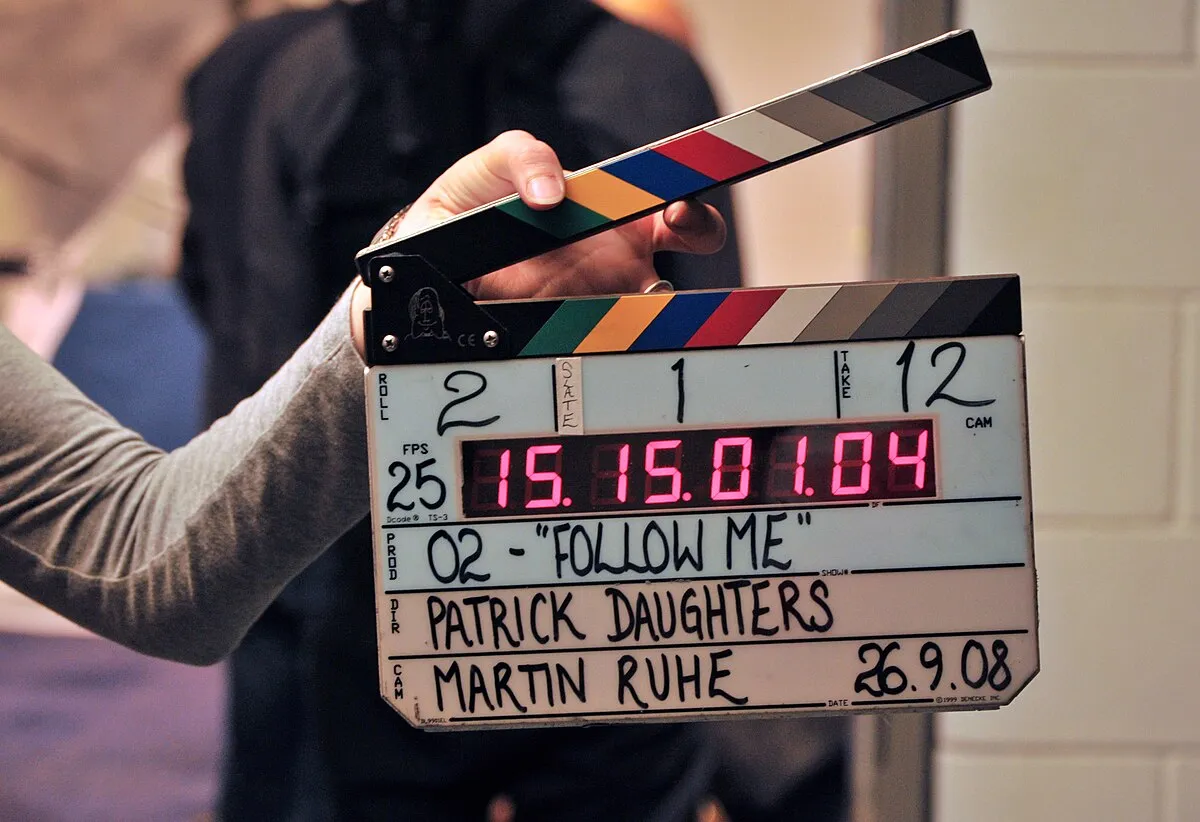
The slate identifies each take on camera, and the clapper sticks give a frame where picture and separately recorded sound can be lined up (Wikipedia, "Clapperboard"). It carries the title, date, director, DP and scene, angle and take.
Slate
A timecode slate held in shot, showing roll, scene and take, the running timecode and the director's name.Photo: Mattbr, Wikimedia Commons, CC BY 2.0.
Smart slate. Shows SMPTE timecode jam-synced to the camera; the sticks are still clapped as a backup.
Tail slate. Filmed at the end of a take, upside down.
MOS. No sound; the sticks are blocked by a hand.
Roll, speed, action, cut
The calls before every take follow a fixed order (No-Nonsense Filmmaking):
AD: "Quiet on set."
AD: "Camera ready?" Operator: "Ready."
AD: "Sound ready?" Mixer: "Ready."
AD: "Roll sound." Mixer: "Speed."
AD: "Roll camera." Operator: "Speed."
The slate is called and clapped, then removed.
Director: "Action."
Director: "Cut."
"Speed" means the equipment "is running at the speed necessary to create sync sound."
The order of calls for a take, as given in No-Nonsense Filmmaking (LMU, 2025).
Abby Singer and the martini shot
The Abby Singer is the second-to-last shot of the day, and the martini shot is the last (Wikipedia). The first is named after assistant director Abby Singer (1917–2014), who warned the crew so they could start packing, which he said saved the director 10 to 15 minutes per move (citing DGA Monthly, March 2002).
Magic hour
Magic hour, or golden hour, is the period just after sunrise or before sunset when light is warm and soft (Wikipedia, "Golden hour"). For Days of Heaven (1978), Néstor Almendros described it in American Cinematographer (June 1979) as "lasting only about twenty minutes a day."
Wrap
"Wrap" is the end of shooting, for the day or the whole production. The DGA agreement makes the second AD responsible for supervising "the wrap in the studio and on location" (Paragraph 1-304), and the nine-hour rest period for ADs and UPMs starts one hour after company wrap (Paragraph 13-116).
Video, data and continuity
Video village
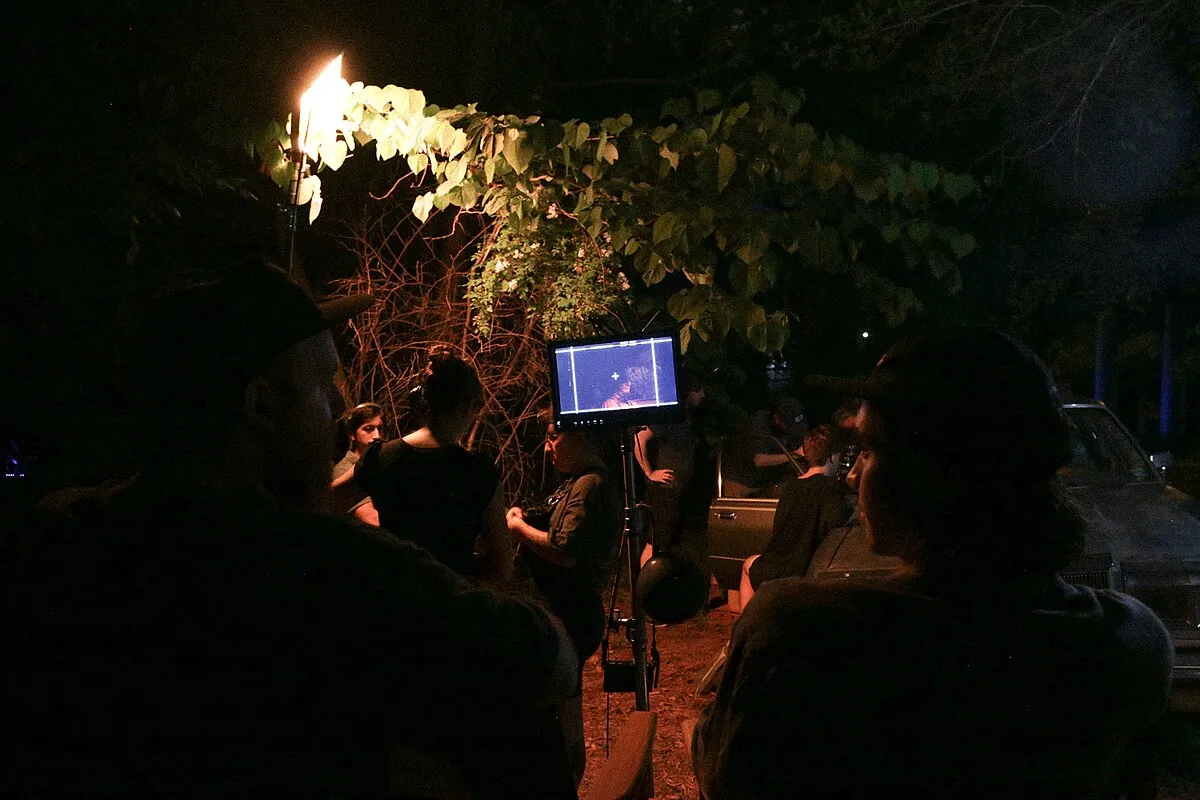
Video village is the cluster of monitors near set where the director, producers and others watch the live camera feed during takes. Netflix says colour management applied at the DIT station is "distributed to the various on-set monitors, including video village."
Video village
At night on set, people gather around a monitor showing the camera feed.Photo: Moments in Between, Wikimedia Commons, CC BY-SA 4.0.
DIT (digital imaging technician)
Netflix describes the on-set DIT as "a key role in setting up, overseeing and communicating the overall image pipeline between the set and Post Production and VFX departments." Netflix separates three related roles:
Role
What Netflix says it covers
DIT (on-set)
The image pipeline, live grading and live QC
DIT (near-set)
A hybrid with data management. Live grading and live QC are not possible from near-set
Data manager / digital loader
The data management plan for the original camera files and sound files
Script supervisor and continuity
The script supervisor "oversees the continuity of the motion picture including dialogue and action during a scene" (Wikipedia, citing Pat Miller's Script Supervising and Film Continuity, 1999). They keep continuity notes, a lined script showing which lines each setup covers, and a daily log of takes for the editor. For the editing side, see Continuity Editing Grammar.
Film crew roles and management
Unit production manager (UPM)
The UPM "is required to coordinate, facilitate and oversee the preparation of the production unit... all off-set logistics, day-to-day production decisions, locations, budget schedules and personnel" (DGA, Paragraph 1-302).
First assistant director (1st AD)
The first AD "is the Director's right hand" (DGA Assistant Directors Training Program). They own the schedule and, in production, "facilitates an organized flow of production activity," running the set and directing background action (Paragraph 1-303).
Second assistant director (2nd AD)
The second AD is "the First's right hand" (DGA Training Program), handling call sheets, the production report, extras vouchers and signing cast in and out, and making sure that "cast, crew and extras, are ready at the beginning of the day" (Paragraph 1-304).
Line producer
Under the PGA's Code of Credits, the line producer is "the single individual who has the primary responsibility for the budget and logistics of the feature film's production, from pre-production through completion of production." "All below-the-line department heads report to the Line Producer."
Above the line and below the line
The budget's top sheet splits costs at a line (Wikipedia, "Below-the-line"): writers, producers, director and principal cast above it; crew, equipment, locations and post below. In Stephen Follows's analysis of 107 budgets, above-the-line was 16% to 26% of the total (see Film Budgets and Schedules).
Gaffer
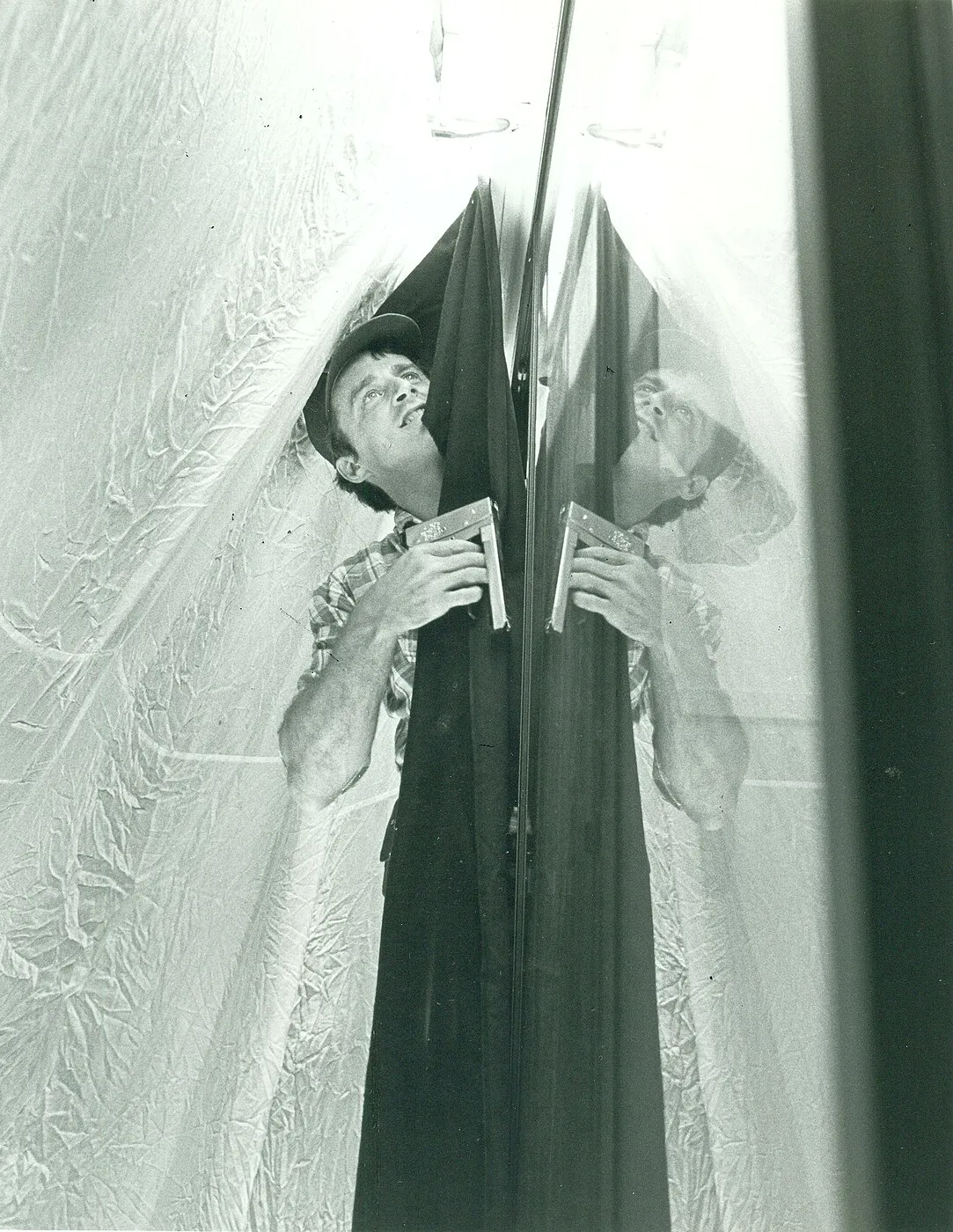
The gaffer is the head of the lighting (electrical) department, who carries out the director of photography's lighting plan on set (Wikipedia, "Gaffer (filmmaking)"). IATSE Local 728 uses the title chief lighting technician (CLT).
Gaffer
Gaffer Patrick Shellenberger looks up while fixing material with a staple gun on set; a mirror beside him repeats his reflection.Photo: Nancy Wong (1983), Wikimedia Commons, CC BY-SA 4.0.
Key grip
The key grip runs the grip department (Wikipedia, "Grip (job)"), which handles camera support, rigging and non-electrical light shaping: flags, nets, diffusion and negative fill. On US union jobs, "grips do not touch the lights themselves."
Best boy
The best boy (electric or grip) assists the gaffer or key grip as "the foreman for the department," handling crew booking, equipment rental and paperwork (Wikipedia, "Best boy"). In 2024, IATSE adopted the titles "assistant chief lighting technician" and "2nd company grip."
Dolly grip
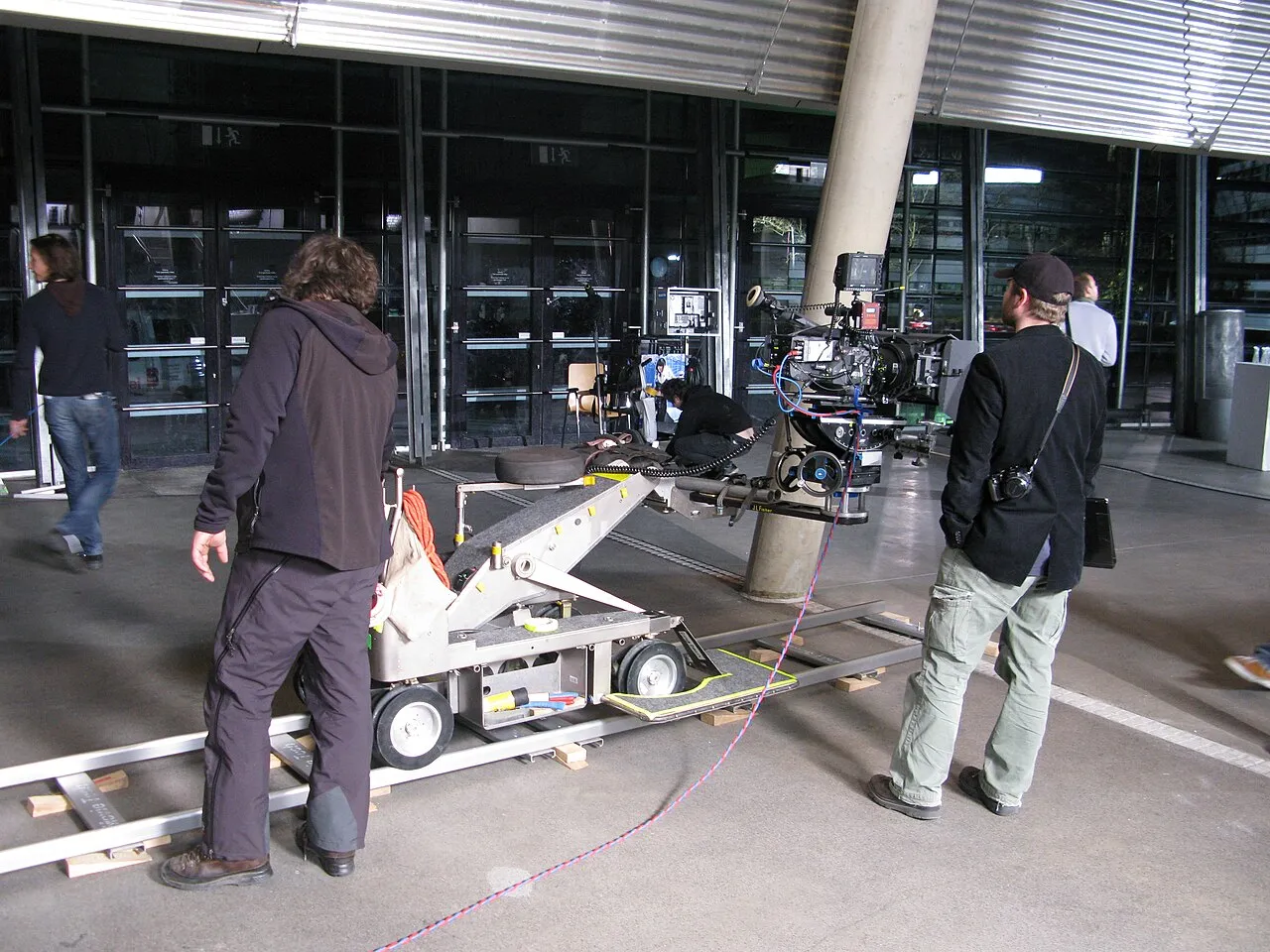
The dolly grip "operates camera dollies and sometimes camera cranes" (Wikipedia, "Grip (job)"); on a moving shot, their start, stop and speed are as much part of the take as the operator's framing. See Camera Movement and Rigs Explained.
Dolly
Crew stand around a camera dolly on track, with the camera mounted on its arm.Photo: Schlaier, Wikimedia Commons, CC BY 3.0.
Production assistant (PA)
A production assistant is an entry-level crew member (Wikipedia, "Production assistant"). Set PAs report to the AD department: they lock up the set, relay "rolling" and "cut", and hand out paperwork and radios.
How we compiled this
Duties come from the DGA Basic Agreement 2023–2026 (read 18 November 2026), the DGA training program and the PGA Code of Credits; set procedure from No-Nonsense Filmmaking; DIT and video village from Netflix; crew titles and set lore from Wikipedia, with its underlying citations named. Vinc makes an AI film studio.
Néstor Almendros, "Photographing Days of Heaven," American Cinematographer, June 1979 (as cited by Wikipedia)
·
·6 min read
Aspect Ratios in Film Explained: 1.33 to 2.39 and 9:16, With the History and Delivery Specs
Aspect ratios in film are width divided by height. See where 1.375, 1.85, 2.39, 16:9, IMAX and 9:16 came from, and the containers cinemas and Netflix expect.