Turn a small idea into a one-sentence premise and a mood board with three reference films.
Covers: How to find a film idea and build a mood board: the short answer · Where one-minute ideas come from · Watch some real one-minute films first
Find a one-minute film idea, research it, and build a mood board from film stills, paintings and photos. Then name three reference films and say what each one is for.
Method. Reference sources (FilmGrab, Library of Congress), example films (Filminute, PES, Lumière) and the paintings' museum records checked November 18, 2026. The method and the worked example are ours. Vinc makes an AI film studio.
How to find a film idea and build a mood board: the short answer
Pick one small moment you've lived or watched, one person, one place and one change. Write it as a single sentence. Then spend an hour on research: gather 15–30 images (film stills, paintings, photos) and pin them on one board. Cut it down to 6–9 images that agree on light, colour and framing, and name three reference films, each with a reason. That board decides the look of every later step, so make it before you write the script.
This is step 1 of 10 in our "Start here" path. Each guide ends with a timed exercise and builds the same one-minute example film, The Letter.
The ten steps of the Start here path. This guide covers the first: the idea and the look.
Where one-minute ideas come from
A one-minute film has room for one situation that changes once, so big ideas (a war, a heist, a life story) don't fit. Look in these places, in this order:
Source
Ask yourself
Example seed
Your own week
What small thing surprised you?
A parcel arrived for someone who used to live here
An object
Who owns it, and what happens when they find it?
A letter, a key, a voicemail
A place you know
What happens here at a time nobody watches?
A kitchen at dawn, a launderette at closing
A rule
What if one rule of daily life broke?
The lift only goes to floors that don't exist
A real one-minute film
What made it work, and what's my version?
See the examples below
Write five seeds in five minutes, then keep the one you can picture as images. If the idea only works as a voice-over, it's an essay, not a film.
Premise
A premise is the one-sentence version of the film: a character, a situation and what changes. "A woman finds a letter she wrote to herself at sixteen, and it makes her leave the house" is a premise. Our story structure lesson covers the longer forms (logline, synopsis, treatment) when you need them.
Watch some real one-minute films first
Three to watch before you start (checked 18 November 2026):
L'Arroseur arrosé (Louis Lumière, 1895). A gardener, a hose, a boy who steps on it. One fixed camera, under a minute, and a complete joke with a setup, a turn and a payoff.
Fresh Guacamole (PES, 2012). Everyday objects turn into guacamole ingredients. At 1 minute 40 seconds, PES's site calls it "the shortest film ever nominated for an Oscar".
What Did They Say? (Kevin Jin Kwan Kim, 2024). Best Filminute 2024 at Filminute, a festival whose rules require films to be "exactly 60 seconds in total running time, including titles and credits".
Our structure guide breaks each one down: premise, turn and why it works.
Do the background research
Research makes a small film feel specific. Spend 20 minutes on it and write down facts you can show on screen:
The place. What does it look and sound like at that hour? Which way does the light come in?
The person. What do they do for work, what do they wear, what's on their walls?
The object. If there's a prop at the centre (a letter, a phone), what does it really look like? Stamps, paper, handwriting.
The period. If it isn't today, check what existed then.
Keep each finding as a line in a notes file. You'll turn them into set dressing and wardrobe in the character design guide.
Gather references and build the board
Mood board
A mood board is a single page of reference images that shows how the film should look and feel: its light, colour, framing and texture. It's a tool for decisions, not decoration: every image should answer "this, not that" about something you'll choose later.
Where to find references:
Type
Where
What to check
Film stills
FilmGrab, a free archive of stills from "nearly 4,000 films"
The site presents them "for education and reference purposes only", so use them for planning, not in your film
Paintings
Museum collection sites
Many older works are public domain; check each museum's terms
Fewer ads, easier to keep tidy and share with a collaborator
Searchable film stills
ShotDeck (paid), searchable by lighting, colour and shot type
Best when you need "night interior, practical light, close-up" fast
Your own photos
Your phone
Shoot the real place at the real hour
Then build it in this order:
Collect 15–30 images fast, without judging.
Sort them into rows: light, colour, framing, people and wardrobe, places.
Cut to 6–9 images that agree with each other. If two images pull in different directions, keep one.
Write one line under each kept image: what you're taking from it ("cold window light, warm lamp inside").
Pull a palette of 4–5 colours from the board.
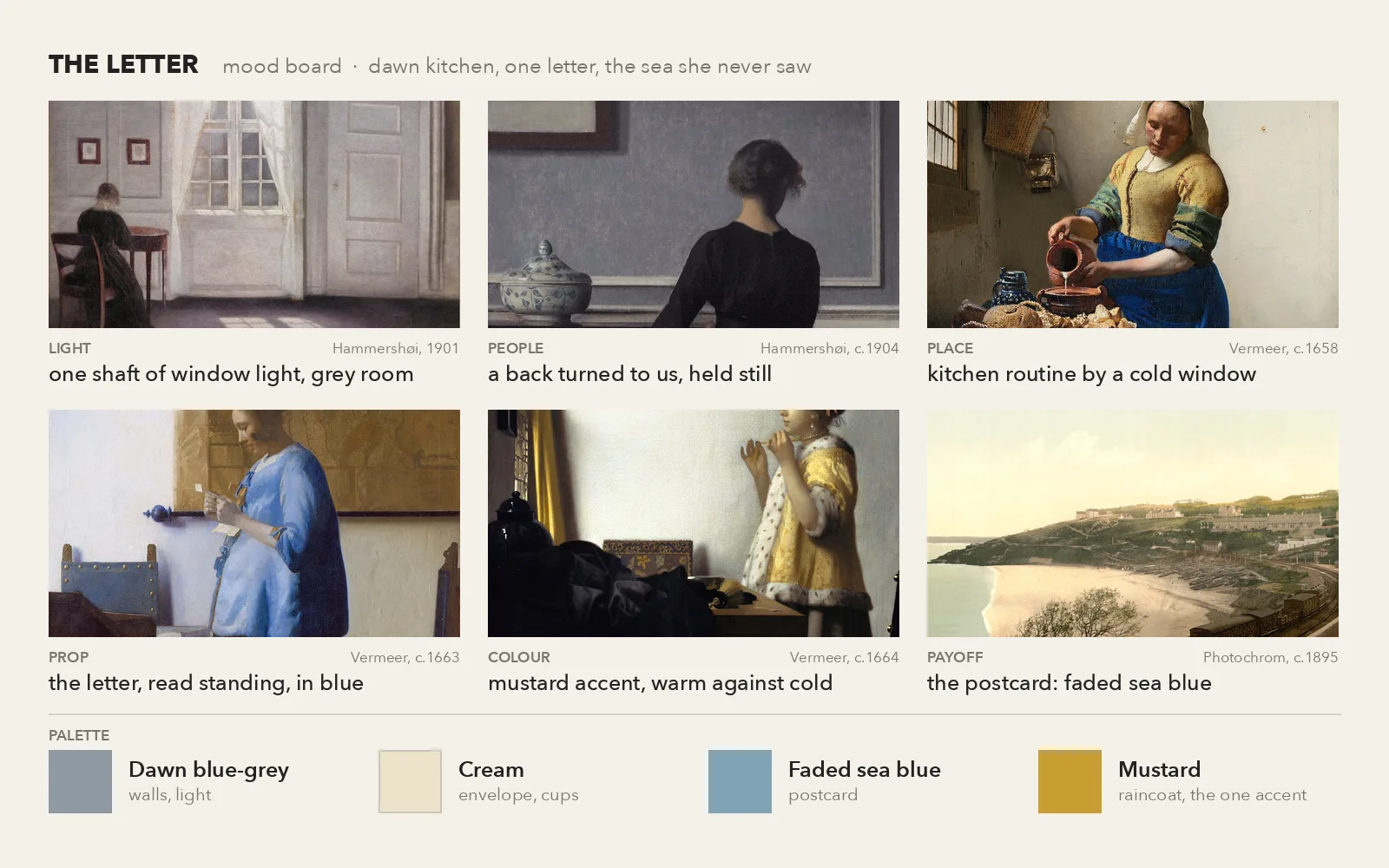
An example board for The Letter: six public-domain references, each tagged with what it gives the film (light, people, place, prop, colour, payoff) and one line on what to take from it, plus the four-colour palette pulled from them. We used public-domain paintings and photos here so we can publish the board; your own board can mix in film stills and phone photos, like the worked example below.Vilhelm Hammershøi, Interior in Strandgade, Sunlight on the Floor (1901, SMK) and Interior with Young Woman Seen from the Back (1903–04, Randers Kunstmuseum); Johannes Vermeer, The Milkmaid (c. 1658, Rijksmuseum), Woman in Blue Reading a Letter (c. 1663, Rijksmuseum) and Woman with a Pearl Necklace (c. 1664, Gemäldegalerie Berlin); St. Ives, Porthminster Beach, Cornwall (photochrom, c. 1895, Detroit Publishing Co., Library of Congress). All public domain, via Wikimedia Commons.
Colour palette
A colour palette is the small set of colours the film keeps returning to, usually a dominant tone plus one or two accents. Pick it from your board, write the colours down by name, and use the same words in every prompt and wardrobe note. Our colour grading terms lesson explains how a grade enforces it later.
Name three reference films, and why
A reference film is a finished film you point to for one specific quality. Name three, and give each one a job, so nobody copies a whole film:
Reference
Take this
Not this
Film 1
The light, or the colour
The story
Film 2
The rhythm, or the camera
The setting
Film 3
The tone, or the performance style
The look
"It's like Aftersun" is vague. "The way Aftersun lets an adult look back at a younger self" is a reference you can use.
The film we'll carry through all ten guides is the one from our how to start AI filmmaking guide: a kitchen at dawn, Maya, an unopened letter.
Premise. Maya, 34, finds a letter on her kitchen table at dawn. It's from herself, written at sixteen, and it asks one question: "Did you see the sea yet?"
Research notes. Dawn light comes in low and blue through an east-facing window. A kettle heating in the background gives the scene a clock. In our story, the letter comes from a "letter to your future self" class project, posted back to her years later. A sea postcard pinned by the window plants the payoff.
Mood board (6 images).
#
Reference
Taking
1
Vilhelm Hammershøi, Interior in Strandgade, Sunlight on the Floor (1901, SMK, Copenhagen)
Quiet grey room, one shaft of window light, a back turned to us
2
Edward Hopper, Morning Sun (1952, Columbus Museum of Art)
A woman alone, looking out of a window at early light
3
A still from Jeanne Dielman, 23 quai du Commerce, 1080 Bruxelles (FilmGrab)
Static, centred kitchen frames; routine as drama
4
Your own phone photo of a kitchen at 6 a.m.
The real colour of dawn indoors
5
A Library of Congress postcard of a seaside
The postcard prop and its faded colours
6
Close photo of blue ballpoint handwriting on cream paper
The letter
Palette. Dawn blue-grey (walls, light), cream (envelope, cups), faded sea blue (postcard), and one warm accent: a mustard raincoat on the chair, which she takes when she leaves.
Three reference films.
Jeanne Dielman, 23 quai du Commerce, 1080 Bruxelles (Chantal Akerman, 1975). Take the static, patient kitchen frames, where a small change in routine is the event. It topped Sight and Sound's 2022 critics' poll (BFI).
Aftersun (Charlotte Wells, 2022). Take the idea of an adult looking back at a younger self; A24's synopsis: "Sophie reflects on the time spent with her idealistic father on their last vacation" (A24).
Paterson (Jim Jarmusch, 2016). Take the gentle, unhurried rhythm of daily routine, and the way a small object (his notebook) carries the story.
Do it in Vinc
Paste your premise, pick a style and a frame format, then press Begin. The Director finds the look: Sage pulls credited film references from FilmGrab, and you pick one and lock it for every shot. Make your own board first, so you know which reference to pick.
How we compiled this
Reference sources, example films, paintings and film facts were checked against the pages listed below on 18 November 2026. The idea-source table, the board method and the Letter example are ours. Vinc makes an AI film studio.
Aspect Ratios in Film Explained: 1.33 to 2.39 and 9:16, With the History and Delivery Specs
Aspect ratios in film are width divided by height. See where 1.375, 1.85, 2.39, 16:9, IMAX and 9:16 came from, and the containers cinemas and Netflix expect.