Each style label in a prompt stands for specific choices of lighting, camera, frame count and staging, set by films such as Double Indemnity, Primary, The Blair Witch Project, Astro Boy and Coraline. This article breaks each style into those choices, covers the composition rules behind them including the weak evidence for the golden ratio, and sets out what the official guides say about naming styles, studios and living artists.
Method. American Cinematographer, Criterion, BFI Sight and Sound, Box Office Mojo, Britannica, David Bordwell's essays, MediaSmarts, open textbooks, a 2016 Frontiers review of aesthetics research, and official Google, LTX, Luma, Kling and Runway guides and usage policies, checked November 18, 2026. Vinc makes an AI film studio.
Film noir's look is darkness with a few chosen highlights. American Cinematographer (March 2003) says Double Indemnity (1944) "epitomizes the look of film noir," and John F. Seitz's lighting shows its elements:
Darkness as the default, with highlights only on what matters, such as "Phyllis' glinting eyes or a gun she is planting."
Light broken by blinds: "often breaking up soft light with Venetian blinds to achieve a dim, hazy effect."
Expressionism used sparingly: the film "never employs the stylized effects of German Expressionism."
In lighting terms noir is low key: a high key-to-fill ratio and deep shadow (see the lighting glossary).
Noir keeps being revived, as in Blade Runner 2049, where Deakins lit with "pools of light surrounded by darkness" (AC, December 2017).
How the guides phrase it
Google's Veo guide writes "film noir style with deep shadows and stark highlights." Naming the elements gives the model more: "low-key, single hard source through Venetian blinds, face half in shadow, black-and-white" (our illustration).
Cinéma vérité and the observational documentary
What made it possible
Vérité was made possible by lightweight sync-sound gear: before Primary (1960), "Cameras capable of synchronizing sound were too heavy to lift off a tripod" (Thom Powers, Criterion, 2016). Robert Drew's team built "a shoulder-mounted Auricon 16 mm camera and a portable Perfectone audio recorder suitable for a two-person crew" and set rules: "No interviews. Tell the story through action, not narration."
The visual grammar
The equipment became the look: handheld at shoulder height, available light, sync sound, a camera that reacts rather than stages. Fiction borrows it: Saving Private Ryan (1998) was handheld "for probably about 90 percent" of the film, with 45° and 90° shutters for choppy motion (see frame rate and shutter angle).
How the guides phrase it
Runway's Text to Video guide writes "Handheld documentary film style. Natural camera shake."; Kling specifies "Not a gimbal, slider, tripod lock-off, drone or digitally stabilised camera"; Google says handheld can "convey realism, immediacy, or unease."
Found footage
The defining film
Found footage is fiction presented as recordings made by the characters and found afterwards, so every shot must be one a character could plausibly have taken. In The Blair Witch Project (1999), the actors were "outfitted with a combination of film and Hi8 video cameras" and filmed themselves (The Saturday Evening Post). Box Office Mojo lists a $60,000 budget and a $248,643,994 worldwide gross, about 4,100 times over (our arithmetic), though other budget estimates are higher.
The visual grammar
The camera's faults are the look: drifting framing, wrong exposure, light from what the characters carry. No guide mentions "found footage," so describe who holds the camera: "shot by a character on a consumer camcorder, the operator is running and breathing hard" (our illustration).
Mockumentary
A mockumentary uses documentary form for fiction, usually comedy: the vérité kit plus to-camera interviews. This Is Spinal Tap (1984) was convincing enough that "many filmgoers, including Ozzy Osbourne, thought they were watching a documentary about a real musical group" (Britannica).
The music-video aesthetic
Music video is picture cut to music: a 2021 study by Prétet, Richard and Peeters concluded that "a 'language of music-video clips' exists," with editors favouring "the co-occurrence of music and video events." It also tolerates effects that "didn't have to make sense" (Sony Cine). Runway's Gen-4 clips run 5 or 10 seconds, so beat-matched montage is assembled in the edit.
Anime
Limited animation
Limited animation saves money by "recycling drawings and cutting the number of original frames per second," the approach of Osamu Tezuka's Mushi Production (Sight and Sound). Astro Boy (1963), "Japan's first long-form anime program," used "a reduced number of frames, reused drawings, and techniques like only moving the mouth" (Nippon.com) and "set the aesthetic blueprint for modern anime." Western studio animation is mostly on twos (see the 12 principles of animation); limited animation holds poses longer.
Smear frames
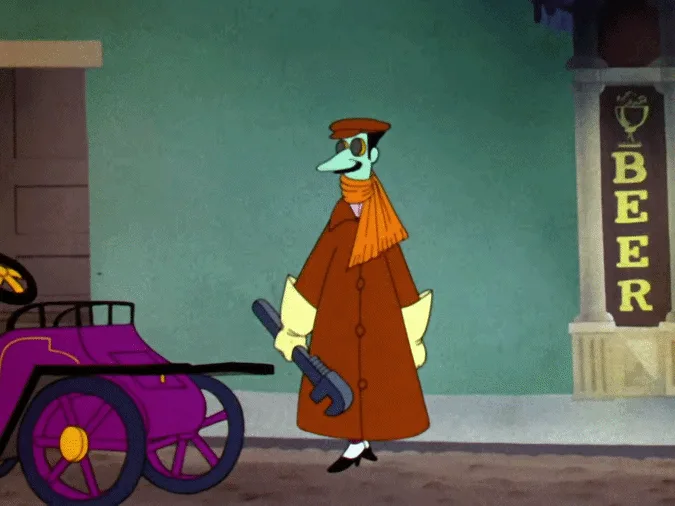
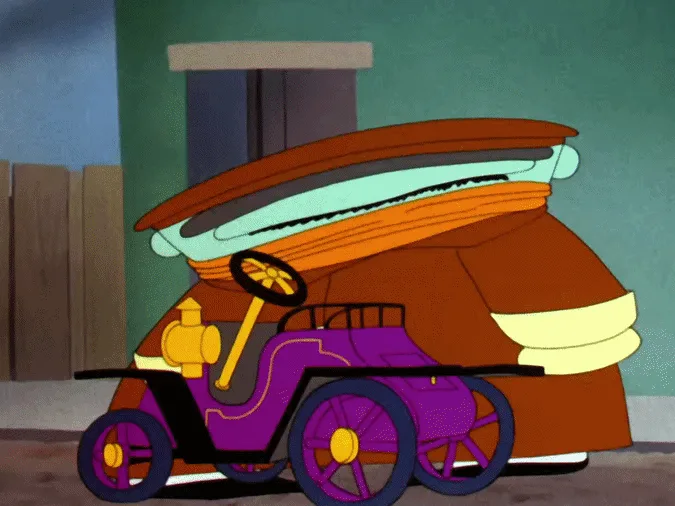
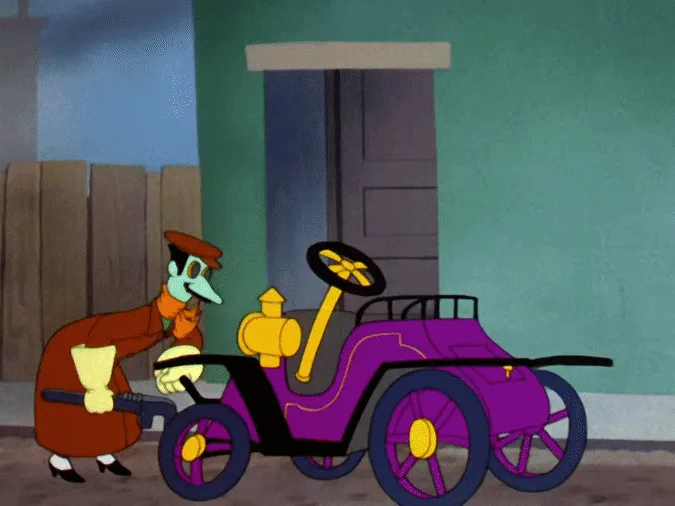
A smear is a single distorted, blurred drawing between two poses that sells very fast motion: characters "shoot from one pose to the next with a single 'blurred' frame between them" (Cartoon Brew), as in Chuck Jones's The Dover Boys (1942). It comes from American cartoons, not anime.
Before
Smear
After
The character starts upright, is drawn as one stretched, distorted shape mid-move, then lands crouched by the car.The Dover Boys at Pimento University (1942), Chuck Jones. Public domain (US).
How the guides phrase it
Google lists "Japanese anime style" and "cel-shaded animation." Neither guide mentions limited animation, so describe it: "held poses, only the mouth and hair move" (our illustration).
Stop-motion and claymation
The technique
Stop-motion is "a form of animation pioneered in 1898, in which animators manipulate physical models by hand between frames" (CFA Magazine). On Kubo and the Two Strings (2016), "Every 50 hours of work resulted in approximately 4 seconds of footage." For Coraline (2009) Laika 3D-printed 6,333 faces (The Hollywood Reporter); Kubo's lead had 23,187.
Printed replacement faces for a lead character
Coraline (2009)6,333
Kubo (2016)23,187
Boston University CFA Magazine (October 2018) and The Hollywood Reporter. Coraline's printed faces were each hand-painted.
Many prompts now ask for exactly the "jittery, jerky" look that replacement faces removed.
Claymation is a trademark
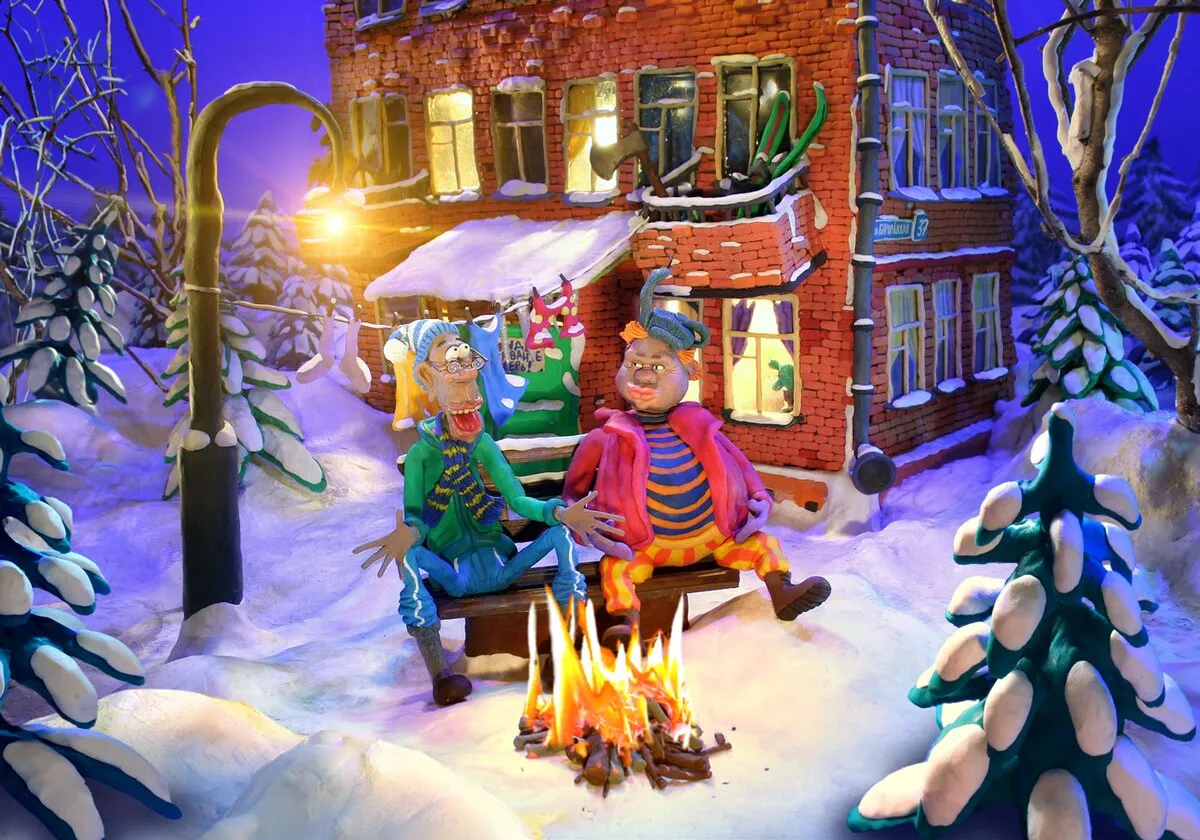
"Claymation" began as a brand name: Will Vinton, who made the Academy Award-winning clay short Closed Mondays (1975) with Bob Gardiner, "received the trademark for the term 'Claymation' in 1978" (Oregon Encyclopedia). The general term is clay animation.
Clay animation
Clay characters sit by a fire in a miniature snowy street, with the clay texture visible on every surface.Max Sviridov Studios, Wikimedia Commons, public domain (released by author).
How the guides phrase it
Kling's guide gives the most precise prompt we found: "Handcrafted clay stop-motion animation in the style of Aardman Animations. Preserve clearly visible fingerprints, clay textures, and slightly uneven surfaces, with the characteristic stepped motion of 12 fps stop-motion animation." LTX lists "Jittery stop-motion"; Google "claymation style."
Director signatures
Wes Anderson: planimetric staging and compass-point cutting
Wes Anderson's frames are planimetric: the camera perpendicular to a back wall, people lined up "like clothes on a line" (Composition in Film). David Bordwell's 2014 essay notes his twists:
Symmetry: single characters "centered, as if posed."
Wide lenses: Anderson "favors quite wide-angle lenses (often 40mm)," where most planimetric directors go long.
Compass-point editing: he cuts straight in, or turns 90° or 180° "to what's 'behind' the camera."
A ratio per era in The Grand Budapest Hotel: 1.85, 2.40 and 1.37 (see Aspect Ratios Explained).
Bordwell places Anderson in a tradition running back through Keaton and Ozu.
Stanley Kubrick: one-point perspective
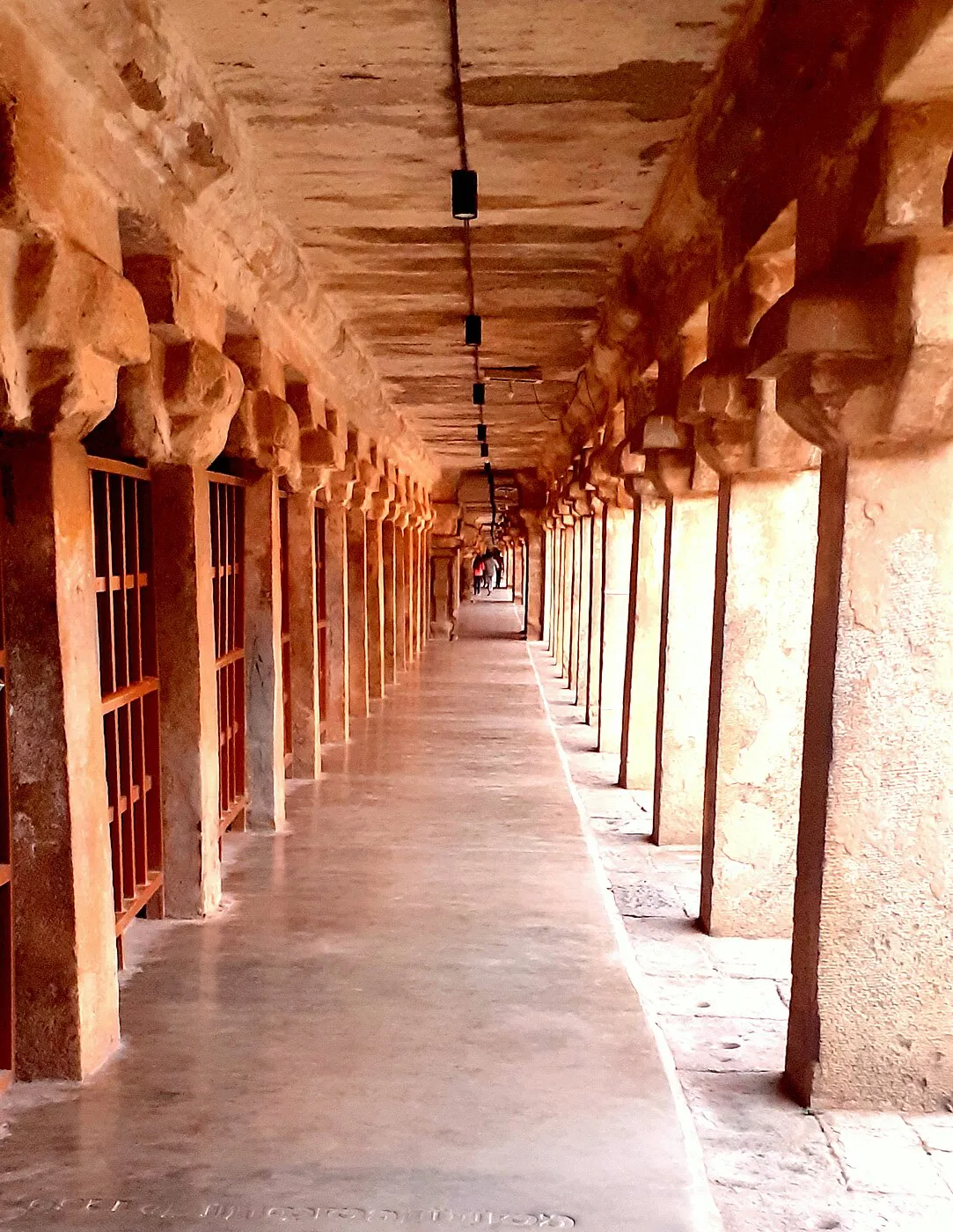
In one-point perspective, parallel lines in the set (corridor walls, ceilings, floors) converge on a single vanishing point, "a technique known as one-point perspective, famously used by Stanley Kubrick" (MediaSmarts). Kogonada's 2012 supercut Kubrick // One-Point Perspective collects examples.
One-point perspective
Not from a Kubrick film: a pillared temple corridor whose floor, ceiling and columns converge on a single vanishing point.Photo: Sindugab, Wikimedia Commons, CC0 (public domain dedication).
A symmetrical frame: the main subject sits on the vertical centre line and the two halves mirror each other, as in planimetric and one-point-perspective shots.
Composition terms the styles rely on
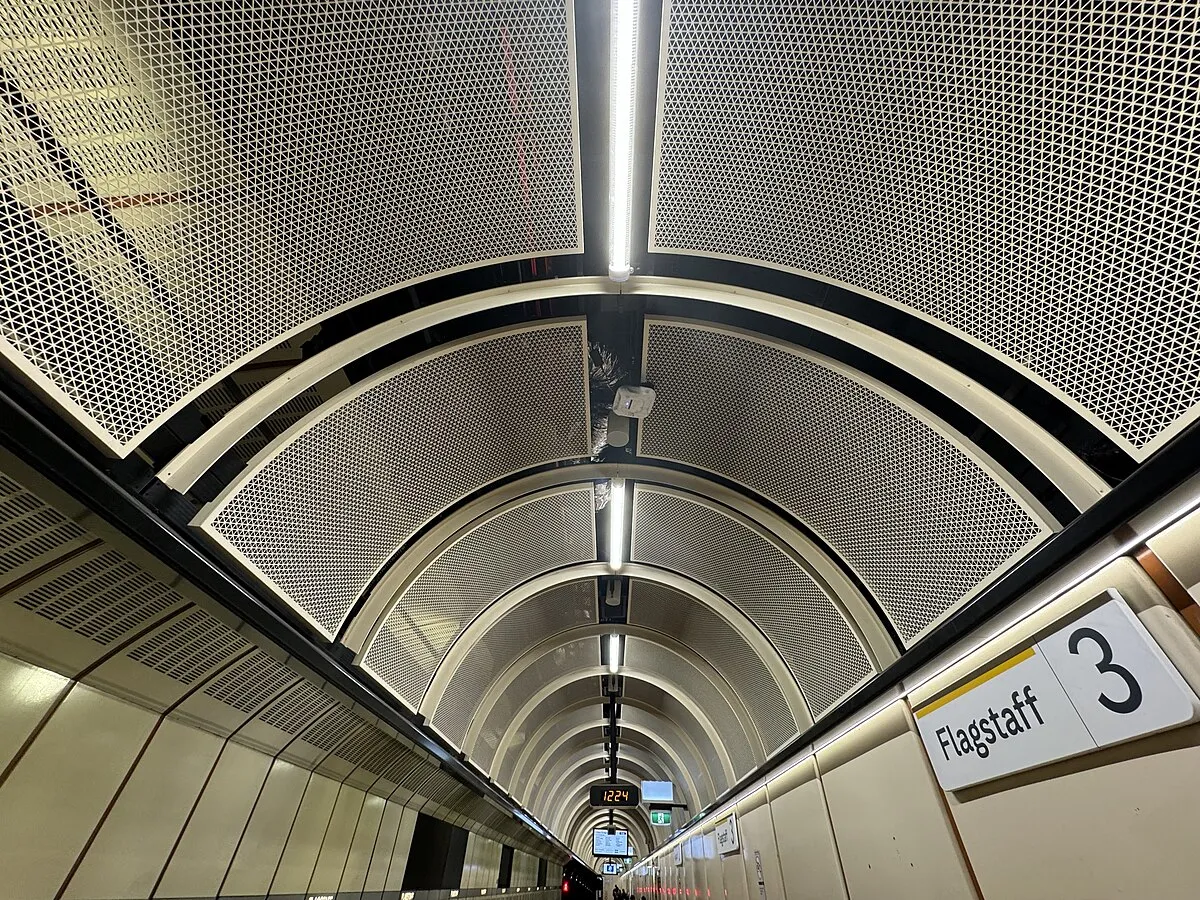
Leading lines
MediaSmarts defines leading lines as "actual or imaginary lines that lead the eye to key elements," found "in nature (rivers, horizons) or artificial structures (streets, buildings)"; diagonals add "movement, tension and depth."
Leading lines
The ribs and light strip of a station roof all run toward one point at the far end of the platform.Photo: PEPSI697, Wikimedia Commons, CC BY-SA 4.0.
Negative space
Negative space is "the visually quiet area that surrounds the active area of a composition" (OpenTextBC). It can make "subjects appear smaller to convey loneliness or isolation" (MediaSmarts).
Lead room: empty space in front of a moving or looking subject. MediaSmarts notes that too little room ahead of the subject, called short siding, creates tension.
Centred framing
Centred framing puts the subject in the middle, where audiences "will assign importance" (MediaSmarts). It underpins the Anderson and Kubrick looks and is the opposite of the rule of thirds (Composition in Film).
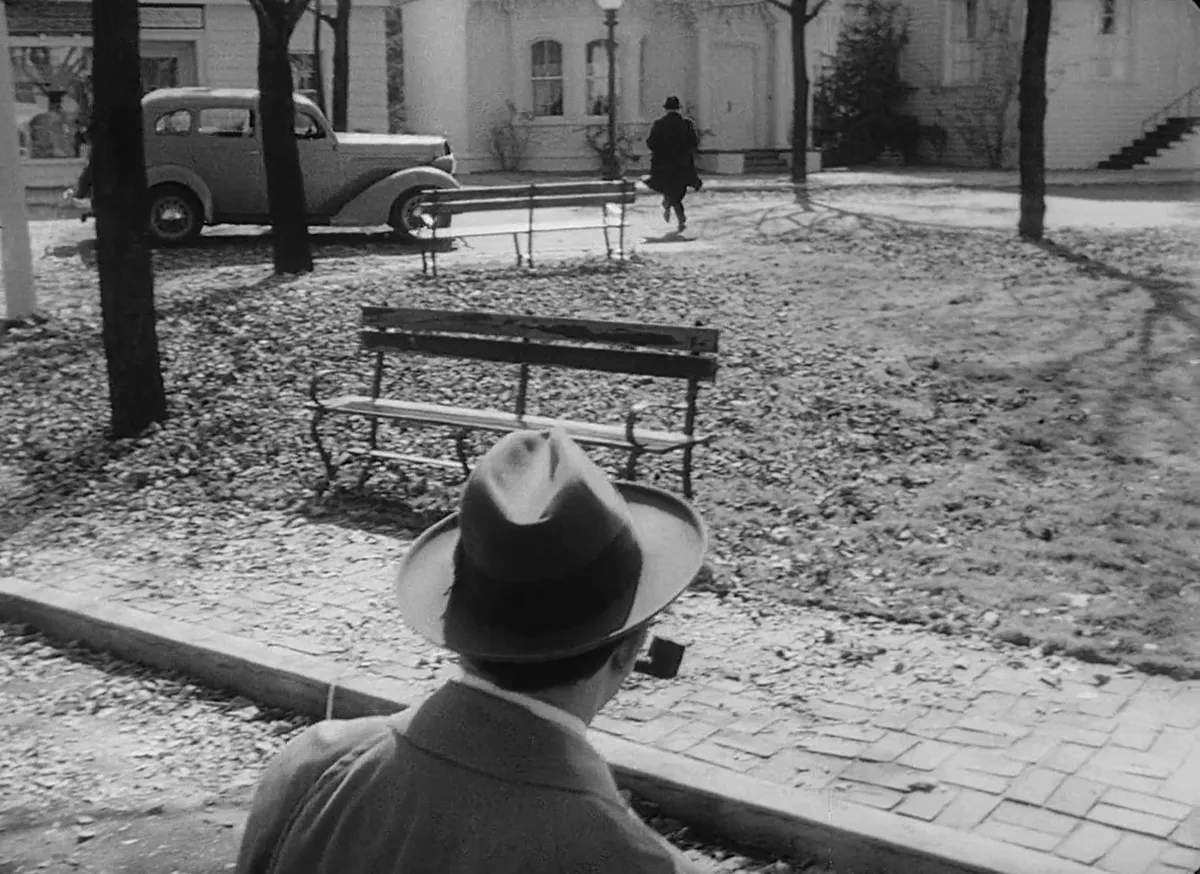
Foreground layering
Foreground layering places objects on all of the "three layers to depth, foreground, middle ground, and background" (CCSF Video Production Handbook) to give "the illusion of depth." In The Lost Weekend, Seitz puts "bottles on a shelf" between the camera and the hero; Kling writes it into prompts as "layered depth."
Foreground layering
A man's back and hat fill the foreground, a bench sits in the middle ground, and a small figure walks across the far side of the square.The Stranger (1946), Orson Welles. Public domain (US).
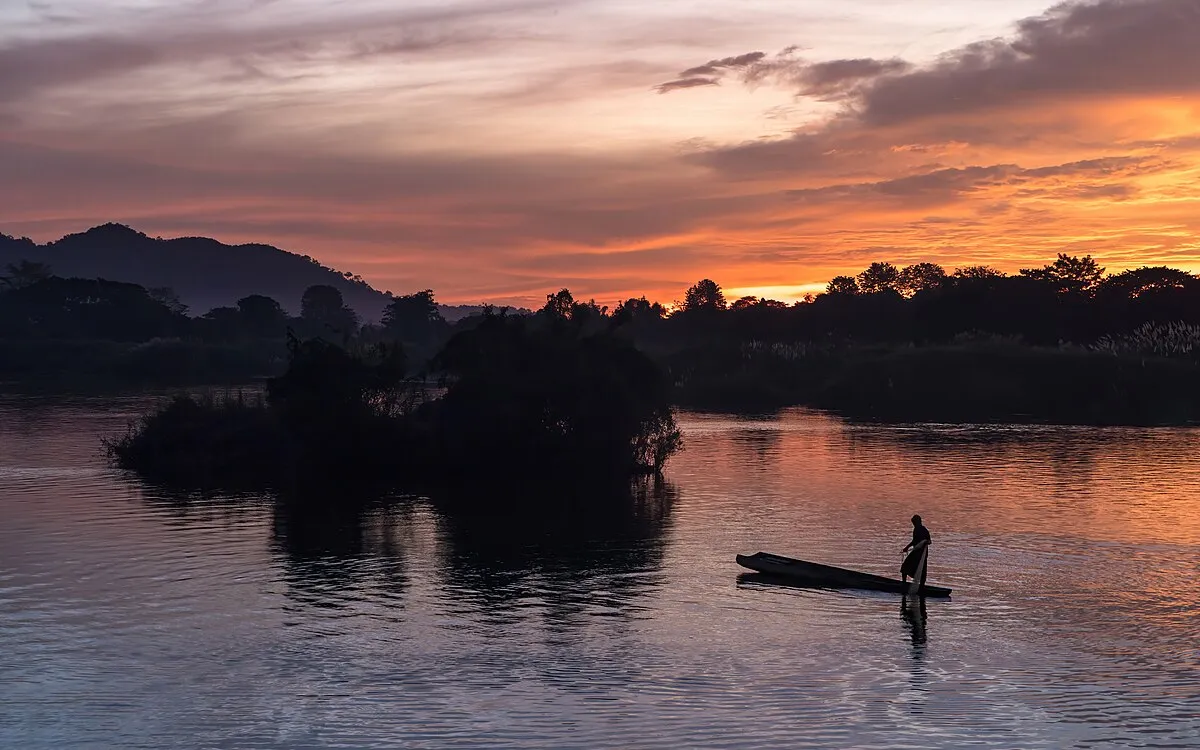
Silhouettes
A silhouette is a subject recorded as a dark shape against a brighter background: expose for the background and give the subject little or no front light. Google's guide puts it as "backlighting to create a silhouette."
Silhouette
A fisherman on a narrow boat is a dark shape against the sunset reflected in the river.Photo: Basile Morin, Wikimedia Commons, CC BY-SA 4.0.
The golden ratio, and the evidence
The golden ratio is φ ≈ 1.618, often sold as the most pleasing rectangle, but research doesn't support a general preference. A 2016 review (Spehar, Walker and Taylor) traces the claim to Fechner (1876), whose findings "have been criticized on methodological grounds"; later work confirmed "that the universal preference for the golden ratio is weak," though individual preferences are "strong and stable over time" (McManus et al., 2010).
Naming styles, directors and living artists in prompts
The official guides take different positions:
Source
What it says
Google (Veo guide)
Lists "in the style of Van Gogh" under art movements and artists, and studio styles such as "classic Disney animation style" and "Pixar-like 3D animation."
Kling 4.0 guide
Uses a studio name in its own example: "in the style of Aardman Animations."
LTX guide
Lists genre and movement labels ("Film noir," "Documentary," "Claymation," "Cyberpunk"). Names no people.
Luma
Uses technique words ("documentary realism," "Handheld camera"). Names no people.
Runway Usage Policy
Prohibits "Attempts to create content in the style of a known, living artist."
OpenAI (DALL·E 3)
"DALL·E 3 is designed to decline requests that ask for an image in the style of a living artist."
No guide uses a film director's name, and on Runway a living director falls under the living-artist rule. Naming traits is also more specific than "Wes Anderson style":
Style
What to describe instead (our illustration)
Film noir
Low-key, single hard source, Venetian-blind shadows, black-and-white, night
Vérité / observational
Handheld at shoulder height, available light, no interview, camera reacts late
Found footage
Shot by a character on a named device, on-camera light, operator in motion
Mockumentary
Handheld coverage plus to-camera interview with an off-screen questioner
Music video
Short shots cut on the beat, wet-down surfaces, stylised colour
Anime (TV)
Cel-shaded, sharp lines, saturated colour, held poses, mouth-only movement
Stop-motion / clay
Fingerprints in clay, 12 fps stepped motion, miniature-set lighting, macro depth of field
Anderson-like
Camera perpendicular to the back wall, centred subject, symmetrical group in layers, 40mm wide lens
Kubrick-like
One-point perspective down a corridor, vanishing point at frame centre
How we compiled this
Film detail comes from American Cinematographer, Criterion, The Saturday Evening Post, Box Office Mojo, Britannica, Prétet et al., Sight and Sound, Nippon.com, Cartoon Brew, CFA Magazine, The Hollywood Reporter and the Oregon Encyclopedia; composition from Bordwell, MediaSmarts, OpenTextBC, CCSF and Spehar et al.; prompt wording and policies from the vendors' own guides, checked 18 November 2026. We left out claims we couldn't source, such as who coined "film noir."
Laure Prétet, Gaël Richard and Geoffroy Peeters, "Is there a 'language of music-video clips'? A qualitative and quantitative study," arXiv:2108.00970, 2021 (abstract)
Branka Spehar, Nicholas Walker and Richard P. Taylor, "Taxonomy of Individual Variations in Aesthetic Responses to Fractal Patterns," Frontiers in Human Neuroscience 10:350, 2016, doi:10.3389/fnhum.2016.00350
Aspect Ratios in Film Explained: 1.33 to 2.39 and 9:16, With the History and Delivery Specs
Aspect ratios in film are width divided by height. See where 1.375, 1.85, 2.39, 16:9, IMAX and 9:16 came from, and the containers cinemas and Netflix expect.