Haze, god rays, rain, moonlight, neon, crushed blacks and wet streets each describe something physical: particles in the air, the sun's angle, a gas's emission lines, a black point or the angle at which water reflects. This article defines each term with figures from meteorologists, physicists, manufacturers and cinematographers, then shows how the Google, LTX, Luma, Kling and Runway prompt guides phrase it.
Method. AMS Glossary of Meteorology, ESTA, Britannica, HyperPhysics, APS, LEE Filters, Kodak and Netflix glossaries, a University of Utah night-rendering report, American Cinematographer articles and official Google, LTX, Luma, Kling and Runway prompt guides, checked November 18, 2026. Vinc makes an AI film studio.
What this article covers
A prompt can name the lamps and still miss the look: what fills the air, the weather, the colour of sources, how dark the blacks are, how surfaces reflect. Key, fill, kelvin, lighting patterns, gels and magic hour are in Lighting Terms and Setups; shot sizes in Camera Language for AI Video Prompts.
Hard and soft light
What the words mean
Kodak's glossary defines hard lighting as "specular or harsh, giving sharp dense shadows and glaring highlight," and soft lighting as "diffuse, giving a flat scene in which the brightness difference between highlights and shadows is small." Since both words also describe film contrast, write "soft light" explicitly.
Size and distance
Hardness depends on how big the source looks from the subject: a bigger or closer source casts a softer shadow edge (geometry in our lighting article). Distance also costs light: under the inverse-square law (HyperPhysics), light at 1 m is "one fourth as much at 2 meters," two stops less.
A point source spreads over a sphere, so light per unit area falls to one quarter at twice the distance and one ninth at three times.
Diffusion materials and what they cost
Diffusion is translucent material in front of a lamp: it enlarges the source, softening the light, and absorbs some of it. LEE Filters' published transmission (daylight Source C):
LEE filter
LEE's description
Transmission
Light lost
251 Quarter White Diffusion
"A weak diffusion used for soft light effects"
80%
⅓ stop
250 Half White Diffusion
"A medium diffusion used for soft light effects"
60%
¾ stop
216 White Diffusion
(full strength)
36%
1½ stops
129 Heavy Frost
"A strong diffusion that eliminates nearly all shadows"
25%
2 stops
Light transmitted through LEE diffusion
251 Quarter White80%
250 Half White60%
216 White36%
129 Heavy Frost25%
LEE Filters product pages, Transmission Y under Daylight (Source C), checked 18 November 2026. Heavier diffusion is softer and darker.
In a prompt, name the result, not the material.
How the guides phrase it
Google's Veo guide gives "soft morning sunlight streaming through a window"; Luma uses "Single point light source from above left" for a hard key. Naming the source and its direction gives the model more than an adjective.
Atmospherics: what is in the air
Fog, mist and haze, as meteorologists use the words
Fog, mist and haze are three grades of obscured air, separated by the American Meteorological Society's Glossary of Meteorology:
Fog: water droplets that cut visibility below 1 km, grey in colour.
Mist: droplets that leave visibility "not less than 1 km"; "intermediate between fog and haze."
Haze: "Particles suspended in air, reducing visibility by scattering light"; bluish against dark, "a yellowish veil" against light.
In a prompt, "fog" is a grey wall; "haze" is a thin layer that softens distance and shows beams.
Haze and fog on set
On set, haze and fog come from machines. ESTA's Introduction to Modern Atmospheric Effects (4th edition, 2005) says "almost all modern atmospheric effects are fogs: tiny droplets of liquid floating in the air"; hazers "produce a thin haze of highly refined mineral oil, glycol, or some other fluid."
Fog on set
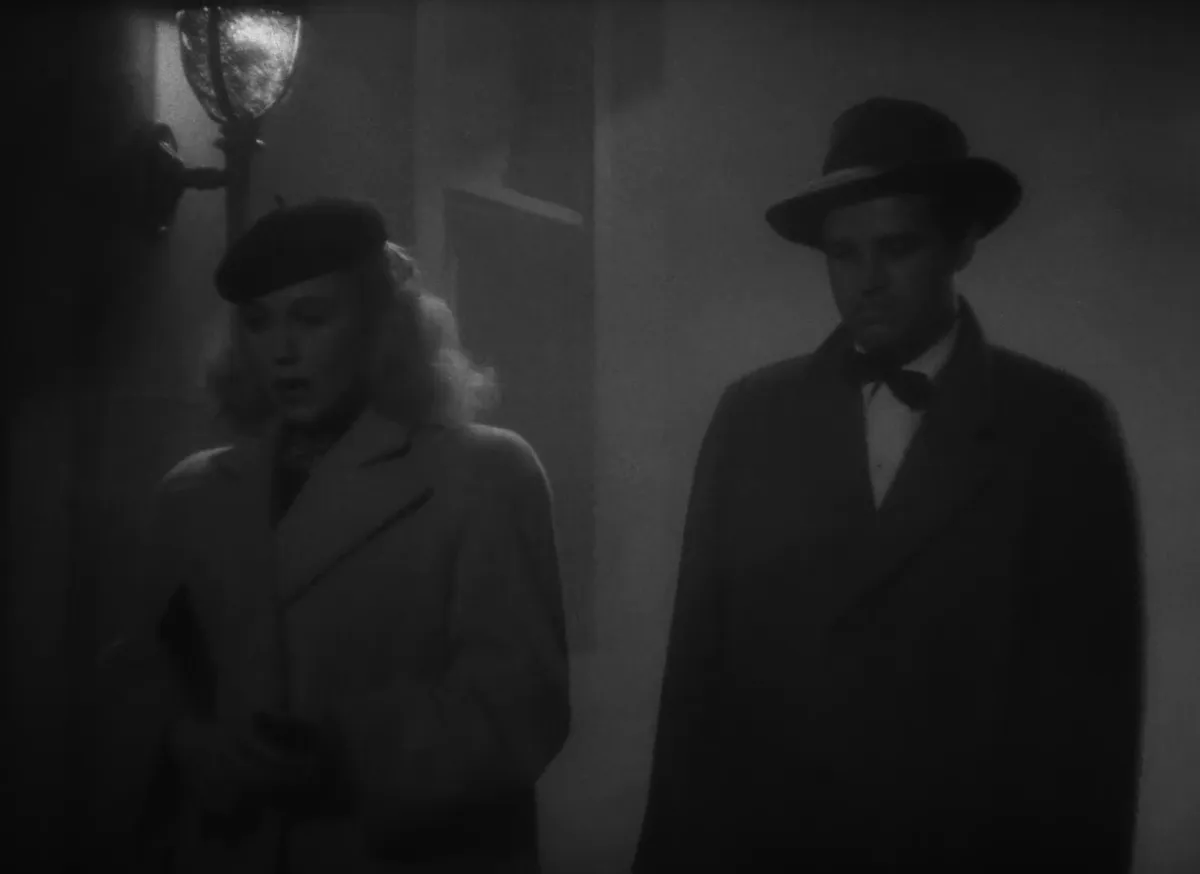
Two figures stand in a night street where fog softens the background and lowers the contrast.Detour (1945), Edgar G. Ulmer. Public domain (US).
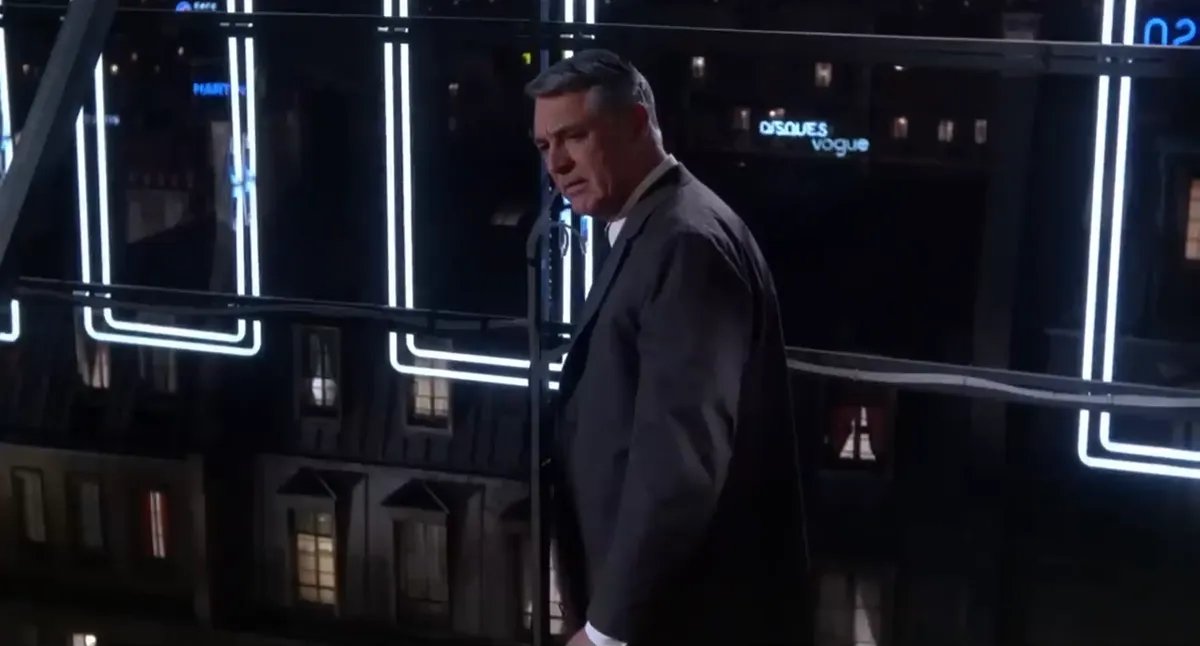
Atmosphere can also carry coloured light: on Blade Runner 2049 (2017), Deakins "filled the stage with mist" so a giant LED advert "was basically lighting the whole shot — the atmosphere and Ryan" (AC, December 2017).
Volumetric light, god rays and dust motes
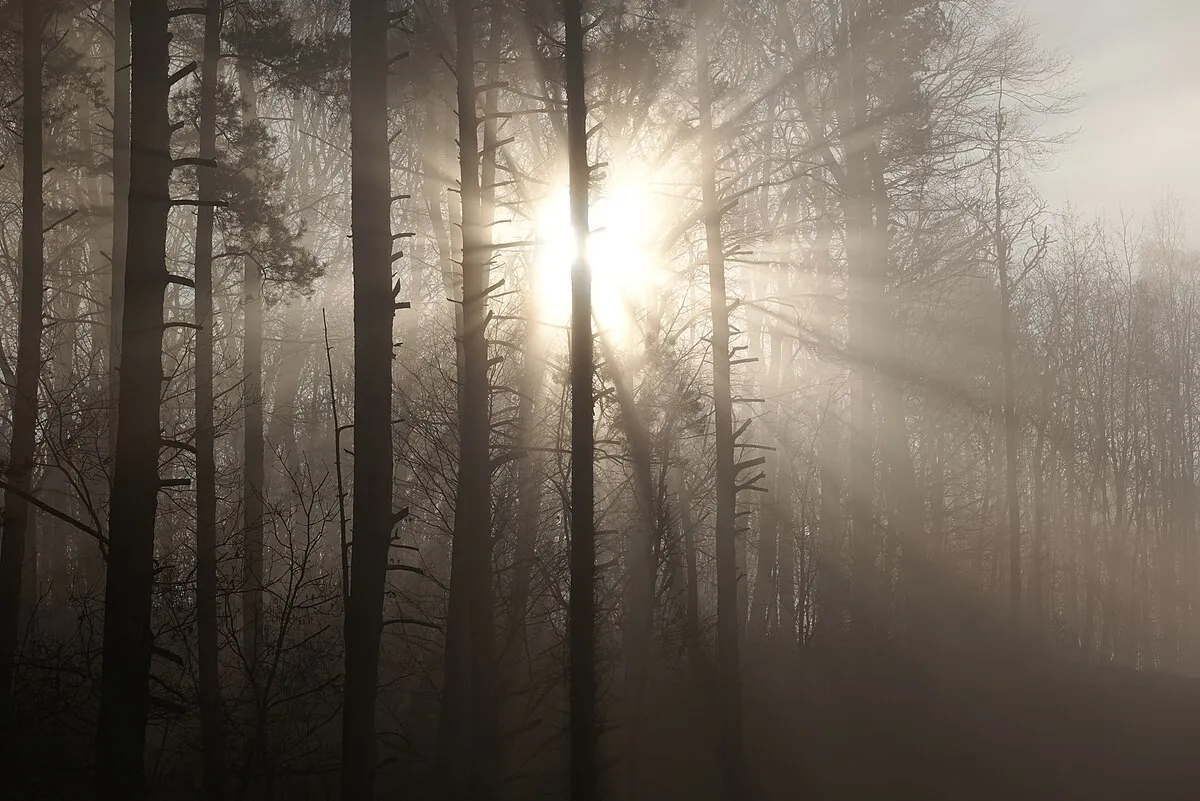
Volumetric light is a beam made visible because particles in the air scatter it toward the camera. Encyclopaedia Britannica calls this the Tyndall effect, "which makes visible a light beam entering a window," caused by particles "roughly the same size as the wavelength of light."
God rays
Low sun through a misty pine forest; the mist makes the beams between the trunks visible.Photo: Jakub Hałun, Wikimedia Commons, CC BY 4.0.
"God rays" is the informal name for crepuscular rays, bands that "seem to diverge fanlike from the sun's position" (AMS). A shaft needs particles in the air and something solid (a window frame, branches) to edge it; dust motes are the same effect with bigger particles. Google's guide writes "volumetric lighting creating visible light rays" and "floating dust motes in a sunbeam."
Rain, and why it is backlit
Rain only shows on camera when it is backlit against something dark: "the rain closest to the light source will look the brightest" (David Mullen, ASC, on the Cinematography Mailing List). In a prompt: "rain backlit by a streetlamp against a dark alley."
Wet-downs
A wet-down is water sprayed on the ground with no rain in the air, because "A black matt surface at night is completely lost on camera" until it is made reflective (Sony Cine, October 2020). Google's guide lists "reflections on wet pavement."
Snow
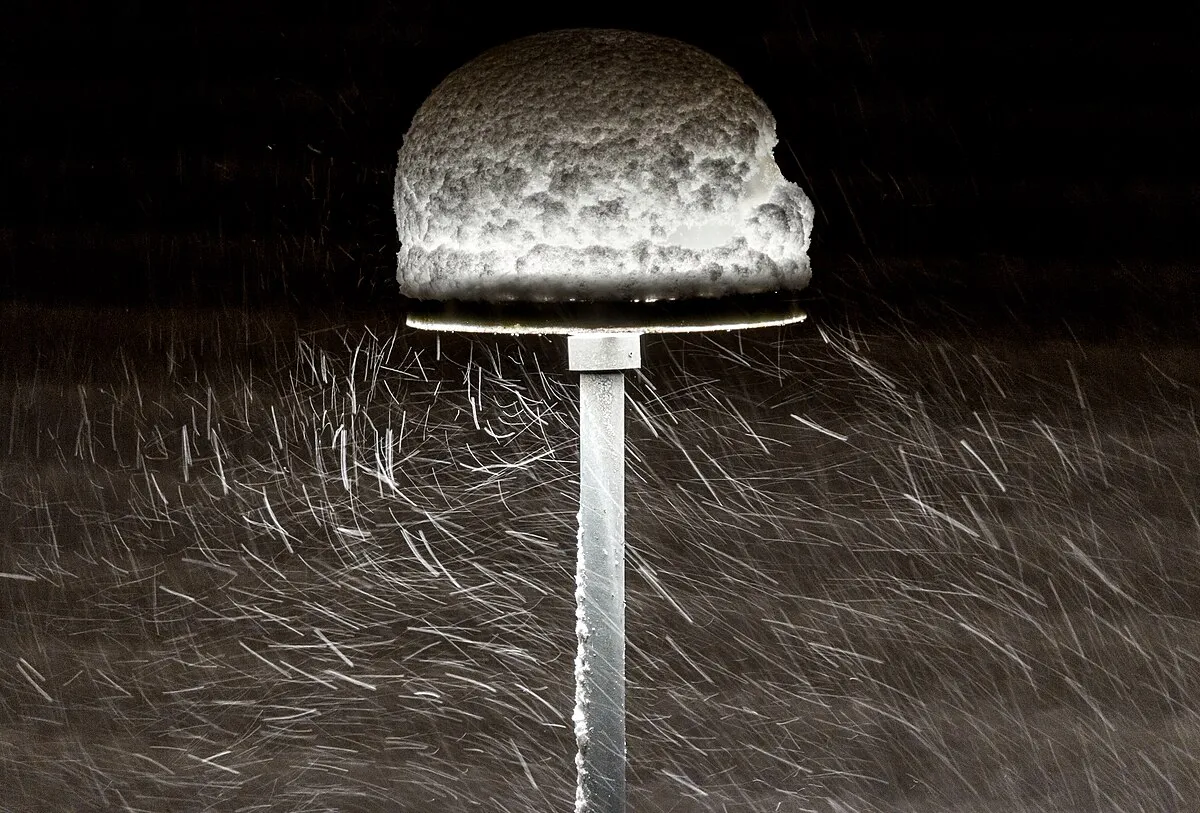
Film snow has been faked with whatever looks white and falls well, from cotton to CGI, now "the predominant method," per the Academy's explainer (December 2020):
Period
Material
Example
Until the late 1920s
Cotton, dropped after the Los Angeles Fire Department deemed it a fire risk
1925
Salt and flour
The Gold Rush
1930s–40s
Chrysotile asbestos
The Wizard of Oz, Citizen Kane
1946
Foamite (fire-extinguisher foam) with sugar and water, nearly 6,000 gallons through a wind machine
It's a Wonderful Life
1965
Marble dust over wax and cold water
Doctor Zhivago
1984
SnowCel, a paper-based product
The Company of Wolves
2000s
CGI, "the predominant method"
Snow
Falling snow shows as bright streaks only where a street lamp lights it against the dark.Photo: W.carter, Wikimedia Commons, CC BY-SA 4.0.
Runway's Gen-4 guide says an adjective ("the dusty desert") "can lead to more natural results," while describing the element ("Dust trails behind them") "can lead to emphasis of the element." Describe the dust only when it is the point.
Weather and time of day
Overcast
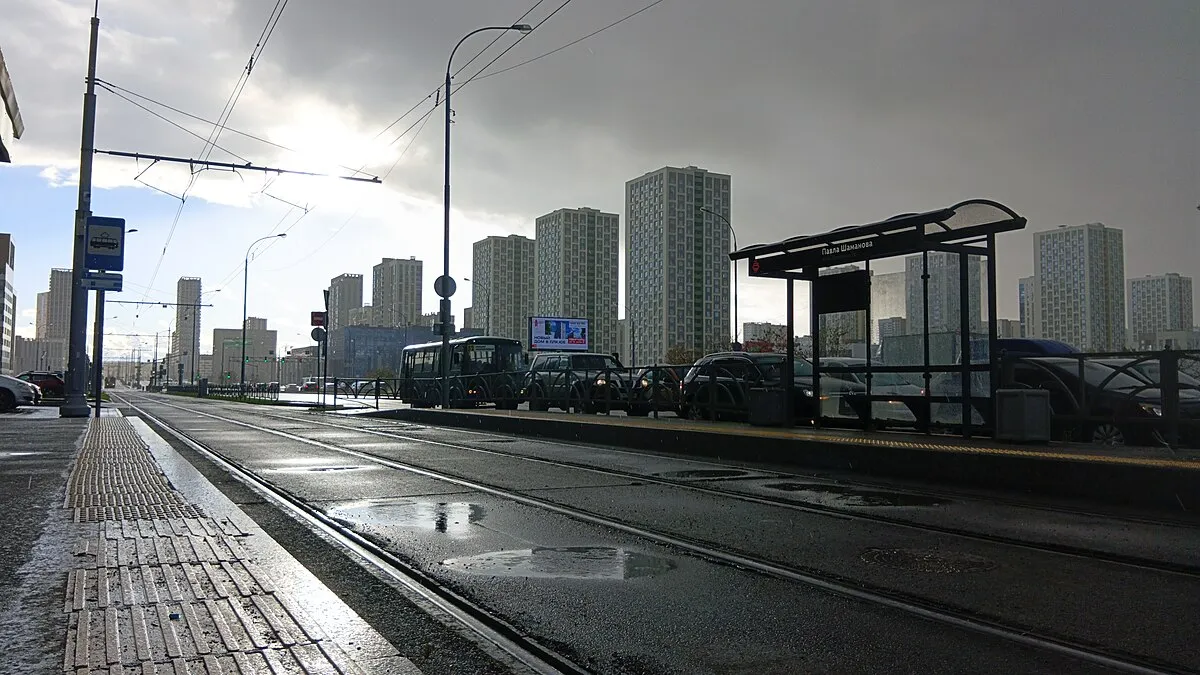
An overcast sky turns the whole sky into one very large soft source, so hard shadows almost vanish. On Saving Private Ryan, Janusz Kamiński found that when it was "overcast with some little highlights, it looked really beautiful" (AC). Google's guide offers "overcast daylight."
Overcast
A grey sky covers the whole scene, so the street and tower blocks show no hard shadows.Photo: S. Kleinmichel, Wikimedia Commons, CC BY 4.0.
Golden hour and blue hour, in sun angles
Golden hour and blue hour have no official definition: The Photographer's Ephemeris (TPE) found five sun-tracking apps giving five answers:
App
Golden hour (sun's elevation)
Blue hour
A, B
−4° to +6°
−6° to −4°
C
0° to +6°
−8° to −4°
D
0° to +10°
−10° to −3°
E
−4° to +6°
(not used)
TPE uses 0° to +6° for golden hour; only twilight is standardised (US National Weather Service: civil twilight to 6° below the horizon). Clock times vary with date and latitude, so describe the result: "low sun just above the horizon, long shadows."
Moonlight, and why film makes it blue
Moonlight is very dim and slightly warm: about 0.2 lux under a full moon against 121,000 lux of sun, roughly 19 stops apart ("Night Rendering," Jensen et al., 2000; our arithmetic). Films show it blue anyway, which the authors call "a real perceptual effect" of rod vision in dim light.
Since real moonlight is rarely shootable, night is built by day-for-night (see our lighting glossary and the colour-grading glossary) or with a sensitive camera, as on Collateral (2004), where HD let Dion Beebe "see silhouettes of palm trees against the night sky" (AC).
Neon, sodium and mixed colour
Neon
Neon glows red-orange because of the gas itself; William Ramsay, who identified it in the 1890s, described "a brilliant flame-covered light, consisting of many red, orange, and yellow lines" (APS). Georges Claude sold the first neon sign in 1912.
Neon
Glowing tubes of a rooftop sign frame a man at night, above the lit windows of the street below.Charade (1963), Stanley Donen. Public domain (US).
Sodium vapour and why it can't be corrected
Sodium streetlights are close to a single colour: "for most practical purposes, all the light from luminous sodium comes from the D-lines" (HyperPhysics). Correction can't create colours a lamp doesn't emit, so under pure sodium everything records as one orange-yellow (our inference).
Mixed colour temperature
Mixed colour temperature means sources of different colours in one frame. On Collateral, Mann found night Los Angeles "too 'fruity'," so the team "selectively reduce[d] saturation on a number of exteriors" and gelled their own lights to match the mercury and sodium streetlights.
What the guides say
LTX advises "one coherent light logic per shot; mixed light sources confuse the result." For a mixed look, give each source a place and a colour: "magenta neon sign frame-left, sodium-orange streetlight from behind" (our illustration).
Contrast and the words used for grades
High contrast and flat
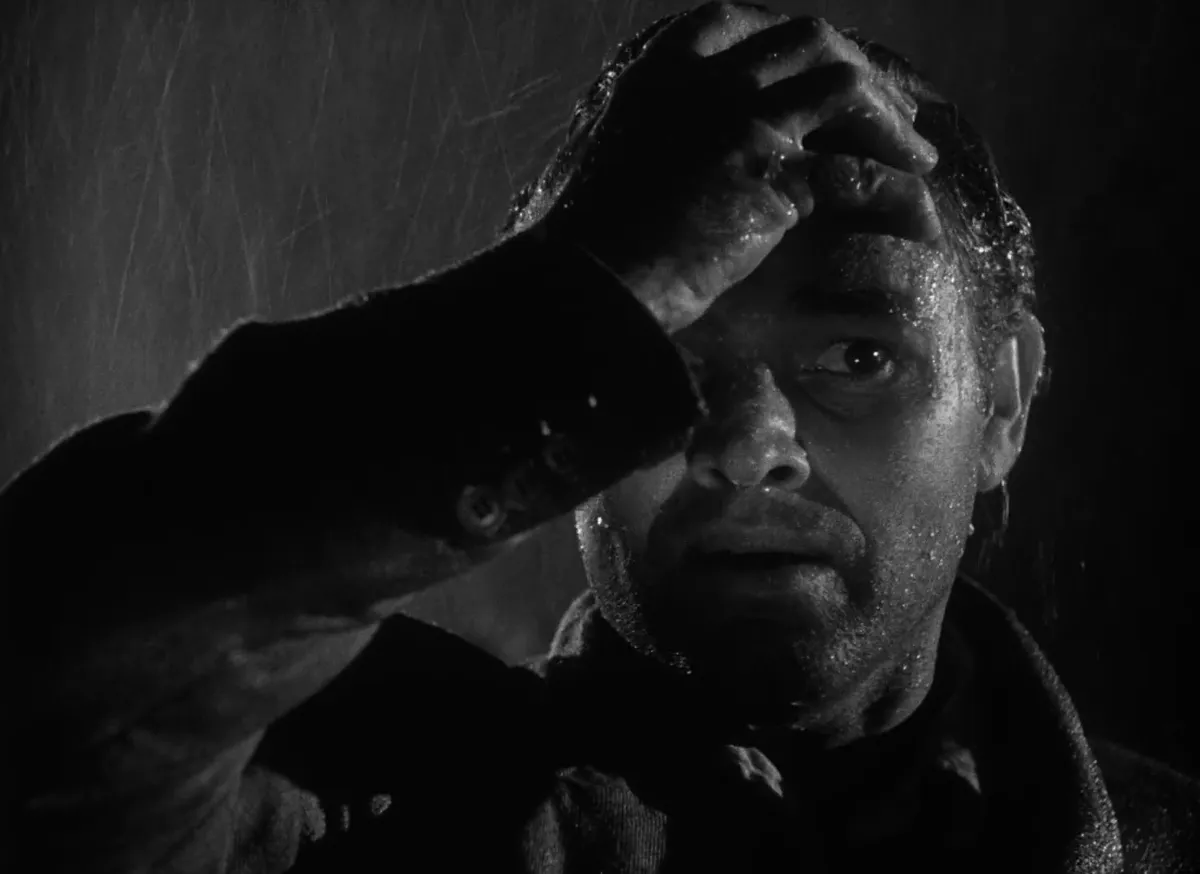
Contrast is tone separation, which Kodak's glossary measures as gamma, the slope of the film's characteristic curve; an image is flat "if its contrast is low." "High contrast" means bright highlights and deep shadows with little in between. Grading tools are in Film Terms: Colour Grading.
High contrast
Hard light picks out his face and hand while most of the frame falls to near black.Detour (1945), Edgar G. Ulmer. Public domain (US).
Crushed blacks
Netflix's QC glossary defines crushed blacks as "when black levels are underexposed causing an overall loss of detail in the shadows/darker portions of the image"; that detail can't be recovered. Stock matters: on The Lighthouse (2019), Double-X had "about 1½ stops less shadow latitude than color stock" (Jarin Blaschke, AC).
Lifted, faded and "matte" blacks
Lifted blacks raise the darkest tones to a dark grey. On film this was flashing, a "Technique for lowering contrast by giving a slight uniform exposure to film before processing" (Kodak); Kamiński flashed Saving Private Ryan "at about 15 percent." Digitally, raise Lift. "Matte" is a confusing word for it, since Kodak's matte is a mask.
Desaturated
Desaturation reduces colour intensity without removing it; Saving Private Ryan got it from 70 percent ENR, a Technicolor lab process. Google's guide uses "muted earthy tones"; LTX uses "Muted."
Monochrome
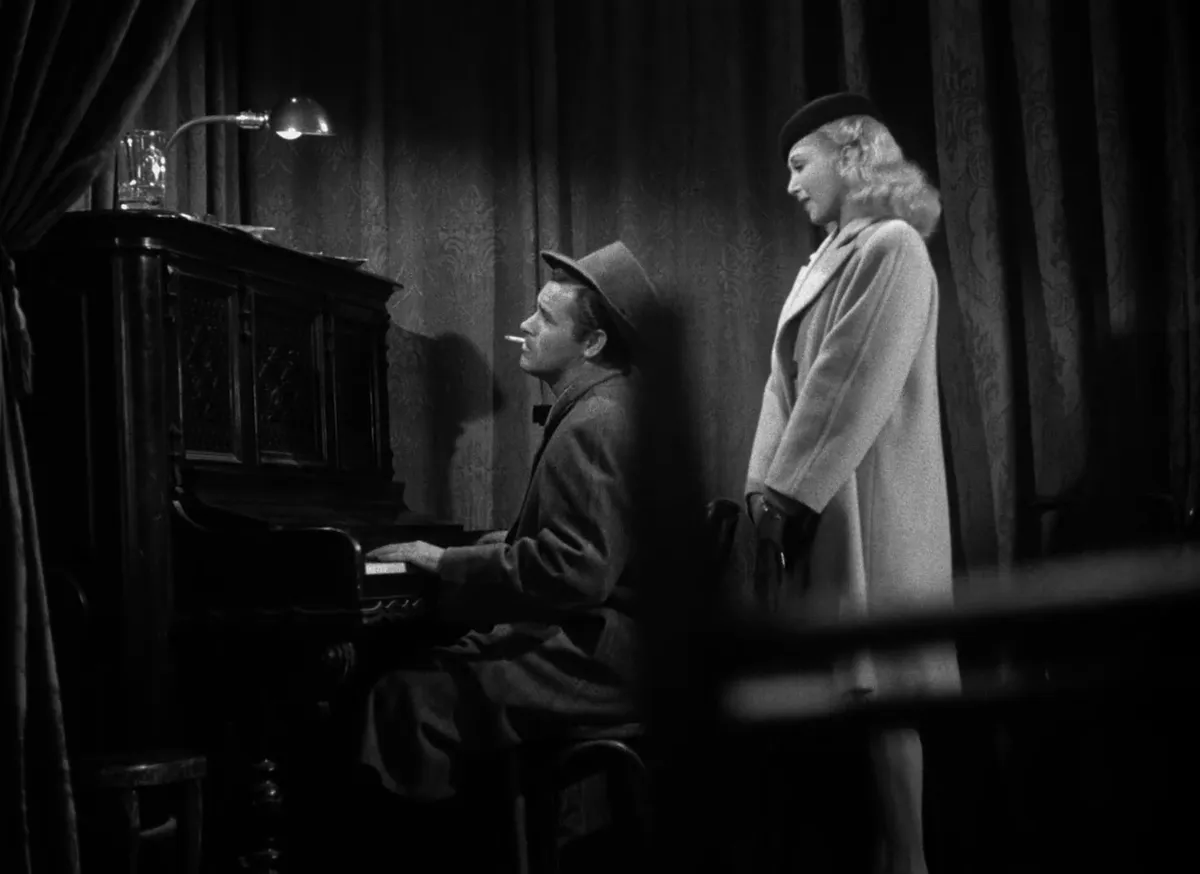
Kodak defines black-and-white film as producing "a monochromatic picture in shades of gray (usually a metallic silver image)," but which colours go dark depends on the stock. The Lighthouse filtered Kodak Double-X to imitate orthochromatic stock, sensitive to "ultraviolet, blue and green light, but not red," so skin records dark and skies pale.
Monochrome
A black-and-white frame: a pianist and a woman in a light coat stand out in a pool of light against dark curtains.Detour (1945), Edgar G. Ulmer. Public domain (US).
Google's guide writes "monochromatic black and white."
Surfaces: wet, glossy, matte, specular
Specular versus diffuse
A smooth surface reflects light in one direction (specular); a rough one scatters it (diffuse): "Matte paints exhibit essentially complete diffuse reflection" (Wikipedia). A specular highlight is the reflection of the source itself, small and sharp from a hard source, broad from a soft one.
Why water and wet streets reflect at a low angle
How much water reflects depends on the viewing angle. From the Fresnel equations (HyperPhysics), water, n = 1.333:
Share of light reflected by a water surface, by angle
0° (looking straight down)2.0%
45°2.8%
60°6.0%
70°13.3%
80°34.8%
85° (grazing)58.4%
Our calculation from the Fresnel equations for unpolarised light, air to water, n = 1.333. Angle is measured from straight down onto the surface.
Straight down, water reflects about 2%; at a camera's grazing angle down a street, a third or more. That is why wet roads streak with reflections in a wide shot.
How the guides phrase surfaces
Google lists "smooth, polished chrome surfaces"; LTX "Glossy surfaces" and "Worn fabric"; Kling uses texture for continuity: "Road surfaces, clothing, and equipment show realistic signs of use."
Putting it in one prompt
Several of these terms together (our illustration, not a vendor example):
Night exterior, empty city street after rain. The asphalt is wet and
reflects a magenta neon sign frame-left in long streaks. Thin haze in
the air; the streetlight behind the subject throws a visible beam and
backlights light drizzle against the dark building. Low contrast with
lifted blacks, muted colour apart from the neon.
How we compiled this
Physics and definitions come from the AMS, ESTA, Britannica, HyperPhysics, the APS, Jensen et al., The Photographer's Ephemeris, the US National Weather Service, LEE Filters, Kodak and Netflix; film examples from American Cinematographer, the Cinematography Mailing List, Sony Cine and the Academy; prompt wording from the official Google, LTX, Luma, Kling and Runway guides. Stop conversions, the moonlight figure and the Fresnel chart are our arithmetic, checked 18 November 2026.
Henrik Wann Jensen, Simon Premože, Peter Shirley, William Thompson, James Ferwerda and Michael Stark, "Night Rendering," Technical Report UUCS-00-016, University of Utah, August 2000 (PDF)
Aspect Ratios in Film Explained: 1.33 to 2.39 and 9:16, With the History and Delivery Specs
Aspect ratios in film are width divided by height. See where 1.375, 1.85, 2.39, 16:9, IMAX and 9:16 came from, and the containers cinemas and Netflix expect.