Composition in film is how the frame is arranged; staging is what moves in it. The rule of thirds, headroom, lead room, Dutch angles, deep focus and long takes.
Method. Sources checked November 18, 2026: the Film Art glossary, MIT and Columbia film glossaries, two open textbooks, American Cinematographer articles (Toland 1941, Children of Men 2006, 1917 2020), Philippe Mather in Kinema, David Bordwell's blog, Wikipedia summaries where noted, and Google and Kling model documentation. Vinc makes an AI film studio.
Composition in film vs staging: two different decisions
Composition is how the frame is arranged. Staging is what the people and objects in front of the camera do over time. Shot sizes, lenses, camera rigs and lighting have their own articles.
Mise-en-scène and blocking
Mise-en-scène.Film Art (Bordwell and Thompson, 7th ed., 2004) defines it as "all of the elements placed in front of the camera to be photographed: the settings and props, lighting, costumes and makeup, and figure behavior." Columbia's film glossary gives the literal sense: "staging in action," a term from the theatre.
Blocking. MIT's Film Lexicon: "the arrangement of the characters' positions and movements in a shot or sequence." It sets where actors start, where they go, and when.
Rule of thirds meaning: useful, old, and not a law
What it says. LMU's open textbook No-Nonsense Filmmaking (Livingstone and Livingstone, 2025) describes dividing "the frame into equal thirds, both horizontally and vertically," and placing important elements along those lines or "where they intersect."
Where it came from. According to Wikipedia's account, John Thomas Smith first wrote it down in Remarks on Rural Scenery (1797), suggesting that "in a design of landscape, to determine the sky at about two-thirds" was a good rule. It began as advice about where to put the horizon in a landscape painting, and George Field (Chromatics, 1845) soon objected that it "is neither accurate nor universal."
The evidence. Amirshahi, Hayn-Leichsenring, Denzler and Redies tested it computationally ("Evaluating the Rule of Thirds in Photographs and Paintings,"
2, 2014): highly rated photographs and paintings scored about as low as photographs that didn't follow it. They conclude the rule "seems to play only a minor, if any, role." Treat it as a useful default for keeping a subject out of the dead centre, not a model of what makes an image good.
Headroom, nose room and lead room in film
Definitions from the City College of San Francisco handbook:
Term
Definition
Getting it wrong
Headroom
"The area from the top of the subject's head to the top of the frame"
Too much "can make the subject appear too low in the frame and makes them appear not as important." Too little "can cut off the person's head if they move or make the shot seem too cramped."
Nose room (look room)
"The area in front of the subject of the shot"
"Too little nose room makes the frame feel unbalanced because of the amount of room behind them."
Lead room
The same idea "for a subject in motion"
Viewers "want to see what is coming up in front of them, not what is behind them," so give "more room in front of their motion than behind."
Symmetry and the planimetric frame
The main alternative to thirds is the centred, flat composition David Bordwell calls the planimetric image ("Shot-consciousness," 2007): "The camera stands perpendicular to a rear surface, usually a wall," and "the characters are strung across the frame like clothes on a line."
He traces it from Buster Keaton through Godard's Vivre sa vie (1962) to Wes Anderson, who relies on it more and more, often with wide-angle lenses. It can give grandeur, posed tableaux, or a deadpan comic beat, as in Jared Hess's Napoleon Dynamite (2004).
The Dutch angle: meaning and examples
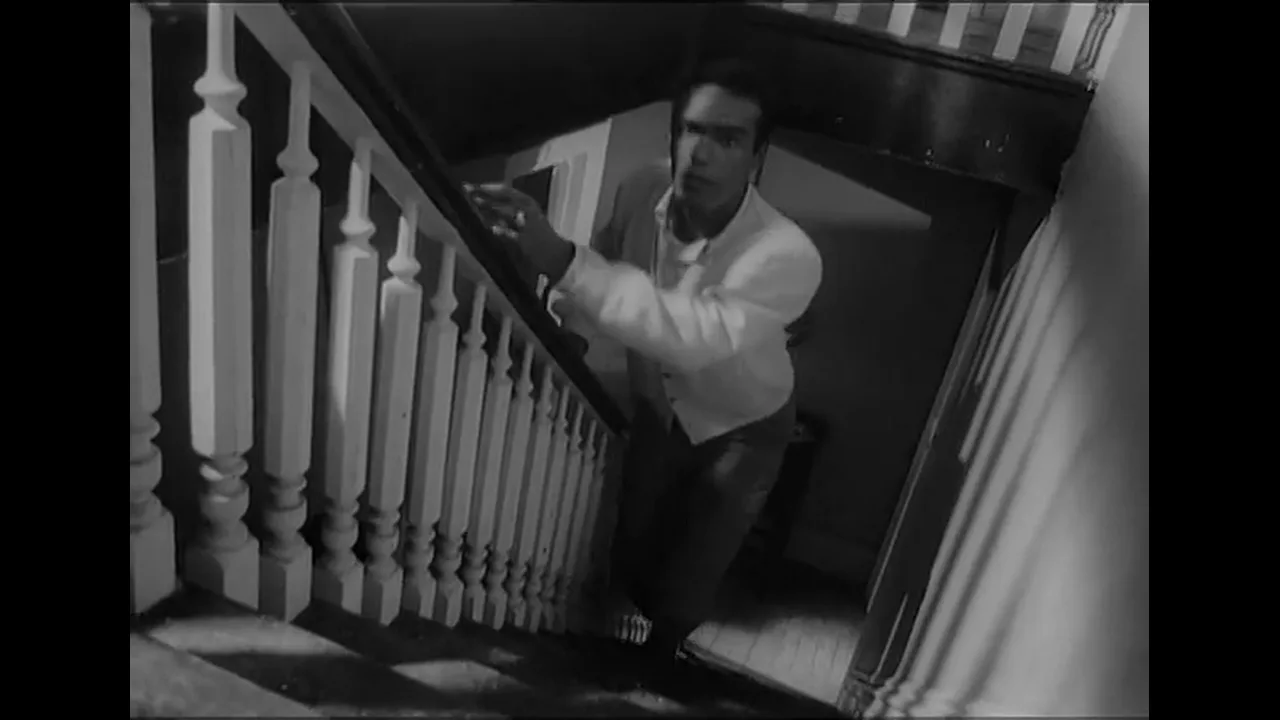
Film Art calls it canted framing: "A view in which the frame is not level; either the right or left side is lower than the other, causing objects in the scene to appear slanted out of an upright position." Columbia's glossary says the tilt is usually meant "to suggest imbalance, transition, or instability."
Dutch angle
The camera is rolled, so the banister and stairs run at a steep slant across the frame.Night of the Living Dead (1968), George A. Romero. Public domain (US).
The Third Man (1949). Carol Reed's film, shot by Robert Krasker, is the best-known sustained use, and Krasker won the Academy Award for black-and-white cinematography for it. Reed recalled (to Charles Thomas Samuels, 1972) that William Wyler sent him a spirit level with a note: "Carol, next time you make a picture, just put it on top of the camera, will you?"
When it fails. Roger Ebert's 2000 review of Battlefield Earth: its director "has learned from better films that directors sometimes tilt their cameras, but he has not learned why."
Deep focus and deep space: Citizen Kane by the numbers
Film Art separates two ideas that are often confused:
Deep focus is optical: "a use of the camera lens and lighting that keeps both the close and distant planes being photographed in sharp focus."
Deep space is staging: "an arrangement of mise-en-scene elements so that there is a considerable distance between the plane closest to the camera and the one farthest away. Any or all of these planes may be in focus."
You can stage in deep space and let the background blur; deep focus keeps it sharp too. Citizen Kane (1941) is the standard example because Gregg Toland, ASC, described how he did it in "Realism for Citizen Kane" (American Cinematographer, February 1941):
Variable
Conventional practice (Toland's figures)
Citizen Kane
Aperture for interiors
f/2.3 to f/2.8
"not greater than f:8 — and often smaller," mostly f/11, one scene at f/16
Depth of field
"between 8 and 10 feet for the great majority of shots"
Some sets needed sharp focus "over a depth of nearly 200 feet"
Lenses
—
24mm for extreme wide-angle effects. At f/11 to f/16, the 35mm, 28mm and 24mm "become for all intents and purposes universal-focus lenses"
Film stock
Plus-X
Super-XX (Weston rating 64, per the editor's note)
Sets
Open tops for overhead lights
"The majority of our sets for Citizen Kane had actual ceilings"
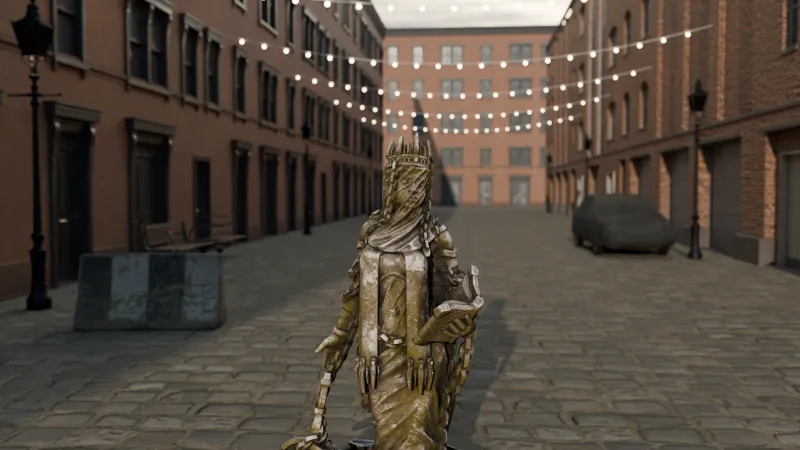
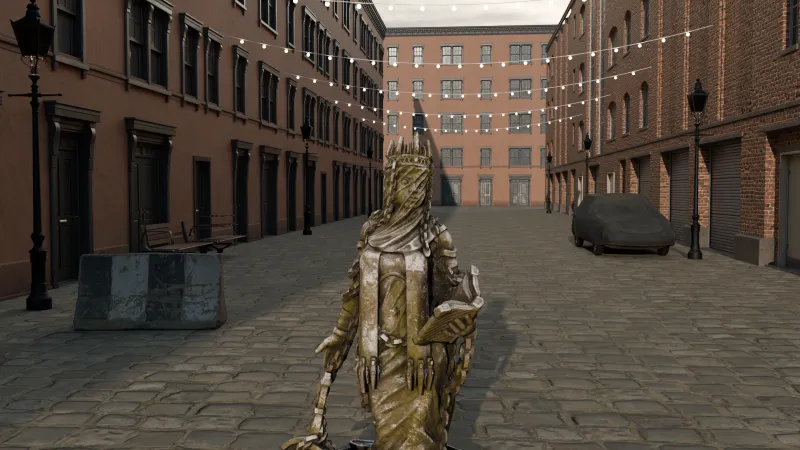
With one wide lens stopped down and focused at 4 feet 6 inches, everything "from 18 inches to infinity" held acceptably sharp. Toland wanted viewers to feel they were "looking at reality, rather than merely at a movie." The cost was light: small apertures need much more of it.
35 mm · f/2
35 mm · f/16
Toland's trade-off, rendered: a 35 mm lens, statue 3 m away, wide open and then stopped down. At f/2 the far buildings are already only slightly soft, which is why wide lenses suit deep focus; at f/16 the whole street is sharp, but it needs 64 times the light of f/2. Rendered in Vinc's virtual camera lab.Scene: CC0 Poly Haven assets (Gothic Statue by Benny Weimer; facades by James Ray Cock; Fire Hydrant by Gonçalo Felício).
Definition.Film Art: "a shot that continues for an unusually lengthy time before the transition to the next shot." A "one-shot film" is usually several takes joined so the cuts don't show.
Film
Year
Director / DP
What the record shows
Rope
1948
Alfred Hitchcock
Takes of up to about 10 minutes, the length of a magazine, joined by alternating hidden and visible cuts
Russian Ark
2002
Alexander Sokurov / Tilman Büttner
A single Steadicam take through the Hermitage, shot on 23 December 2001
Children of Men
2006
Alfonso Cuarón / Emmanuel Lubezki
Car ambush built as one shot with "a couple of seamless cuts"
1917
2019
Sam Mendes / Roger Deakins
Feature built to look like one shot; "take lengths were up to 8½ minutes"
Rope. Counts differ: Chris Wisniewski (Reverse Shot, 2007) counts "eleven shots"; Philippe Mather (Kinema, 2009) arrives at "12 cuts, or 13 takes." A 35mm Technicolor magazine "contained 952 feet of film, a little more than ten minutes worth," and magazine changes were hidden by moving into a character's back until the screen went black.
Russian Ark. The take moves through 33 rooms of the Hermitage with more than 2,000 actors, on the fourth attempt. Wikipedia gives the take as 87 minutes and the running time as 96 (other accounts say 90), so the often-quoted "96-minute single take" is the running time; we say roughly 87 to 90 minutes.
Children of Men.American Cinematographer (December 2006) calls the car ambush "an uninterrupted six-minute shot inside a futuristic car," with "a couple of seamless cuts." Other timings differ, so treat six minutes as approximate.
1917. Deakins (AC, January 2020) switched from a 40mm to a 35mm in the tunnels, where "you don't really notice this in the transitions because the camera moves inside at those moments," and used on-set playback to match position and camera speed at each blend.
The lesson from the joined films: hide the join on something dark, close or fast, and match position and speed on either side of it.
Composition and staging in AI-generated video
Google's video prompt guide defines the Dutch angle and deep depth of field ("keeps most or all of the image, from foreground to background, in sharp focus"), but we found no mention of the rule of thirds, headroom, lead room or symmetry in its guides. So describe the placement rather than relying on the label (our illustrations):
Medium close-up, woman at left third of frame looking toward frame right, generous empty space on the right, small gap above her head.

Planimetric frame: camera perpendicular to a pale green wall, three people seated in a row facing the lens, centred, symmetrical.

Deep focus, deep staging: a boy playing in the snow far outside the window, sharp; his mother at a table in the mid-ground; a man signing papers in the foreground, all in sharp focus.
The long take hits a hard limit: Google lists Veo 3.1 clip lengths of 4, 6 or 8 seconds, and Kling's Multi-Shot mode runs 3 to 15 seconds. Join generations the way Rope and 1917 were joined: put each join on something dark, close or fast, describe the camera's position and speed identically at the end of one clip and the start of the next, and check every join frame by frame. Tilt only the shots that need a Dutch angle, so the tilt reads.
How we compiled this
Definitions come from the glossary of Film Art (7th ed.), MIT's Film Lexicon, Columbia's Film Language Glossary and two open textbooks; technical figures from Toland's 1941 American Cinematographer article, AC's Children of Men and 1917 articles, and Philippe Mather's Kinema essay on Rope. For the rule of thirds' history and Russian Ark we relied on Wikipedia's summaries of named sources, we didn't read the Amirshahi et al. paper itself, and we left out Kubrick's symmetry because we found no source we could check. Model documentation was read on November 18, 2026; Vinc makes an AI film studio.
Sources
David Bordwell and Kristin Thompson, Film Art: An Introduction, 7th ed., McGraw-Hill, 2004, glossary (excerpt hosted by UC Irvine)
Seyed Ali Amirshahi, Gregor U. Hayn-Leichsenring, Joachim Denzler and Christoph Redies, "Evaluating the Rule of Thirds in Photographs and Paintings," Art & Perception 2, 2014, pp. 163–182, doi:10.1163/22134913-00002024
Aspect Ratios in Film Explained: 1.33 to 2.39 and 9:16, With the History and Delivery Specs
Aspect ratios in film are width divided by height. See where 1.375, 1.85, 2.39, 16:9, IMAX and 9:16 came from, and the containers cinemas and Netflix expect.