What is production design in film? The creation of a film's physical world: who designs, builds, dresses and props it, plus backlots, palettes and Oscars.
Method. Checked November 18, 2026 against Art Directors Guild (IATSE Local 800) and SDSA pages, ScreenSkills job profiles, the BLS Occupational Outlook Handbook, the Academy's ceremony pages, Warner Bros. and Pinewood studio pages and cited news reports; Wikipedia was used for category and backlot history, with the books it cites named. Vinc makes an AI film studio.
What is production design in film?
Charles Tashiro's entry in the Schirmer Encyclopedia of Film defines production design as "the creation and organization of the physical world surrounding a film story": everything on screen that isn't an actor, a costume or a light. This lesson covers who designs, builds, dresses and props a set, where sets live, colour palettes and credits.
In the US, set designers and art directors are represented by the Art Directors Guild (IATSE Local 800). Its history page says the term "art director" was first used in 1914, by Wilfred Buckland.
Role
Definition
Source
Production designer
"Create and develop the overall look, atmosphere and emotion that move the story."
Art Directors Guild
Art director
Primary function is "to support and follow through on the visual concepts for the production" set by the production designer and director.
Art Directors Guild
Assistant art director
Works with construction crews (construction coordinator, foreman), helps acquire materials and researches period and contemporary design.
"Develop designs for sets and scenery, by hand or using computer software to draft construction drawings" and builds set models.
Art Directors Guild
Model maker
Makes "set models used for study, research or presentation"; not built to appear on camera.
Art Directors Guild
Scenic artist
Paints "backdrops, murals, figures, portraits, free hand decoration, fine art painting and stained glass."
Art Directors Guild
Graphic artist
Provides "production graphics" among other graphic work.
Art Directors Guild
Set decorator
Curates "the environment through objects to tell the story of the characters."
Set Decorators Society of America
Production designer
The production designer heads the art department and is responsible for the look of the film. ScreenSkills says they research the script with the director and DP, then draw "sketches showing mood, atmosphere, lighting, composition, colour and texture," and set the department's budget and schedule.
Tashiro writes that David O. Selznick coined the title for "the greater-than-normal contribution" of William Cameron Menzies to Gone with the Wind (1939).
Art director
The art director leads the art department and follows through on the designer's concept; Wikipedia's summary, citing Ward Preston's What an Art Director Does (1994), is that designers set the concept, schedules, budget and staffing while art directors oversee the creation of the visuals. On large films ScreenSkills lists supervising, standby and assistant art directors too.
Set designer (draughtsperson)
In US usage a set designer drafts the construction drawings, by hand or in CAD, and builds models; they are not the designer of the film. In the UK the job is usually called draughtsperson.
Illustrators and storyboard artists
Illustrators paint what a set will look like before it is drawn to scale; storyboard artists draw the shots. Both are ADG crafts, and storyboards have their own lesson: Storyboards and Shot Lists.
Graphic and scenic artists
Graphic artists make every printed or screen item in the frame: signs, newspapers, labels, phone screens. Scenic artists paint backdrops, murals, faux finishes and ageing on the built set.
Construction manager
The construction manager turns drawings into structures: ScreenSkills says they "interpret the drawings of the production designer, art directors and draughtspersons and work out how to build them in ways that are safe and environmentally friendly," hire the crew, and strike the set afterwards. In the US the equivalent is often the construction coordinator (Wikipedia, "Set construction").
Set decoration
Set decorator
The set decorator chooses and places everything in the set that tells you who lives there. The Set Decorators Society of America (SDSA) puts it as "curating the environment through objects to tell the story of the characters," in collaboration with the production designer, director and director of photography. ScreenSkills says decorators list what each set needs, buy or hire it, dress the set the day before shooting and strike it afterwards.
Buyer
The buyer finds and books the objects. The SDSA calls the buyer "the eyes of the Set Decorator"; ScreenSkills' production buyer books items from prop houses and schedules hire dates "to minimise costs."
Leadperson (leadman)
The leadperson, traditionally called the leadman, runs the set dressing crew. The SDSA's analogy is: "If the Set Decorator is the Composer of a symphony, the Leadperson is the Conductor." They schedule pickups and returns, staff the crew and track rentals.
Set dresser and swing gang
Set dressers are the crew who physically move, place and rig the furniture and objects, "skilled craftspeople who implement and enhance the vision of the Set Decorator" (SDSA). A swing gang is "one or more persons who make last-minute changes on a film set" (Wikipedia), often dressing the next set overnight.
On-set dresser
The on-set dresser stays with the shooting unit as "the custodian of the set" (SDSA), keeping the dressing continuous from take to take: if a vase moves between the wide and the close-up, the editor has a problem.
Props
Prop and property master
A prop "is any moveable item that can be seen on a film. It could be a hat, gun, cushion, wine glass, lightsaber, carpet, kitchen unit, tree or aircraft" (ScreenSkills). The word is short for "property" (Wikipedia, "Theatrical property").
The prop master runs the property department: properties lists, deciding what to hire or make, a "set and strike" schedule, and returning hired props at wrap.
Props versus set dressing
Crews divide objects by who touches them: prop masters deal with "objects an actor holds," set decorators with "the walls, floors, vehicles and furniture" (ScreenSkills). A glass on the bar is set dressing; picked up and drunk from, it becomes a prop.
Hero props
A hero prop is a detailed version meant for close inspection by the camera. Wikipedia's example is a Star Trek phaser with a depressible trigger and a light-up muzzle.
Where sets live: location, stage, backlot
Practical location
A practical location is "any location that already exists in the real world," in the wording Wikipedia takes from Joe Wallenstein's Practical Moviemaking (2012). The art department dresses it rather than builds it, and the location manager judges how a place "could be turned into a set" (ScreenSkills). Real places give authenticity but tend to have "short ceilings, immovable walls, and nowhere to hang lights."
Built set and sound stage
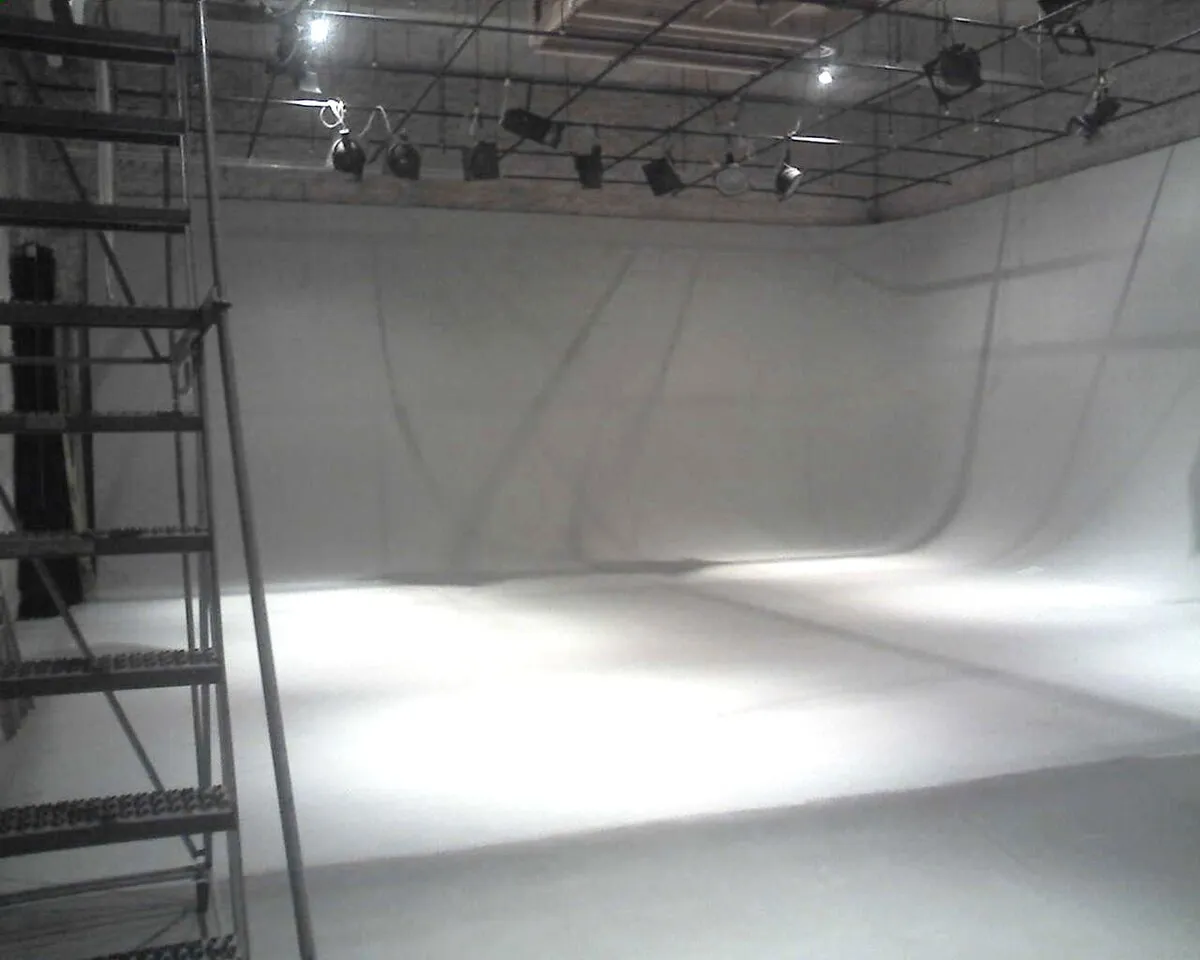
A built set is constructed from the designer's drawings, usually on a sound stage: in Wikipedia's definition, "a large, soundproof structure, building or room with large doors and high ceilings." Stages give control a location cannot: lighting grids, movable walls and no traffic noise.
Sound stage
An empty stage with a curved white cyclorama wall and a lighting grid hung from the ceiling.Photo: Nullcron, Wikimedia Commons, CC BY-SA 3.0.
For Barbie (2023), production designer Sarah Greenwood and set decorator Katie Spencer built Barbie Land as life-size dollhouses on soundstages (Yahoo Entertainment, November 2023).
Backlot
A backlot is "an area behind or adjoining a movie studio containing permanent exterior buildings for outdoor scenes" (Wikipedia, citing Allen J. Scott's On Hollywood). The streets stay standing and are reused for decades.
Backlot
A standing set on the Universal Studios backlot: a wrecked jet engine and debris among half-built house fronts.Photo: Rob Young, Wikimedia Commons, CC BY 2.0 (cropped).
Backlot fact
Figure
Source
Warner Bros. Burbank lot area
110 acres with "10 backlots"
Warner Bros. Studio Tour Hollywood
WB Midwest Street
Built in the 1930s; used in "nearly 400 movies and shows," including Gilmore Girls (Stars Hollow)
Warner Bros. Studio Tour Hollywood
WB New York Street
Used in A Star Is Born, The Big Bang Theory, Blade Runner
Warner Bros. Studio Tour Hollywood
Pinewood Studios (UK)
3 exterior backlots, plus a permanently filled Underwater Stage
Pinewood Group
Shepperton Studios (UK)
31 stages, 2 large backlots
Pinewood Group
Backlots shrank after the studio era: the failure of Camelot (1967) "marked the end of large-scale backlot production in Southern California" (Wikipedia, citing Bingen and Wanamaker, 2014), and CGI has sped the decline (see Film Terms: VFX).
Colour palettes
A colour palette is the range of colours chosen for a film's world. Sets, clothes and light all carry colour, so the designer works "with all the other visual departments, costume, lighting, visual and special effects, and graphic design" (ScreenSkills). Post is covered in Colour Grading Terms Explained.
A signature colour is a material to source early. For Barbie, Greenwood's team asked Rosco for "200 liters of your pure pigment," though she told Yahoo "we didn't cause the world to run out of pink paint"; IPCM reported Rosco's stock was already low after a February 2021 freeze.
How the work flows
A rough order of work for one set, compiled from the job descriptions above:
Order of art department work on one set, compiled from ScreenSkills, Art Directors Guild and SDSA job descriptions.
Who gets the credit
The Oscar, first presented as Art Direction on May 16, 1929, has been shared with set decorators since 1947 and was renamed Production Design for the 85th Academy Awards (Wikipedia). In 2019 Hannah Beachler won for Black Panther with Jay Hart; Vanity Fair reported she was the first African American nominated, and the first to win. Each nomination names a designer and a decorator:
Film (98th Academy Awards, 2026)
Production design
Set decoration
Frankenstein (winner)
Tamara Deverell
Shane Vieau
Hamnet
Fiona Crombie
Alice Felton
Marty Supreme
Jack Fisk
Adam Willis
One Battle after Another
Florencia Martin
Anthony Carlino
Sinners
Hannah Beachler
Monique Champagne
Getting into the guild
For readers who want the job, the ADG publishes its entry thresholds for art directors:
Route
Requirement
Source
Assistant art director
400 days' experience in an art department craft within the last four years
Art Directors Guild
Art director
175 days as an art director or production designer, plus an established reputation in production design
Art Directors Guild
Industry Experience Roster
At least 30 days for signatory companies within the 365 days before applying, or 175 days as an art director or assistant art director (union or not) within three years
Art Directors Guild
Using these terms on a small or AI production
Our illustration: on a micro-budget film, keep the categories anyway. List set dressing and props separately, give one person the on-set dresser's job, and agree a palette with costume and light first. For staging, see Composition and Staging Terms.
For AI video, name the location type, era, palette, key set dressing and hero props in the prompt or reference sheet, and check the room stays the same from shot to shot.
How we compiled this
Checked November 18, 2026 against the Art Directors Guild, the Set Decorators Society of America, ScreenSkills, the Academy and studio pages. Wikipedia supplied the Oscar, backlot, stage, location, prop and swing-gang history; we name the books it cites. Productions appear only where a news report covers them.
Aspect Ratios in Film Explained: 1.33 to 2.39 and 9:16, With the History and Delivery Specs
Aspect ratios in film are width divided by height. See where 1.375, 1.85, 2.39, 16:9, IMAX and 9:16 came from, and the containers cinemas and Netflix expect.