VFX terms explained: plates, mattes, roto, keying, matchmove, render passes, HDRI, LiDAR and the LED volume, each defined from the documents productions use.
Method. Sources checked November 18, 2026: Netflix Studio Partner Help Center VFX and virtual production pages, OpenEXR documentation, the Blender manual, SAG-AFTRA's July 2024 digital-replica bulletin, American Cinematographer (February 2020), Kerbl et al. (SIGGRAPH 2023), Debevec and Malik (SIGGRAPH 97), and Wikipedia for history. Vinc makes an AI film studio.
How to use this part
Visual effects (VFX) work builds a shot from photographed plates, mattes and computer graphics, combined in a composite. This is part 9 of a 10-part glossary, built on documents productions actually work from: Netflix's VFX specifications, the OpenEXR docs, the Blender manual and SAG-AFTRA's bulletins. "In a prompt" notes are our illustration unless a vendor guide says otherwise.
A common order of work for one VFX shot; productions vary, but the pull and the final delivery to the DI are fixed points in Netflix's documentation.
A plate is a piece of photography that a VFX shot is built on. In Netflix's naming guide, a plate takes its shot's name plus a plate number and version (AGM_104_065_010_PL01_v001 is plate 1, first pull), and prefixes can show its role:
Prefix
Plate type
FG
Foreground
BG
Background
EL
Element (smoke, fire, rain, muzzle flash)
RF
Reference
BS / GS
Bluescreen / greenscreen
CC
Colour chart
LG
Lens grid
CP
Clean plate
A re-pull of the same take increments the version (v002); a new element or take increments the plate number (PL02).
Plate photography
Plate photography means shooting plates on purpose, often with a dedicated unit. Netflix's plate-capture guide for virtual production sets measurable targets:
sensor readout under about 18 ms, to limit rolling-shutter skew
at least 3840 × 2160 active photosites per camera
at least 25 degrees of overlap between cameras in a stitched array
usually deep focus, so blur can be added later
It also lists notes to record with every plate, from lens and ISO to camera height and sun position.
In a prompt: Our illustration: for a background to composite behind live action, ask for "deep focus, no people, locked-off camera".
Clean plate
A clean plate is the same framing shot without the actors or objects that will be removed or replaced, so there is real background to fill in with. Netflix's naming guide gives it its own code, CP, and its QC glossary's V-105 "VFX Plate" is "a static roll capturing the background of a set."
VFX pull
A pull is the extraction of the plate frames from the original camera files for a vendor. Per Netflix (details in part 8), plates go out as 16-bit EXR in ACES or camera-linear, or DPX in camera log; "LOG EXRs will not be accepted".
Separating the image: mattes, roto and keys
Matte and alpha
A matte is a mask that controls which parts of an image are kept when images are combined (Wikipedia). Digitally it is a greyscale alpha channel; OpenEXR: "0.0 means the pixel is transparent; 1.0 means the pixel is opaque." The basic "over" operation, published by Porter and Duff at SIGGRAPH '84:
A garbage matte is a rough, often hand-drawn mask "used to exclude parts of an image that another process, such as bluescreen, would not remove" (Wikipedia), such as lighting stands. A holdout matte does the reverse, forcing back in parts a keyer would remove.
Roto (rotoscoping)
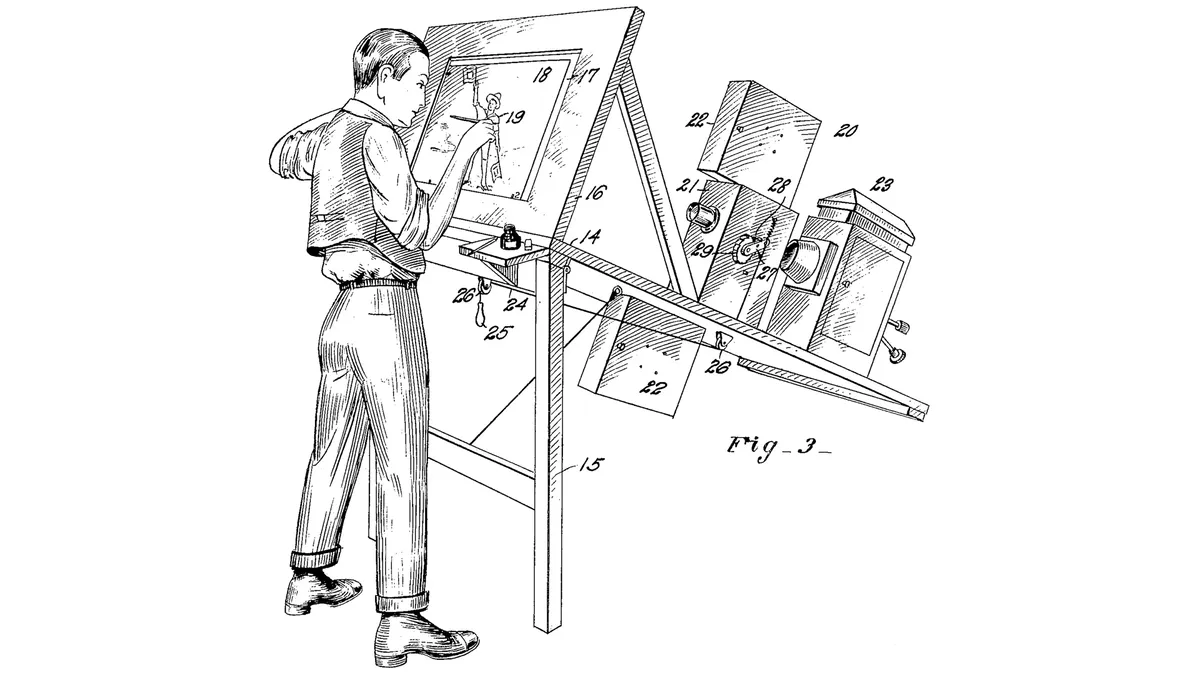
Roto is drawing a matte by hand, shape by shape and frame by frame, around something in live-action footage. The word comes from the rotoscope. Max Fleischer invented it in 1915 to trace live action for animation, and it was patented as US 1,242,674 on 9 October 1917 (Wikipedia, "Rotoscoping").
Rotoscope
Max Fleischer's patent drawing: an artist at an easel traces frames projected onto the glass from the machine behind.US Patent 1,242,674, Max Fleischer (1917). Public domain.
Keying and chroma key
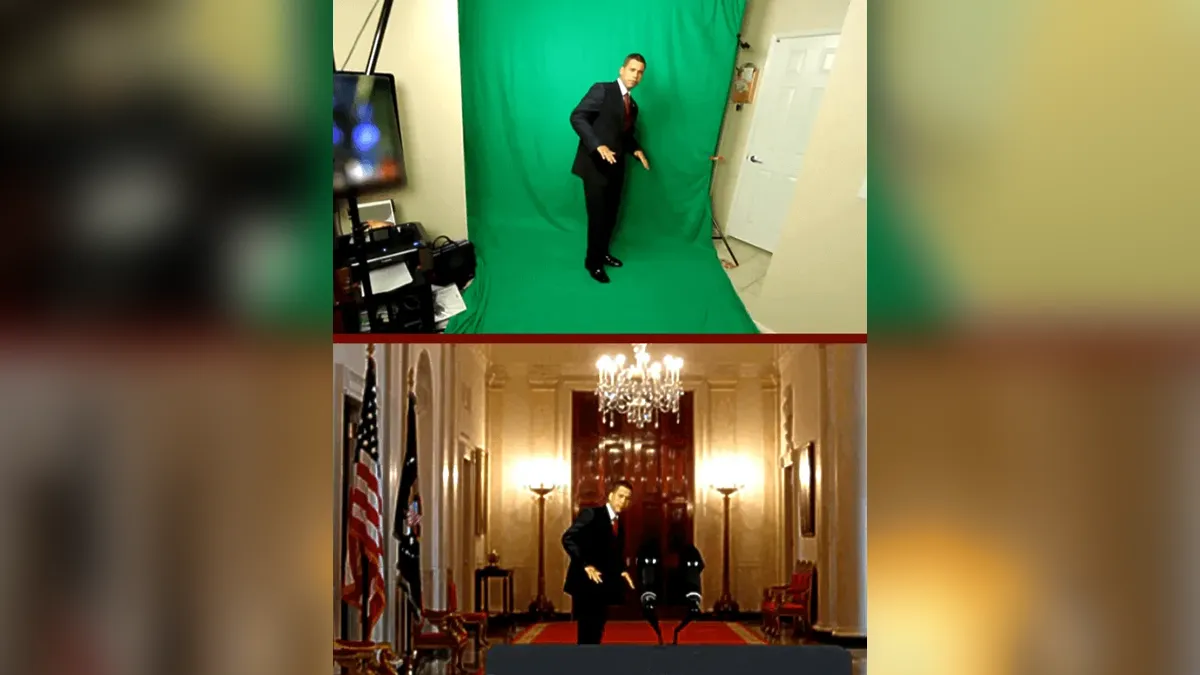
Keying generates a matte automatically from a property of the image. Chroma keying makes a colour range transparent so another image shows through (Wikipedia, "Chroma key"). Blue and green are used because they are "considered to be the furthest away from skin tone." Green became the TV default partly because cameras record more detail in the green channel, which gives a cleaner key.
Chroma key
Top: a performer in front of a green screen. Bottom: the green replaced with a background so he appears in a formal room.Iman Crosson, Wikimedia Commons, CC BY-SA 3.0.
In a prompt: Our illustration: if a model can't output alpha, ask for a "flat, evenly lit, saturated green background with no shadows on it", and expect to clean up the edges.
Spill
Spill is screen-coloured light that bounces off the backing onto the subject, showing as a green or blue fringe on hair and edges (Wikipedia, citing Foster's The Green Screen Handbook). Fixes: a bigger screen further from the actors, or spill suppression in software.
Building the shot
Comp (compositing)
Compositing is "the process of digitally assembling multiple images to make a final image" (Wikipedia, "Digital compositing"). Each layer is combined with the "over" operation above.
Tracking, matchmove and solve
Match moving inserts CG into live action with the correct position, scale and motion (Wikipedia, "Match moving", citing Dobbert's Matchmoving, 2005).
2D tracking follows features across the image, enough to stabilise a shot or replace a distant sign.
3D tracking, or matchmove, recovers the camera's movement through space.
The solve works backwards from many 2D tracks to a camera position for every frame.
Netflix recommends shooting lens distortion grids "per lens type, per sensor mode" "when a significant amount of 3D tracking is anticipated."
CG and render passes (AOVs)
CG, computer-generated imagery, is rendered in layers so the compositor can adjust each part separately. The Blender manual defines a pass as "a type of intermediate rendering information that's extracted as a separate image":
Pass
What it holds (Blender manual)
Combined
"The render output before any compositing is applied"
Depth
"Distance to the nearest visible surface"
Position / Normal
World-space position and surface normals, used for relighting
Vector
Motion vectors for adding motion blur in comp
Cryptomatte
Object, material or asset masks that work "with transparency, as well as motion blur and depth of field"
Shader AOV
Custom passes (arbitrary output variables), up to 16 colour and 16 value AOVs
The passes usually travel together in one multichannel EXR.
Deep compositing
A normal ("flat") image stores one value per channel per pixel. A deep image "can store an unlimited number of samples per pixel," and "each of those samples is associated with a depth, or distance from the viewer" (OpenEXR, "Interpreting OpenEXR Deep Pixels"). A compositor can then place CG smoke between two CG characters without a holdout matte for each.
Set extension
Set extension means building the parts of a set that weren't built: upper floors, distant streets, a skyline. Netflix's QC glossary code V-102 reads "Shot requires the set to be virtually extended." It predates CG: glass shots, scenery painted on glass in front of the lens, were refined by Norman Dawn in the early 1900s (Wikipedia).
Digital double
A digital double is a CG replica of a performer, usually built from a scan. In the US it is a contract matter: SAG-AFTRA's July 2024 bulletin distinguishes employment-based, independently created and background actor digital replicas. The producer must give at least 48 hours' notice before scanning, get "clear and conspicuous" consent, and get fresh consent for each new use.
Capturing the set: light and geometry
HDRI (high dynamic range image)
An HDRI records the full range of light in a scene, from deep shadow to the sun, by merging several bracketed exposures into one radiance map. Paul Debevec and Jitendra Malik described the method in "Recovering High Dynamic Range Radiance Maps from Photographs" (SIGGRAPH 97). Shot as a 360-degree panorama on set, an HDRI lights the CG so it matches the plate.
LiDAR
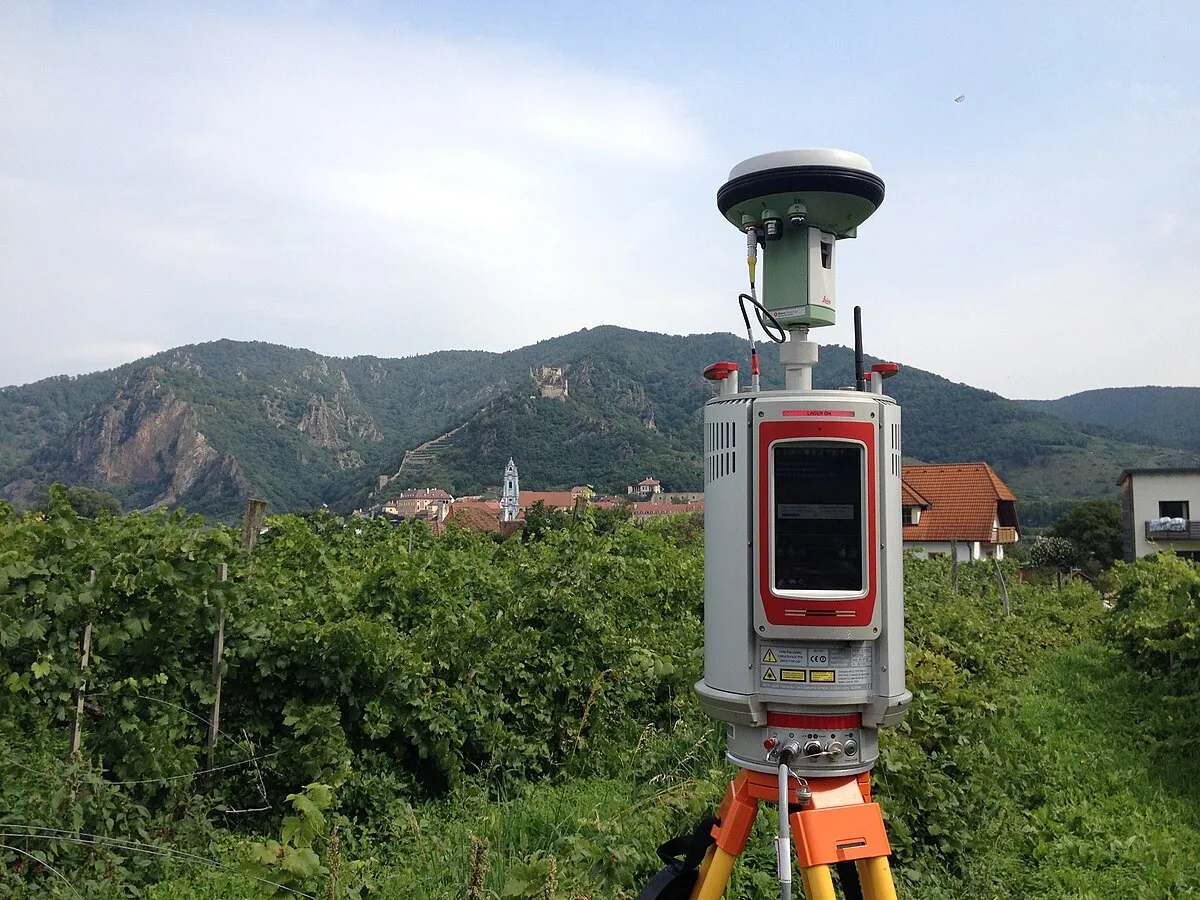
LiDAR scanners measure distance with laser pulses and record a set as a point cloud, giving the matchmove and CG teams the set's true dimensions. Netflix's archive spec asks for "Lidar & photogrammetry for any custom-built/key environments (cleaned/processed where available). No raw point cloud data." For per-frame depth capture, see Measured 3D on Set.
LiDAR scanner
A terrestrial laser scanner stands on a tripod with a GNSS receiver mounted on top.Photo: Ekrem Canli, Wikimedia Commons, CC BY-SA 3.0.
Photogrammetry
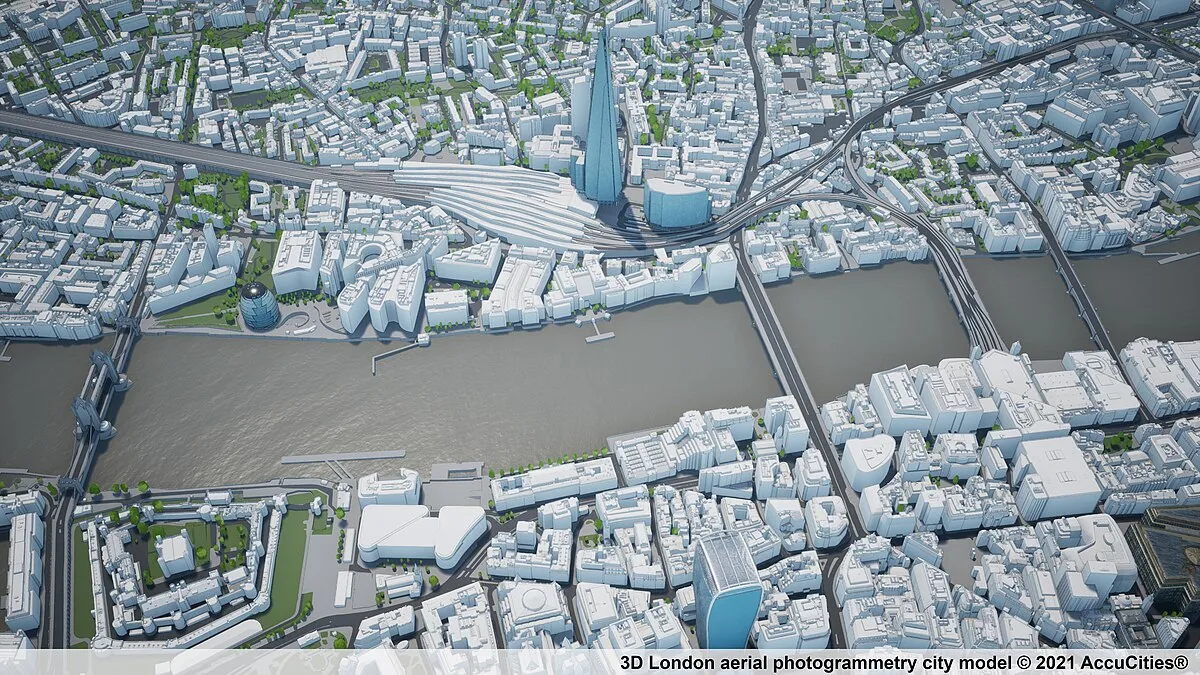
Photogrammetry is "the science and technology of obtaining reliable information about physical objects and the environment" from photographs (Wikipedia, citing the ASPRS definition). In practice, many overlapping photos of an object or place are turned into a textured 3D model. American Cinematographer (February 2020) reported that about 30 to 40% of the virtual backdrops in The Mandalorian's LED volume were built from photogrammetry.
Photogrammetry
A 3D model of central London built from aerial photographs, with the river and building blocks in grey.AccuCities, Wikimedia Commons, CC BY-SA 4.0.
Witness photos
Witness photos are reference stills of the camera setup and the set, taken so VFX can reconstruct what the plate camera saw. Netflix's plate-capture guide lists them among the notes to record with each plate.
Planning and virtual production
Previs, techvis and postvis
Previsualisation is "the process of visualizing scenes, sequences, or environments before their physical production" (Wikipedia), usually rough 3D animation of shots. Techvis is the technical version: Netflix says it "can lay out potential camera options based on the content or show exactly how things need to be staged in order to achieve a desired shot." Postvis is visualisation done in post, after the plates exist; The Third Floor lists all three as separate services.
Virtual production and the LED volume
Virtual production here means in-camera VFX (ICVFX), which Netflix defines as using "display surfaces (such as LED walls with accurately projected content) to achieve the final visual effect in-camera during the shoot." It distinguishes three approaches:
Approach
What plays on the wall
2D
Pre-rendered or filmed plates at a fixed perspective, such as driving plates instead of a process trailer
3D
Real-time engine output, synced to camera tracking, so perspective changes with the camera
2.5D
Distant layers pre-rendered, nearer layers live in the engine
Example: The Mandalorian. Jay Holben's February 2020 American Cinematographer article describes a curved LED wall 20 feet high, covering 270 degrees around a 75-foot performance area, built from 1,326 Roe Black Pearl BP2 panels, with Unreal Engine content driven through ILM's StageCraft. The high-resolution patch matched to the lens, the frustum, was rendered about 40% wider than the lens's view to absorb roughly 10 to 12 frames of latency.
Netflix lists LED-specific problems: moiré, usually fixed with shallower focus or "a movement as little as 1cm or a single degree"; flicker from genlock or shutter mismatches; and colour shifts, which its open-source OpenVPCal tool corrects with a calibration LUT.
Gaussian splats
3D Gaussian splatting represents a scene as a set of 3D Gaussians fitted to photos of it. Kerbl, Kopanas, Leimkühler and Drettakis introduced the method at SIGGRAPH 2023 ("3D Gaussian Splatting for Real-Time Radiance Field Rendering," ACM Transactions on Graphics). It renders novel views in real time at 1080p, at 100 fps or more, making splats a fast way to turn a photographed location into a 3D background (Measured 3D on Set covers Blender's splat import).
Money and paperwork
VFX bidding, budget lock and shot count
VFX is priced shot by shot and asset by asset: vendors bid against a breakdown, the studio locks a budget and tracks spending against it. Netflix's documentation names the documents:
Document
What Netflix says it contains
VFX Breakdown (Budgeted)
"VFX cost breakdown with context on approach assumptions and associated VFX bids"
Locked budget
"The Total Project Budget at the Lock Date," split into vendor and non-vendor costs and net of tax incentives
EFC (estimated final cost)
"Sum of the Actual and Estimated Costs To Complete the Project," from the cost report
Exposure reports
"Additional VFX Costs Arising From Shooting," logged by the VFX supervisor on set, as "hot cost" or "potential"
VFX Shot and Asset Status Report
Status, scope of work, methodology and cost summary "per shot and asset"
Shot count is the number of VFX shots in the locked cut, each with a structured name such as AGM_104_065_010_comp_NFX_v005. A shot that loses its clean plate on set becomes a line on the exposure report.
In a prompt: Our illustration: AI shots are often priced per generation or per revision round, not per shot. Our AI shot cost breakdown compares the two.
How we compiled this
Plate, archive, QC and virtual production terms come from Netflix's Studio Partner Help Center (read 18 November 2026), image formats from OpenEXR, passes from the Blender manual, replica rules from SAG-AFTRA, and history and general definitions from Wikipedia and the original papers. We found no checkable source for typical shot counts or per-shot prices, so we give none. Vinc makes an AI film studio.
Thomas Porter and Tom Duff, "Compositing Digital Images," Proceedings of SIGGRAPH '84, Computer Graphics 18(3), 1984
·
·6 min read
Aspect Ratios in Film Explained: 1.33 to 2.39 and 9:16, With the History and Delivery Specs
Aspect ratios in film are width divided by height. See where 1.375, 1.85, 2.39, 16:9, IMAX and 9:16 came from, and the containers cinemas and Netflix expect.