Screenplay format, with an example scene: Courier 12-point, a 1.5-inch left margin, every element on the page, page-a-minute data and revision colours.
Method. Sources checked November 18, 2026: the Academy Nicholl Fellowships formatting tips and sample script, Final Draft's knowledge base on elements, scene numbers, continueds, locked pages and revision colours, and Stephen Follows's March 2026 page-to-runtime analysis. Vinc makes an AI film studio.
Why a screenplay looks the way it does
Screenplay format is the set of layout conventions a script is written in: Courier 12-point type, fixed margins, and dialogue in a narrow column under the speaker's name. Readers use the page to decide whether to buy a story; the crew later uses it to plan the shoot. The fixed typeface makes page counts mean roughly the same thing from one script to the next.
The screenplay is the last development deliverable and the first production document: it is written in development, then numbered, locked and revised once pre-production starts.
There is no single official standard
The Academy of Motion Picture Arts and Sciences runs the Nicholl Fellowships in Screenwriting. Its formatting tips open by saying "There is no absolute 'standard' format used by all professional screenwriters working in the American film industry."
Its sample script, written by Greg Beal in 1996 and revised through February 2014, sets a practical test: "Clarity is the goal. If your script's format can be easily read by anyone working in the film industry, then it falls within acceptable standards." The measurements below are a norm, not a law.
The elements of screenplay format
Final Draft describes a script as "a stack of elements", each with its own indents and capitalisation.
Term
What it means
When to use it
Scene heading (slugline)
INT. or EXT., location and time of day, in capitals
At the start of every scene
Action (description)
What happens and what we see or hear, margin to margin
Between headings and dialogue, in short paragraphs
Character cue and extensions
The speaker's name in capitals, with (O.S.), (V.O.) or (CONT'D)
Above every speech
Parenthetical
A few words of action or delivery under the cue
Sparingly, mostly for bits of action
Dialogue
What the character says
Always after a cue or parenthetical
Transition
CUT TO:, DISSOLVE TO:, MATCH CUT TO: at the right
Only where it adds something; many writers drop them
Shot
A camera angle, movement or direction within a scene
Rarely in spec scripts, which use master scenes
Dual dialogue and intercut
Side-by-side speeches; INTERCUT WITH: for phone calls
Characters talking at once, or across two places
Scene heading (slugline)
Final Draft defines the scene heading as the element that "marks the beginning of a scene, describing where and when the scene takes place." It runs, in uppercase, INT. (interior), EXT. (exterior) or I/E, then the location, then the time of day.
In a shooting script, scene headings are the element that gets a scene number.
Action (description)
Action, in Final Draft's wording, "represents screen direction that tells what is happening in the scene." It runs between the main margins.
The Nicholl guide adds three conventions: capitalise a character's name the first time they appear, break description into short paragraphs instead of "dense blocks running on for lines", and never type description or dialogue in all caps.
Character cue and extensions
The character cue is the speaker's name, in capitals, above their dialogue. An extension after it says where the voice comes from: (O.S.) for offscreen, (V.O.) for voice-over. Final Draft adds (CONT'D) when an action paragraph interrupts a speech, though the Nicholl guide notes that "many writers have dropped (CONT'D) from their repertoire."
Parenthetical
A parenthetical is a short direction under the cue or between lines of dialogue, which Final Draft says "should be no more than a few words." The Nicholl guide says line-reading directions are "frowned upon these days, but some writers still use them for bits of action."
Dialogue
Dialogue is what the character says, always after a cue or a parenthetical. When a speech breaks across a page, Final Draft puts (MORE) under the last line and repeats the name with (CONT'D) at the top of the next page.
Transition
A transition, in Final Draft's terms, "marks the end of a scene and may indicate how the passage between scenes takes place," for example CUT TO: or DISSOLVE TO:, set at the right of the page. The Nicholl guide says many writers drop them, "feeling that a new scene header clearly signifies a cut without the need of any additional indicator."
Shot
A shot element names "a camera angle, camera movement or direction within a scene." For spec scripts the Nicholl guide advises master scenes: "No CLOSE UPs, no WIDE SHOTs, mostly no shots of any kind," though "It's okay to sneak in a shot here and there when it's necessary to highlight a moment or move the action along."
Dual dialogue and intercut
Dual dialogue sets two speeches side by side for characters who talk at once; Final Draft's feature "positions two consecutive dialogue paragraphs side by side." An intercut handles a phone call between two places: the Nicholl sample writes the first location, puts "INTERCUT WITH:" on the right, then the second location, and both sides then talk without a new heading for each line.
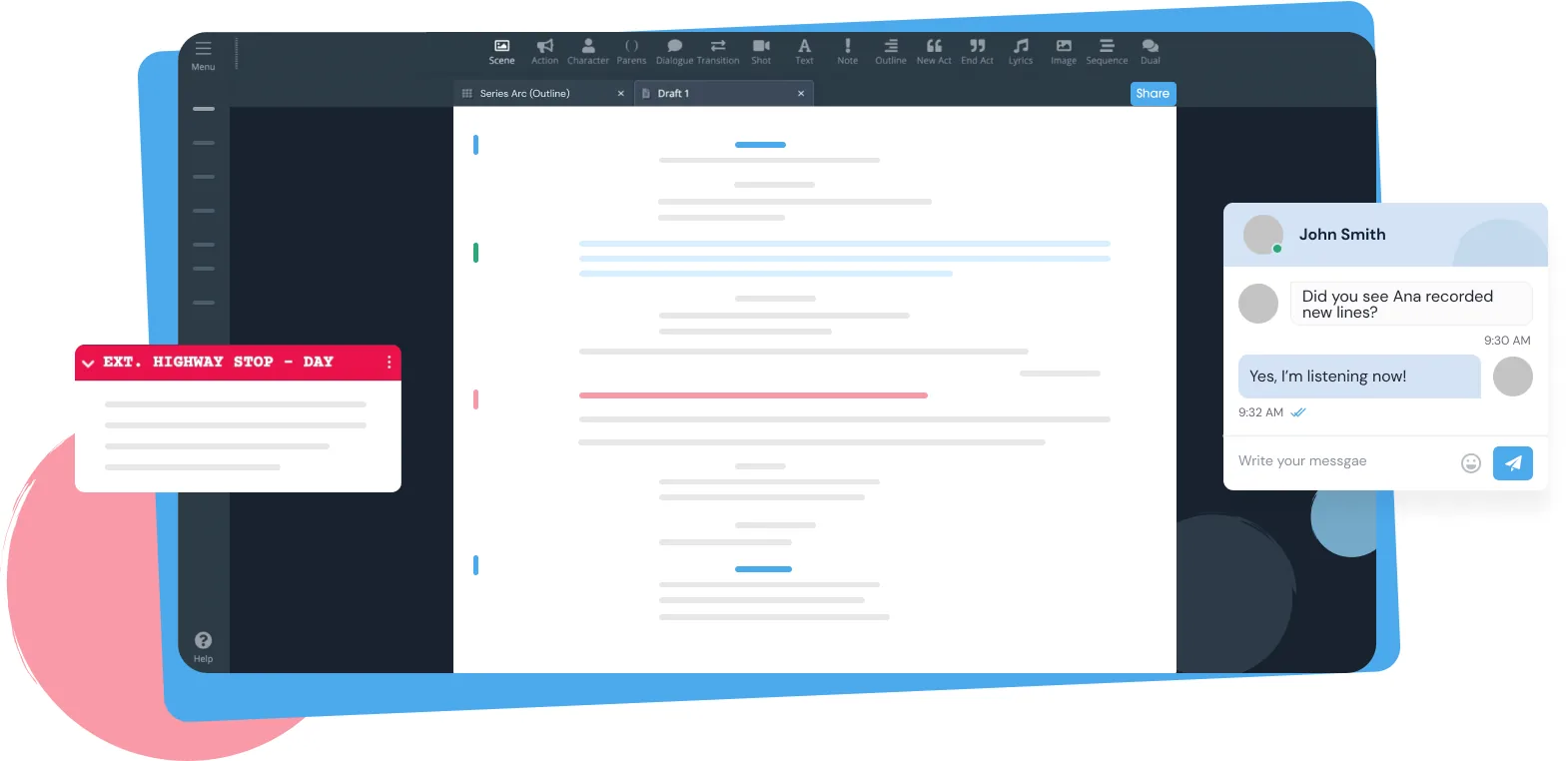
WriterDuet
Screenwriting software treats each element as a style you switch between: WriterDuet puts them in a toolbar above the page, so a scene heading, action line or character cue gets its indents and capitals automatically.Screenshot of WriterDuet's product page, 18 Nov 2026.
Screenplay format margins and font
Element
Nicholl guide measurement
Notes from the guide
Font
Courier, 12-point, 10-pitch, non-proportional
Avoid Courier New "unless you want your script to be about 10% longer"; title page exempt
Left page margin
1.5 in
Action and scene headings start here
Right page margin
1.0 in
Top margin
1.0 in to the body, 0.5 in to the page number
Bottom margin
0.5 to 1.5 in
Depends on where the page break falls
Dialogue
Left 2.5 in, right 2.5 in
About 3.5 in of text per line; "you can cheat those a tad"
Character name
About 4.0 to 4.2 in
Some writers centre names instead
Parenthetical
Starts about 3.0 in, about 1.5 in wide
Wraps to the next line past that width
Page number
Upper right, about 0.5 in down, 0.75 in from the right edge
Numbering may start on page two
The Academy's formatting tips list the faults that most often mark a script as out of format:
a font "other than Courier 12-point, ten-pitch, non-proportional"
"Extremely narrow or extremely wide outside margins"
"Extensive use of bold print"
description or dialogue in all caps
"Long, long, long descriptive passages"
dialogue that runs from the left margin to the right
Screenplay format example: a short scene
Our own illustration, laid out to the Nicholl measurements as closely as plain text allows, as a writer's draft (no scene numbers).
FADE IN:

INT. LAUNDROMAT - NIGHT

Fluorescent hum. Every dryer but one sits still. MARA (30s,
paint on her sleeves) feeds coins into the last working
machine.

The door chimes. DEV (30s) steps in out of the rain, holding
a single wet sock.

                        DEV
              Is this the one that works?

                        MARA
                  (not looking up)
              It's the one that's mine.

Dev holds up the sock. She looks at it, then at him.

                        MARA (CONT'D)
              Fine. One sock.

                        DEV (V.O.)
              That was the first thing she ever
              gave me.

                                                   CUT TO:

EXT. LAUNDROMAT - CONTINUOUS

The dryer light glows through the window as the rain
thickens.
Screenwriting software sets these indents for you. Your job is knowing which element each paragraph is.
The page-a-minute rule: what the data says
The industry rule of thumb is that one page of a correctly formatted screenplay plays as about one minute of screen time. Production leans on the same idea when it measures scenes in eighths of a page (see film terms on set and in production) and plans days and costs around page counts (see film budgets and schedules).
The largest public test we found is by film data researcher Stephen Follows. On March 30, 2026 he compared PDF page counts of 2,520 US Letter and 351 A4 screenplays with IMDb runtimes, expressed as a ratio of pages to minutes, where 1.0 means the rule holds exactly.
Measure (Follows, March 2026)
Result
Sample
2,520 US Letter scripts, 351 A4 scripts
Average pages-to-minutes ratio, US Letter
1.1 ("about 55 seconds" per page)
Scripts within 0.95 to 1.05
18.2%
Chance of missing runtime by more than six minutes
"roughly a four-in-five chance"
A4 ratio
1.02; median A4 script 110 pages vs 119 for Letter
Screenplay pages per minute of runtime (1.0 = one page per minute)
Musical0.90
War0.99
A4 scripts1.02
All US Letter scripts1.10
Comedy1.15
Stephen Follows, 'Does one page of a screenplay really equal one minute of screen time?', March 30, 2026. 2,520 US Letter and 351 A4 scripts compared with IMDb runtimes. Genre values are those stated in the article text.
A ratio above 1.0 means each page plays for less than a minute: comedy reads fast on screen, musicals play long. Follows's revised rule is: "approximately one minute of screen time, give or take 20%, depending on genre, era, and paper size."
Treat page count as a planning estimate, useful for budgeting and for spotting a 150-page draft, not a measure of runtime.
Writer's draft vs shooting script
The Nicholl guide says submission, sales and first drafts "all usually share certain characteristics: no scene numbers, few designated camera shots and sequences generally written in master scenes." Shooting scripts are "the form in which scripts are most often available online, in books and at libraries," which is why new writers often copy the wrong format.
Once a script goes into production, Final Draft's documentation describes what gets added:
Scene numbers. "In standard screenplay format, scene numbers would normally be assigned to scene headings only," printed in the left and right margins. When a new scene goes in between two numbered scenes, it keeps the old numbers and takes a letter, so a scene added after 28 becomes 28A.
Scene CONTINUEDs. When a scene runs onto the next page, (CONTINUED) prints at the bottom and CONTINUED: with the scene number at the top of the next.
Locked pages. Locking "locks the text on a particular page so that any revisions or deletions of text don't affect the numbering of any other page." Overflow from page 3 goes onto a new page 3A, and page 4 still starts with the same sentence.
Revision marks and colours. Changed lines get asterisks, and each revision set has its own page colour.
The point is that a breakdown, schedule or shot list made from an earlier draft still points to the right place.
Revision colours, in order
Final Draft's knowledge base gives the standard sequence and attributes it to the Writers Guild of America West:
Order
Revision set
0
Unrevised draft: production White
1
Blue
2
Pink
3
Yellow
4
Green
5
Goldenrod
6
Buff
7
Salmon
8
Cherry
9–16
Second Blue, Second Pink, Second Yellow, Second Green, Second Goldenrod, Second Buff, Second Salmon, Second Cherry
The same page notes that "some television shows use their own revision sets so the above color sequence or wording may not be used by all productions," so check the production's own list.
The WGA West revision sequence as listed by Final Draft: each new set of changed pages takes the next colour, then the cycle restarts with 'second' colours.
Format when the script drives AI shots
The same structure helps an AI video pipeline. Scene headings give a shot generator its conditions (interior or exterior, location, time of day), action says what the camera sees, cues say who is in the scene, and (V.O.) or (O.S.) say whether a voice belongs on screen.
Measurements, draft conventions and format faults come from the Academy Nicholl Fellowships' tips and sample script; element definitions, production additions and the revision colour order (which Final Draft attributes to the WGA West) come from Final Draft's knowledge base. Page-to-runtime figures come from Stephen Follows's March 2026 analysis, and the example scene is our own. Sources were checked November 18, 2026.
Aspect Ratios in Film Explained: 1.33 to 2.39 and 9:16, With the History and Delivery Specs
Aspect ratios in film are width divided by height. See where 1.375, 1.85, 2.39, 16:9, IMAX and 9:16 came from, and the containers cinemas and Netflix expect.