How to make an AI trailer from trailer research: the two-minute limit, three-act proportions, title cards, hits and risers, workflow and tool prices.
Method. NATO trailer guidelines, Stephen Follows' length data, a 2014 CogSci trailer study, editor interviews and vendor price lists read November 18, 2026; act timings and costs are our arithmetic. Vinc makes an AI film studio.
How to make an AI trailer: the short answer
Write the trailer before you generate anything. Pick a length (US cinema guidelines cap theatrical trailers at two minutes) and split it into three acts: set-up, complication, escalation. Build the music bed first, generate shots to fill its beats, then add title cards, hits and risers in the edit.
No AI trailer maker removes the need for that order, because trailers are cut to the music, and video models make 4–30 second clips that can't follow an uploaded track.
How long should a movie trailer be?
Two minutes is the industry ceiling for cinema trailers in the US. The National Association of Theatre Owners' In-Theater Marketing Guidelines say: "Trailers shall not exceed two minutes in length." Each distributor gets two exemptions a year, "with a maximum length of 3 minutes". NATO (now Cinema United) applied them from 1 October 2014; they are voluntary and cover cinemas, not YouTube.
What trailers actually run, from two analyses by film-data researcher Stephen Follows:
Trailer lengths: the rule and the measured averages (seconds)
NATO In-Theater Marketing Guidelines (2014); Stephen Follows, 'How long is the average movie trailer?' (17 Jul 2017, ~20,000 films released 2000–2016) and 'Have movie trailers always been this long?' (17 Jul 2025, 6,926 trailers from 4,004 top-grossing films, 1930–2025).
The 2017 study found an average of 114.2 seconds, with horror and sci-fi trailers the shortest. The 2025 study found 122.0 seconds across top-grossing films, with "most years sitting just above two minutes" since 2010. It also could not verify a commonly cited 2:30 MPAA limit in an official source.
For an AI trailer, plan for 90 to 120 seconds and size the shot list to it.
What is the three-act structure of a trailer?
A trailer sets up, complicates and escalates, but does not resolve.
The practitioner's version. In Filmmaker magazine (13 January 2012), Stephen Garrett describes building indie trailers on a music bed of three cues, "Because trailers lend themselves to a three-act structure":
"Act One: Introduce the films' characters and environment."
"Act Two: Complicate their world with obstacles to overcome."
"Act Three: Intensify the conflicts and ratchet up the tension/excitement/humor. (Montages invariably end up in Act Three.)"
His rule for the ending: "never resolve anything! Whenever possible, leave questions unanswered."
The measured version. Catalina Iricinschi and Donald Hu of Cornell had viewers segment 21 trailers (one comedy, drama and action film per decade, 1940–2010) in the Proceedings of the Cognitive Science Society (2014). The segmentation "follows the 1/4 – 1/2 – 1/4 three-act pattern, with drama and action having roughly half of the total time as complication."
Applied to a 120-second trailer (our application, not a rule):
A 120-second trailer split by the 1/4–1/2–1/4 proportions Iricinschi and Hu measured, with Garrett's act labels; our application, not a fixed rule.
Faster than it used to be, though the research gives trends, not a target. Iricinschi and Hu found trailer shots from 1960 to 2010 "consistently decrease in shot duration". Ping Feng's 2016 Temple University thesis (abstract), on 130 Hollywood trailers from 1951 to 2015, found average shot lengths "still display a declining trend" and that "the shorter the shot is, the more motions there are within it."
In practice, the music sets pace. A beat lasts 60 ÷ BPM seconds: at 120 BPM, half a second, or 12 frames at 24 fps. Save the fastest, highest-motion cutting for Garrett's act-three montage. Beat arithmetic is in How to Make an AI Music Video; other cut criteria in How Editors Decide Where to Cut.
Veo 3.1 makes 4–8 second clips and Kling 4.0 makes 3–30 seconds, while a fast act-three cut may use under a second of each, so you'll generate far more footage than the trailer shows.
How do you use title cards in a trailer?
Title cards, or copy cards, set up premise, time and place quickly. Garrett warns that "Because Hollywood movies overuse copy and narration, they can look and feel tired", but cites cases where they work. His Carlos trailer opens with three cards: "IN THE 1970s AND 1980s / ONLY ONE MAN / COULD HIJACK THE WORLD". The Bill Cunningham New York trailer uses one-word cards: "PHOTOGRAPHER. / PERFECTIONIST. / LONER. / MAVERICK. / VISIONARY." He also links typography to genre: "Thick sans-serif font with jaunty music? Comedy. Elegant serif font with dour orchestral cue? Drama."
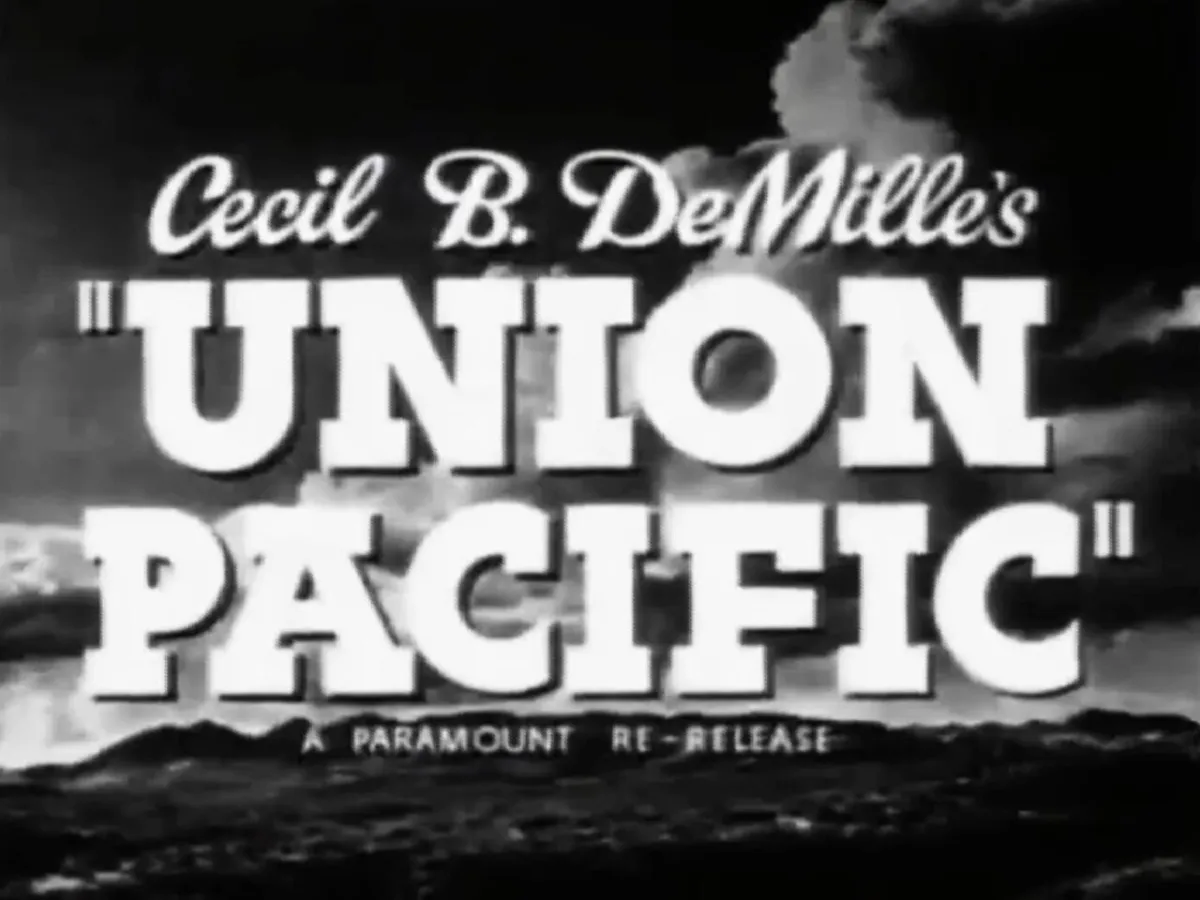
Title card
The title card from a reissue trailer for Cecil B. DeMille's Union Pacific (1939): the title set over a sky, with "A Paramount Re-Release" beneath.Union Pacific (1939) reissue trailer, Paramount. Public domain (US, no copyright notice), via Wikimedia Commons.
Cards need sound. Editor Jonny Elwyn's Inside Professional Trailer Editing (15 March 2023) puts it as a rule: "You need a suck back and a hit into every title card."
Make the cards in the editor, not the video model. Google's Veo guidance avoids quotation marks around dialogue "to avoid rendering text in the video" (best practices). Kling 4.0 can render text if you specify "the exact text content, position, alignment, on-screen duration", but a typo means a new generation. Cards over black or a generated plate are cheaper to revise; see Film Terms: Motion Graphics and Compositing.
What sound design does a trailer need?
In a No Film School interview (Jo Light, 24 December 2025), trailer editor Leonardo Oliveira defines five effects:
Effect
Oliveira's definition
Hit
"A sound that accentuates a specific beat"
Suckback
"Builds up toward a beat"
Whoosh
"Smoother transition combining suckback and hit"
Riser
"Longer buildup toward a major moment"
Drone
"Ambient sound that sets the overall mood"
He uses stems ("one isolated layer from a song, like pulling out just the vocals") to extend or shorten cues, and Elwyn's breakdown shows music dropping out entirely for effect: silence is part of the kit.
The 2010s' signature low brass "BRAAAM" has a disputed origin; Wikipedia summarises competing claims around the Inception (2010) campaign from Mike Zarin, Hans Zimmer and Zack Hemsey. For the craft behind these layers, see Sound Design Explained and Film Terms: Sound.
What is the workflow for an AI trailer?
An AI trailer built music-first: structure and cues before any generation, cards and sound design in the edit.
Logline and act beats. One line per act: who and where, what goes wrong, how it escalates. No ending. See our pitch deck guide for loglines.
Generate. One action per shot; syntax is in the Veo 3 Prompt Guide and Kling Prompt Guide. Text-to-video is fine for atmosphere and establishing plates.
Rough cut to the music, then add cards, voice-over, hits, risers and drones, and mix.
Vinc's landing page describes a Director agent that drafts the screenplay from a brief, character sheets you lock so "faces stay the same in every shot", and an editor where you "trim on the timeline, mix the score and effects, add captions and render the finished film."
AI trailer maker tools and prices
List prices checked 18 November 2026, per unit as each provider publishes it:
Plans from $10/month (1,000 credits); Veo 3.1 Fast is 12 credits/s without audio by our arithmetic. 7-day trial needs a card; desktop or laptop browser only
A worked example (our arithmetic). A 120-second trailer, generating twice the footage you use (240 s) at 1080p:
Generation: $24 on Veo 3.1 Fast without audio, $56.40 on Kling 4.0, or $96 on Veo 3.1 with audio. In Vinc (us), Veo 3.1 Fast without audio is 2,880 credits, about $24–29 depending on plan.
Extras: 30 Imagen 4 stills $1.20, 60 s of effects $0.60, a 600-character voice-over $0.12, a month of Suno Pro $10.
Generation dominates and grows with every retry, which is why the music and shot list come first.
How we compiled this
We read every source listed below on 18 November 2026; the act timings, shot arithmetic and cost example are our calculations from them. We could not open the full Feng thesis or the original press reports on the BRAAAM, so we give no trailer shot-length figures and don't settle that dispute. Vinc makes an AI film studio.
Iricinschi, Catalina, and Donald Hu. "Parsing strategies in film trailers." Proceedings of the Annual Meeting of the Cognitive Science Society 36 (2014). eScholarship
AI Music for Film: Suno, Udio and Other Generators on Licences, Ownership, Lawsuits and Cue Sheets
Whether an AI-generated track can go in your film depends on the plan you made it on, whether the terms exclude film and TV, and whether anyone can own it at all. This guide compares the published terms of Suno, Udio, ElevenLabs Music, Stable Audio and AIVA, sets out the label lawsuits as reported, and explains what US copyright law and North American PRO rules mean for your cue sheet.